
What Rental Reimbursement Insurance Actually Does for You
Rental reimbursement insurance is optional auto insurance coverage that pays for a rental car while your vehicle is being repaired after a covered accident — so you’re not stuck without transportation when you need it most.
Quick answer:
| Question | Answer |
|---|---|
| What does it cover? | Rental car costs while your car is repaired after a covered accident |
| Is it included in standard coverage? | No — it’s an optional add-on |
| How much does it cost? | About $2–$15 per month |
| What are typical daily limits? | $30–$100 per day, depending on your policy |
| Does it cover breakdowns? | No — only covered accident or comprehensive claims |
| Can you add it after an accident? | No — coverage only applies to future losses |
Most drivers don’t think about rental coverage until they need it. And by then, it’s too late to add it. A recent study found that 59% of eligible policyholders don’t carry rental reimbursement coverage — yet nearly half of those who filed a claim still ended up renting a vehicle out of pocket.
That’s a real financial hit. Average daily rental rates in the U.S. now run $50–$80 per day, and a typical collision repair can take anywhere from a few days to several weeks.
The good news? A full year of rental reimbursement coverage usually costs about the same as a single day’s rental. It’s one of the most affordable protections you can add to your auto policy.
I’m Geoff Stanton, President of Stanton Insurance Agency and a Certified Insurance Counselor (CIC) with over 25 years of experience helping Massachusetts and New Hampshire drivers find the right coverage — including rental reimbursement insurance that actually matches their daily transportation needs. In this guide, I’ll walk you through exactly how this coverage works, what it pays for, and how to avoid the gaps that catch most drivers off guard.
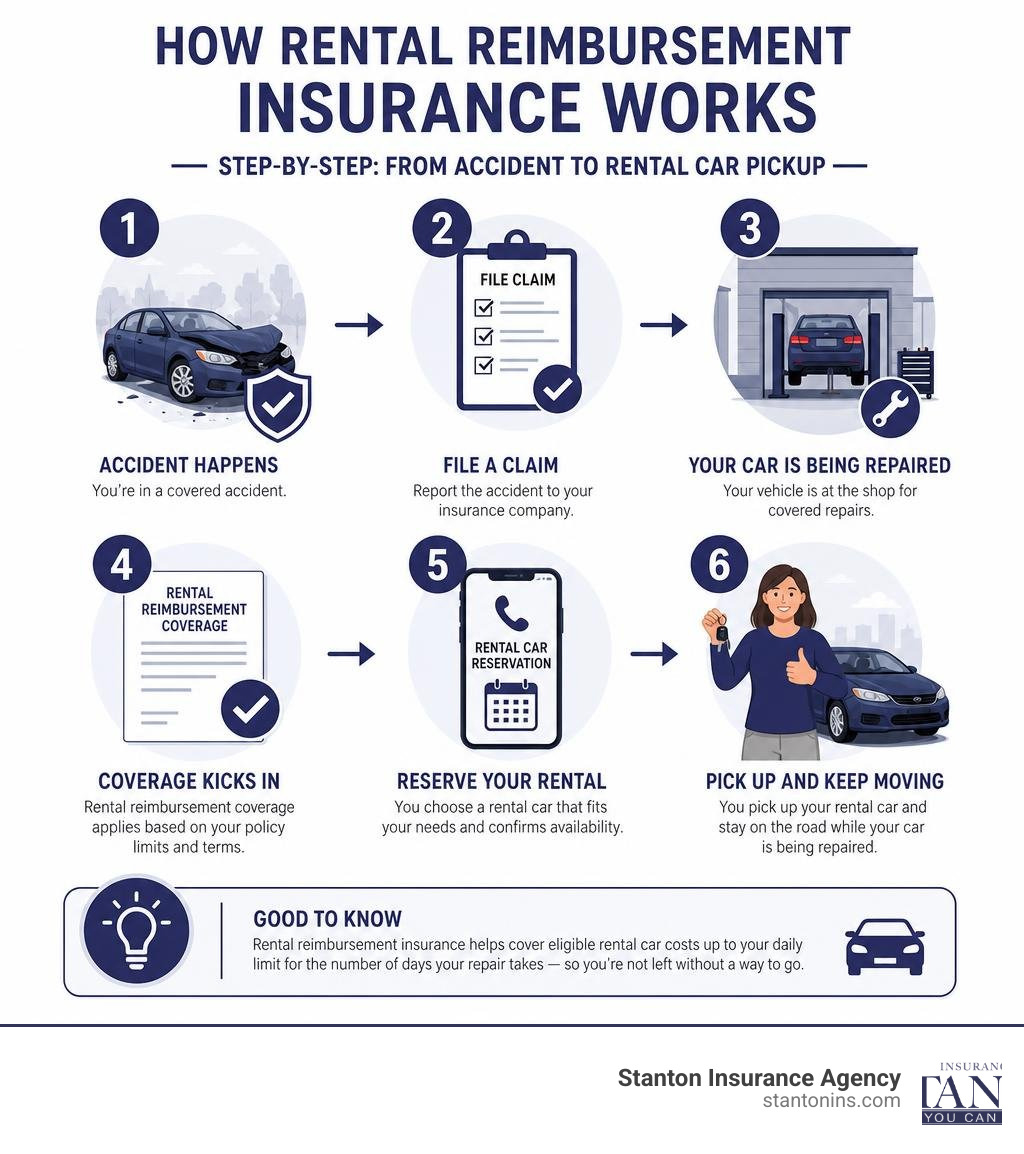
Must-know rental reimbursement insurance terms:
What is Rental Reimbursement Insurance and How Does It Work?

At its core, rental reimbursement insurance is an optional coverage designed to solve a very practical problem: how do you get to work, drop the kids off at school, and run your weekly errands when your primary vehicle is sitting in a local auto body shop?
To understand how this coverage operates, you first need to know that it does not stand alone. You cannot buy rental reimbursement as a separate, isolated policy. Instead, it is an optional endorsement that you add to an existing personal auto policy. Furthermore, insurance companies almost universally require you to already carry both comprehensive and collision coverages on that vehicle before they will allow you to add rental reimbursement.
The mechanics of how the coverage is triggered are highly specific. Rental reimbursement only kicks in when your vehicle suffers physical damage from a “covered loss.” A covered loss is an event that your policy is actively paying to repair. For example, if you slide on an icy patch on Route 101 in New Hampshire and dent your bumper, your collision coverage pays for the repairs, which in turn activates your rental reimbursement coverage. If a stray branch falls on your car during a summer storm in Massachusetts, your comprehensive coverage handles the vehicle damage, and your rental reimbursement covers your temporary set of wheels.
Once a claim is active, there are two primary methods for handling the rental car payments:
- Direct Billing: This is by far the most convenient route. Many insurance providers have established partnerships with major national rental car agencies. When you use an approved repair shop and a partner rental agency, your insurer can set up direct billing. The rental car company bills your insurance company directly up to your daily policy limit. You only have to step in and pay if you select a vehicle that exceeds your daily limit, or if you run over your policy’s maximum duration.
- Receipt Submission: If you choose to rent a vehicle from an independent local rental agency, or if direct billing is not set up in time, you will need to pay the rental costs out of pocket. You must then submit the detailed rental agreements and receipts to your claims adjuster for reimbursement. While this method still covers your costs, it does require you to have the cash or credit limit available upfront.
For a deeper dive into how claims are processed from start to finish, you can read our Auto insurance claims guide. To get a broader perspective on how this coverage fits into your overall auto policy structure, check out this Essential guide to rental reimbursement.
Understanding Coverage Limits vs. Real-World Rental Costs
One of the most common and frustrating surprises drivers face after an accident is discovering that their rental coverage limit doesn’t actually cover the cost of a modern rental car. This gap exists because insurance policies are written with specific daily and total maximum limits, while real-world rental prices fluctuate based on inflation, season, and vehicle class.
When you select rental reimbursement coverage, you will choose a limit structure that looks something like this: $30/$900, $40/$1,200, or $50/$1,500.
- The first number represents the daily limit—the maximum amount the insurance company will pay for a single day’s rental.
- The second number represents the total maximum limit—the absolute cap on what the insurer will pay per claim.
If you have a $40/$1,200 policy, your insurer will pay up to $40 per day for a maximum of 30 days ($1,200 divided by $40). If your repairs take 15 days and the rental costs $38 per day, you are fully covered. However, if you rent an SUV that costs $75 per day, your insurer still only pays $40 per day. You will be responsible for paying the remaining $35 per day out of your own pocket. Over a two-week repair period, that adds up to a $490 unexpected bill.
Let’s look at how typical policy limits stack up against real-world rental rates in 2026:
| Vehicle Class | Average Daily Rental Rate (2026) | Typical Policy Daily Limit | Average Out-of-Pocket Cost Per Day |
|---|---|---|---|
| Economy / Compact | $50 – $65 | $30 – $40 | $10 – $25 |
| Midsize / Standard Sedan | $60 – $80 | $40 – $50 | $10 – $30 |
| Full-size Sedan | $75 – $95 | $40 – $50 | $25 – $45 |
| Compact / Midsize SUV | $85 – $110 | $50 | $35 – $60 |
| Minivan / Large SUV | $110 – $150+ | $50 – $100 | $60 – $100+ |
As the table illustrates, if you carry a basic $30-per-day limit, you will likely struggle to find even the smallest economy car without paying a portion of the bill yourself. If you are a parent who absolutely needs a minivan or a large SUV to transport your family, a standard $30 or $40 daily limit will leave you with a massive financial gap.
When setting up your auto policy, it is highly recommended to look at local rental rates in your area of Massachusetts or New Hampshire. If you drive a large vehicle or have multiple children, opting for a higher limit—such as $50 or $100 per day—is usually well worth the extra dollar or two per month in premium costs.
What is Covered (and What is Excluded) Under the Policy?
To avoid headaches at the rental counter, it is essential to understand the boundaries of your coverage. Rental reimbursement is not a blank check for temporary transportation; it is highly specific to the cause of your vehicle’s damage.
To understand the foundation of these rules, it helps to read our Comprehensive insurance guide. In short, if the event that damaged your car isn’t covered by your physical damage coverages (comprehensive and collision), your rental reimbursement will not apply.
What is Covered by Rental Reimbursement Insurance?
When your vehicle is disabled due to a covered loss, your policy helps pay for alternative transportation. While a physical rental car is the most common choice, many modern policies offer excellent flexibility. Covered expenses typically include:
- Standard Rental Cars: The cost of renting a vehicle from a licensed commercial rental agency while your car is actively being repaired or until a total loss settlement is reached.
- Public Transportation: If you live in a transit-friendly area of Massachusetts, such as the greater Boston area, or commute via the commuter rail, some policies allow you to use your daily benefit to cover train or bus fares instead of renting a car.
- Rideshares and Taxis: If you don’t want the stress of driving and parking a rental car, certain insurers let you submit receipts for rideshare services or traditional taxis to keep you mobile.
- Deductible Repayment (Select Policies): In some cases, if your rental car is damaged while in your possession, certain high-tier policies will help cover the rental owner’s deductible up to a specific limit (often $500).
For a detailed analysis of how these benefits apply across different scenarios, you can read the resource Does car insurance cover rental costs?.
What is Excluded from Rental Reimbursement Insurance?
Rental reimbursement is strictly designed for post-accident recovery. It is not a catch-all for every scenario where you find yourself without a car. The following expenses are explicitly excluded:
- Mechanical Breakdowns: If your alternator fails or your transmission slips on the way home, your rental reimbursement will not pay for a loaner car. These are considered maintenance issues, not sudden, accidental physical damage. The only exception is if you carry separate mechanical breakdown insurance.
- Routine Maintenance: Taking your car in for an oil change, a brake job, or state inspection? You will need to arrange your own ride or wait in the lobby; rental reimbursement does not apply.
- Vacations and Leisure: You cannot use this coverage to rent a car for a summer road trip to the White Mountains or Cape Cod just because you want to keep miles off your personal vehicle.
- Incidentals and Deposits: Your policy will not cover the security deposit held on your credit card, fuel used during the rental period, highway tolls, parking tickets, or mileage fees.
- Additional Rental Agency Insurance: When you sign the rental contract, the agent will likely offer you their optional Collision Damage Waiver (CDW) or personal effects coverage. Your rental reimbursement policy will not pay for these add-ons.
Who Pays for the Rental Car If You Are Not at Fault?
If you are involved in an accident where another driver is clearly at fault, the financial responsibility for your temporary transportation shifts. However, navigating this process requires understanding your options, as the “at-fault” route is not always the fastest.
When another driver causes an accident, their property damage liability coverage is legally responsible for putting you back in the position you were in before the crash. This includes providing you with a “loss of use” benefit, which typically translates to a rental car of a comparable class to your damaged vehicle while it is being repaired.
If you go through the at-fault driver’s insurance, you have two primary advantages:
- No Deductible: You do not have to pay your own collision deductible to get your car repaired.
- No Strict Policy Limits: The at-fault carrier must provide reasonable transportation. If you drive a midsize SUV, they should generally pay for a midsize SUV rental, rather than capping you at a strict $30 daily limit.
However, there is a major catch: time. Before the other driver’s insurance company will authorize a rental car, they must conduct an insurance investigation. They must contact their own policyholder, review the police report, establish liability, and confirm that the policy was active. This process can easily take several days or even weeks. If your car is undrivable immediately after the crash, you cannot afford to wait on their timeline.
This is where your own rental reimbursement insurance becomes incredibly valuable. If you have the coverage on your own policy, you can file a claim with your insurer immediately. We can help you set up a rental car right away, bypassing the wait.
Once the repairs are complete and your insurer has paid the bills, they will initiate a process called subrogation. Your insurance company will pursue the at-fault driver’s insurance carrier to claw back the money they spent on your repairs and your rental car. Once successful, they will also recover and return your deductible to you.
To learn more about how fault, claims, and deductibles impact your overall insurance costs, read our comprehensive Auto insurance cost guide.
Frequently Asked Questions about Rental Reimbursement
Is rental reimbursement included in full coverage auto insurance?
No. This is one of the most common misconceptions in the insurance industry. “Full coverage” is a colloquial term that typically refers to a policy that includes liability, collision, and comprehensive coverages. It does not mean that every optional bell and whistle is automatically included.
Rental reimbursement is always a separate, optional add-on. If you do not specifically request it and pay the additional premium, you do not have it. You can easily verify if you have this coverage by looking at your policy’s declarations page for a line item labeled “Rental Reimbursement,” “Extended Transportation Expenses,” or “Substitute Transportation.”
To better understand the differences between basic mandatory coverages and optional additions, you can read our guide on Full coverage vs liability comparison.
Can you add rental reimbursement coverage after an accident has occurred?
No. Insurance is designed to protect against unexpected future risks, not active losses. You cannot retroactively add rental reimbursement coverage to cover a rental car for an accident that has already occurred.
If you attempt to add the coverage after a crash, the new endorsement will only apply to future accidents. It is critical to review your policy declarations and add this coverage before you find yourself in a fender bender.
How long will insurance pay for a rental car after an accident?
The duration of your rental car coverage depends on three main factors:
- The Repair Timeline: Your coverage will pay for the rental only for the “reasonable” period of time it takes to repair your vehicle. If the body shop is waiting on parts or has a backlog, your claims adjuster will work with them to monitor the timeline. However, you cannot keep the rental car indefinitely just because you are too busy to pick up your repaired vehicle.
- Your Policy Limits: Once you hit your total policy limit (e.g., $1,200 on a $40/$1,200 policy), the coverage stops, even if your car is still in the shop.
- Total Loss Settlements: If your car is determined to be a total loss (totaled), the rules change. Because the car is not being repaired, you do not get to keep the rental for 30 days. Instead, once the insurance company makes a formal total loss settlement offer, the rental coverage typically terminates within 48 to 72 hours. This brief window is designed to give you just enough time to purchase a replacement vehicle.
Conclusion
Getting into an auto accident is stressful enough without the added headache of wondering how you will buy groceries, get to work, or pick up your kids from practice. Rental reimbursement insurance is one of the most affordable ways to buy peace of mind. For just a few dollars a month, you can ensure that a collision won’t derail your entire daily routine or leave you with a massive, unexpected rental bill.
As a local, independent agency serving communities across Massachusetts and New Hampshire, we at Stanton Insurance Agency are committed to helping you build a policy that fits your actual life. We don’t believe in one-size-fits-all insurance. We want to make sure that if you drive an SUV in NH or commute into Boston from MA, your daily limits actually cover the cost of keeping you on the road.
Don’t wait until you’re standing on the side of the road waiting for a tow truck to find out what’s on your declarations page. Let us review your current policy and make sure you’re fully protected. Get a personalized auto insurance quote with us today, or give us a call to add this essential protection to your existing coverage.