
Why Understanding the Different Types of Car Insurance Companies Matters Before You Buy
There are several types of car insurance companies drivers can choose from, each serving different needs, risk profiles, and budgets. Here’s a quick overview:
| Company Type | What Makes It Different |
|---|---|
| Preferred/Standard/Non-Standard Insurers | Grouped by the risk level of drivers they insure |
| Direct Writers | Sell policies directly to you, no agent middleman |
| Captive Agents | Represent only one insurance company |
| Independent Agencies | Shop multiple carriers to find your best fit |
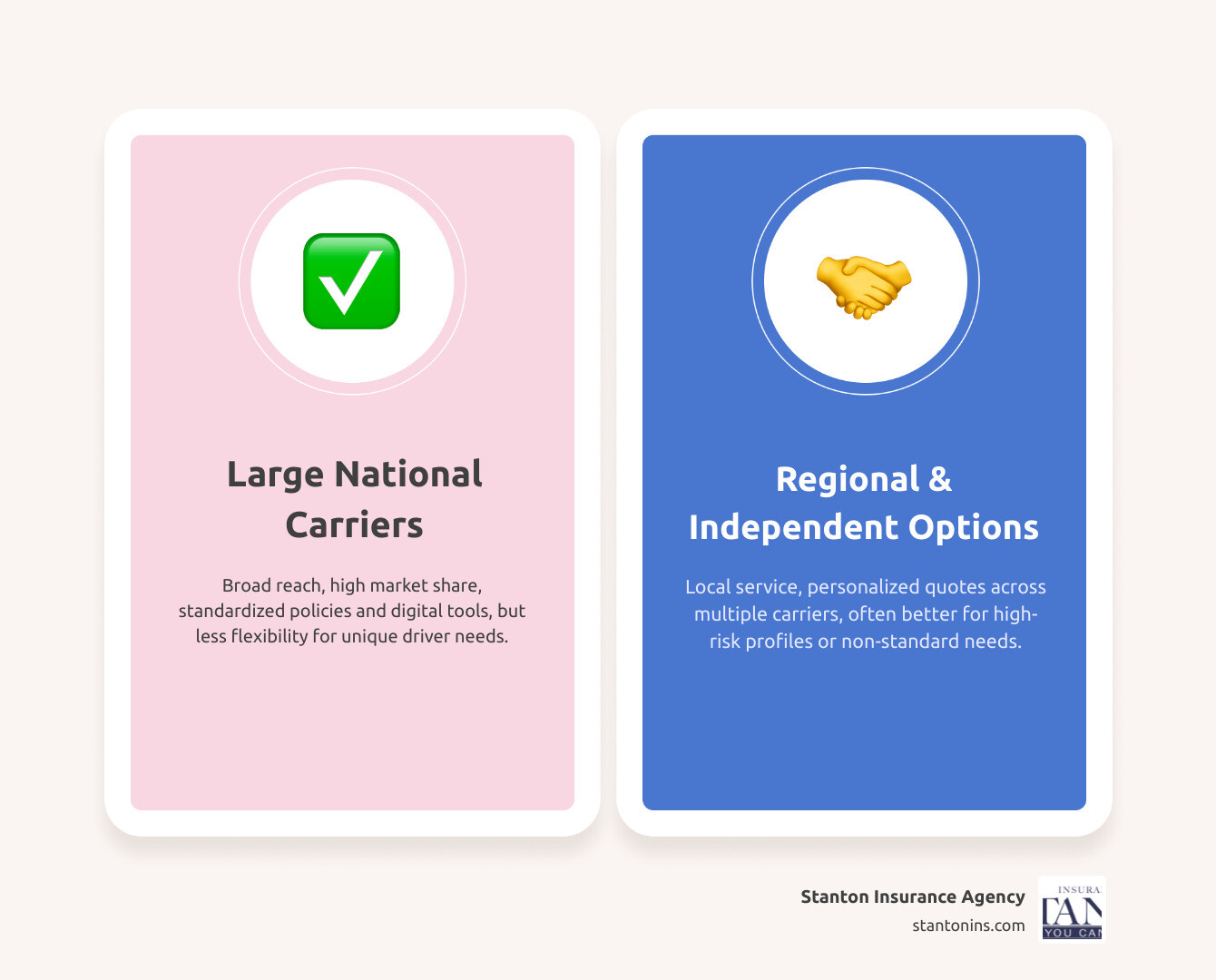
| National Carriers | Large companies with broad reach and broad product availability |
| Regional/Local Carriers | Smaller companies, sometimes cheaper, often more personalized |
| Mutual vs. Stock Insurers | Differ in ownership structure and how profits are used |
Picking an insurance company isn’t just about the lowest price. The type of company you choose affects your coverage options, claims experience, and the service you get when something goes wrong.
The largest insurers together control a significant share of the U.S. personal auto market. But that does not mean the biggest brand is always the right choice for every driver.
I’m Geoff Stanton, President of Stanton Insurance Agency and a Certified Insurance Counselor (CIC) with over 25 years of experience helping Massachusetts and New Hampshire drivers navigate the types of car insurance companies and find coverage that actually fits their lives. In the sections below, I’ll break down everything you need to know to make a confident, informed choice.
Types of car insurance companies vocabulary:
- Auto Insurance Agencies
- cheap private car insurance companies
- private auto insurance companies near me
Types of Car Insurance Companies Drivers Should Know
When most people shop for auto insurance, they focus on one thing: price. Fair enough. But price is only one piece of the puzzle. The real difference often comes from how a company is built, who it wants to insure, and how it sells and services policies.
In plain English, the main types of car insurance companies can be grouped by:
- Risk class
- Distribution model
- Geographic reach
- Ownership structure
- State regulation and licensing
Auto insurance is part of the property and casualty side of the insurance industry, and it is regulated primarily by the states, not the federal government. If you want a higher-level overview of how insurance regulation works, this Introduction to financial services and insurance regulation is a useful starting point.
Preferred, standard, and non-standard insurers
One of the simplest ways to sort car insurance companies is by the kind of driver they are built to insure.
- Preferred insurers
- Standard insurers
- Non-standard insurers
Preferred insurers usually want drivers with:
- Clean driving records
- Continuous prior insurance
- Good credit where allowed by law
- Fewer claims
- Lower overall risk
These companies often offer broader policy options, better pricing for low-risk households, and more room for bundled coverage.
Standard insurers sit in the middle. They are often a fit for average drivers who may have a couple of blemishes on their record but still qualify for solid coverage and competitive rates.
Non-standard insurers are designed for higher-risk drivers, such as people with:
- Multiple tickets
- Recent accidents
- A lapse in prior insurance
- Serious violations
- Limited payment flexibility
That does not automatically make them “bad” companies. It just means their underwriting appetite is different. They fill an important market need. The tradeoff is that premiums can be higher and coverage terms may be tighter, so reading policy details matters a lot.
Direct writers, captive agencies, and independent agencies
Another major difference is how policies are sold.
- Direct writers sell directly to consumers, usually online or by phone.
- Captive agents represent one insurance company only.
- Independent agencies can shop multiple carriers.
Each model has pros and cons.
Direct writers can be convenient for simple situations. If your needs are straightforward and you like doing everything online, that can work well.
Captive agents can provide personal service, but they are limited to one company’s products.
Independent agencies, like us, are often most useful when you want options. We can compare carriers, explain coverage differences, and help match your situation to the right market instead of trying to force every driver into one box. If you want a broader overview, here is more info about auto insurance companies.
National, regional, and local insurers
Some companies operate nearly everywhere. Others focus on specific states or regions.
National insurers often bring:
- Broad brand recognition
- Strong digital tools
- Large claims infrastructure
- Lots of discounts and policy options
Regional and local insurers may offer:
- Competitive rates in select states
- More localized underwriting
- Better fit for New England drivers
- More personalized service
This matters because rates are not determined by size alone. Research consistently shows that smaller or regional insurers can sometimes beat larger companies on price. A company that is a perfect fit in Massachusetts or New Hampshire may not be a giant household name, and that is perfectly fine.
Mutual, stock, and reciprocal insurers
Insurance companies also differ in ownership structure.
- Mutual insurers are owned by policyholders
- Stock insurers are owned by shareholders
- Reciprocal insurers are member-based exchanges managed by an attorney-in-fact
For most drivers, this does not change how you file a claim on Tuesday morning after someone backs into your bumper in the grocery store parking lot. But it can influence company philosophy, dividend practices, and long-term strategy.
Mutual insurers may return profits to policyholders in the form of dividends in some cases. Stock insurers generally aim to deliver returns to shareholders. Reciprocal structures operate differently again, with members insuring one another through the exchange.
Ownership structure is worth knowing, but it should not outweigh the basics:
- Coverage quality
- Financial strength
- Complaint trends
- Claims experience
- Price for the protection offered
The Main Types of Car Insurance Coverage Every Company May Offer
Knowing the company type is only half the battle. You also need to know what your policy actually covers. Most car insurance companies offer a core menu of coverages, with some optional add-ons.
At a high level, the main coverage types are:
- Liability
- Collision
- Comprehensive
- Uninsured/underinsured motorist
- Personal injury protection
- Medical payments
- Gap insurance
- Rental reimbursement
- Roadside assistance
For a deeper breakdown of coverage types, see this guide on types of car insurance coverage explained.
Liability, collision, and comprehensive explained
These are the big three.
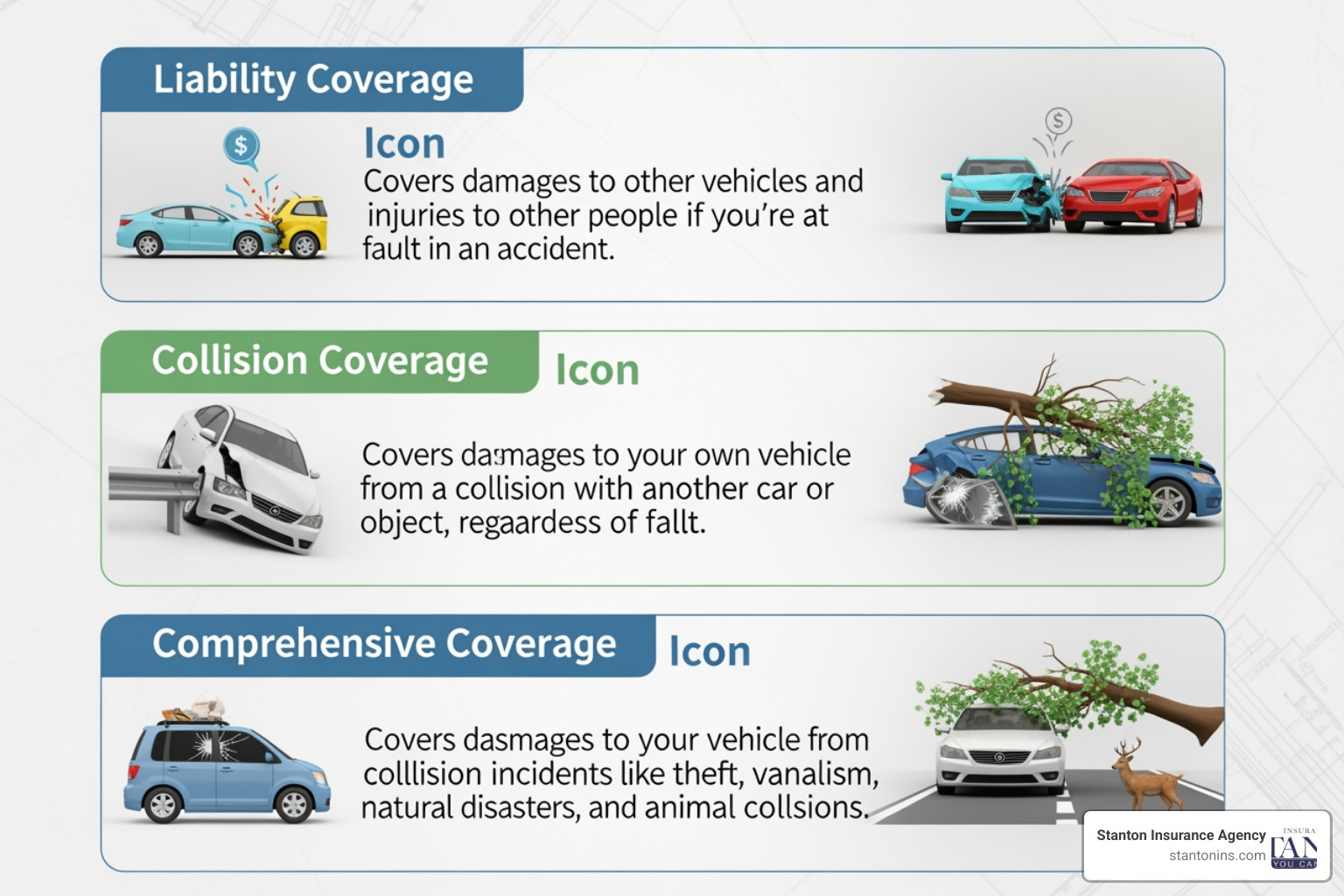
Liability coverage
Liability insurance pays for damage or injuries you cause to others when you are at fault.
It usually includes:
- Bodily injury liability
- Property damage liability
This is the coverage required by law in most states. It protects your finances if you injure someone or damage their vehicle or property. State minimums exist, but they are often too low for a serious accident.
Collision coverage
Collision pays to repair or replace your own vehicle after an accident involving:
- Another vehicle
- A guardrail or pole
- A ditch or rollover
- A single-car crash
Collision usually comes with a deductible. If you choose a higher deductible, your premium may go down, but your out-of-pocket cost after a claim goes up.
Comprehensive coverage
Comprehensive handles damage from things other than a crash, such as:
- Theft
- Vandalism
- Fire
- Falling objects
- Storm damage
- Hail
- Flooding
- Animal strikes, like hitting a deer
If collision is about the crash, comprehensive is about the chaos.
When people say “full coverage,” they usually mean liability plus collision plus comprehensive. It is not a formal policy term, but it is common shorthand.
Uninsured/underinsured motorist, PIP, and MedPay
These coverages focus more on injuries and protection when the other driver cannot fully pay.
Uninsured/underinsured motorist coverage
Uninsured motorist coverage helps if you are hit by a driver with no insurance. Underinsured motorist coverage helps when the other driver’s limits are too low to cover the damage fully.
This coverage can be especially valuable because uninsured driving remains a real problem nationwide. It may also help in hit-and-run situations, depending on the state and policy wording.
Personal injury protection
PIP is broader than basic medical coverage. Depending on the state, it can help pay for:
- Medical bills
- Lost wages
- Essential services
- Certain household expenses after an accident
PIP is strongly associated with no-fault systems, and in some states it can cover around 80% of certain accident-related medical and related expenses.
Medical payments coverage
MedPay is more limited than PIP, but it can still be very helpful. It generally pays medical expenses for you and your passengers after a covered accident, regardless of fault.
One key difference: MedPay focuses on medical costs, while PIP may also include lost income and extra services.
Gap insurance, rental reimbursement, and roadside assistance
These add-ons may not be legally required, but they can save you a lot of money and stress.
Gap insurance
Gap insurance covers the difference between:
- What your car is worth at the time of a total loss
- What you still owe on your loan or lease
This can be especially important for newer cars that depreciate quickly. If your financed vehicle is totaled, standard insurance pays actual cash value, not your loan balance. Gap coverage fills that “uh-oh” gap.
Rental reimbursement
Rental reimbursement helps pay for a rental car while your covered vehicle is being repaired after a claim. If you rely on your car to get to work, school, or hockey practice in a New England winter, this can be more valuable than it sounds.
Roadside assistance
Roadside assistance can help with:
- Towing
- Battery jump-starts
- Flat tires
- Lockouts
- Minor labor
Think of it as the “today is not my day” endorsement.
What Is Required by Law and What Is Optional in Massachusetts and New Hampshire?
State rules matter a lot, and Massachusetts and New Hampshire do not handle auto insurance exactly the same way.
Massachusetts minimum coverage and no-fault rules
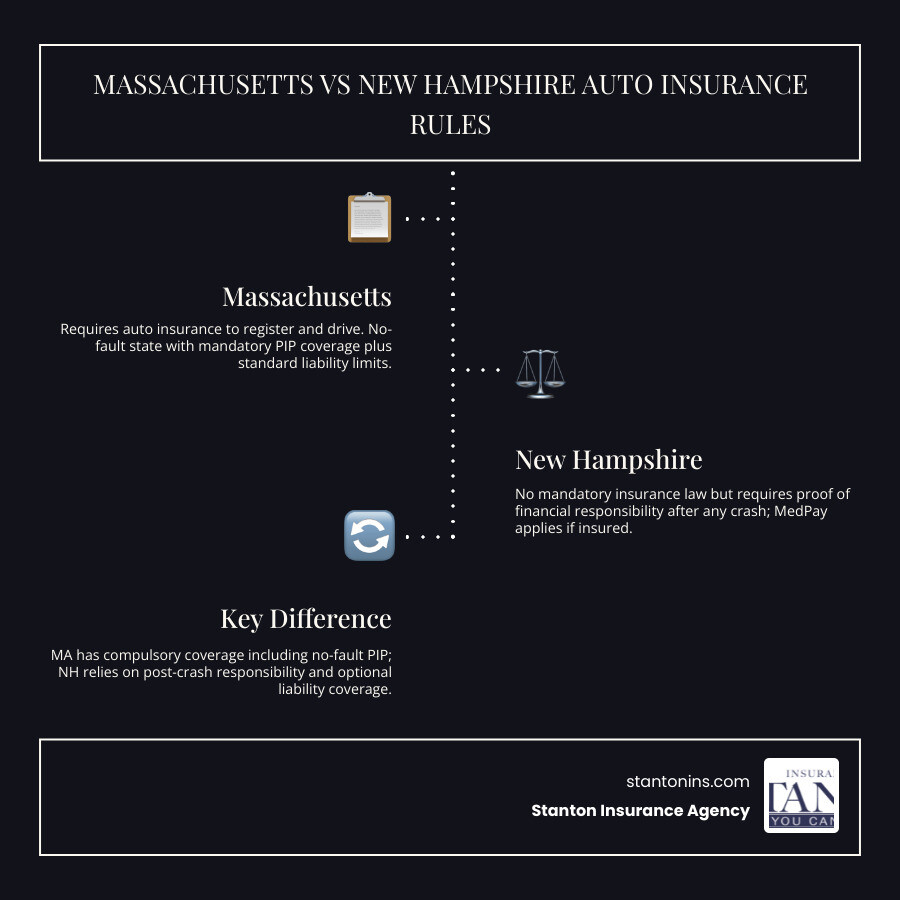
Massachusetts requires auto insurance to register and drive a vehicle. It is also a no-fault state, which is why PIP plays an important role.
According to Massachusetts auto insurance basics, Massachusetts policies generally include required coverage components such as:
- Bodily injury to others
- Personal injury protection
- Bodily injury caused by an uninsured auto
- Damage to someone else’s property
That means in Massachusetts:
- Liability coverage is required
- PIP is required
- Uninsured motorist coverage is required
- MedPay is generally optional
- Collision and comprehensive are optional unless a lender or lessor requires them
If you are shopping locally, here is more info about auto insurance companies in Massachusetts.
New Hampshire rules and financial responsibility
New Hampshire is the unusual one. It does not generally require auto insurance for every driver. But that does not mean going uninsured is a great idea, or even easy.
Per the New Hampshire automobile insurance guide, drivers who choose not to buy insurance must still be able to prove financial responsibility if they cause an accident. In practice, that means you may be personally on the hook for injuries and property damage.
Important New Hampshire points include:
- Auto insurance is not universally mandated before you drive
- Drivers can still face financial responsibility requirements after an accident
- If you do buy a policy, certain coverages are built into New Hampshire policies
- New Hampshire requires uninsured/underinsured motorist protection in insured policies
- New Hampshire also requires MedPay in insured policies, with a minimum amount noted by consumer guidance sources
For many drivers, that makes the “insurance is optional” headline a little less exciting than it first sounds. Optional in theory, risky in real life.
If you want local context, see more info about insurance companies in NH.
Minimum coverage vs full coverage: how to choose
There is no one-size-fits-all answer, but these are the big decision points.
Choose minimum coverage only if:
- Your car is older and low in value
- You could afford to replace it yourself
- You are mainly protecting against liability to others
- Budget is the top concern
Choose full coverage if:
- Your car is financed or leased
- Your vehicle is newer or expensive to repair
- You could not easily replace it out of pocket
- You want protection from theft, weather, vandalism, and animal strikes
A practical rule: if losing the car would create a real financial problem, full coverage is often worth a hard look.
How Big Car Insurance Companies Compare to Smaller and Regional Options
Many drivers assume the biggest insurer must be the best. Sometimes it is. Sometimes it is just the loudest.
Why the biggest insurers dominate the market
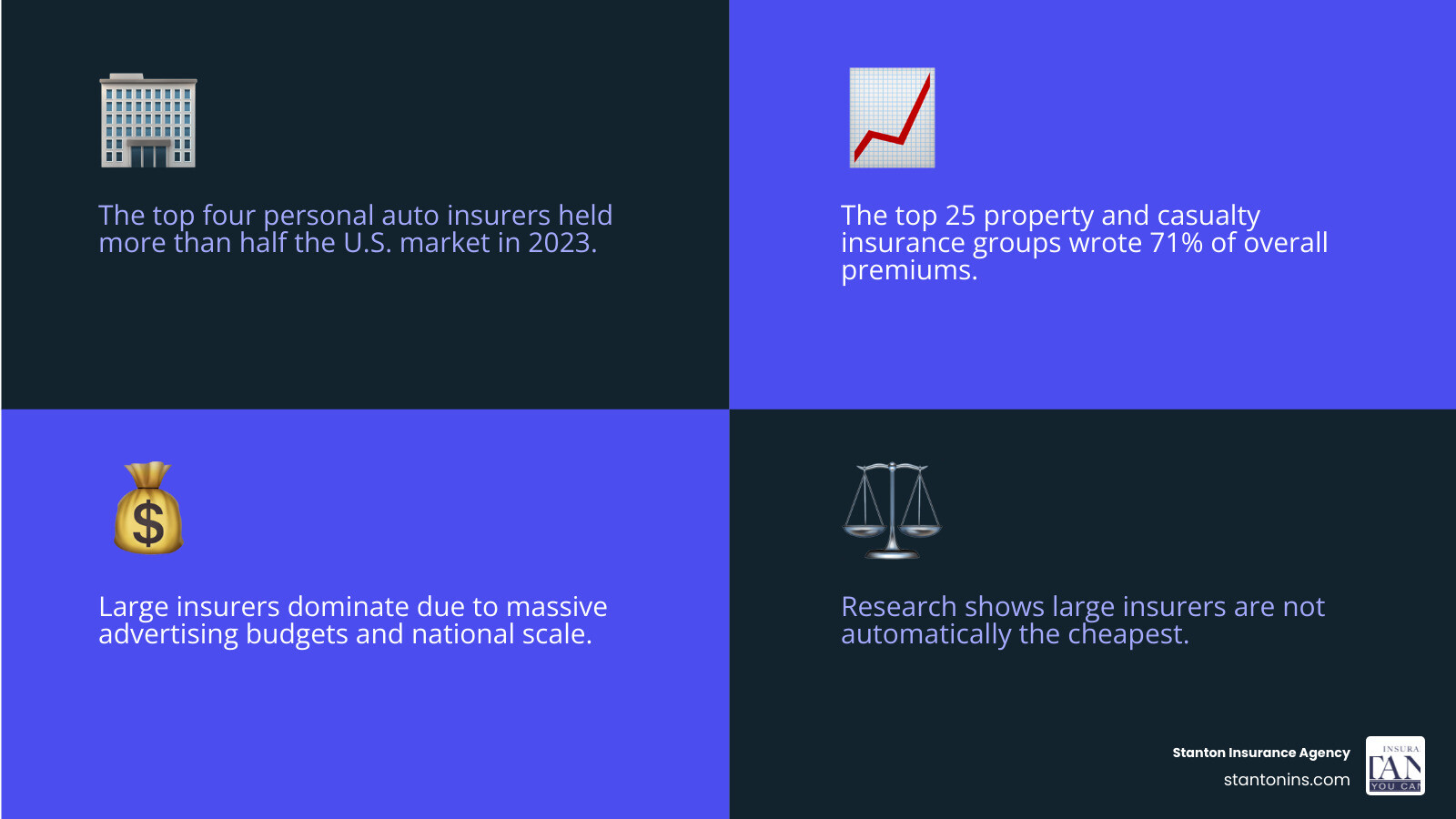
The U.S. auto insurance market is concentrated. Large personal auto insurers control a significant share of the market, and the top property and casualty insurance groups also account for a large share of premiums written nationwide.
Large insurers dominate because they often have:
- Massive advertising budgets
- National scale
- Broad agent or online distribution
- Significant claims infrastructure
- Strong technology investments
Are larger insurers always cheaper or better?
No. This is one of the biggest myths in auto insurance.
Research shows that large insurers are not automatically the cheapest. Rates depend on many factors, including:
- ZIP code
- Driving record
- Age
- Vehicle
- Credit-based factors where permitted
- Prior insurance history
- Claims history
- Coverage choices
In Massachusetts and New Hampshire, regional and local carriers can sometimes beat larger companies on price, depending on the driver, vehicle, and coverage selected.
So no, bigger is not automatically better, and smaller is not automatically cheaper. Shopping is what reveals the answer.
What complaint data and customer satisfaction really tell you
Market share tells you who is big. It does not tell you who is easiest to deal with after a claim.
That is where complaint data and customer satisfaction measures come in. When comparing insurers, we recommend looking at:
- Complaint ratios through NAIC-based reporting
- Claims satisfaction
- Billing complaints
- Digital experience
- Ease of contacting a real person
- Policy retention over time
A low premium loses some charm if the service is frustrating when you actually need help.
At the same time, one metric should never decide everything. A company can have great app reviews and weak claims support, or low complaints and limited local guidance. The trick is balancing price, coverage, and service.
Types of car insurance companies by shopping experience
Different shoppers need different buying experiences.
A few examples:
- If you want fast online quotes and self-service tools, direct writers may appeal to you.
- If you want one carrier’s products and one dedicated brand experience, a captive setup may fit.
- If you want options across multiple insurers, an independent agency is often the best route.
- If you have special needs like teen drivers, multi-car households, high-risk history, or bundled home and auto, comparison shopping becomes even more valuable.
For more guidance, here is more info about comparing car insurance companies.
How to Choose the Right Types of Car Insurance Companies for Your Needs
Now for the part that actually saves money and prevents headaches.
Match the company to your driver profile
Start with your own situation.
A preferred-market company may be ideal if you have:
- A clean record
- Good insurance history
- A home to bundle
- Multiple vehicles
- Higher desired liability limits
A standard-market carrier may be a better fit if you are more middle-of-the-road.
A non-standard option may be necessary if you have:
- Recent violations
- Accidents
- A lapse in coverage
- Trouble qualifying elsewhere
Certain situations also call for specialized thinking:
- Teen drivers may need strong discount options and forgiveness features
- Classic cars often need specialty policies
- Rideshare use may require an endorsement
- Financed vehicles usually need collision and comprehensive
- Homeowners may get better value by bundling
Compare apples to apples before you buy
This is where many shoppers go wrong. They compare one cheap quote to one expensive quote without realizing the coverage is completely different.
Use this checklist:
- Same liability limits
- Same deductibles
- Same collision and comprehensive choices
- Same UM/UIM selection
- Same rental reimbursement option
- Same roadside assistance option
- Same named drivers
- Same garaging address
- Same vehicle use
- Same endorsements and exclusions
If one quote is much cheaper, ask why. Sometimes the answer is great. Sometimes the answer is “because half the coverage disappeared.”
Smart questions to ask before switching
Before you move your policy, ask:
- How do claims get reported after hours?
- Do you offer local support or only a call center?
- What deductibles are available?
- Are there discounts for bundling, safe driving, or paying in full?
- Will my lender require specific coverage?
- Is rental coverage included or optional?
- Is roadside assistance built in?
- When does the new policy start, and how do I avoid a gap?
That last one matters more than people think. Never cancel old coverage until the new policy is confirmed active.
When an independent agency adds the most value
Independent agencies are especially helpful when:
- You want multiple carrier options
- Your household has more than one driver or car
- You need Massachusetts-specific guidance
- You need New Hampshire-specific guidance
- You want help balancing cost with protection
- Your situation is not perfectly standard
That is why many drivers prefer working with an agency that can compare markets instead of offering one-size-fits-all advice. If that sounds like what you need, read more info about best independent car insurance.
Frequently Asked Questions about Types of Car Insurance Companies
What are the main types of car insurance coverage available to drivers?
The main coverage types are:
- Liability
- Collision
- Comprehensive
- Uninsured/underinsured motorist
- Personal injury protection
- Medical payments
- Gap insurance
- Rental reimbursement
- Roadside assistance
Liability covers damage you cause others. Collision covers your car after a crash. Comprehensive covers non-collision losses like theft, vandalism, weather, and animal strikes. UM/UIM protects you when the other driver has too little or no insurance. PIP and MedPay help with medical costs, and add-ons like gap, rental, and roadside address specific needs.
Which types of car insurance are required by law in most states, and which are optional?
In most states, liability insurance is required by law. Some states also require other coverages such as PIP, uninsured motorist coverage, or MedPay.
For our local markets:
- Massachusetts requires liability, PIP, and uninsured motorist coverage as part of its standard system.
- New Hampshire does not generally require insurance for all drivers, but insured policies include required protections such as UM/UIM and MedPay, and drivers remain financially responsible for damages they cause.
Optional coverages usually include:
- Collision
- Comprehensive
- Rental reimbursement
- Roadside assistance
- Gap insurance
One important catch: “optional” does not mean “unnecessary.” Lenders and leasing companies commonly require collision and comprehensive.
What steps can drivers take to find the right car insurance company and coverage for their needs?
We recommend a simple process:
- Decide what coverage you actually need.
- Gather driver and vehicle information.
- Compare quotes with the same limits and deductibles.
- Review complaint trends and service reputation.
- Check state-specific rules for Massachusetts or New Hampshire.
- Ask about discounts, claims handling, and optional endorsements.
- Re-shop at renewal time, especially after major life changes.
If you want a head start, these resources may help:
- Comparing Car Insurance Companies Which One Is Right For You
- Best Independent Car Insurance
- Top Auto Insurance Agencies
Conclusion
The phrase types of car insurance companies can sound more complicated than it really is. Once you break it down, you are simply looking at a few core questions:
- What kind of driver am I?
- What coverage do I need?
- How do I want to shop?
- Do I want one carrier or multiple options?
- Am I choosing based on price alone, or price plus service?
For Massachusetts and New Hampshire drivers, the right answer depends on your vehicle, budget, driving history, and tolerance for risk. A huge national insurer might be right for one household. A regional carrier or independent-agency option might be better for the next door neighbor.
At Stanton Insurance Agency, we help drivers sort through those choices with a focus on trusted protection for the things that matter most. If you want help reviewing your options, start with more info about auto insurance.
