
The Real Cost of a Dog Bite — and What Your Insurance Actually Does
Does personal liability insurance cover dog bites? Yes — in most cases. But the answer comes with important conditions that every dog owner needs to understand.
Here’s the quick version:
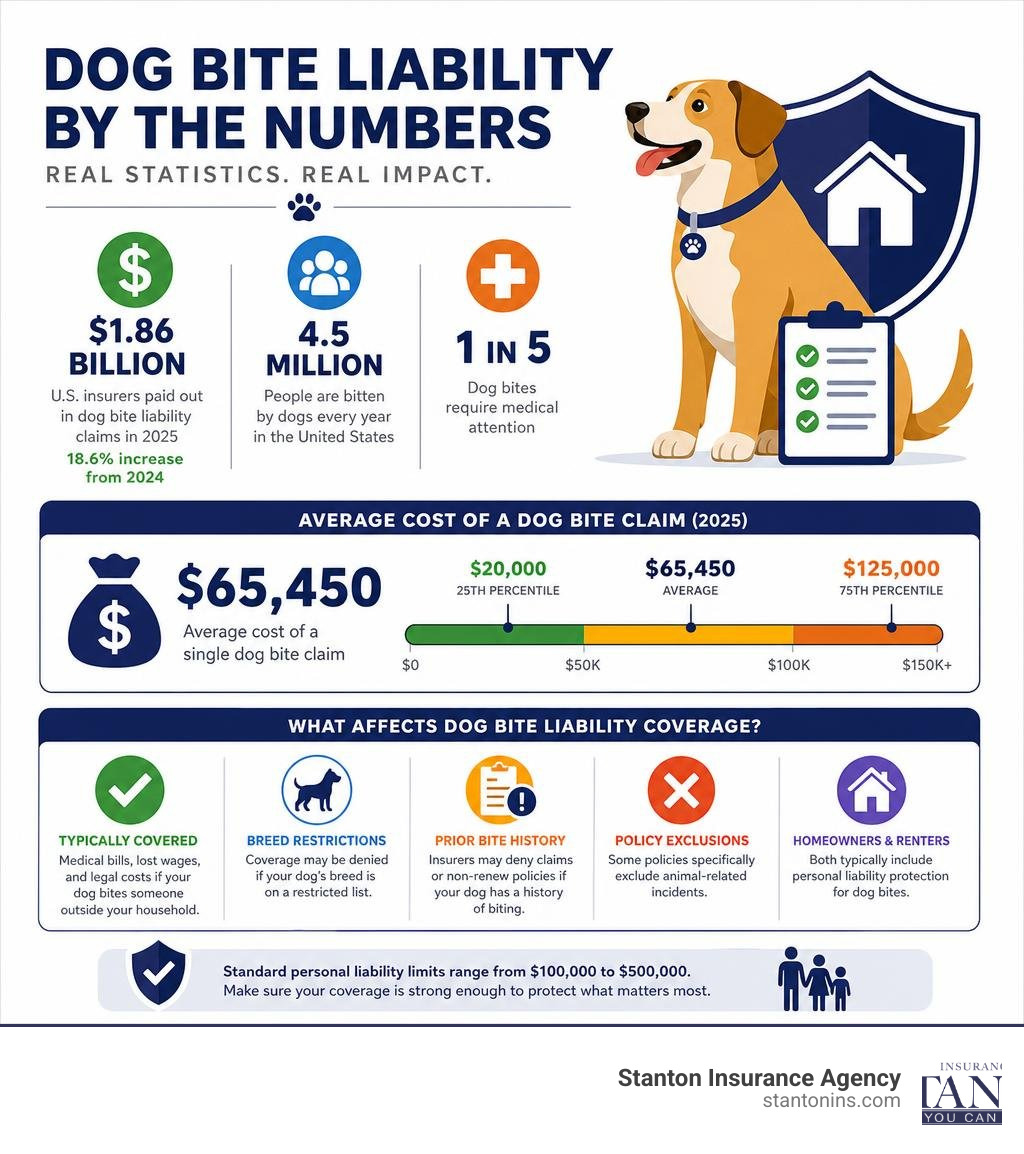
- Personal liability coverage (included in most homeowners and renters policies) can pay for medical bills, lost wages, and legal costs if your dog bites someone outside your household.
- Medical payments coverage can cover immediate medical expenses for an injured guest — often without any fault determination required.
- Coverage is not guaranteed. Your insurer may deny a claim if your dog’s breed is on a restricted list, if your dog has a prior bite history, or if your policy specifically excludes animal-related incidents.
- Standard liability limits typically range from $100,000 to $500,000 — but a single serious dog bite claim averaged $65,450 nationwide in 2025.
- Renters are also covered — renters insurance policies generally include the same personal liability protection as homeowners policies.
The stakes are real. In 2025, U.S. insurers paid out $1.86 billion in dog bite liability claims — an 18.6% jump from the prior year. Even if your dog has never shown aggression, a single incident can result in a lawsuit that threatens your savings, your home, and your financial future.
Dog bites are more common than most people expect. About 4.5 million people are bitten by dogs every year in the United States, and nearly one in five of those bites requires medical attention. That friendly family pet — no matter how well-trained — can react unpredictably in the wrong situation.
For homeowners and renters in Massachusetts and New Hampshire, understanding exactly what your policy covers before an incident happens isn’t just smart — it’s essential.
I’m Geoff Stanton, President of Stanton Insurance Agency and a Certified Insurance Counselor (CIC) with over two decades of experience helping Massachusetts and New Hampshire families navigate questions like does personal liability insurance cover dog bites and find the right protection for their homes and assets. In the sections below, I’ll walk you through exactly how coverage works, what can void it, and what to do if your policy falls short.
Easy does personal liability insurance cover dog bites glossary:
Does Personal Liability Insurance Cover Dog Bites?
When you purchase a homeowners, renters, or condo insurance policy, it typically includes several different “buckets” of coverage. The bucket that protects you when your dog injures someone is personal liability insurance.
Standard personal liability coverage provides a financial safety net if a third party alleges bodily injury or property damage caused by your accidental acts, your negligence, or indeed, your pets. If your dog bites a guest, a delivery person, or a neighbor, this coverage is designed to step in and protect your personal assets from being wiped out by medical bills or a lawsuit.
Third-Party Bodily Injury
If your dog bites someone who does not live in your household, personal liability coverage helps pay for the damages you are legally obligated to cover. This includes the victim’s medical bills, reconstructive surgeries, physical therapy, and even lost wages if the injury prevents them from working.
Furthermore, if the injured party decides to sue you, your personal liability insurance will cover your legal defense costs. Litigation attorneys can easily average over $300 per hour, and those fees can stack up quickly even if you win the case. Fortunately, in most standard policies, defense costs are covered in addition to your policy limits, meaning legal fees won’t deplete the funds available to pay out the actual claim.
Medical Payments Coverage
Standard policies also include “Medical Payments to Others” (often called Coverage F). This is a separate, smaller limit—typically between $1,000 and $5,000—designed for minor injuries that occur on your property.
Unlike general personal liability, medical payments coverage pays out regardless of who is at fault. If a friend is visiting your home, gets a minor scratch or bite from your dog, and needs a quick trip to the urgent care for a tetanus shot, this coverage can pay those bills immediately. It is an excellent tool for resolving minor incidents quickly and amicably without involving lawyers.
Property Damage
While we usually focus on physical bites to humans, dogs can also cause significant property damage. If your dog escapes your yard and tears up a neighbor’s expensive landscaped garden, ruins their custom deck, or attacks and injures their pet (which is legally considered property), the personal liability portion of your policy can help cover the repair or replacement costs.
To dive deeper into how these protections keep your family secure, you can read more about personal liability coverage and review our personal liability insurance complete guide.
How Homeowners and Renters Policies Handle Dog Liability
Understanding how your policy handles dog liability requires looking closely at your coverage limits, where the incident occurs, and how local laws interact with your policy.
Policy Limits
Standard homeowners policies typically start with a personal liability limit of $100,000, though many homeowners opt to increase this to $300,000 or $500,000. While $100,000 might sound like a lot of money, a severe dog bite that requires specialized surgery or results in permanent nerve damage can easily exhaust that limit. If a court awards damages that exceed your policy limit, you are personally responsible for paying the remaining balance, which could put your home, savings, and future wages at risk.
Off-Property Coverage
A common misconception is that homeowners insurance only covers incidents that happen inside your house or on your property. In reality, personal liability coverage is typically “worldwide.” This means if you are walking your dog at a local park in Nashua, NH, or traveling through Massachusetts, and your dog bites a pedestrian, your policy’s liability coverage can still apply.
However, you must check your policy terms carefully. Some insurers write restrictive policies that limit animal liability exclusively to incidents occurring on the insured premises. For renters, knowing these boundaries is particularly crucial. You can read more about how tenant policies handle these situations in our guide on what is personal liability insurance for renters and browse our specialized apartment insurance dog bite guide.
The Importance of Local Laws
Local leash laws and municipal regulations play a massive role in insurance claims. If your town or city has a strict leash law and your dog bites someone while running at large, your insurance company will still generally defend you and pay the claim up to your policy limits. However, violating local ordinances can be used as evidence of negligence in court, and it may prompt your insurer to cancel or non-renew your policy once the claim is resolved.
According to resources from the Insurance Information Institute and standard guidelines from major carriers like Progressive, staying compliant with local laws is one of the best ways to protect both your neighbors and your insurance standing.
Key Factors That Determine Dog Bite Coverage
Insurance companies do not look at all dogs—or all dog owners—the same way. When underwriting a policy or evaluating a claim, insurers look at several critical risk factors.
Breed Restrictions
Many insurance companies maintain lists of “restricted” or “dangerous” breeds. If you own a breed on their list, the insurer may refuse to write your policy, charge a significantly higher premium, or issue a specific exclusion that completely removes dog bite liability from your coverage.
Bite History
If your dog has bitten someone in the past, they are statistically much more likely to bite again in the eyes of an actuary. A single documented bite incident can make it extremely difficult to find standard homeowners coverage. Many carriers will outright exclude dog liability for that specific pet or refuse to renew your entire policy.
Dangerous Dog Classifications
Local municipalities in Massachusetts and New Hampshire have legal processes to classify specific dogs as “nuisance” or “dangerous” after an incident. If your dog receives a formal “dangerous dog” designation, your insurer will almost certainly catch wind of it, which usually results in immediate policy exclusion or non-renewal unless you seek specialized coverage.
Legal Frameworks
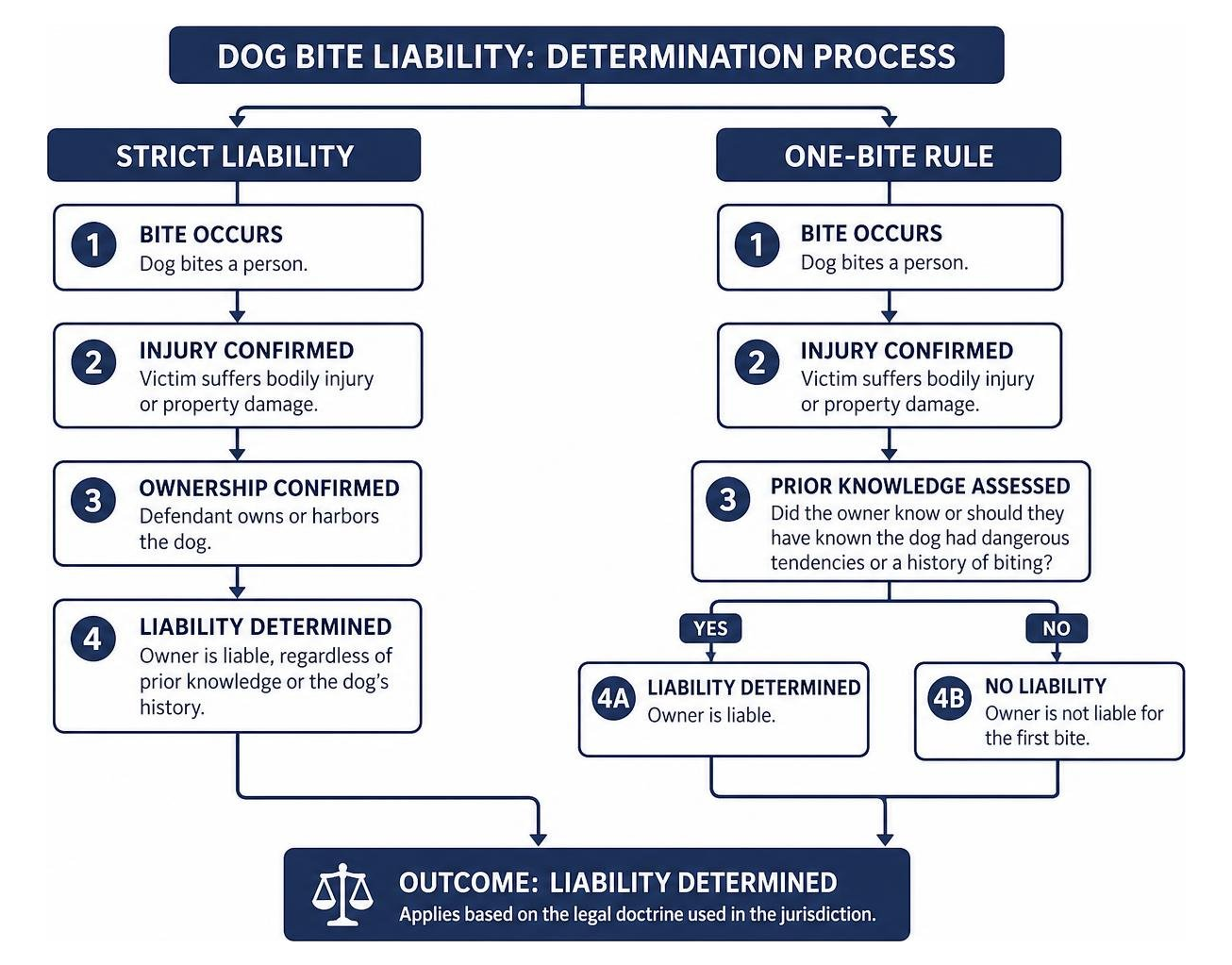
How your insurance claim is handled also depends heavily on state law. States generally fall into one of two legal doctrines: strict liability or the “one-bite rule.”
Under strict liability, an owner is held legally responsible for dog bite injuries regardless of whether the dog has ever shown aggressive behavior before. Under the older “one-bite rule” (which is still used in a handful of states), an owner might not be held liable for the first bite if they had no prior reason to believe the dog was dangerous. Both Massachusetts and New Hampshire are strict liability states, which we will explore in detail below.
| Legal Doctrine | Definition | Application in MA & NH |
|---|---|---|
| Strict Liability | Owner is liable for damages even if the dog has never shown prior aggression or dangerous tendencies. | Yes. Both MA and NH hold dog owners strictly liable for bodily injury and property damage. |
| One-Bite Rule | Owner is only liable if they knew (or should have known) the dog had dangerous tendencies or a history of biting. | No. This rule does not apply in MA or NH for dog bite cases. |
Why Does Personal Liability Insurance Cover Dog Bites for Some Breeds but Not Others?
Underwriters are in the business of assessing risk. Actuarial data shows that certain breeds are involved in a disproportionate number of severe, high-cost liability claims.
Restricted Breeds
While breed restrictions can vary by insurance company, some of the most commonly restricted breeds include:
- Pit Bulls (including Staffordshire Bull Terriers)
- Rottweilers
- German Shepherds
- Doberman Pinschers
- Akita Inu
- Chow Chows
- Siberian Huskies
- Wolf Hybrids
Some insurance companies take a flat-rate approach, refusing to cover homes with these breeds altogether. Other companies evaluate dogs on an individual basis, looking at their specific training, history, and behavior rather than their breed alone.
Mitigating Factors
If you own a restricted breed but have a gentle, well-behaved dog, you aren’t necessarily out of options. Some insurers will waive breed restrictions if you can provide:
- A certificate showing your dog has passed the American Kennel Club’s (AKC) Canine Good Citizen (CGC) test.
- A formal letter from your veterinarian certifying the dog’s gentle temperament.
- A DNA test proving your dog is not actually a restricted breed (highly useful for mixed-breed shelter rescues).
Navigating these guidelines can be tricky, but working with an independent agency like Stanton Insurance Agency allows us to shop your policy across multiple carriers to find those with the most favorable underwriting guidelines for your specific pet.
How Prior Bite History Affects Whether Personal Liability Insurance Covers Dog Bites
If your dog has a history of biting, standard homeowners insurance is rarely going to cover future incidents.
Prior Incidents and Exclusions
Once a dog has bitten someone, insurers view them as a high-risk exposure. If you file a dog bite claim, your current insurer will likely pay the claim (up to your policy limit) but may subsequently issue a non-renewal notice or a liability waiver.
A liability waiver is an endorsement you must sign to keep your property coverage. By signing it, you agree that the insurance company will not pay for any future dog-related injuries. If the dog bites someone again, you will have to pay every penny of the medical and legal bills out of your own pocket.
Specialized Animal Liability Insurance
If you are excluded from standard coverage due to your dog’s breed or bite history, you should look into specialized animal liability insurance. Companies like XINSURANCE offer standalone policies designed specifically for high-risk dogs. These policies can cover third-party bodily injury and property damage, ensuring you remain protected even if your primary homeowners policy has excluded your pet.
To learn more about keeping your entire household secure, check out our personal liability insurance complete guide.
State Laws and Liability Limits: Massachusetts vs. New Hampshire
Because Stanton Insurance Agency serves families throughout Massachusetts and New Hampshire, understand how local state laws shape your liability. Both states are strict liability states, meaning you are legally responsible for any damage or injury your dog causes, even if it is the very first time your pet has ever acted out.
Massachusetts Law
In the Bay State, dog owner liability is governed by Massachusetts General Laws Chapter 140, Section 155. Under this statute, the owner or keeper of a dog is strictly liable for any damage to either the body or property of another person.
There are only a few very narrow exceptions to this rule. You are not liable if the injured person was:
- Committing a trespass or other tort.
- Teasing, tormenting, or abusing the dog.
It is also important to note that if the victim is a child under the age of seven, Massachusetts law presumes the child was not trespassing or teasing the dog, placing an even higher burden of proof on the dog owner. For more local guidance, dog owners can consult resources like Dog Bite Insurance for Massachusetts Dog Owners – C&S Insurance.
New Hampshire Law
In the Granite State, liability is established under New Hampshire RSA 466:19. Similar to Massachusetts, New Hampshire holds dog owners strictly liable for any damage to a person’s body or property.
If your dog knocks someone over on a sidewalk in Concord, bites a runner in Manchester, or damages a neighbor’s property, you are legally responsible for the damages. Local legal experts, such as those at Welts, White & Fontaine, P.C. and Gottesman & Hollis, P.A., emphasize that because NH is a strict liability state, victims do not need to prove that the owner was negligent—only that the dog caused the injury.
Regional and National Comparisons
To put our local risks into perspective, let’s look at some surrounding states and national trends. In 2025, New York had the highest average cost per dog bite claim in the nation at $92,154, followed closely by Connecticut at $87,751. While Massachusetts and New Hampshire claim averages are slightly lower, they still routinely hover around the national average of $65,450.
When you compare this to high-volume states like California (which saw 2,830 claims in 2025) or Florida (2,347 claims), it’s clear that while we have fewer total incidents due to our smaller population, the financial severity of each individual claim in New England remains incredibly high.

What to Do After a Dog Bite Incident
If your dog bites someone, emotions will run high. However, taking the right steps immediately can protect the victim’s health and safeguard your insurance coverage.
1. Seek Medical Attention Immediately
The health and safety of the injured person is the absolute priority. Wash the wound with soap and water immediately, and encourage the victim to seek professional medical care. Even minor dog bites can easily become infected, and documenting the medical treatment is a key part of any future insurance claim.
2. Secure the Dog
Move your dog to a secure, quiet area immediately—such as a crate, a separate room, or behind a secure fence. This prevents further injury and helps calm the animal down. Keep the dog separated from guests and emergency responders.
3. Document the Incident
Gather as much information as possible while the details are fresh. Take clear photos of the injuries, the location where the bite occurred, and your dog. Write down the contact information of the injured party and any witnesses who saw the incident.
4. Notify Your Insurer Promptly
Contact your insurance agent or carrier as soon as possible to report the incident. Do not wait for the injured party to hire a lawyer or send you a medical bill. Prompt reporting allows your insurance company’s claims adjuster to investigate the incident early, which can prevent minor issues from turning into major, expensive lawsuits.
If you are wondering how medical coverage applies to injuries on your property, take a look at our guide on does homeowners insurance cover personal injury to the homeowner.
Frequently Asked Questions About Dog Bite Liability
Navigating the intersection of pet ownership and insurance can raise a lot of questions. Here are clear answers to some of the most common inquiries we receive at Stanton Insurance Agency.
Does renters insurance cover dog bites?
Yes, renters insurance typically includes personal liability coverage that operates similarly to homeowners insurance. If your dog bites a guest inside your rented apartment or injures someone at a nearby park, your renters liability coverage can help pay for their medical bills and your legal defense.
Landlords in Massachusetts and New Hampshire frequently require tenants to carry renters insurance with a minimum of $100,000 or $300,000 in liability coverage specifically to protect themselves from being dragged into a lawsuit if a tenant’s dog bites someone on the property. To learn more about how tenant policies protect you, read does renters insurance cover personal injury.
When should I consider an umbrella policy for dog bites?
You should consider a personal umbrella policy if your total net worth (including your home equity, savings, and retirement accounts) exceeds the liability limits on your standard homeowners or renters policy.
An umbrella policy provides an extra layer of liability protection—typically starting at $1 million—that kicks in once your primary policy limits are exhausted. For dog owners, an umbrella policy is a highly affordable way to secure complete peace of mind. To see how cost-effective this coverage can be, check out our guide on personal liability umbrella insurance cost.
How does pet liability insurance differ from pet health insurance?
It is very common to confuse these two types of coverage, but they serve completely different purposes:
- Pet Liability Insurance is third-party coverage. It protects your financial assets if your dog injures someone else or damages their property.
- Pet Health Insurance is first-party coverage. It operates like health insurance for your dog, helping you pay for their veterinary bills, illnesses, surgeries, and routine wellness care.
To be fully protected, responsible pet owners in New England often choose to carry both types of policies.
Conclusion

Owning a dog is one of life’s greatest joys, but it also comes with significant legal and financial responsibilities. In strict liability states like Massachusetts and New Hampshire, a single unexpected bite can instantly put your home, savings, and financial future at risk.
At Stanton Insurance Agency, we believe you shouldn’t have to choose between protecting your family assets and loving your pet. As an independent agency, we work with multiple top-rated insurance carriers to customize homeowners, renters, and umbrella policies that fit the unique needs of New England dog owners. We can help you identify potential coverage gaps, navigate breed restrictions, and secure the trusted protection you need.
Don’t wait for an accident to find out if you are covered. Protect your home, your family, and your assets with Stanton Insurance Agency today.