
Why a Gap Insurance Agency Could Save You Thousands After a Total Loss
Working with a gap insurance agency is one of the smartest moves you can make when financing or leasing a vehicle. Here is a quick answer if you are short on time:
What does a gap insurance agency do?
- Helps you find and purchase Gap (Guaranteed Asset Protection) insurance
- Gap insurance pays the difference between what your car is worth and what you still owe on your loan or lease after a total loss or theft
- It protects you from being stuck paying a loan balance on a car you no longer have
Top reasons to use a gap insurance agency:
- Compare providers – An independent agency can shop multiple carriers to find the best rate and terms
- Lower cost – Gap coverage through an insurance company is often cheaper than buying it through a dealership
- Easier cancellation – Policy-based gap coverage is simpler to cancel when you no longer need it
- Expert guidance – An agent explains exactly what is and is not covered before you sign anything
Here is the core problem gap insurance solves: new vehicles depreciate fast — roughly 20% in the first year alone. If your car is totaled or stolen early in your loan term, your insurer only pays the car’s actual cash value at that moment. That number can be thousands of dollars less than what you still owe your lender.
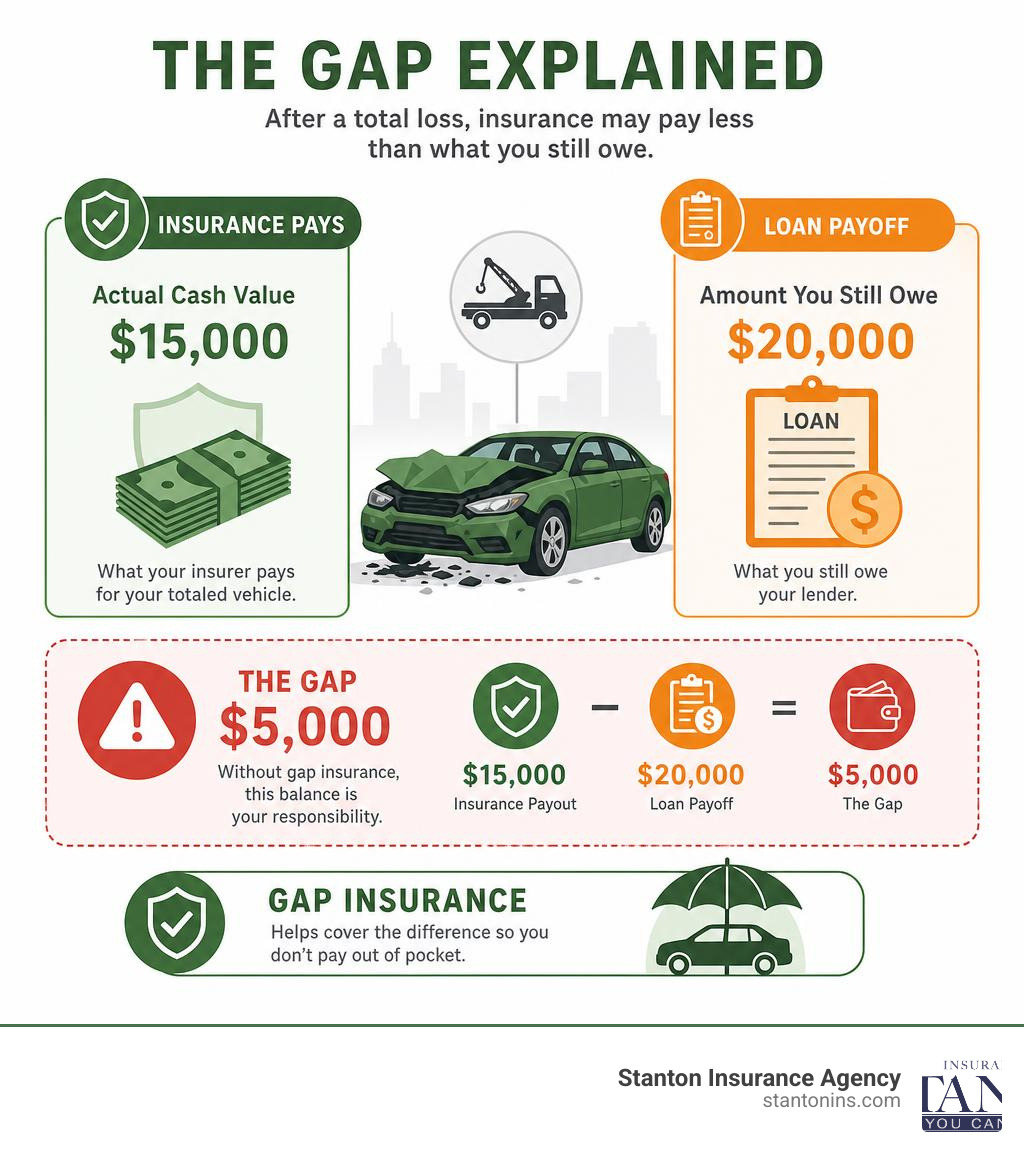
For example, imagine you finance a vehicle for $25,000. A year later, it is totaled. The car is now worth $15,000, but you still owe $20,000. Your standard auto policy pays $15,000. That leaves a $5,000 gap — and without gap insurance, that bill is yours.
I’m Geoff Stanton, President of Stanton Insurance Agency and a Certified Insurance Counselor (CIC) with over 25 years of experience helping Massachusetts and New Hampshire drivers navigate coverage decisions — including finding the right gap insurance agency for their situation. In the sections below, I will walk you through everything you need to know to make a confident, informed decision.
Basic gap insurance agency vocab:
What a Gap Insurance Agency Helps You Understand Before You Buy
Gap insurance, short for Guaranteed Asset Protection, is optional coverage designed for financed or leased vehicles. It helps cover the difference between your vehicle’s actual cash value and the amount you still owe after a covered total loss or unrecovered theft.
A gap insurance agency helps you understand the moving parts before you buy:
- Your loan or lease balance
- Your vehicle’s actual cash value
- How quickly your car may depreciate
- Whether you are upside down, meaning you owe more than the car is worth
- Whether your auto policy includes comprehensive and collision coverage
- Whether gap coverage is available for your vehicle in Massachusetts or New Hampshire
Standard auto insurance is not designed to pay off your loan. It is designed to pay for the value of the vehicle at the time of loss, subject to your policy terms and deductible. That is where gap coverage can matter.
For a deeper primer, you can also read our guide: What is GAP Insurance?
How Gap Insurance Protects Vehicle Owners From Financial Loss
Gap insurance protects you from a very specific but painful problem: owing money on a vehicle that no longer exists.
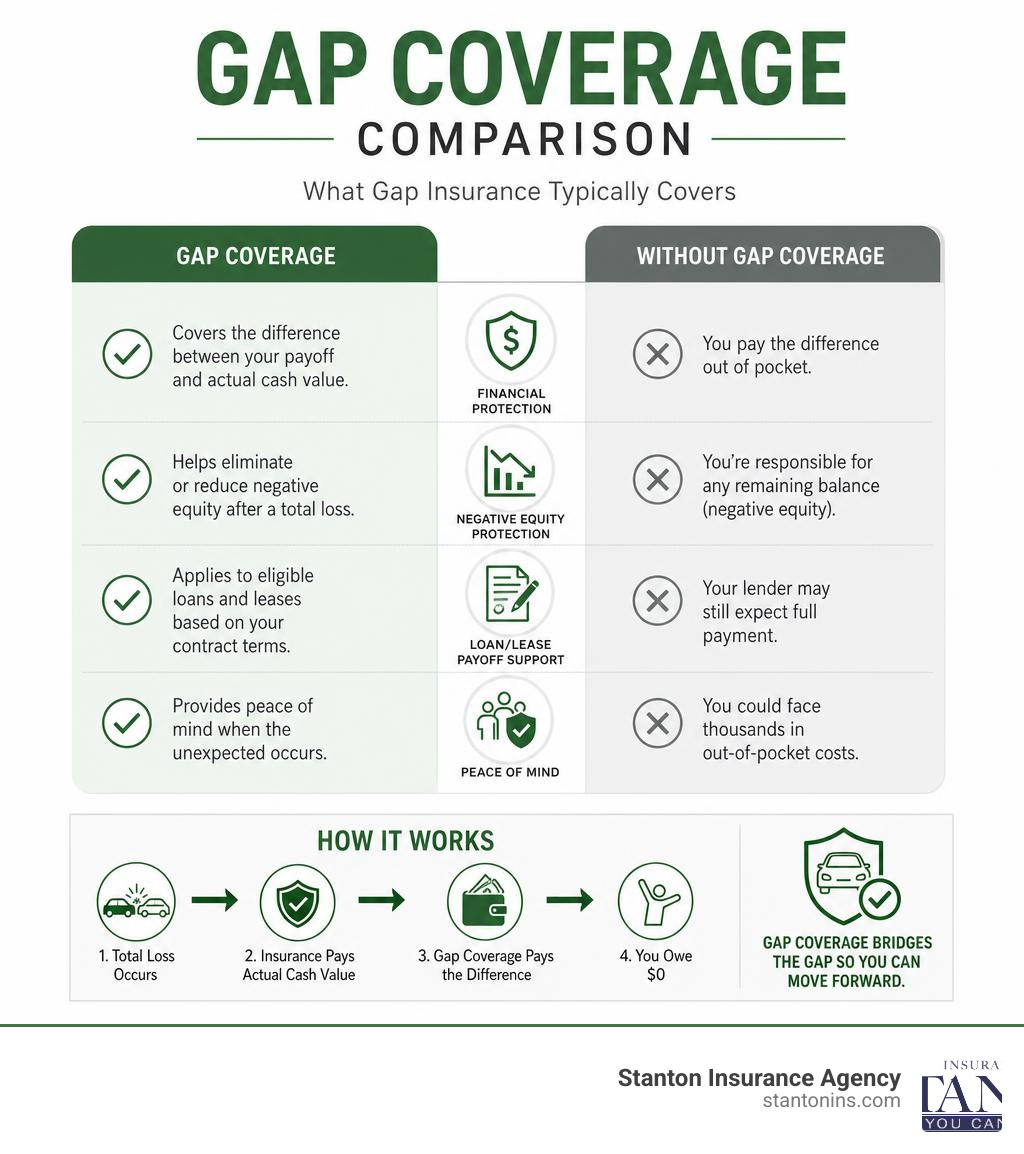
If your financed or leased vehicle is totaled, your collision or comprehensive coverage typically pays the actual cash value of the car. If that amount is less than your lender or leasing company payoff, gap insurance may help cover the remaining balance.
Without gap coverage, you could face:
- A remaining loan payoff after the claim is settled
- A lease payoff obligation
- Out-of-pocket costs for a car you cannot drive
- The need to finance another vehicle while still paying for the old one
- A financial shortfall that affects your savings or credit
This is especially important early in a loan, when depreciation can move faster than your principal balance goes down. In plain English: the car loses value quickly, but your loan is taking its sweet time.
What Happens When a Financed or Leased Vehicle Is Totaled or Stolen

Here is the usual sequence after a covered total loss or unrecovered theft:
- You file a claim with your auto insurer.
- The insurer determines whether the vehicle is a total loss.
- The insurer calculates the vehicle’s actual cash value.
- Your deductible is applied, if applicable.
- The claim payment is issued according to policy and lender rules.
- Your lender or leaseholder applies the payment to your balance.
- If there is still a covered shortfall, gap coverage may help pay the difference.
For theft, gap insurance generally applies only if the theft is covered under comprehensive coverage and the vehicle is not recovered. For an accident, it generally requires a covered collision or comprehensive total loss.
A gap claim usually involves coordination between the auto insurer, the lender or lessor, and the gap provider. This is one reason working with an agency can help. We can help you understand who needs what paperwork and what the coverage is designed to do.
Actual Cash Value vs. What You Still Owe
Actual cash value, often called ACV, is not what you paid for the vehicle. It is the vehicle’s market value just before the loss.
ACV may be affected by:
- Vehicle age
- Mileage
- Condition
- Trim level and options
- Local market pricing
- Prior damage
- Depreciation
- Vehicle history
Your loan payoff is different. It is based on your remaining principal, interest, fees, and contract terms. Early in many loans, payments may be interest-heavy, so the balance can stay high even while the vehicle value drops.
Example:
| Item | Amount |
|---|---|
| Original financed amount | $25,000 |
| Loan balance at time of loss | $20,000 |
| Vehicle actual cash value | $15,000 |
| Potential gap | $5,000 |
If your policy pays $15,000 and you owe $20,000, the $5,000 difference is the problem gap insurance is built to address.
When Gap Insurance Is Most Beneficial for Massachusetts and New Hampshire Drivers
Gap insurance is not necessary for every driver. It is most helpful when the risk of owing more than the vehicle is worth is high.
For Massachusetts and New Hampshire drivers, gap coverage may be worth discussing when you buy, lease, refinance, or recently financed a vehicle. Availability and eligibility depend on the insurer, state filings, vehicle age, vehicle mileage, and loan or lease details.
Who Should Consider Gap Insurance
Gap insurance may make sense if any of these situations apply:
- You made less than a 20% down payment
- You financed for 60, 72, or 84 months
- You leased your vehicle
- You bought a new vehicle that depreciates quickly
- You financed a high-value or luxury vehicle
- You drive high annual mileage
- You rolled an old loan balance into the new loan
- You have limited emergency savings
- Your lender or lessor requires it
- Your vehicle’s loan-to-value ratio is high
- You bought a recent used vehicle with a large financed balance
Longer loans are common, but they can increase gap exposure. The longer the term, the longer it may take for your loan balance to catch up with the car’s market value.
Can You Add Gap Insurance Later Through a Gap Insurance Agency?
Sometimes, yes. But not always.
A gap insurance agency can help you check whether gap coverage can be added to an existing auto policy. Many insurers require that the vehicle also carry comprehensive and collision coverage. Some carriers also have rules about:
- How recently the vehicle was purchased
- Whether you are the first owner
- Vehicle age
- Mileage
- Loan or lease status
- Whether the loan is already upside down
- State availability
- Underwriting approval
Some gap products must be purchased within a certain window after buying the vehicle. Others may be available later as long as the loan or lease is active and the vehicle qualifies.
Our advice: ask early. Gap insurance is one of those coverages that is much easier to discuss before a loss than after one. Insurance is funny that way – it is stubbornly unhelpful once the bad thing has already happened.
When to Drop Gap Coverage
You generally no longer need gap insurance when your vehicle is worth more than the remaining loan or lease payoff.
To check, compare:
- Your current loan payoff statement
- Your vehicle’s market value using a reliable valuation source
- Your loan-to-value ratio
You may be ready to drop gap coverage when:
- Your loan balance is lower than the car’s value
- You have positive equity
- You paid extra toward principal
- You refinanced and improved the loan position
- Your lease is ending
- You paid off the vehicle
- Your annual review shows the coverage is no longer useful
We recommend reviewing gap coverage at least once a year. Paying for unnecessary coverage is not the end of the world, but we would rather help you put that money toward something more fun, like gas station coffee that does not taste like regret.
Dealer Gap Insurance vs. Coverage Through an Insurance Company
Gap coverage is often offered in the dealership finance office, through lenders, or through auto insurance companies. The best choice depends on cost, eligibility, cancellation rules, and coverage terms.
Some dealership programs include features such as deductible reimbursement, replacement credits, or special finance product structures. Dealer-focused gap programs can vary widely, as shown in examples of dealer GAP program structures.
| Feature | Dealer or lender gap | Insurance-company gap |
|---|---|---|
| How it is sold | At purchase or lease signing | Added to auto policy if eligible |
| Cost structure | Often single upfront premium | Often monthly or annual endorsement |
| Financing impact | May be rolled into loan | Usually billed with policy |
| Interest charges | Possible if financed | Typically no loan interest |
| Cancellation | May require separate paperwork | Often easier through policy changes |
| Refunds | May depend on contract terms | Depends on policy and carrier rules |
| Claim coordination | May involve dealer/lender administrator | Often tied to auto claim process |
| Flexibility | Can be less flexible | Easier to review and adjust |
| Guidance | Finance office explanation | Agency comparison and review |
Buying Gap Coverage From a Dealer or Lender
Dealer or lender gap coverage is convenient because it is offered when you buy or lease the vehicle. That convenience can be valuable, especially if your lease requires the protection.
However, there are tradeoffs.
Dealer or lender gap may be:
- Sold as a single premium
- Rolled into the finance contract
- Subject to interest if financed
- Part of a debt cancellation agreement rather than an insurance endorsement
- Harder to cancel later
- Subject to separate refund rules
- Bundled with other finance and insurance products
Some contracts may include extras, such as deductible reimbursement or a credit toward a replacement vehicle. Those features can be useful, but you should understand the total cost and restrictions.
Buying Gap Coverage Through an Auto Insurance Policy
Gap coverage through an auto policy is often structured as an endorsement. It may be less expensive than dealer coverage because it is not rolled into the vehicle loan.
Policy-based gap coverage may offer:
- Lower potential cost
- Billing with your auto policy
- Easier cancellation
- Annual review with your other coverages
- Integration with the auto claim process
- Guidance from an independent agency
Most carriers require comprehensive and collision coverage before gap can be added. This makes sense because gap insurance only works after a covered total loss. If there is no physical damage coverage paying ACV, there is usually no gap payment to trigger.
Availability varies in Massachusetts and New Hampshire, so we help clients review which carriers may offer the coverage and what rules apply.
How Similar Products Like Loan/Lease Payoff Coverage Differ
Loan/lease payoff coverage is similar to gap insurance, but it is not always identical.
The key difference is that loan/lease payoff coverage may limit the payout to a percentage of the vehicle’s value. For example, some programs cap the payment at no more than a set percentage above actual cash value. That means it may not cover the full shortfall if the loan balance is much higher than the car’s value.
Important differences may include:
- Maximum payout cap
- Whether the cap is based on ACV
- Whether prior negative equity is covered
- Deductible treatment
- Whether theft is included
- State-specific definitions
- Vehicle age or mileage restrictions
- Whether leased vehicles qualify
This is where policy wording matters. Similar names do not always mean identical protection.
What Gap Insurance Costs and What It Does Not Cover

Gap insurance is generally considered low-cost protection, especially when added to an auto policy. But the price depends on how and where you buy it.
How Much Gap Insurance Typically Costs
Gap insurance through an auto insurer may cost only a few dollars per month in many cases. Dealer or lender gap is often sold as a lump-sum charge, and if that charge is financed into your loan, you may also pay interest on it.
Cost factors can include:
- Vehicle price
- Actual cash value
- Loan term
- Down payment
- Loan-to-value ratio
- Vehicle age
- Mileage
- State availability
- Carrier rules
- Lease requirements
- Claim history
- Deductible and coverage structure
When comparing options, do not just ask, “What is the monthly cost?” Ask, “What is the total cost over the time I expect to need this coverage?”
A $700 product rolled into a loan is not the same as a small monthly endorsement you can cancel when your equity improves.
Does Gap Insurance Cover Theft, Deductibles, Engine Failure, Medical Costs, or Death?
Here is the plain-language version:
| Question | Typical answer |
|---|---|
| Does gap cover theft? | Often yes, if the vehicle is stolen, not recovered, and the theft is covered by comprehensive coverage. |
| Does gap cover deductibles? | Usually no, although some gap contracts may include deductible reimbursement up to a stated limit. |
| Does gap cover engine failure? | No. Mechanical breakdown is not a total loss from a covered accident or theft. |
| Does gap cover medical bills? | No. Medical costs are handled by other coverages, depending on the policy and state rules. |
| Does gap cover death or funeral costs? | No. Gap insurance is not life insurance or bodily injury coverage. |
Gap insurance is not a warranty. It does not repair your transmission, replace your brakes, or comfort your check engine light when it starts glowing like a tiny orange threat.
It also does not replace liability coverage, medical payments coverage, personal injury protection where applicable, or uninsured motorist coverage.
Does Gap Insurance Cover Negative Equity?
Gap insurance is designed to address negative equity, but not every kind of negative equity is covered in full.
Negative equity means your loan or lease payoff is higher than the vehicle’s actual cash value. But contracts may limit or exclude:
- Prior loan balances rolled into the new loan
- Late payments
- Skipped payments
- Unpaid fees
- Finance charges
- Add-on products
- Excess loan-to-value amounts
- Amounts above a program maximum
Some vehicle protection programs list examples of eligibility limits, such as maximum original financed amounts, term lengths, deductible coverage limits, or loan-to-value restrictions. You can see examples of how vehicle protection eligibility may be structured here: vehicle protection eligibility examples
The takeaway: gap insurance can be excellent protection, but the contract language matters.
How Insurance Providers Structure Gap Insurance in 2026
In 2026, gap coverage is not one-size-fits-all. Some providers offer true gap insurance. Others offer loan/lease payoff coverage. Some limit eligibility to newer vehicles. Some require you to be the original owner. Some only offer coverage in select states.
That is why “Who has the best gap insurance?” is not a universal question. A better question is: “Which available provider offers the best fit for my vehicle, loan, lease, and state?”
What a Gap Insurance Agency Compares Across Providers
When we review gap options, we compare more than price.
A good gap insurance agency should look at:
- Massachusetts or New Hampshire availability
- Whether the vehicle is financed or leased
- Vehicle age
- Mileage
- New or used eligibility
- First-owner requirements
- Comprehensive and collision requirements
- Maximum payout
- Deductible language
- Negative equity limits
- Late-payment or skipped-payment treatment
- Cancellation terms
- Refund rules
- Claim process
- Policy bundling options
- Customer service access
The cheapest option is not always the best option. The best option is the one that actually works when you need it.
Common Coverage Structures Used by Major Auto Insurers
Most auto insurance gap options fall into a few common structures:
True gap coverage
This is designed to pay the difference between the actual cash value settlement and the covered loan or lease payoff after a total loss.Loan/lease payoff coverage
This is similar, but may cap the payment at a percentage of the vehicle’s value.New vehicle gap endorsement
Some carriers restrict gap coverage to newer vehicles or vehicles added within a certain purchase window.Lease-focused protection
Some lease contracts include gap protection automatically, while others require it separately. Always read the lease agreement.Dealer or lender-administered gap
These products may have their own term limits, deductible reimbursement provisions, cancellation rules, and claim administrators.
In nearly all cases, the coverage is triggered only by a covered total loss or unrecovered theft. It does not apply simply because your vehicle value drops.
What to Ask Before Choosing a Provider
Before choosing a gap provider, ask these questions:
- Is gap coverage available in Massachusetts or New Hampshire for my policy?
- Is this true gap coverage or loan/lease payoff coverage?
- Is there a maximum payout cap?
- Does the policy cover leased vehicles, financed vehicles, or both?
- Is my vehicle too old or too high-mileage?
- Do I need to be the first owner?
- Do I need comprehensive and collision coverage?
- Does it cover unrecovered theft?
- Am I responsible for my deductible?
- Are prior loan rollovers covered?
- Are late payments or skipped payments excluded?
- What happens if I refinance?
- How do I cancel the coverage?
- Is there a refund if I cancel early?
- Who handles the claim?
- What documents will be required after a total loss?
- How long should I keep the coverage?
If the answer sounds vague, ask again. If it still sounds vague, call us. We enjoy policy wording more than most people enjoy normal hobbies.
Frequently Asked Questions About Gap Insurance Agencies
Is Gap Insurance Required by Law in Massachusetts or New Hampshire?
No. Gap insurance is not required by law in Massachusetts or New Hampshire.
However, your lender or leasing company may require it as part of your finance or lease agreement. Even when gap insurance is optional, lenders and lessors commonly require comprehensive and collision coverage on financed or leased vehicles.
New Hampshire has different auto insurance requirements than Massachusetts, but that does not change the basic gap insurance question. If you finance or lease a vehicle, your contract may still require certain coverages.
Can Gap Insurance Be Purchased at Any Time During a Loan or Lease?
Sometimes. It depends on the provider.
You may be able to add gap coverage to an existing auto policy if:
- The loan or lease is still active
- The vehicle meets age and mileage rules
- The carrier offers gap in your state
- You carry comprehensive and collision
- You meet any purchase-window or ownership rules
- The vehicle passes underwriting requirements
Some providers restrict gap to new vehicles or require it to be added shortly after purchase. Others may allow it later. The best move is to ask as soon as you finance or lease the vehicle.
Is Gap Insurance Worth It If I Have Full Coverage?
It can be.
“Full coverage” usually means your auto policy includes liability, comprehensive, and collision coverage. But full coverage does not mean your insurer will pay off your loan.
Comprehensive and collision coverage typically pay the vehicle’s actual cash value after a covered loss. If your loan or lease balance is higher than that value, you may still owe money.
Gap insurance may be worth it if:
- You made a small down payment
- You have a long-term loan
- You lease the vehicle
- You financed taxes, fees, or add-ons
- Your vehicle depreciates quickly
- You do not want to use savings to pay a loan shortfall
- You owe more than the vehicle is currently worth
If you have strong positive equity, gap insurance is usually unnecessary.
Conclusion
Gap insurance is simple in concept but important in the details. It helps protect you from the financial shortfall that can happen when a financed or leased vehicle is totaled or stolen and the insurance payout is less than the payoff.
At Stanton Insurance Agency, we help Massachusetts and New Hampshire drivers review their auto coverage, loan or lease situation, and gap insurance options. Our goal is trusted protection for your valuable assets, without confusion, pressure, or mystery math.
If you are buying, leasing, refinancing, or wondering whether you still need gap coverage, we can help you make a clear decision.
Start here: Get auto insurance guidance