
What is Annual Mileage and Why Does It Matter?
Annual mileage insurance is how your auto insurer uses the number of miles you drive each year to calculate how much you pay for coverage. The fewer miles you drive, the less time you spend on the road — and the lower your statistical risk of a claim.
Here’s what you need to know at a glance:
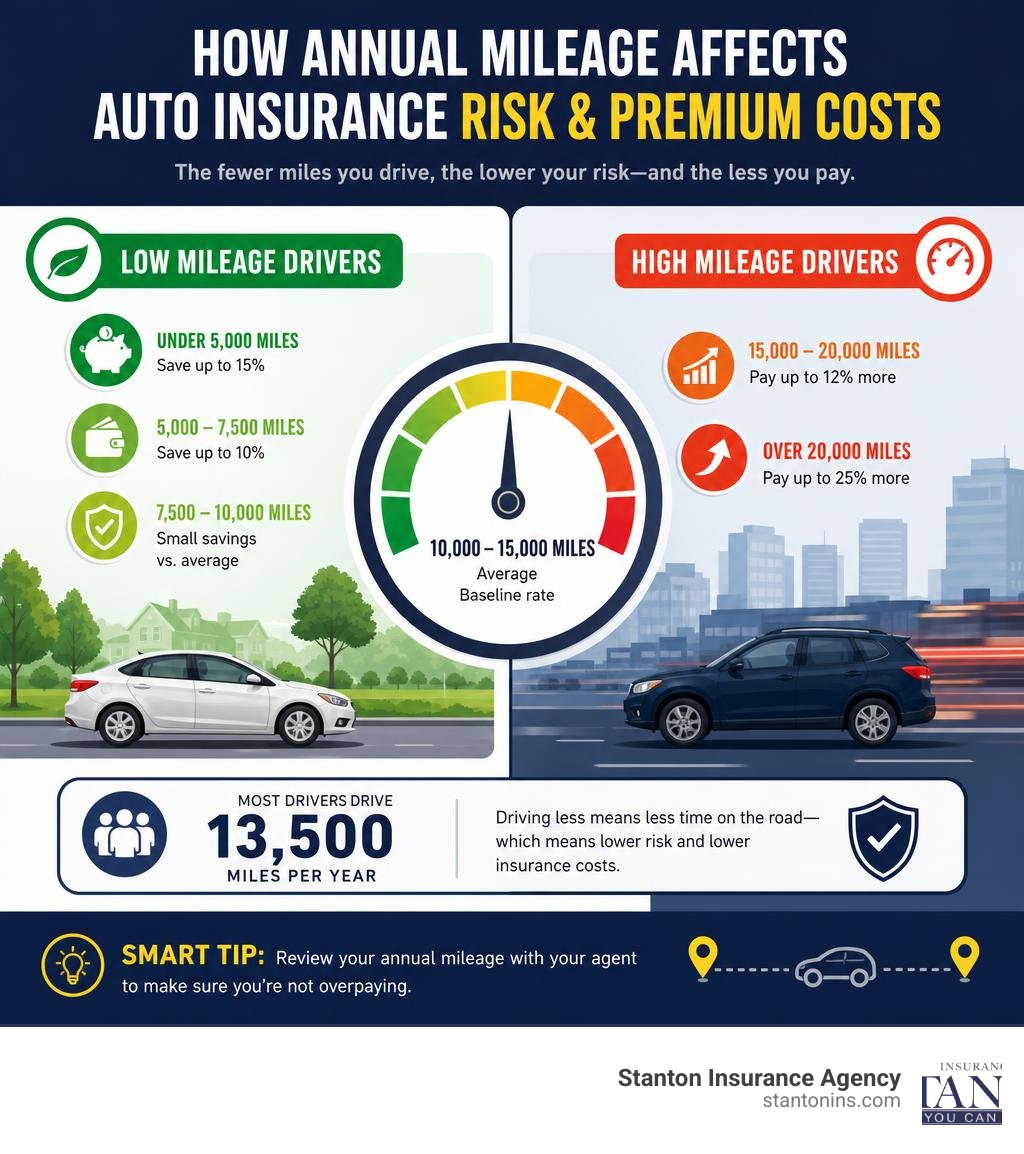
| Annual Mileage | Risk Level | Typical Premium Impact |
|---|---|---|
| Under 5,000 miles | Very low | Save up to 15% vs. average |
| 5,000 – 7,500 miles | Low | Save up to 10% |
| 7,500 – 10,000 miles | Below average | Small savings vs. average |
| 10,000 – 15,000 miles | Average | Baseline rate |
| 15,000 – 20,000 miles | Above average | Pay up to 12% more |
| Over 20,000 miles | High | Pay up to 25% more |
Most Americans drive around 13,500 miles per year. But if your car sits parked more than it moves — because you work from home, you’ve retired, or you rely on public transit — you could be overpaying for miles you simply don’t drive.
The problem? Most drivers never question what number their insurer has on file. Some policies default to 12,000 miles per year if you never provided an estimate. That default could be costing you real money.
I’m Geoff Stanton, President of Stanton Insurance Agency and a Certified Insurance Counselor (CIC) with over 25 years of experience helping Massachusetts and New Hampshire drivers find the right coverage — including navigating annual mileage insurance to make sure clients aren’t paying more than they should. Let’s break down exactly how mileage affects your premium and what you can do about it.
Annual mileage insurance further reading:
At its core, annual mileage is the total number of miles you expect to drive your vehicle over a 12-month policy period. For insurance underwriters, this number is a crucial piece of the pricing puzzle. It represents your “road exposure.”
Every time you pull out of your driveway in Worcester, Boston, or Manchester, you encounter variables: distracted drivers, unpredictable New England weather, and congested highways. Statistically, the more miles you put on your odometer, the higher your risk of being involved in an accident.
Because insurance is fundamentally about pricing risk, your annual mileage directly influences your premium. If we look at How mileage affects auto insurance rates, the correlation is clear: less time on the road means fewer opportunities for a fender bender.
When you apply for a policy or renew an existing one, insurers look at a variety of rating factors. Along with your driving record, age, and vehicle type, mileage helps establish your risk tier. If you want to dive deeper into how this fits into the bigger picture, check out our guide on What factors affect your car insurance premium.
How Insurers Define Low, Average, and High Mileage
Insurance companies don’t look at mileage as a single, continuous sliding scale. Instead, they group drivers into brackets:
- Low Mileage (Under 7,500 miles per year): Drivers in this bracket typically include remote workers, retirees, and city dwellers who rely heavily on public transit. If you fall into this category, you pose the lowest risk to insurers.
- Average Mileage (7,500 to 15,000 miles per year): The average American drives roughly 13,500 miles annually. If your daily commute is moderate and you use your car for weekend errands, you will likely land in this baseline tier.
- High Mileage (Over 15,000 miles per year): Long-distance commuters, sales professionals, and road-trip enthusiasts populate this tier. Because of their high road exposure, these drivers present a greater risk of filing a claim.
Demystifying Annual Mileage Insurance: How It Works

When you buy a standard auto insurance policy, your premium is calculated using the mileage estimate you provide at the start of the term. The insurance company uses this figure to place you into a premium bracket.
This is different from pay-per-mile or usage-based insurance, where your premium fluctuates dynamically month-to-month. Under a traditional policy, your rate remains fixed for the six-month or one-year term, based on your projected annual mileage.
Understanding How does annual mileage affect car insurance is all about understanding risk exposure. If you estimate your mileage accurately, your premium will align with your actual risk. If your habits change permanently, you can adjust your policy terms mid-cycle to reflect your new reality.
Who Benefits Most from Annual Mileage Insurance?
Certain driving profiles stand to save the most by optimizing their annual mileage settings:
- Remote and Hybrid Workers: If you transitioned to a work-from-home model, your daily commute vanished. You might only be driving to the grocery store or local social events.
- Retirees: Without a daily commute to an office, retirees often see their annual mileage drop well below 7,500 miles.
- Multi-Vehicle Households: Many families in Massachusetts and New Hampshire have a “secondary” vehicle — perhaps an older SUV used only for winter weather or a weekend sports car. Keeping these vehicles rated for low mileage is one of the easiest ways to save. You can find more strategies like this in our list of 10 auto insurance cost hacks.
How to Find the Best Annual Mileage Insurance Policy
Finding the right policy isn’t just about picking the lowest number on an online comparison tool. Because every insurance carrier uses different algorithms to calculate mileage-based risk, rates can vary significantly.
Working with independent agents — like our team at Stanton Insurance Agency — gives you a distinct advantage. We don’t write for just one company; we compare options across multiple regional and national carriers to find the best fit for your specific driving habits. We can help you look at customized coverage limits, stack discounts, and ensure you aren’t paying for a default mileage tier you don’t need.
How Mileage Affects Your Insurance Premium
To understand the financial impact of your odometer, let’s look at how claims data correlates with mileage.
According to industry data, vehicles driven less than 3,000 miles annually are involved in 40% fewer claims than average. Conversely, cars driven 20,000 miles or more annually record 31% more claims.
Because of this dramatic difference in risk, insurers price their policies accordingly. The table below illustrates how average premiums scale based on mileage brackets:
| Mileage Bracket | Average Claim Frequency | Premium Impact |
|---|---|---|
| Under 3,000 miles | 40% fewer claims | Significant savings |
| 5,000 miles | Below average claims | ~15% savings |
| 10,000 miles | Average claims | Baseline rate |
| 15,000 miles | Above average claims | ~12% increase |
| 20,000+ miles | 31% more claims | ~25% increase |
If you are trying to budget for your vehicle expenses, knowing these brackets is essential. For a detailed breakdown of local costs, check out our guide on How much is car insurance per month in Massachusetts.
The Financial Impact of High Mileage
If you are a high-mileage driver logging over 20,000 miles per year, your premium could be 25% higher than a baseline driver’s rate. This increase is a direct reflection of your increased road exposure. More time on busy highways like I-90 or I-93 simply increases the probability of an incident.
However, there is a silver lining: mileage rate increases typically plateau after 20,000 miles. Insurers rarely charge more for 30,000 miles than they do for 20,000 miles, as the risk model reaches its maximum rating factor. To learn more about how baseline rates are calculated in our area, read about the Average cost of car insurance in MA.
State-Specific Rules in Massachusetts and New Hampshire
In New England, state-specific regulations play a massive role in how auto insurance is administered.
- Massachusetts: The Commonwealth has strict vehicle safety and emissions inspection laws. Every year, you must take your vehicle to a licensed inspection station. During this process, your exact odometer reading is recorded and uploaded directly to the Massachusetts Registry of Motor Vehicles (RMV) database. Insurers have direct access to this data, meaning they can easily verify if your self-reported mileage matches your actual driving habits. You can learn more about the state’s regulatory framework through the Massachusetts car insurance basics page.
- New Hampshire: While New Hampshire does not legally mandate auto insurance for all drivers, those who choose to purchase coverage (or are required to due to prior violations) must navigate similar underwriting rules. State inspections also record odometer data, which insurers utilize to verify risk. For a detailed look at costs in the Granite State, consult the New Hampshire auto costs resource.
How to Accurately Calculate and Track Your Mileage

Calculating your annual mileage doesn’t require a complex spreadsheet. You can easily estimate your yearly total using a simple baseline formula.
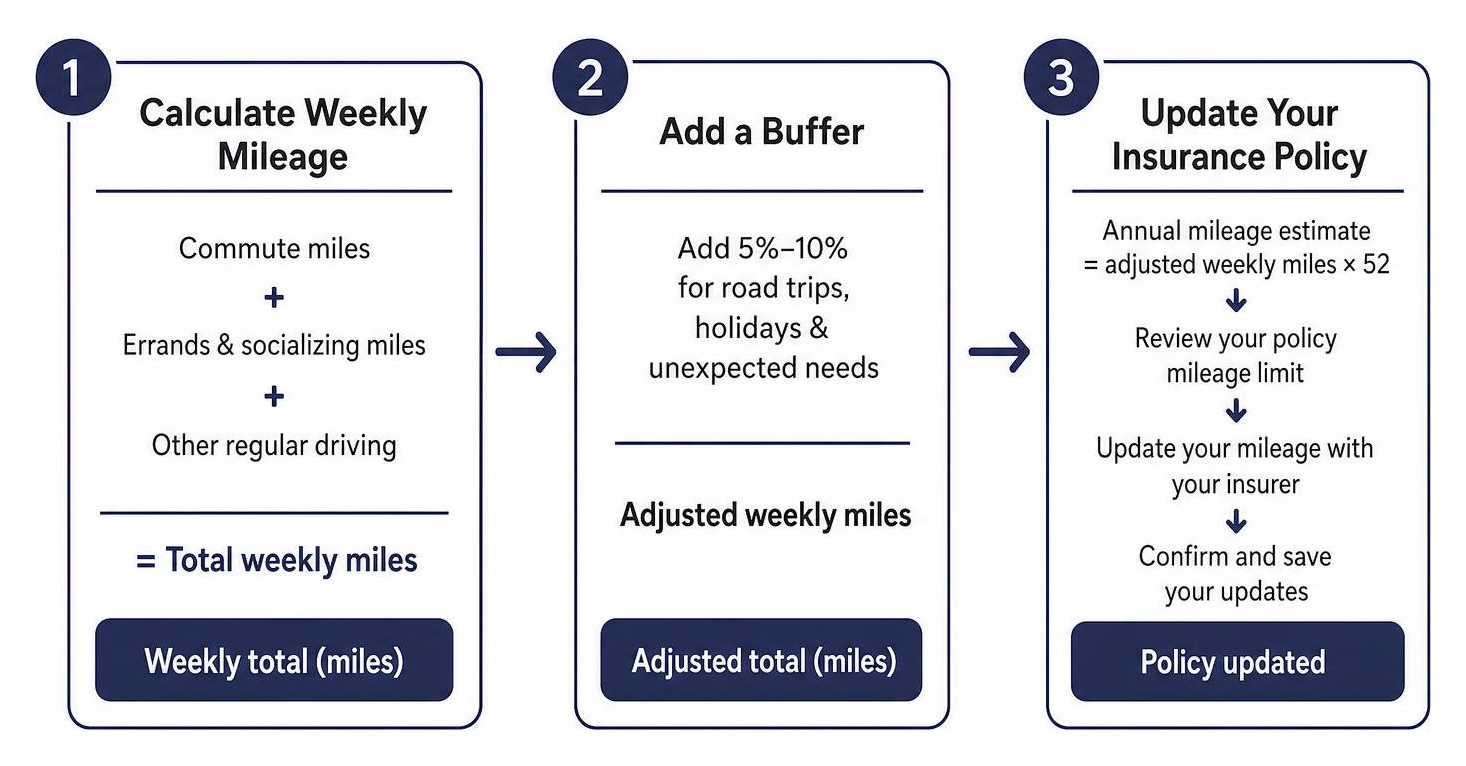
First, determine your typical weekly mileage by tracking your daily activities:
- Commute: Multiply your daily round-trip work commute by the number of days you work per week.
- Errands & Socializing: Estimate your weekly miles spent driving to the grocery store, gym, or visiting family.
- Annual Buffer: Add a 5% to 10% buffer to account for occasional road trips, holidays, or unexpected emergencies.
Once you have your weekly total, multiply it by 52.
For example, if you drive 100 miles per week for errands and local trips, your baseline is 5,200 miles. If you plan two road trips to the White Mountains or Cape Cod totaling 800 miles, your estimated annual mileage is 6,000 miles. If you want to see how this estimate translates to actual dollars, you can use our guide on Demystifying your drive with a premium calculator.
Below is a visual guide to the step-by-step process of calculating and updating your mileage:
What Happens If You Exceed Your Declared Mileage?
Life happens. Maybe you took an unexpected new job with a longer commute, or you decided to spend the summer driving across New England. If you exceed your declared mileage, your policy won’t automatically be canceled mid-term, but it can lead to adjustments at your next renewal.
However, if you significantly and intentionally underestimate your mileage to secure a lower rate, you run the risk of committing “material misrepresentation.” In the event of a severe accident, if an adjuster discovers your odometer is tens of thousands of miles over your declared limit, the insurer could potentially dispute or deny your claim, leaving you personally liable for damages.
How Insurance Companies Verify Your Odometer
Many drivers wonder: How does my insurance company actually know how much I drive?
Self-reporting is no longer the only source of data. Insurers regularly cross-reference your declared mileage with third-party databases. Reputable auto service facilities, oil change shops, dealerships, and state inspection stations routinely log vehicle odometer readings into centralized databases (such as CARFAX or registry databases) accessible by insurance underwriters.
If you report that you drive 5,000 miles a year, but your annual Massachusetts state inspection report shows a 15,000-mile difference from the previous year, the underwriting system will flag the discrepancy and adjust your rates accordingly.
Low-Mileage Discounts vs. Pay-Per-Mile Insurance
If you are a low-mileage driver, you generally have two paths to savings: traditional low-mileage discounts or pay-per-mile/usage-based insurance (UBI).
Traditional Low-Mileage Discounts
Traditional low-mileage discounts are applied to a standard auto policy. You self-report your estimated annual mileage (which is verified via databases or odometer photos at renewal), and if you fall below a certain threshold (typically 7,500 miles), the insurer applies a discount of up to 15%.
This is the simplest option because it doesn’t require tracking devices or monthly billing fluctuations. It keeps your premium predictable while rewarding your limited time on the road. You can often combine this with other programs, which you can read about in our guide on how to Drive smart and save with defensive driving discounts.
Pay-Per-Mile and Usage-Based Insurance (UBI)
For drivers who travel extremely short distances — under 6,000 to 8,000 miles per year — pay-per-mile insurance can offer even deeper savings.
Under this model, your monthly bill is split into two parts:
- A flat monthly base rate (e.g., $30/month) to cover the vehicle while it is parked.
- A variable per-mile fee (e.g., 5 cents per mile) tracked via an OBD-II device plugged into your car’s diagnostic port or a mobile app.
If you only drive 300 miles in a month, your bill would be $45 ($30 base + $15 mileage fee). However, if you take a long road trip, your monthly bill will spike. To determine if this model fits your lifestyle, read this detailed analysis on Is pay-per-mile insurance worth it.
Frequently Asked Questions about Annual Mileage
Can my insurance company verify my mileage if I don’t use a tracking device?
Yes. Even without a plug-in telematics device or mobile app, insurers can verify your mileage. They do this by accessing commercial databases that aggregate odometer readings from annual state safety inspections, emissions testing, oil change chains, mechanics, and dealership service departments.
What are the risks of underestimating or lying about my mileage?
Intentionally lying about your annual mileage to secure a lower premium is legally classified as “soft fraud.”
If you are caught, the consequences can be severe:
- Denied Claims: Your insurer may refuse to pay for damage or liability after an accident.
- Policy Cancellation: The carrier can cancel your policy for material misrepresentation, making it incredibly difficult (and expensive) to secure coverage with another company.
- Rate Adjustments: The insurer will retroactively charge you the premium you should have been paying based on your actual mileage.
What should I do if my driving habits change mid-policy?
If you experience a major life event — such as transitioning to a permanent work-from-home role, retiring, or moving closer to your office — you should notify your insurance agent immediately. You do not have to wait until your policy renewal to make this change. Your agent can process a mid-term adjustment, which can immediately lower your monthly premium. If you want to make sure you are not overpaying, check out our guide on Car insurance monthly rates.
Conclusion
Your car insurance premium should reflect how you actually use your vehicle. If your car spends more time in your driveway than on the highway, you shouldn’t be paying the same rate as a long-distance commuter. Optimizing your annual mileage insurance settings is one of the most straightforward, yet frequently overlooked, ways to lower your auto insurance costs.
At Stanton Insurance Agency, we specialize in providing trusted, personalized asset protection for drivers across Massachusetts and New Hampshire. We can help you look at your actual driving habits, verify your mileage brackets, and find the right carrier to maximize your savings.
Ready to stop paying for miles you don’t drive? Let’s review your policy together. Get a customized auto insurance quote today, or contact our team to speak with a local professional.
