
Why Understanding the Factors Affecting Insurance Rates Can Save You Money
The factors affecting insurance rates are more straightforward than most people think — once you know what insurers actually look at.
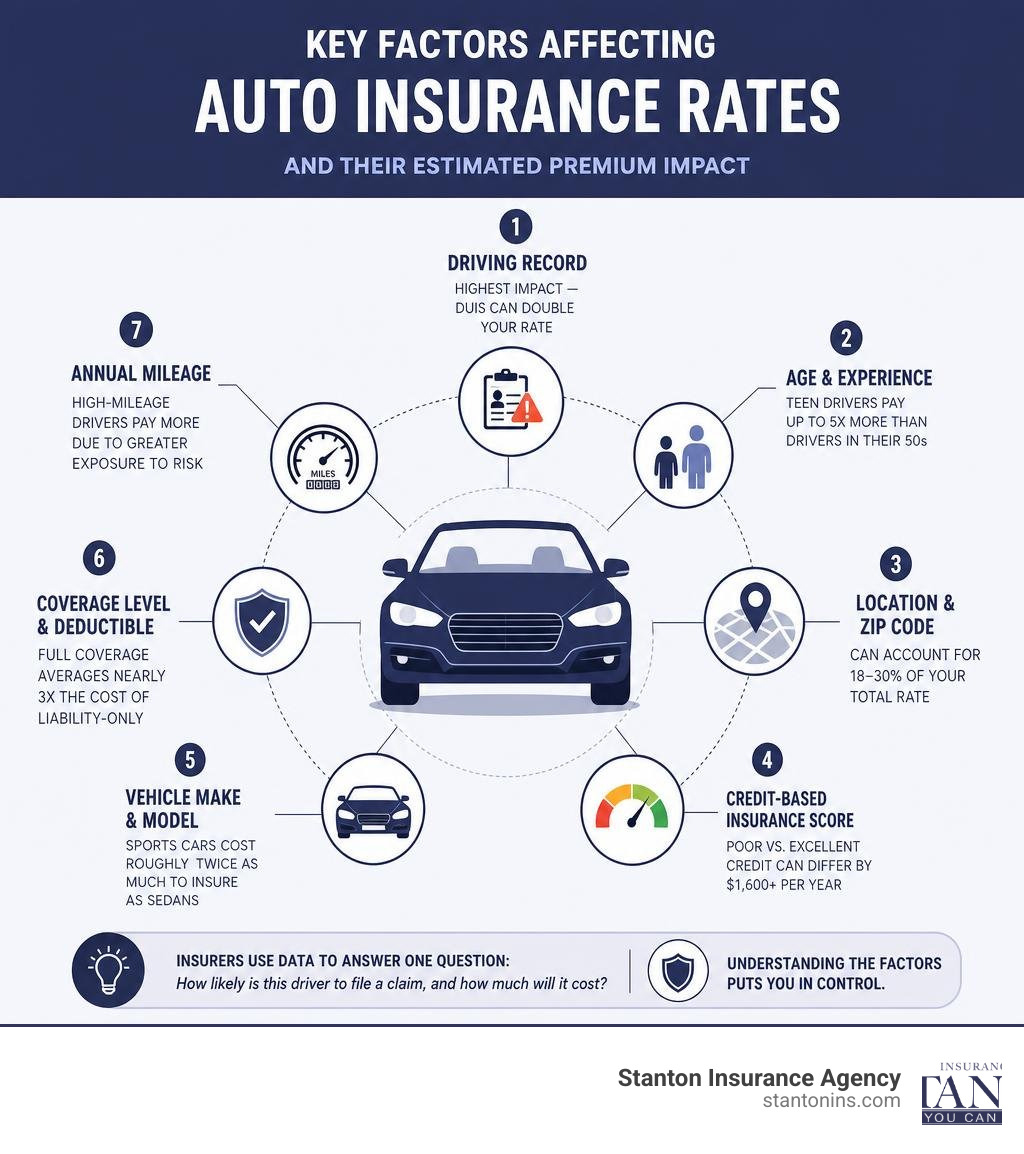
Here are the main factors that determine your car insurance premium:
| Factor | Impact on Premium |
|---|---|
| Driving record | Highest impact — DUIs can double your rate |
| Age and experience | Teen drivers pay up to 5x more than drivers in their 50s |
| Location and ZIP code | Can account for 18–30% of your total rate |
| Credit-based insurance score | Poor vs. excellent credit can differ by $1,600+ per year |
| Vehicle make and model | Sports cars cost roughly twice as much to insure as sedans |
| Coverage level and deductible | Full coverage averages nearly 3x the cost of liability-only |
| Annual mileage | High-mileage drivers pay more due to greater exposure to risk |
Most drivers assume their rate is random — or that there’s nothing they can do about it. Neither is true.
Insurers use a detailed formula built on actuarial data. Every factor they weigh is tied to one core question: how likely is this driver to file a claim, and how much will it cost?
Understanding that logic puts you in control.
I’m Geoff Stanton, President of Stanton Insurance Agency and a Certified Insurance Counselor (CIC) with over 25 years of experience helping Massachusetts and New Hampshire residents navigate the factors affecting insurance rates and find coverage that fits their lives. In this guide, I’ll walk you through everything that goes into your premium — and exactly what you can do to lower it.
Factors affecting insurance rates terms to learn:
Understanding the Basics: Rate vs. Premium
To truly understand how your insurance bill is calculated, we must first clear up a very common point of confusion: the difference between an insurance rate and an insurance premium. While these terms are often used interchangeably in casual conversation, they mean completely different things in insurance.
An insurance rate is the base price set at the group level. Actuaries establish rates by analyzing massive pools of historical data to estimate the cost of future claims for broad categories of risk. They look at general accident statistics, vehicle repair costs, and safety trends. The rate represents the cost per unit of insurance coverage for a specific class of risk.
An insurance premium, on the other hand, is the actual dollar amount you pay for your specific policy. It is calculated by taking the base rate and adjusting it up or down using your individual risk characteristics—such as your driving history, your exact ZIP code, and the coverage limits you choose.
To break this down simply:
| Feature | Insurance Rate | Insurance Premium |
|---|---|---|
| Definition | The unit price of coverage for a specific group risk class. | The total personal cost you pay for your individual policy. |
| How It’s Set | Determined at the group level using broad actuarial data. | Determined at the individual level by adjusting the base rate. |
| Regulation | Must be filed with and approved by state insurance regulators. | Customized dynamically based on personal policy choices. |
| Can You Control It? | No. It is based on market-wide trends and regulatory rules. | Yes. You can influence it through your choices and behavior. |
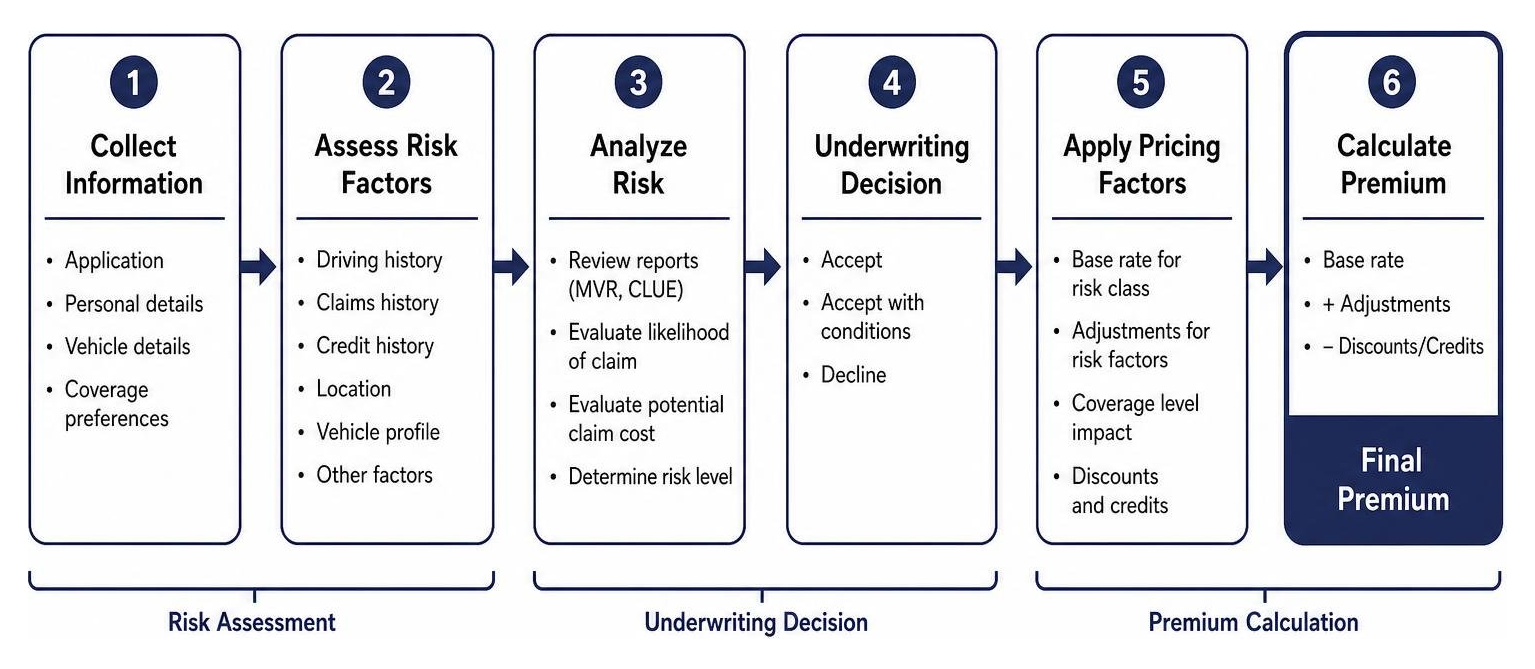
This translation from a broad rate to your personal premium relies on two key disciplines: actuarial science and the underwriting process.
Actuaries use highly sophisticated mathematical models—often employing Generalized Linear Models (GLMs)—to analyze historical claims data. They look at how variables correlate with the frequency of claims (how often accidents happen) and the severity of claims (how much those accidents cost).
Once the actuaries establish the baseline pricing structures, underwriters step in to evaluate you as an applicant. Underwriters review your specific risk profile using tools like Motor Vehicle Records (MVRs) and Comprehensive Loss Underwriting Exchange (CLUE) reports. Their job is to decide whether you fit into the company’s risk guidelines and to apply the correct pricing factors to calculate your final premium.
Core Factors Affecting Insurance Rates for Drivers
When we look at what actually moves your premium, your personal profile as a driver is the most significant piece of the puzzle. Insurance companies want to know how safely you drive and how much experience you have behind the wheel.
Driving History and Claims History
Your driving history is the single most powerful controllable factor in determining your premium. It serves as the primary predictor of your future risk. If you have a clean record, you represent a low risk, which translates directly into lower premiums.
However, violations and accidents will cause your rates to spike. For instance, a single speeding ticket can increase your rate by roughly 22% to 25%. If you are convicted of a major violation like a DUI, the financial consequences are severe: average six-month premiums can jump from $1,103 to $2,133—nearly doubling your costs. At-fault accidents also carry a heavy penalty, typically raising your rates by 25% to 60% for a period of three to five years.
In addition to traffic violations, your claims history plays a massive role. Insurers look at how many claims you have filed in the past five to seven years. Even if a claim was not entirely your fault, a pattern of frequent claims suggests to underwriters that you are highly exposed to risk, which will drive up your premium.
Age and Experience Level
Age is a major proxy variable for driving experience. Statistically, young and inexperienced drivers are far more likely to be involved in accidents. According to the Insurance Institute for Highway Safety (IIHS), teen drivers aged 16 to 19 are nearly three times more likely to be involved in a fatal crash than drivers aged 20 and older.
This dramatic difference in risk is reflected in premium pricing. The average annual car insurance premium for drivers in their 20s sits at approximately $2,284, whereas experienced drivers in their 50s enjoy some of the lowest rates in the industry, averaging $1,555.
As a driver accumulates clean years on the road, the age surcharge steadily decreases. Rates typically drop significantly at age 20, and even further at age 25. Premiums generally hit their lowest point when drivers are in their mid-50s and early 60s, before beginning to rise again after age 70 as physical reflexes and visual acuity naturally decline.
How Location and ZIP Codes Act as Factors Affecting Insurance Rates
Where you park your car at night has a massive impact on your insurance premium. In fact, your ZIP code can account for 18% to 30% of your total rate because of the hyper-local risk environment.
When assessing geographic risk, insurance companies look at several key localized variables:
- Urban Density: Cities have more cars on the road, which naturally leads to a higher frequency of multi-vehicle collisions.
- Crime Rates: Rates of vehicle theft, vandalism, and break-ins vary drastically from one neighborhood to another.
- Weather Events: Areas prone to severe winter storms, coastal flooding, or hail experience higher comprehensive claims.
- Local Repair Costs: The cost of labor and medical care in your specific region directly impacts how much an insurer must pay out for a claim.
Because we operate primarily in Massachusetts and New Hampshire, we see how different state laws and local environments shape premiums.
Massachusetts is a no-fault insurance state with unique regulatory characteristics. The state’s dense urban centers, complex roadways, and high cost of living contribute to elevated insurance costs. If you want to dive deeper into why this is the case, read our detailed guide on Why is Car Insurance So Expensive in Massachusetts?. Because rates can vary widely between carriers in the Bay State, the state government explicitly advises that It Pays To Shop Around. For a detailed breakdown of local rating variables, you can also review The Cost of Auto Insurance in Massachusetts: What Factors ….
By contrast, New Hampshire has a very different regulatory framework. It is the only state in New England that does not legally mandate car insurance for most drivers (though you must prove financial responsibility if you are at fault in an accident). This unique legal landscape, combined with lower population density and a more rural environment, makes New Hampshire auto insurance highly competitive.
According to recent data, New Hampshire is consistently ranked among the most affordable states for auto coverage. To understand the local market dynamics, you can check out the Average Cost of Car Insurance in New Hampshire for 2026 – Experian or read the official state announcement: New Report Shows New Hampshire Among the Most Affordable …. If you are looking for the absolute lowest pricing in the Granite State, you can compare options using Cheapest Car Insurance Rates in New Hampshire 2026 – SoFi.
Credit Scores and Demographics as Factors Affecting Insurance Rates
Beyond how you drive and where you live, insurers look at socioeconomic and demographic indicators to refine their risk models.
Credit-Based Insurance Scores
In states where it is permitted, insurers use a credit-based insurance score to help predict the likelihood of future claims. Actuarial data shows a remarkably strong correlation between financial responsibility and cautious driving behavior. Drivers with poor credit (scores between 300 and 579) pay an average of $3,147 annually, while those with excellent credit (scores between 800 and 850) pay just $1,506 for the exact same coverage.
However, there is a major regulatory split in our local region:
- Massachusetts: State law strictly prohibits insurance companies from using credit scores, credit history, or credit inquiries to determine auto insurance rates or premiums.
- New Hampshire: State law allows the use of credit-based insurance scores. If you live in New Hampshire, maintaining a strong credit profile is one of the most effective ways to keep your insurance costs low.
Personal Demographics
Insurers also look at demographic factors like marital status and gender as statistical proxies for risk:
- Marital Status: Statistically, married drivers are involved in fewer accidents than single, divorced, or widowed drivers. On average, married couples save 6% to 12% on their premiums compared to single drivers of the same age and driving record.
- Gender: Young male drivers statistically exhibit riskier driving behaviors than young female drivers, leading to higher average premiums for males under the age of 25. However, this gap narrows almost completely as drivers age.
To learn more about how these and other variables are built into insurance pricing, you can read the industry whitepaper on Insurance Rating Variables: What They Are and Why They Matter.
How Vehicle Choice and Policy Decisions Impact Costs
The car you choose to drive and the specific policy options you select have a direct, mathematical impact on your premium.
Vehicle Make, Model, and Safety Features
When an underwriter looks at your vehicle, they are evaluating its intrinsic risk. This includes how much it costs to repair, how easily it damages other property (known as “aggressivity”), its theft rate, and its safety ratings.
For example, high-performance sports cars cost significantly more to insure because they are statistically driven at higher speeds and cost more to repair. Conversely, minivans and small SUVs typically enjoy the lowest rates. If you are a New Hampshire resident looking to see how your vehicle choice affects your local rates, take a look at Vehicle factors that affect auto insurance rates in New Hampshire.
A common point of confusion is the impact of modern Advanced Driver Assistance Systems (ADAS)—such as lane-departure warnings, automatic emergency braking, and parking sensors. While these safety features certainly reduce the frequency of accidents, they are a double-edged sword. When an accident does occur, these advanced sensors and cameras are incredibly expensive to replace and recalibrate. As a result, the reduction in claim frequency is often offset by an increase in claim severity.
For a deep dive into how vehicle technology and underwriting intersect, check out The Architecture of Auto Insurance Premiums: A Comprehensive Rating Analysis.
Coverage Levels and Deductibles
The decisions you make on your policy application directly dictate the financial exposure your insurance company is taking on.
First, you must choose between liability-only and full coverage. Liability-only coverage meets the bare minimum legal requirements to pay for damage you cause to others. Full coverage adds collision and comprehensive protections to repair or replace your own vehicle. The cost difference is stark: full coverage with a $500 deductible costs an average of $880 for six months, compared to just $298 for liability-only coverage.
Second, your choice of deductible—the amount you pay out of pocket before your insurance kicks in—directly influences your premium. Choosing a higher deductible reduces the insurer’s potential payout, which lowers your premium. Moving your deductible from $500 to $1,000 can reduce your collision and comprehensive premiums by 10% to 20%. To understand how to balance these choices, read our guide on Auto Insurance Costs.
Annual Mileage and Usage Patterns
How much you drive determines your exposure to the hazards of the road. Simply put: if your car is parked safely in a garage, it cannot get into a highway collision.
Insurers typically group drivers into mileage brackets. Drivers who travel more than 15,000 miles annually pay an average of $913 for six months of coverage, compared to $855 for low-mileage drivers who stay under 7,500 miles per year.
To capitalize on this, many drivers are enrolling in telematics or usage-based insurance (UBI) programs. These programs use a mobile app or an in-car device to track your actual driving behavior in real-time—monitoring your speed, braking habits, acceleration, and the times of day you drive. Safe, low-mileage drivers can save anywhere from 10% to 22% by sharing this data with their carrier.
For a complete overview of how these rating factors fit together, you can read What Affects Car Insurance Rates? Factors, Data and How to Save.
Actionable Strategies to Lower Your Insurance Premiums
Now that you know the science behind the pricing, let’s focus on the practical steps you can take to lower your bill. You do not have to accept high premiums as an unchangeable fact of life.
Here are the most effective strategies to lower your insurance costs:
- Bundle Your Policies: One of the easiest ways to secure a massive discount (often between 10% and 25%) is to buy your auto, home, condo, or renters insurance from the same carrier. To see how this works across different property types, check out our Renters Insurance Cost Complete Guide and our breakdown of How Much Does Condo Insurance Cost?.
- Raise Your Deductibles: If you have a healthy emergency fund, raising your comprehensive and collision deductibles from $500 to $1,000 will immediately lower your premium.
- Improve Your Credit Score (NH Residents): If you live in New Hampshire, pay down credit card balances to keep your utilization below 30%. This can boost your credit-based insurance score and save you hundreds of dollars annually.
- Maintain Continuous Coverage: Avoid lapses in your insurance coverage. Even a brief lapse of a few days can mark you as a high-risk driver to future underwriters, raising your rates for years.
- Ask About Group and Student Discounts: Many carriers offer discounts for alumni associations, specific professions, and students who maintain a “B” average (3.0 GPA) or higher.
- Shop Around Regularly: Insurance carriers adjust their rates and risk appetites constantly. Working with an independent agency like us allows you to compare quotes across multiple carriers to ensure you are always getting the best deal.
For more detailed insider tips, read our complete guide on 10 Auto Insurance Cost Hacks That Save Money.
Frequently Asked Questions About Insurance Rates
Why did my car insurance rate increase at renewal even with a clean record?
This is a very common issue known as “renewal pricing drift.” Even if nothing has changed in your personal driving profile, insurance companies must adjust their rates to keep pace with market-wide inflation, rising vehicle repair costs (largely driven by expensive ADAS technology), and increasing medical care costs. Additionally, global reinsurance costs and a rise in severe weather events in New England can cause carriers to raise baseline rates across entire ZIP codes.
How long do accidents and traffic violations affect my premium?
In most cases, minor violations (like a speeding ticket) and at-fault accidents will impact your premium for three to five years. The surcharge is usually highest in the first year and gradually tapers off over time, provided you maintain a clean record. Major violations, such as a DUI, can stay on your record and affect your insurance rates for up to ten years depending on state laws and your carrier’s lookback period.
Is a credit-based insurance score the same as a regular credit score?
No, they are not the same. While both are derived from information in your credit report (such as your payment history and outstanding debt), they are calculated differently. A traditional credit score (like a FICO score) is designed to predict your likelihood of defaulting on a loan. A credit-based insurance score is designed specifically to predict the likelihood and cost of future insurance claims. If you live in Massachusetts, insurers are legally barred from using this score to price your policy.
Conclusion
Understanding the factors affecting insurance rates is the first step toward taking control of your financial life. Your premium is not a random number; it is a highly calculated reflection of your individual risk profile, your vehicle, and your policy choices.
Because the insurance landscape in New England is complex—with Massachusetts and New Hampshire operating under completely different regulatory systems—working with a local, independent expert is invaluable.
At Stanton Insurance Agency, we are committed to helping you protect your most valuable assets while finding every available discount. We do not believe in one-size-fits-all policies. We take the time to analyze your unique situation, compare options across multiple trusted carriers, and build a customized plan that fits your budget.
Ready to see how much you could save? Get a personalized quote from Stanton Insurance Agency today, and let us help you find the perfect balance of trusted protection and competitive pricing.
