What Does Renters Insurance Actually Cost Per Year?
Annual renters insurance cost in the U.S. typically falls between $151 and $276 per year — or roughly $13 to $23 per month — for a standard policy with $30,000 in personal property coverage and $100,000 in liability protection.
Here’s a quick snapshot by coverage level:
| Personal Property Coverage | Estimated Annual Cost | Estimated Monthly Cost |
|---|---|---|
| $20,000 | $182/year | $15/month |
| $30,000 | $175–$240/year | $15–$20/month |
| $50,000 | $240–$360/year | $20–$30/month |
| $100,000 | $480–$720/year | $40–$60/month |
Rates vary by state, credit score, deductible, and insurer.
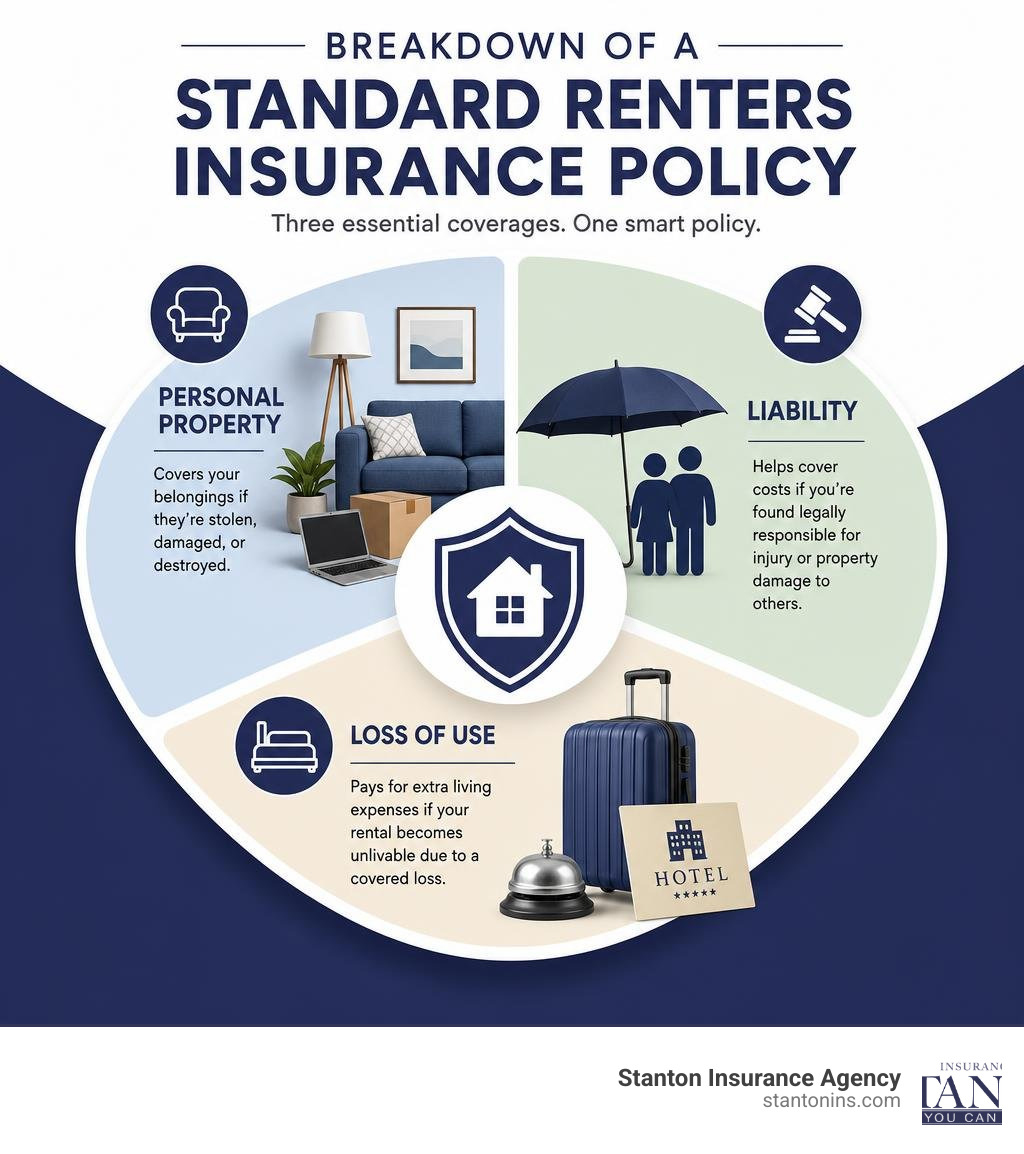
Most renters are surprised by how affordable this protection actually is. For roughly the price of a streaming subscription, a renters policy covers your personal belongings, shields you from liability, and pays for a hotel if your apartment becomes uninhabitable after a fire or burst pipe.
Yet many renters go without coverage entirely — often because they overestimate the cost, assume their landlord’s policy protects them, or simply haven’t gotten around to it. The truth is, your landlord’s insurance covers the building, not your stuff. One theft, fire, or water damage event can easily wipe out thousands of dollars in belongings.
I’m Geoff Stanton, President of Stanton Insurance Agency in Waltham, Massachusetts, and I’ve spent over two decades helping renters and families understand the true annual renters insurance cost and find coverage that actually fits their lives. In this guide, I’ll walk you through exactly what drives those numbers — and how to make sure you’re not overpaying.
Annual renters insurance cost word list:
Understanding the Average Annual Renters Insurance Cost
When you are planning your monthly or annual budget, renters insurance is one of the easiest expenses to justify. Unlike homeowners insurance, which must cover the physical structure of a house and can cost thousands of dollars annually, renters insurance only covers what is inside your walls—plus your personal liability. Because of this, the annual renters insurance cost is incredibly low.
Understanding what goes into this cost is key to making sure you do not pay a penny more than necessary. It helps to look at the regional differences and how insurers assess the risk of your specific rental property. To dive deeper into the basics of policy pricing, you can always check out our comprehensive Renters Insurance Cost Complete Guide.
National Averages for Annual Renters Insurance Cost
On a national level, renters insurance is remarkably consistent, though it does fluctuate depending on the data set you look at. According to the Average Cost of Renters Insurance in 2026, the national average sits around $182 per year (about $15 per month) for a basic policy with $20,000 in personal property coverage.
If you decide to bump your personal property coverage up to $30,000 and keep your liability protection at $100,000, the national average shifts to about $276 per year (roughly $23 per month). For most people, paying $15 to $23 a month is a drop in the bucket compared to the peace of mind it provides. If a pipe bursts or a fire breaks out, trying to replace $30,000 worth of clothes, electronics, and furniture out-of-pocket would be financially devastating.
Regional Differences: Massachusetts vs. New Hampshire
While national averages give us a great starting point, insurance is highly localized. Since we serve clients across Massachusetts and New Hampshire, we see how regional factors influence your final rate.
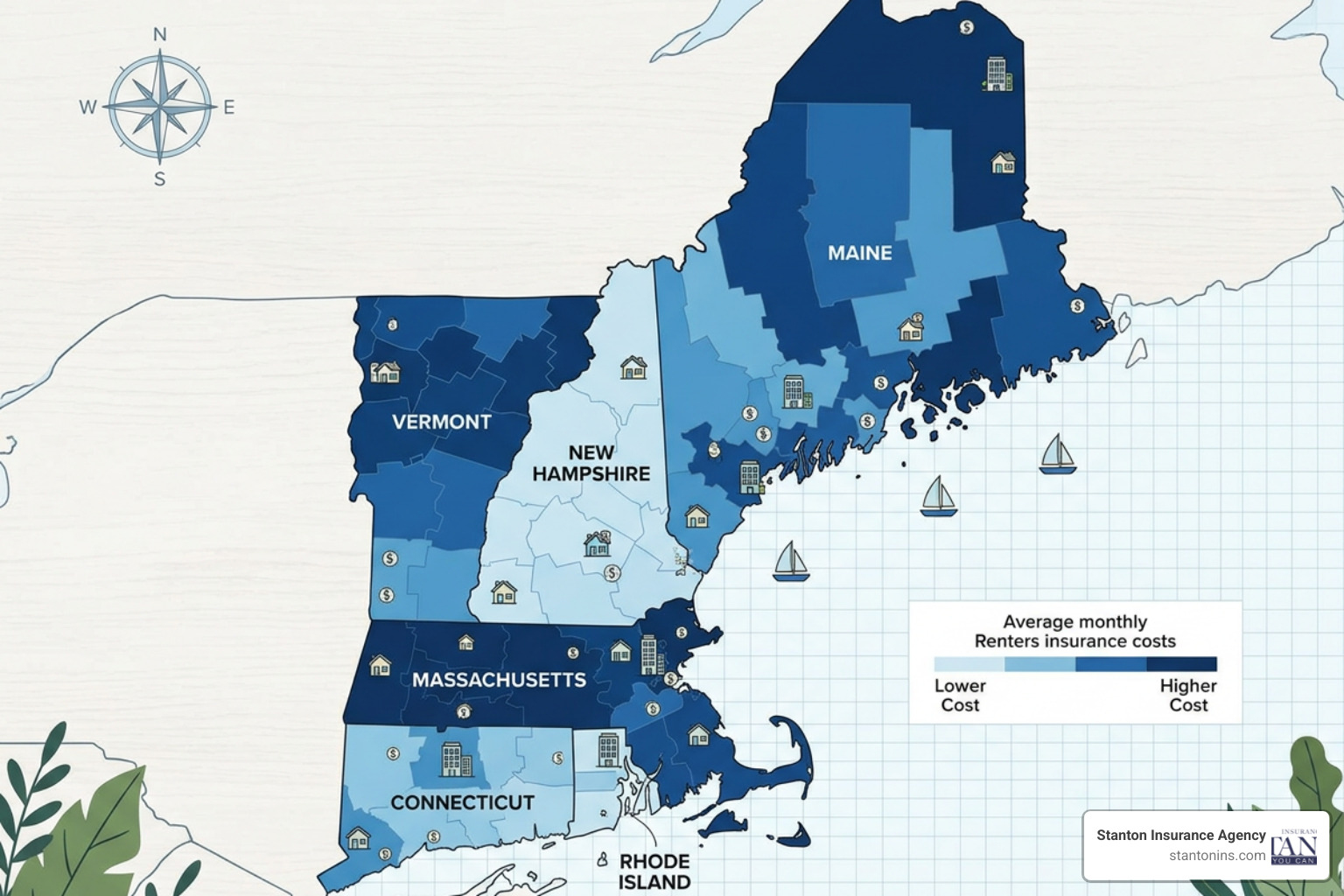
In Massachusetts, the average annual renters insurance cost sits around $177 to $216 per year (about $15 to $18 per month). This makes MA highly competitive and slightly below the standard national average. However, if you live in dense urban areas like Boston or Worcester, or near coastal regions vulnerable to Nor’easters, you might see slightly higher premiums due to increased risks of theft or storm-related water damage. For a detailed breakdown of local rates, check out our guide on How Much is Renters Insurance in Massachusetts? or read The Real Deal: What You’ll Pay for Renters Insurance in MA.
In New Hampshire, renters enjoy even lower rates. The Average renters insurance cost in New Hampshire hovers around $206 per year (roughly $17 per month). The state’s lower population density and lower urban crime rates keep premiums incredibly affordable. However, Granite Staters still need to watch out for harsh New England winters, which can bring heavy snow loads and frozen plumbing pipes.
Key Factors and How to Lower Your Premium
Insurers do not just pull a number out of a hat when calculating your premium. They look at a variety of personal and environmental risk factors. By understanding these pricing drivers, you can take active steps to lower what you pay. If you want to see exactly how these factors apply to your situation, you can get a quick estimate using Your Instant Renters Insurance Quote: No Waiting, Just Saving.
How Coverage Limits Impact Your Annual Renters Insurance Cost
The single biggest factor under your control is your coverage limit. Your policy is divided into different buckets of protection, and adjusting the limits of these buckets directly impacts your premium:
- Personal Property Coverage: This is the dollar limit of your belongings. Moving from a $20,000 limit to a $50,000 limit will increase your premium, but not as much as you might think. Usually, doubling your coverage only adds a few dollars to your monthly bill.
- Liability Protection: This covers legal and medical costs if someone is injured in your apartment or if you accidentally damage someone else’s property. The standard policy includes $100,000 in liability, but we almost always recommend bumping this to $300,000. Why? Because raising your liability limit usually costs less than $10 to $15 extra per year. You can read more about this in The 100k Renters Insurance Policy: Your Guide to Coverage and Requirements.
- Actual Cash Value (ACV) vs. Replacement Cost Value (RCV): An ACV policy pays out what your items are worth today, factoring in years of wear and tear (depreciation). An RCV policy pays out what it actually costs to buy those items brand new today. RCV costs about 10% to 11% more in premiums, but it is worth every penny when you actually have to file a claim. To understand how these choices impact your wallet, explore our article Unpacking Renters Insurance Costs: From Liability to Your Wallet.
Deductibles, Credit Scores, and Claims History
Beyond your coverage limits, three personal factors play a massive role in your annual rate:
- Your Deductible: This is the amount you pay out-of-pocket before your insurance kicks in. Standard deductibles are usually $500 or $1,000. Raising your deductible from $500 to $1,000 can lower your annual premium by 10% to 15%. However, you should only choose a higher deductible if you have that cash sitting in an emergency fund. For those considering other options, we have analyzed the pros and cons in No Deductible Renters Insurance: Is It Worth the Premium?.
- Your Credit Score: In New Hampshire, insurers are permitted to use your credit-based insurance score to help determine your premium. Renters with poor credit can pay significantly more than those with excellent credit. In Massachusetts, however, state regulations prohibit insurance companies from using your credit score to price your renters insurance policy.
- Your Claims History: If you have filed multiple renters insurance claims in the past three to five years, insurance companies will view you as a higher risk, which will drive up your premium. Keeping small claims off your record is a smart way to keep your rates low.
Smart Strategies to Reduce Your Yearly Premium
If you want to shave money off your premium without sacrificing coverage, here are the most effective strategies we recommend:
- Bundle Your Policies: This is the king of insurance discounts. By bundling your renters insurance with your auto policy, you can save anywhere from 10% to 25% on your premiums.
- Install Safety and Security Devices: Most insurers offer discounts of 5% to 15% if your rental has smoke detectors, deadbolts, fire extinguishers, or a security system.
- Pay in Full: If you can afford to pay your entire annual renters insurance cost upfront rather than in monthly installments, you will usually save on administrative fees.
- Go Paperless: Opting for electronic policy documents and automatic monthly payments often triggers a small discount.

What Renters Insurance Covers and Excludes
To truly understand the value of your annual premium, you need to know exactly what you are paying for. A standard renters policy is incredibly comprehensive, but it does have clear boundaries.
A typical policy includes four core coverages:
- Personal Property: Protection for your clothes, furniture, electronics, and kitchenware against “named perils” like fire, smoke, windstorms, theft, and vandalism.
- Personal Liability: Protection if a guest slips and falls in your kitchen and decides to sue you. It covers your legal defense fees and any settlements up to your policy limit.
- Medical Payments to Others: A smaller bucket of coverage (usually $1,000 to $5,000) that pays for a guest’s medical bills if they suffer a minor injury in your home, regardless of who was at fault.
- Loss of Use (Additional Living Expenses): If a fire makes your apartment unlivable, this covers the cost of a hotel, restaurant meals, and even extra commute costs while your home is being repaired.
According to How Much Is Renters Insurance? $23/mo Average (2026 Rates), it is vital to understand what standard policies exclude so you do not get caught off guard.
| Covered Perils (Standard Policy) | Excluded Perils (Requires Separate Coverage) |
|---|---|
| Fire and Smoke | Floods (Surface water or rising bodies of water) |
| Theft and Vandalism | Earthquakes and Earth Movement |
| Water Damage from Burst Pipes | Normal Wear and Tear / Maintenance Issues |
| Windstorms and Hail | Damage Caused by Pests (Bedbugs, Mice) |
| Explosions | Roommate’s Personal Belongings |
If you live in a flood-prone area of Massachusetts or New Hampshire, you will need to purchase a separate flood insurance policy, as standard renters insurance will not cover flood damage. Additionally, standard policies cap payouts for high-value items like jewelry, fine art, or high-end bicycles (often at $1,500). If you own expensive valuables, you can add a “scheduled personal property endorsement” to your policy to ensure they are fully covered.
Frequently Asked Questions About Renters Insurance Costs
Navigating insurance can bring up plenty of questions. Here are some of the most common queries we hear from tenants in Massachusetts and New Hampshire.
Is renters insurance required by law in Massachusetts or New Hampshire?
No, neither the Commonwealth of Massachusetts nor the State of New Hampshire has a law requiring tenants to carry renters insurance.
However, your landlord can legally require it as a condition of your lease agreement. Many property managers and private landlords in Waltham, Boston, Manchester, and Concord now require tenants to show proof of a renters policy with at least $100,000 in liability coverage before handing over the keys. According to the Rental Insurance – New Hampshire Insurance Department, this protects both you and the landlord from massive out-of-pocket expenses if an accident occurs.
How much does a standard $100,000 liability policy cost?
When landlords ask for a “$100,000 policy,” they are referring to the personal liability limit, not the personal property limit.
Because liability coverage is highly affordable for insurance companies to provide, a standard policy with $100,000 in liability and $20,000 to $30,000 in personal property coverage only costs about $15 to $20 per month (or roughly $180 to $240 per year). If you want to explore more about basic liability pricing, check out our guide on How Much is Renters Insurance?.
Does renters insurance cover roommates or pets?
Generally, renters insurance policies are designed for individuals or families.
- Roommates: Unless you are married or closely related, your standard policy will not cover your roommate’s belongings. While some insurers allow roommates to be listed on a single policy, we almost always advise against it. If your roommate files a claim, it goes on your insurance record and can raise your rates for years. It is much cleaner and safer for each roommate to buy their own affordable policy. You can read more about these logistics in the Average Renters Insurance Cost (Per Month & Per Year) FAQ | InsuraFAQ.
- Pets: Renters insurance does not cover your pet’s health bills, nor does it cover damage your pet does to your own belongings. However, the liability portion of your policy does cover you if your dog bites a guest inside your home or at a local park, subject to policy terms. That some insurance companies maintain breed restriction lists; if you own certain breeds, your liability coverage for dog bites might be excluded or require a special rider.
Conclusion
At the end of the day, paying an annual renters insurance cost of $150 to $250 is a small price to pay for the massive safety net it provides. Whether you are renting a historic multi-family home in Waltham, a modern loft in Boston, or a cozy apartment in Manchester, unexpected accidents can happen to anyone.
At Stanton Insurance Agency, we are proud to be a local, family-owned business that treats our New England neighbors like family. We do not believe in one-size-fits-all policies. Instead, we work with you to understand exactly what you own, what coverage you need, and how to maximize your discounts to keep your costs as low as possible.
Ready to protect your space and get the peace of mind you deserve? Get a Renters Insurance Quote from our team today, or give us a call to chat through your coverage options!