
Estimator Tools vs. Formal Quotes
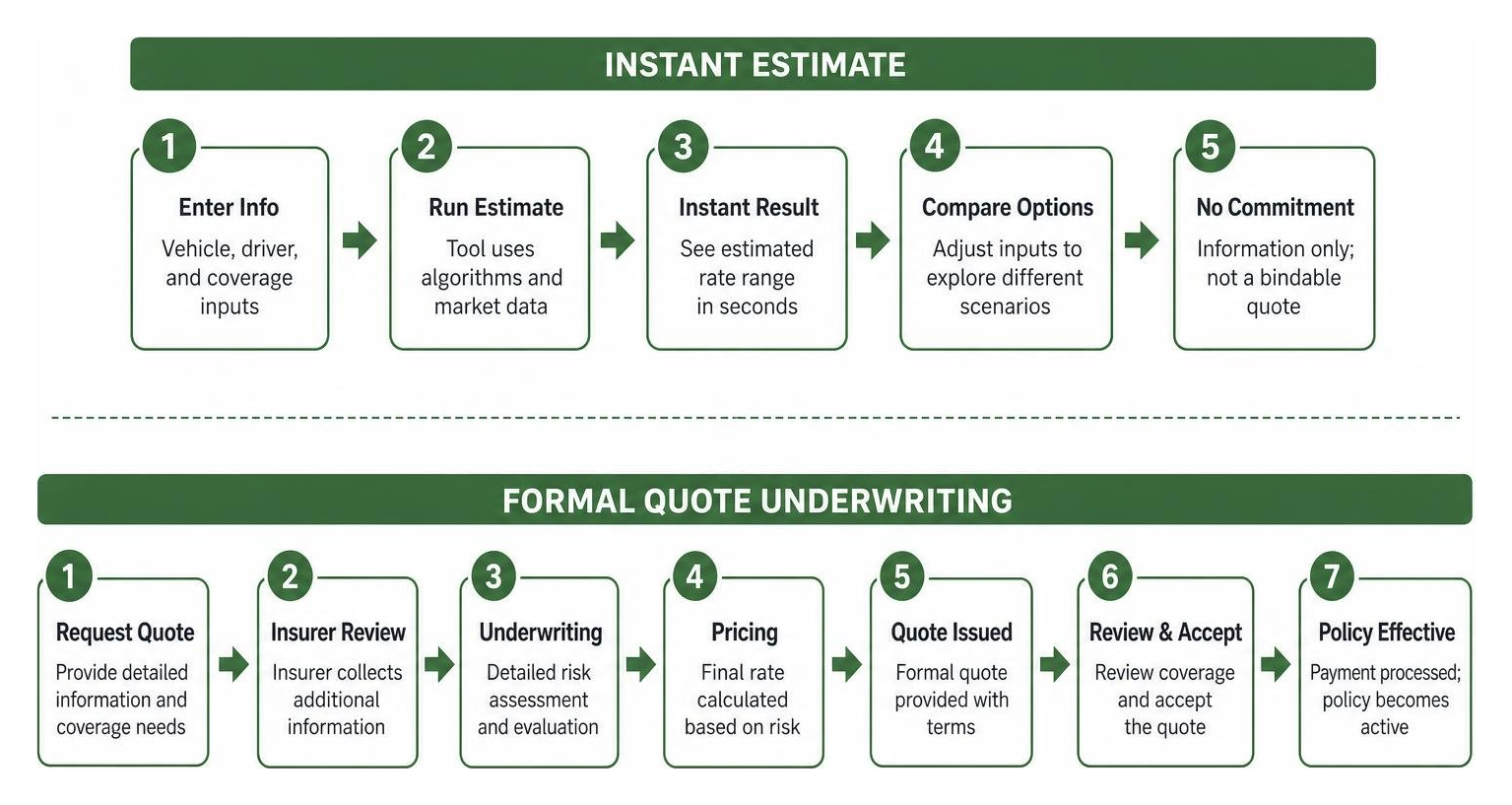
When you start shopping around for insurance, it is easy to confuse a quick online calculation with a bindable policy document. An online auto insurance estimate provides an initial ballpark figure, whereas an underwritten quote leads to a formal, legally binding agreement with an insurer. Most web-based tools perform a soft pull comparison that does not affect your credit score, allowing prospective policyholders across Massachusetts and New Hampshire to evaluate potential costs before committing.
Estimates rely primarily on self-reported data, such as your general driving history, annual estimated mileage, and vehicle details. In contrast, formal quotes require rigorous verification during the underwriting process, where insurance carriers pull official Motor Vehicle Records (MVR) and Comprehensive Loss Underwriting Exchange (C.L.U.E.) reports to confirm prior claims and driving infractions.
Vehicle owners can start with Stanton Insurance Agency’s internal resources to understand estimate ranges before requesting a personalized policy review. Understanding how these estimates are calculated makes learning how to estimate your car insurance price without losing your mind straightforward.
Online Tools for Quick Auto Insurance Estimates
Online estimator tools establish an instant rate baseline based on standard user inputs, such as vehicle details and driver demographic information. These algorithms run standard baseline equations—multiplying regional risk averages by factors like driver experience and coverage selections—to return realistic ballpark ranges within minutes. They provide an efficient starting point for prospective buyers who want to test multiple coverage tiers without committing to formal underwriting right away.
Prioritizing robust privacy protection ensures that your personal information remains secure while exploring coverage options. While many online platforms demand your phone number and email address up front, Stanton Insurance Agency’s educational guides can help you run through common cost scenarios before speaking with an agent. Reviewing resources like crunching numbers made easy with a car insurance estimate calculator makes estimate planning practical for everyday budgeting.
Key Factors That Determine Auto Insurance Estimates
Insurers evaluate several risk criteria to determine estimates, including driver experience, driving history, vehicle garaging location, annual mileage, coverage selections, and credit-based insurance information where state law allows it. Young and newly licensed operators often pay higher premiums because carriers associate limited driving experience with higher loss risk. In Massachusetts, auto insurers cannot use credit information from consumer reporting agencies for private passenger auto underwriting or rating. In New Hampshire, insurers may use insurance scores or consumer-report information in rating or underwriting when they follow state disclosure and exception rules.
| Risk Category | Rating Factor Details | Impact on Expected Premium |
|---|---|---|
| Age & Experience | Newly licensed drivers, youthful operators, and length of driving history | Less experience generally increases estimated premiums; established safe-driving history can improve pricing. |
| Driving History | Speeding tickets, at-fault accidents, moving violations, and claim history | A clean driving record helps maintain baseline pricing; recent violations can create multi-year surcharges. |
| Vehicle & Usage | Make, model, trim, safety features, garaging address, and estimated annual mileage | Higher repair costs, dense traffic areas, and higher mileage can raise estimates; qualifying safety features may reduce them. |
| Credit-Based Insurance Information | Allowed in NH under applicable rules; not allowed for MA private passenger auto rating or underwriting | Can affect tier placement where permitted; Massachusetts drivers should not see auto rates based on credit information. |
Explore detailed insights on pricing factors in our auto insurance cost complete guide.

Getting Accurate Auto Insurance Estimates Before Purchasing a Car
Requesting estimates before completing a vehicle purchase enables effective pre-purchase budgeting. A car loan payment is only part of your monthly outlay; insuring a higher-value sedan, sports car, or truck can alter your total monthly budget considerably. Evaluating insurance costs alongside loan terms ensures that you avoid unexpected ownership costs after leaving the dealership lot.
By providing a sample Vehicle Identification Number (VIN) from a dealer’s inventory listing, drivers receive precise auto insurance estimates reflecting exact safety features, trim levels, and engine specifications alongside estimated annual mileage. VIN decoding allows insurers to account for specialized anti-theft equipment and factory driver-assistance features that qualify for discounts. Knowing these numbers in advance helps clarify the real cost of driving whats the average monthly auto insurance.
Regional Rate Variations and State Benchmarks in Massachusetts and New Hampshire
Insurance costs fluctuate depending on local regulations, state insurance requirements, carrier filings, repair costs, and claim trends. National averages can be useful for broad budgeting, but they should not be treated as a guaranteed local price. For example, Experian reported an average U.S. full-coverage premium of $2,924 per year in June 2026 based on policies sold through its automotive insurance marketplace. Massachusetts and New Hampshire drivers should still compare local estimates because state rules, required coverages, vehicle garaging location, and carrier appetite can change the final number.
For local New England drivers, state-level rules play a major role:
- Massachusetts: Every vehicle operating in Massachusetts must be insured. State law also prohibits private passenger auto insurers from basing underwriting or rates on credit information, so pricing relies more heavily on driving record, vehicle risk, annual mileage, selected coverages, and territory-related factors.
- New Hampshire: Auto insurance is not required for every driver in every circumstance, but drivers must be able to meet state financial responsibility requirements if they cause an accident or are required to file proof of insurance. In practice, maintaining coverage is the safest way to protect against liability claims and satisfy lender or leasing requirements.
Drivers evaluating regional requirements can review massachusetts car insurance what you can expect to pay and examine the average cost of car insurance in ma for reliable financial benchmarks in New England.
Impact of Vehicle Types and Coverage Choices
A vehicle’s make and model directly influence specialized body repair costs and overall claim severity. Fixing complex bodywork, calibration sensors, or aluminum frame elements on a luxury vehicle costs far more than replacing standard panels on an entry-level commuter sedan. Modern vehicles equipped with Advanced Driver Assistance Systems (ADAS)—such as lane departure warnings, adaptive cruise control, and parking assist—may require calibration after certain repairs, which can increase claim costs.
Advanced safety feature discounts—such as automatic emergency braking, blind-spot monitoring, and anti-theft tracking systems—can reduce rates when a carrier recognizes those features in its rating plan. Conversely, choices surrounding collision coverage, comprehensive coverage, liability limits, and deductible selections dictate out-of-pocket exposure. Raising your deductible from $500 to $1,000 can lower your monthly premium, but it also requires maintaining sufficient savings in case you need to file a claim.
Balancing optimal policy limits with competitive pricing is central to driving a bargain finding your perfect full coverage price.
Electric Vehicles vs. Gas-Powered Vehicles
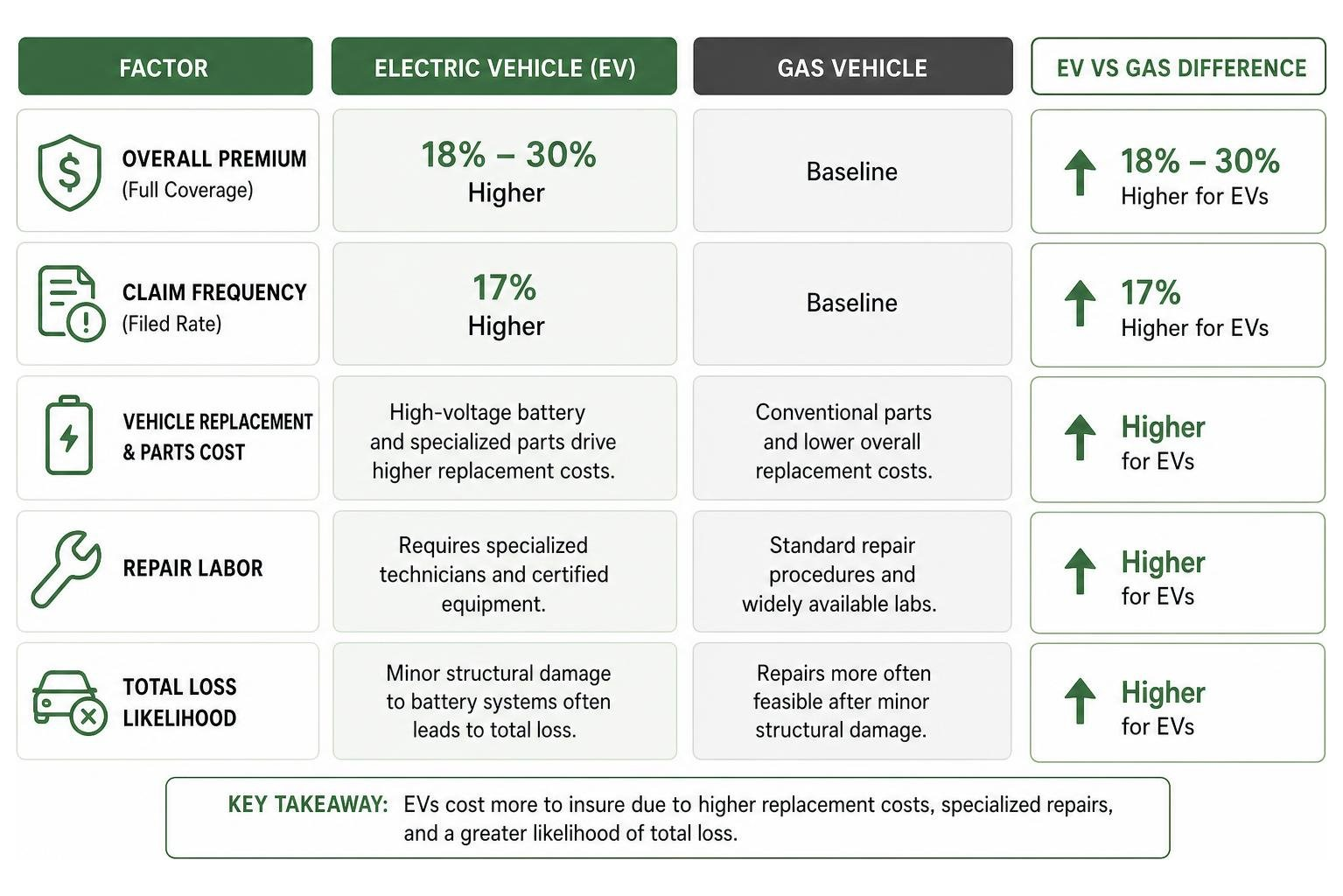
Electric vehicles can cost more to insure than comparable gas-powered vehicles because their battery systems, sensors, parts availability, and specialized repair procedures can increase claim severity. The exact difference varies by model, carrier, driver profile, garaging location, and coverage selections, so EV owners should compare estimates before buying rather than relying on a single national percentage.
Several factors can drive up EV insurance estimates:
- Higher Vehicle Replacement & Parts Cost: Advanced high-voltage battery banks represent a significant share of total vehicle value and can be expensive to repair or replace.
- Specialized Repair Labor: Servicing damaged electrical architectures requires high-voltage certified technicians and properly equipped repair facilities.
- Total Loss Risk After Battery Damage: Structural impacts that affect battery housing integrity may lead to higher claim severity or total loss decisions, depending on the model and damage.
Learn more about these vehicle trends in our overview of auto insurance costs.
Strategies to Lower Your Premium Rates
Drivers can reduce annual premiums through multi-policy bundling, safe driving programs, telematics participation, and annual payment discounts. Paying premiums annually rather than through monthly installment plans removes administrative processing fees and installment convenience charges. Furthermore, bundling auto policies with homeowners or renters coverage often yields substantial discounts across both policies.
| Coverage Type | Description | Primary Benefits | Premium Profile |
|---|---|---|---|
| Full Coverage | Comprehensive, collision, and liability protection | Minimal out-of-pocket loss, repair funding | Higher premium |
| State Minimum Liability | Meets state legal minimum requirements (MA/NH rules) | Basic legal compliance | Lower premium |
Applying practical strategies like 10 auto insurance cost hacks that save money and consulting the smart shoppers playbook finding the best car insurance deals online helps maximize savings.
Comparing Quotes Effectively
Achieving an accurate apples-to-apples comparison requires matching liability limits, aligning deductibles, and maintaining parity across optional coverage riders. If one estimate uses $50,000/$100,000 bodily injury limits with a $1,000 deductible, and another uses $250,000/$500,000 limits with a $500 deductible, the pricing comparison will be misleading and fail to reflect true value.
Evaluating carrier options allows drivers to compare car insurance quotes from 120 plus top insurers today.
Frequently Asked Questions About Car Insurance Rates
How far in advance can I get an estimate before buying a vehicle?
You can request an estimate weeks in advance of purchasing a vehicle by providing sample vehicle VINs from dealer inventory listings. This allows you to plan your monthly budget, negotiate vehicle purchase terms with full visibility into ownership costs, and ensure smooth coverage activation before driving off the lot in Massachusetts or New Hampshire.
Why are electric vehicles more expensive to insure than traditional cars?
Electric vehicles can be more expensive to insure because of complex sensor arrays, high-voltage battery modules, parts costs, and specialized repair labor. The difference is not identical for every EV, so compare estimates for the exact year, make, model, trim, and garaging address before buying.
How does credit score affect my estimated car insurance premium in Massachusetts and New Hampshire?
Credit score impact varies by state regulation. In Massachusetts, private passenger auto insurers cannot use credit information from consumer reporting agencies for rating or underwriting. In New Hampshire, insurers may use insurance scores or consumer-report information when they comply with state insurance rules, disclosures, and exceptions.
Conclusion
Securing trusted protection for your vehicle requires an attentive policy review and customized guidance. Stanton Insurance Agency offers tailored auto insurance solutions designed to safeguard valuable assets for drivers throughout Massachusetts and New Hampshire. Whether you are comparing initial estimates or seeking a comprehensive policy review, our experienced team ensures you find the right coverage balance at competitive regional rates.