What Massachusetts Drivers Need to Know About SR-22 Insurance
If you’ve been asked to file SR-22 insurance in Massachusetts, here’s the short answer:
Massachusetts does not require SR-22 certificates for in-state violations. But if you were suspended in another state, you may still need one — and getting it isn’t straightforward.
| Question | Quick Answer |
|---|---|
| Does MA require SR-22 for local violations? | No — MA uses compulsory liability insurance laws instead |
| When would a MA driver need an SR-22? | Only when required by another state after an out-of-state violation |
| How long must an SR-22 be maintained? | Typically 3 years of continuous coverage |
| Lowest SR-22 cost in MA? | Starts around ~$108/month for minimum coverage |
| Average SR-22 cost in MA? | ~$171/month for liability-only coverage |
| What if you don’t own a car? | A non-owner SR-22 policy can still satisfy the requirement |
Most Massachusetts drivers never deal with SR-22 filings. The state tracks financial responsibility through its own compulsory insurance laws — not SR-22 certificates. But the moment an out-of-state violation enters the picture, the rules change fast.
A common real-world scenario: a Massachusetts driver gets a DUI in New Hampshire, Vermont, or Rhode Island. That state suspends their driving privileges and demands an SR-22 before reinstating them. The Massachusetts RMV then mirrors that suspension under interstate reciprocity — and suddenly, you’re stuck in a legal catch-22. Insurers won’t issue a policy to a suspended driver. But you can’t get unsuspended without the insurance.
There’s a way through it — but it takes knowing the right steps.
I’m Geoff Stanton, President of Stanton Insurance Agency in Waltham, Massachusetts, and I’ve spent over two decades helping Massachusetts drivers navigate complex auto insurance situations — including SR-22 insurance in Massachusetts and out-of-state reinstatement challenges. Let’s walk through exactly how this works and what your options are.
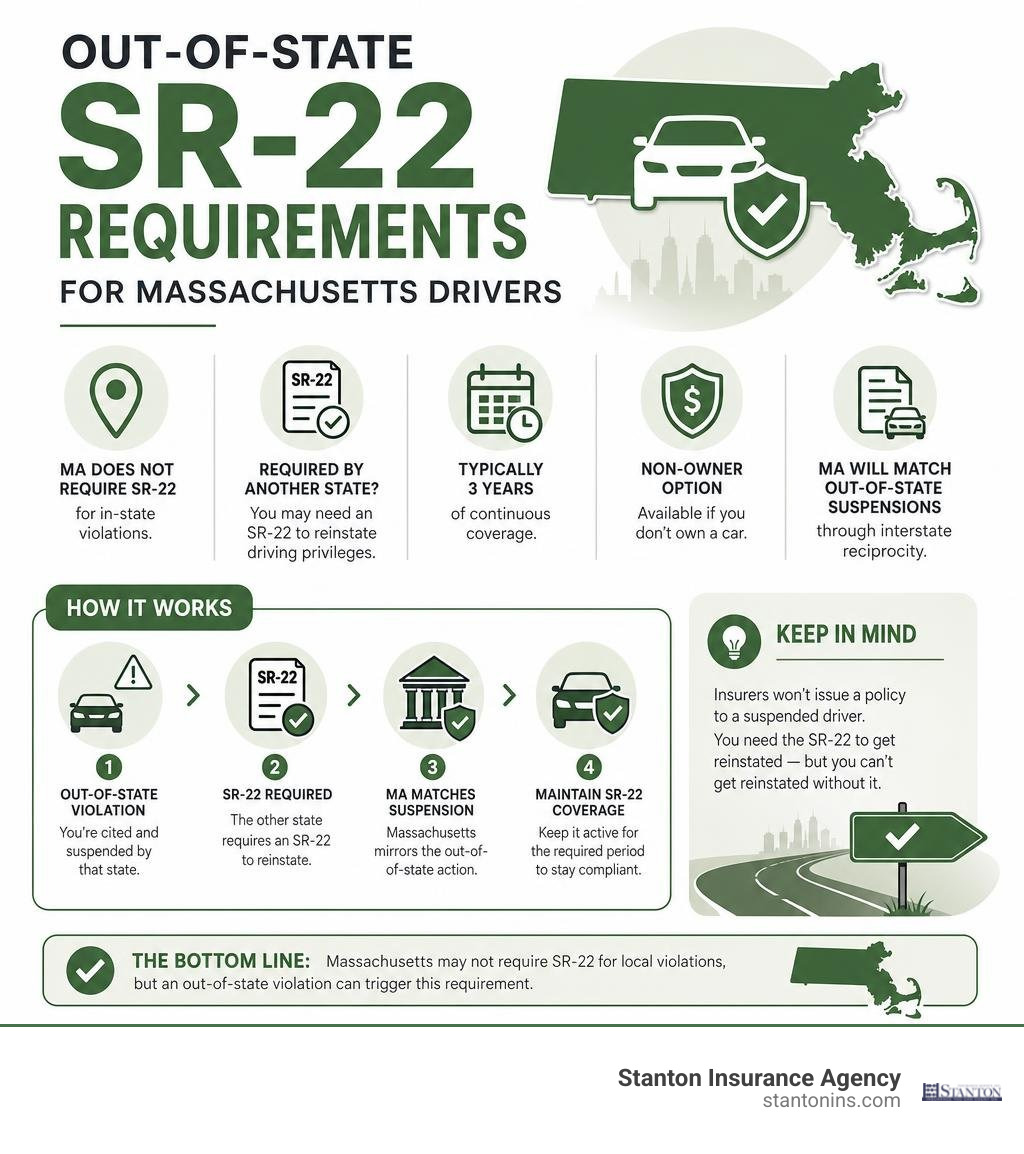
SR-22 insurance Massachusetts word guide:
What Is an SR-22 Certificate and Does Massachusetts Require It?
First, let’s clear up a massive misconception: an SR-22 is not actually auto insurance. It is an official certificate of financial responsibility issued by an insurance company directly to a state’s motor vehicle department (DMV or RMV). The certificate serves as legal verification that you carry an active auto policy meeting or exceeding the minimum liability limits required by law.
In most states, when a driver commits a major offense—such as driving under the influence (DUI/OUI), driving without insurance, or accumulating excessive surchargeable points—the court or licensing authority mandates an SR-22 filing to track their driver status continuously.
However, the Commonwealth of Massachusetts is different.
Massachusetts does not issue or require SR-22 certificates for driving infractions committed within its own borders. Even when applying for a hardship license or facing an in-state license suspension, the Massachusetts Registry of Motor Vehicles (RMV) does not ask for an SR-22.
Why? Because Massachusetts operates under strict compulsory insurance laws. Every motor vehicle registered in the state must maintain continuous coverage, and insurance companies directly notify the MA RMV via real-time electronic databases whenever a policy is initiated, modified, or cancelled. Because the RMV tracks financial responsibility internally for all resident drivers, a separate certificate like the SR-22 is legally redundant within the state.
To learn more about baseline policy requirements, check the official Massachusetts motor vehicle coverage standards or read our comprehensive guide on understanding Massachusetts insurance requirements.
Who Needs SR-22 Insurance Massachusetts Policies?
If Massachusetts does not require SR-22 filings natively, why do thousands of Bay State residents find themselves searching for SR-22 insurance in Massachusetts every year?
The answer comes down to interstate driver reciprocity and out-of-state violations.
You will need an SR-22 while residing in Massachusetts if you fall into one of these specific situations:
- Out-of-State Traffic Convictions: You hold a Massachusetts driver’s license, but you were cited or convicted for an offense like an OUI/DUI, reckless driving, or driving uninsured in another state (such as New Hampshire, Vermont, New York, or Maine) that requires an SR-22 filing for reinstatement.
- Prior Residency in an SR-22 State: You recently moved to Massachusetts from a state where you were under an active SR-22 filing order. Until your legal obligation to that former state expires, you must keep an active SR-22 on file with their DMV—even while living and driving in Massachusetts.
- National Driver Register Flags: An out-of-state suspension causes your national driver eligibility status to register as “Not Eligible.” The MA RMV will honor that suspension and refuse local license renewal until the foreign state’s SR-22 mandate is fully satisfied.
When you’re classified as a high-risk motorist across state lines, navigating the complex rules can feel overwhelming. Take a moment to review our strategy for handling high-risk driver coverage to learn how to keep your premiums manageable.
SR-22 vs FR-44 and SR-44 Form Differences
Depending on where your violation took place, you may hear terms like SR-22, FR-44, or SR-44 thrown around. While they all function as administrative proof of coverage, their insurance threshold requirements vary substantially:
- SR-22 Form: The standard Certificate of Financial Responsibility used by the majority of U.S. states. It requires you to maintain your state’s standard minimum liability insurance limits.
- FR-44 Form: Used primarily in states like Florida and Virginia, an FR-44 is required specifically after severe alcohol or drug-related driving convictions. It mandates significantly higher liability limits—often double or triple the state’s standard statutory minimums (e.g., $100,000/$300,000/$50,000).
- SR-44 Form: Used in select jurisdictions as an alternate high-limit compliance certificate specifically for repeat DUI offenders. Like the FR-44, it demands elevated coverage limits well above baseline standards.
If an out-of-state court demands an FR-44 or SR-44 rather than a standard SR-22, your auto policy in Massachusetts must be endorsed with limits that satisfy that foreign jurisdiction’s heightened financial responsibility standards.
How Out-of-State DUIs, AAMVA Withdrawals, and RMV Reinstatements Work
When a Massachusetts resident receives an OUI/DUI or severe citation in another state, an administrative chain reaction begins immediately under interstate legal agreements like the Driver License Compact.

Here is how an out-of-state citation impacts your local driving status:
- Out-of-State Suspension: The foreign state (for example, New Hampshire) suspends your driving privilege within its borders and orders an SR-22 filing as a prerequisite for reinstatement.
- National Reporting: The foreign state logs your status as “Suspended” or “Not Eligible” in the National Driver Register (NDR) and the State Director System.
- RMV Reciprocal Action: The Massachusetts RMV receives notification of the out-of-state offense. By law, the RMV suspends your Massachusetts driver’s license until you clear the originating suspension.
- Administrative Catch-22: You call an insurance company to buy a policy so they can send an SR-22 to the foreign state. However, many standard auto insurance carriers refuse to write a policy for a driver with an actively suspended license. Simultaneously, the foreign state refuses to reinstate your driving rights until the SR-22 is submitted.
If your violation occurred nearby, you can review specific New Hampshire SR-22 requirements to understand what that neighboring state expects.
Navigating AAMVA Withdrawals and 30-Day Temporary Reinstatements
To break this classic administrative stalemate, the Massachusetts RMV utilizes a specialized procedural mechanism known as a 30-day temporary reinstatement.
When an out-of-state suspension triggers an AAMVA Withdrawal (an automatic system revocation managed via the American Association of Motor Vehicle Administrators network), you cannot simply order insurance online. You must request an administrative hearing with an RMV Hearing Officer.
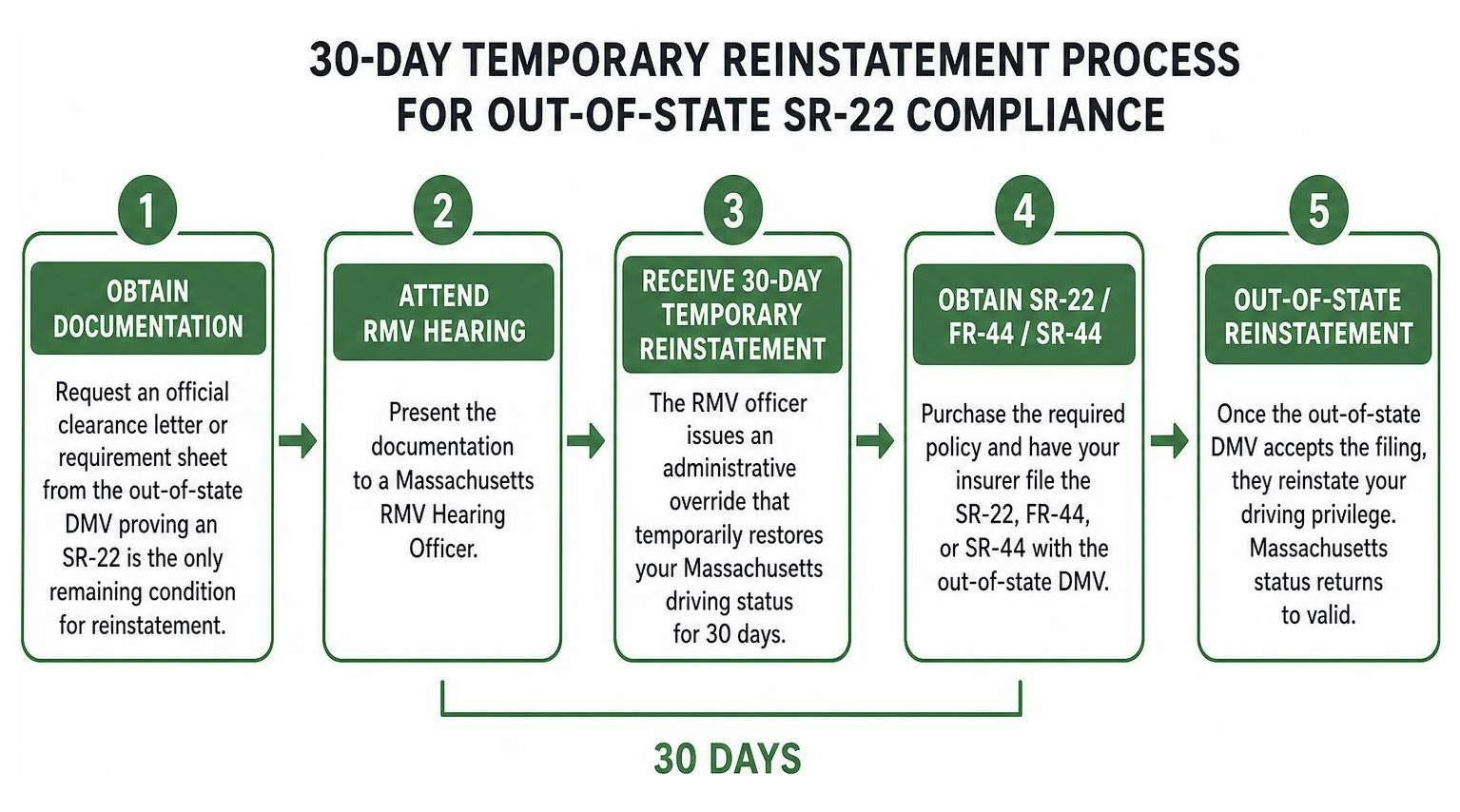
The step-by-step resolution process works like this:
- Step 1: Obtain Documentation. Request an official clearance letter or requirement sheet from the out-of-state DMV proving that an SR-22 filing is the only remaining condition preventing your license reinstatement.
- Step 2: Attend an RMV Hearing. Present this documentation to a Massachusetts RMV Hearing Officer.
- Step 3: Secure a 30-Day Temporary Reinstatement. The RMV officer issue an administrative override that temporarily restores your Massachusetts driving status for 30 days.
- Step 4: Purchase Insurance with SR-22 Endorsement. With your status temporarily marked valid, an authorized Massachusetts insurance agency can bind your policy and issue the out-of-state SR-22 certificate.
- Step 5: Final Out-of-State Clearance. The foreign DMV receives the SR-22 filing, lifts your suspension, and issues a full Notice of Restoration. You submit this final proof to the MA RMV to permanently clear your file and pay the standard $100 RMV license reinstatement fee.
Ignition Interlock Devices and Repeat Offenders
For drivers facing multiple OUI/DUI convictions across state lines, financial responsibility filings are only one part of the restoration equation. Massachusetts enforces Melanie’s Law, which mandates the installation of an Ignition Interlock Device (IID) for repeat offenders.
If you are applying for a hardship license or full license reinstatement following two or more OUI convictions (regardless of whether those convictions happened in Massachusetts or another state):
- You must have an approved IID installed in any vehicle you own, lease, or operate at your own expense.
- The device requires a clean breath sample (Blood Alcohol Concentration below 0.02%) before the engine will start, alongside periodic rolling retests.
- You must maintain the IID for a mandatory restriction period (typically two years minimum, or lifetime for subsequent offenses).
- Removing or tampering with the device, or failing multiple breath tests, triggers immediate license revocation and potential felony charges.
Understanding SR-22 Insurance Massachusetts Costs and Mandatory Coverage Limits
Carrying high-risk auto coverage or filing an out-of-state SR-22 increases your monthly insurance expenses. On average, maintaining SR-22 insurance in Massachusetts costs approximately $171 per month ($2,052 annually) for a liability-only policy, while full coverage policies for high-risk profiles average $398 per month ($4,778 annually).
Generally, the physical SR-22 filing fee itself is tiny—usually a one-time administrative charge between $15 and $50. The primary driver of the overall cost is the high-risk premium surcharge resulting from the underlying driving violation (such as an OUI, reckless driving, or severe speeding ticket). A major violation typically increases base insurance premiums by 20% to 50% or more.
It is also vital to understand Massachusetts’ mandatory minimum coverage requirements. Effective July 1, 2025, Chapter 275 of the Acts of 2024 officially raised compulsory coverage limits across the Commonwealth:
| Coverage Type | Old MA Statutory Minimum | New MA Statutory Minimum (Effective July 1, 2025) | Typical Out-of-State SR-22 Requirement |
|---|---|---|---|
| Bodily Injury to Others (Per Person) | $20,000 | $25,000 | $25,000 – $50,000+ |
| Bodily Injury to Others (Per Accident) | $40,000 | $50,000 | $50,000 – $100,000+ |
| Damage to Someone Else’s Property | $5,000 | $30,000 | $10,000 – $25,000+ |
| Personal Injury Protection (PIP) | $8,000 per person | $8,000 per person | N/A (No-Fault state specific) |
| Uninsured Motorist Coverage | $20,000 / $40,000 | $25,000 / $50,000 | Varies by state |
Because Massachusetts’ new minimum property damage requirement ($30,000) exceeds many other states’ baselines, a standard Massachusetts policy will easily meet out-of-state property damage thresholds. However, you must always confirm that your policy’s bodily injury limits equal or exceed whatever the foreign state requires.
For a deeper dive into statutory policy requirements, explore our detailed breakdown on Massachusetts minimum car insurance coverage rules.
How to Obtain SR-22 Insurance Massachusetts Coverage with a Suspended License
When standard market insurers turn you down due to a suspended driver’s license or severe violation history, you still have viable routes to secure legally valid coverage:
- Work with an Independent Local Insurance Agency: Independent agencies (like Stanton Insurance Agency) represent multiple insurance carriers. We know precisely which insurance companies possess the technical capability to issue cross-border SR-22 filings directly to foreign state DMVs.
- Utilize the Massachusetts Automobile Insurance Plan (MAIP): If you are denied coverage in the standard voluntary market, state law guarantees access to insurance through MAIP. MAIP assigns high-risk drivers to licensed Massachusetts auto insurers on a rotating quota system, ensuring every driver can obtain mandatory coverage.
- Pay the Administrative Endorsement Fee: Once your policy is bound, your agent requests the SR-22 endorsement. The insurer submits the form electronically or via certified mail to the appropriate state DMV, charging a nominal $15–$50 fee.
If your premium increases significantly after a violation or point assessment, check out our practical tips on appealing driving surcharges to see if you can lower your state surcharge tier.
Non-Owner SR-22 Insurance for Drivers Without a Car
What if an out-of-state court demands an SR-22 to restore your driving privileges, but you do not own a motor vehicle?
The solution is a Non-Owner SR-22 Auto Insurance Policy.
A non-owner policy provides bodily injury and property damage liability protection for you when driving vehicles owned by others (such as rentals or borrowed cars). Because a non-owner policy does not cover comprehensive or collision damage for a specific vehicle, it is significantly cheaper than a standard auto policy—often costing 30% to 50% less.
Key features of Non-Owner SR-22 Insurance include:
- Fulfills all legal financial responsibility requirements for out-of-state license reinstatement.
- Attached to you as an individual driver, rather than a specific automobile registration.
- Excludes coverage for vehicles owned by members of your immediate household or cars provided for your regular, everyday use.
Maintaining Your SR-22 Filing: Duration and Consequences of Lapses
Securing your initial SR-22 certificate is only the first step—maintaining uninterrupted coverage is what keeps your driving record clear.
In almost all jurisdictions, you are required to maintain an active SR-22 continuously for three consecutive years (36 months), though some states mandate up to five years for repeat offenses.
If you live in Massachusetts but carry an out-of-state SR-22 requirement, compare your obligations with neighboring regional laws by reviewing these SR-22 insurance guidelines in neighboring states.
The Severe Risks of Policy Lapses
Maintaining continuous coverage without a single day of interruption is vital. If your auto insurance policy cancels, lapses due to late payment, or non-renews during your mandated period, your insurer is legally required to immediately file an SR-26 form with the foreign state DMV. The SR-26 officially notifies the state that your financial responsibility filing has been terminated.
Here is what happens immediately after an SR-26 is filed:
- Automatic License Re-Suspension: The foreign state revokes your driving privileges instantly.
- Reciprocal Local Suspension: The MA RMV receives NDR notification and re-suspends your Massachusetts driver’s license.
- The Penalty Clock Resets: In most states, a coverage lapse resets your mandatory timeframe back to day one. A lapse at month 35 means starting your 3-year requirement all over again.
- New Reinstatement Fees: You will owe additional administrative reinstatement fees to both the out-of-state DMV and the Massachusetts RMV ($100).
- Higher Insurance Rates: Insurance companies view policy lapses as a major risk factor, leading to elevated premiums when you attempt to re-establish coverage.
Frequently Asked Questions about SR-22 Insurance in Massachusetts
Does Massachusetts require an SR-22 for in-state driving violations?
No. Massachusetts does not require SR-22 filings for driving infractions, OUIs, or license reinstatements that occur within Massachusetts under state jurisdiction. Instead, Massachusetts enforces financial responsibility through its compulsory auto insurance system. The MA RMV tracks coverage electronically via direct insurance company databases. You will only need an SR-22 if another state demands it following an out-of-state traffic violation or license suspension.
How much does SR-22 insurance cost on average in Massachusetts?
While the administrative fee to file an SR-22 form is only $15 to $50, the auto insurance policy itself averages $171 per month ($2,052 per year) for minimum liability coverage and up to $398 per month ($4,778 per year) for full coverage. Pricing depends heavily on your driving record, age, zip code, and the severity of the underlying driving violation.
What happens if my SR-22 policy lapses before the required timeframe?
If your policy lapses or cancels, your insurance carrier will automatically issue an SR-26 cancellation form to the state licensing authority. That state will immediately re-suspend your driving privileges, trigger a reciprocal suspension with the Massachusetts RMV, and reset your required 3-year compliance timer back to the beginning.
Conclusion
Navigating cross-border driver suspensions, National Driver Register holds, and SR-22 insurance in Massachusetts can feel like dealing with an endless administrative maze. But keeping your driving privilege intact doesn’t have to be overwhelming when you have the right local guidance.
To recap the crucial steps:
- Verify whether your SR-22 requirement originates from an out-of-state authority.
- If suspended, work with the MA RMV to obtain a 30-day temporary reinstatement so you can legally bind auto coverage.
- Partner with an experienced local insurance agency capable of electronically issuing cross-border SR-22 certificates.
- Maintain 100% continuous coverage for the entire mandatory period (typically 3 years) to prevent penalty clock resets.
At Stanton Insurance Agency, we specialize in helping Massachusetts and New Hampshire drivers resolve complex coverage issues and restore their peace of mind behind the wheel. Contact our expert team today to explore tailored auto insurance options that keep you legal, protected, and moving forward.