Understanding Your Auto Insurance Cost in 2026
Sticker shock at your latest car insurance bill? You’re not alone. Auto insurance rates have been climbing across the country, and many drivers are feeling the pinch.
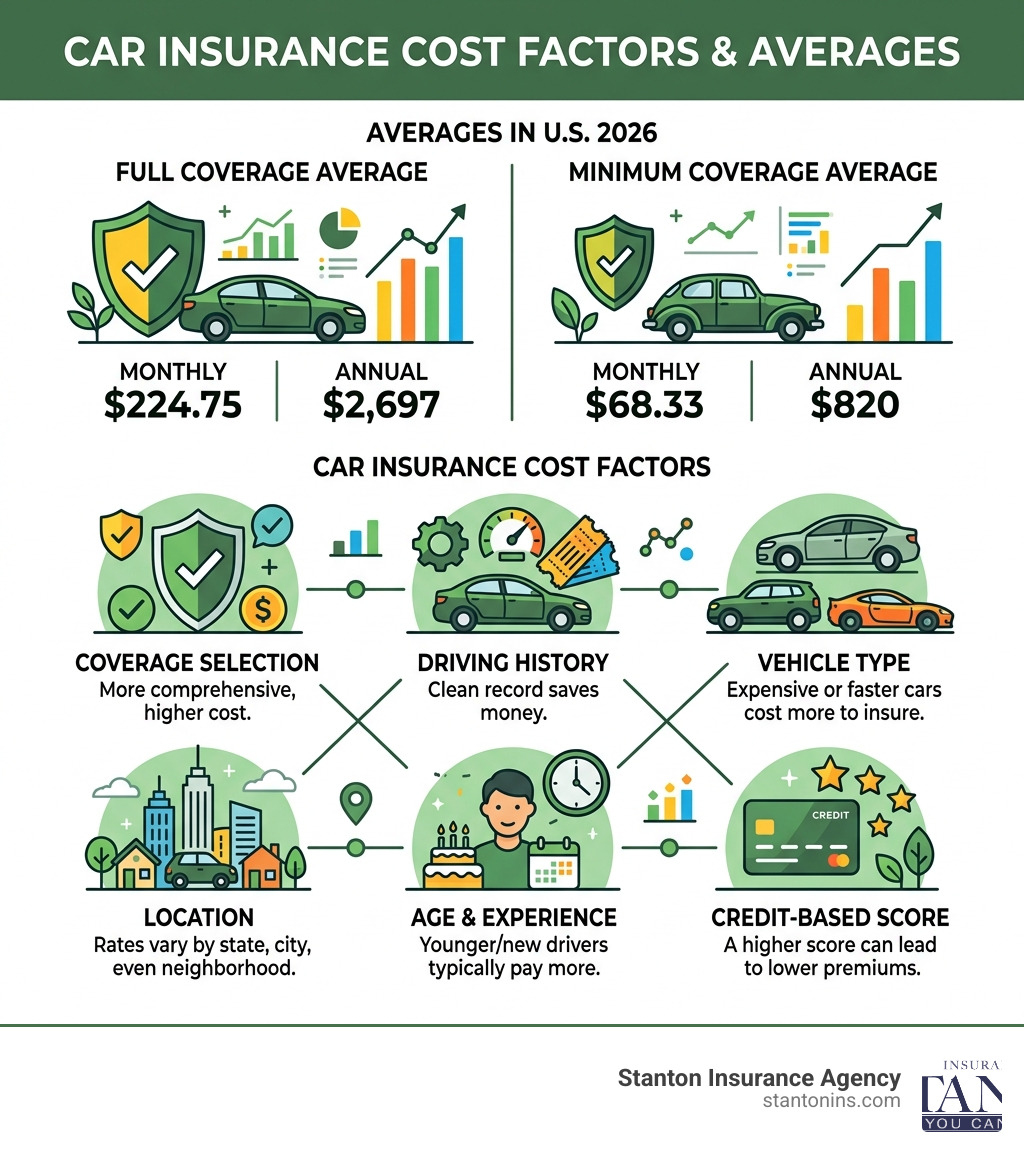
As of April 2026, the average Auto Insurance Cost in the U.S. can range quite a bit depending on your coverage needs:
- Full Coverage:
- Average Monthly Cost: $225
- Average Annual Cost: $2,697
- Minimum Coverage:
- Average Monthly Cost: $68
- Average Annual Cost: $820
These averages give you a starting point. But your actual premium depends on many things. Understanding these costs and what affects them is key to finding savings.
I’m Geoff Stanton, President at Stanton Insurance Agency in Waltham, Massachusetts. With decades of experience, I specialize in helping individuals and families navigate their Auto Insurance Cost to protect their vehicles and assets without overpaying. We’ll explore ten smart hacks to help you save money on your car insurance.
Auto Insurance Cost helpful reading:
Understanding the Average Auto Insurance Cost in 2026
To effectively lower your premiums, we first need to look at the current landscape. According to recent industry data, the national average for a full coverage policy has reached $2,697 annually. This represents a significant 12% rate increase from just a year ago.
Why is this happening? It isn’t just one factor; it’s a “perfect storm” of economic pressures. Inflation has driven up the price of raw materials, which in turn makes vehicle parts more expensive. Modern cars are also packed with complex technology—sensors, cameras, and specialized glass—that cost significantly more to fix after a minor fender bender. Furthermore, claim severity has risen; accidents are resulting in higher medical costs and more expensive vehicle total-loss payouts.
At Stanton Insurance Agency, we monitor these Auto Insurance Costs closely to ensure our clients in Massachusetts and New Hampshire aren’t being unfairly penalized by national trends that might not apply to their specific driving profile.
National Averages for Full vs. Minimum Coverage Auto Insurance Cost
When discussing Auto Insurance Cost, the distinction between “full” and “minimum” coverage is the biggest price driver.
- Full Coverage ($225 monthly): This typically includes liability, plus comprehensive and collision coverage. Collision pays for damage to your car after an accident, while comprehensive covers non-collision events like theft, fire, or falling branches. Most drivers with a loan or lease are required to carry this.
- Minimum Coverage ($68 monthly): This consists only of the state-mandated liability limits. While it is the cheapest way to stay legal, it provides no protection for your own vehicle. If you cause an accident, you are on the hook for your own repairs.
Deciding between the two requires a balance of risk. For a deep dive into whether “liability only” is right for your older vehicle, check out our Liability Only Insurance Cost Guide.
Regional Variations: Massachusetts and New Hampshire Auto Insurance Cost
Geography is one of the most powerful factors in determining your premium. Even within the New England area, moving across a state line can drastically change what you pay.
| State | Avg. Monthly Full Coverage | Avg. Monthly Minimum Coverage |
|---|---|---|
| Massachusetts | $209 | $67 |
| New Hampshire | $181 | $58 |
| National Average | $225 | $68 |
As you can see, both Massachusetts and New Hampshire currently enjoy rates below the national average. Massachusetts drivers benefit from strict regulations and a ban on using credit scores to set rates. Meanwhile, New Hampshire—the “Live Free or Die” state—has some of the lowest rates in the country due to lower population density and lower litigation rates.
However, as the official Mass.gov site reminds us, it always pays to shop around. Rates in Boston or Manchester will differ significantly from rates in the Berkshires or the White Mountains. You can find more specific data in our guides for Car Insurance Rates Massachusetts and Auto Insurance Rates In New Hampshire.
10 Hacks to Slash Your Premiums

Now that we understand the baseline, let’s get into the actionable “hacks” that can bring those numbers down. Many of these strategies are underutilized by the average driver.
1. Bundle Your Policies
This is the “Old Faithful” of insurance savings. By placing your auto and homeowners (or renters) insurance with the same carrier, you can often save between 10% and 25% across both policies. It also simplifies your life by giving you one point of contact.
2. Opt for Higher Deductibles
Your deductible is the amount you pay out-of-pocket before insurance kicks in. By raising your collision and comprehensive deductibles from $500 to $1,000, you can lower your monthly premium by a significant margin. Just ensure you have that $1,000 tucked away in an emergency fund.
3. Pay Your Premium Annually
Most insurers charge a “convenience fee” for monthly installments. If you can afford to pay the full six-month or twelve-month premium upfront, you’ll usually see a “pay-in-full” discount and avoid those monthly administrative fees.
4. Improve Your Credit-Based Insurance Score
In New Hampshire, insurers use a credit-based insurance score to predict risk. Drivers with poor credit can pay nearly 76% more than those with excellent credit. Note: If you are in Massachusetts, this hack doesn’t apply, as the state prohibits the use of credit scores in auto insurance pricing.
5. Take a Defensive Driving Course
Many carriers offer a discount (often around 5% to 10%) for drivers who complete an approved accident prevention or defensive driving course. This is especially helpful for teen drivers and seniors looking to offset age-related rate hikes.
6. Inquire About Low Mileage Discounts
Since the shift toward remote work, many people are driving far less than the standard 12,000 miles per year. If you drive less than 7,500 miles annually, let us know. You may qualify for a low-mileage discount or a usage-based insurance program.
7. Leverage Safety and Anti-Theft Features
Does your car have automatic emergency braking, lane departure warnings, or a high-tech anti-theft system? These features reduce the likelihood of a claim, and insurers often reward that with lower rates.
8. Maintain Continuous Coverage
Insurance companies view a “lapse” in coverage as a major red flag. Even if you don’t currently own a car, maintaining a “non-owner” policy can keep your insurance history intact, ensuring you get the best rates when you buy your next vehicle.
9. Increase Your Shopping Frequency
We recommend reviewing your coverage every 12 months or after major life events (marriage, moving, buying a home). Carrier algorithms change constantly; the company that was cheapest for you last year might not be the most competitive this year.
10. Choose Your Vehicle Wisely
Before you sign the papers on that new car, get a quote. A high-performance sports car or an expensive electric vehicle (EV) will always cost more to insure than a standard sedan or a minivan. For more on this, see our Average Liability Auto Insurance Cost Guide.
How Driving Records and Demographics Impact Pricing

While hacks are great, your personal profile remains the foundation of your Auto Insurance Cost. Insurers are essentially professional “risk guessers,” and they use your past behavior to predict your future claims.
The Financial Toll of a Poor Driving Record
Your driving record is the single most important factor you can control. A single mistake behind the wheel can haunt your wallet for three to five years.
- DUI Conviction: This is the most expensive violation. On average, a DUI increases full coverage premiums by 96% nationally.
- At-Fault Accidents: A single at-fault accident typically results in a 43% increase in premiums.
- Speeding Tickets: Even a minor “need for speed” can increase your rates by an average of 22%.
Maintaining a clean record is the most effective long-term strategy for low-cost insurance. If you’ve had a recent incident, we can help you find carriers that are more “forgiving” than others. Learn more in our Liability Car Insurance Cost Guide.
Age and Credit Score: The Hidden Cost Drivers
Demographics often feel unfair because you can’t change your age. However, understanding these brackets helps with budgeting.
- Teens (Age 16): These drivers are the most expensive to insure, with an average annual cost of $5,740 for full coverage. This is due to a statistical lack of experience and higher accident frequency.
- Adults (Age 40): This is often the “sweet spot” for insurance, with rates averaging $2,697.
- Seniors (Age 70+): Rates tend to stay low but may begin to creep up again as insurers account for slower reflex times.
Regarding credit scores, the impact is massive in states where it is allowed. A driver with poor credit might pay $3,916 for the same policy that costs a driver with good credit $2,315. Again, for our Massachusetts clients, you are protected from this specific “hidden cost” by state law. For a complete breakdown of these demographics, see our How Much Car Insurance Complete Guide.
Frequently Asked Questions about Auto Insurance Cost
Is it more cost-effective to pay car insurance premiums annually or monthly?
In almost every case, paying annually is more cost-effective. Monthly payments often include “installment fees” or “financing charges” that can add $5 to $15 to every single bill. Over a year, that’s an extra $60 to $180 just for the “privilege” of paying monthly. If you are on a tight budget, monthly is a great convenience, but if you can save up and pay the full amount, you’ll keep more money in your pocket.
What information is needed to get an accurate car insurance quote?
To get an accurate Auto Insurance Cost estimate, you should have the following ready:
- Driver’s Licenses: For all drivers in the household.
- Vehicle Identification Number (VIN): This tells the insurer exactly what safety features and engine type your car has.
- Address: Specifically where the car is parked at night (garaging address).
- Driving History: Details of any tickets or accidents in the last 5 years.
- Annual Mileage: An estimate of how much you drive each year.
- Current Policy: To ensure we are comparing “apples to apples” regarding your limits.
How does the type of vehicle influence my insurance costs?
The car you drive matters for three main reasons:
- Repair Costs: Luxury brands and EVs have specialized parts and require specialized labor, driving up the cost of claims.
- Safety Ratings: Cars that protect passengers well in a crash reduce medical claim costs.
- Theft Rates: Certain models are targeted by thieves more often than others. Interestingly, vehicle theft dropped 17% in 2024—the largest decrease in 40 years—which has helped stabilize the “comprehensive” portion of your premium.
Conclusion
Navigating the complexities of Auto Insurance Cost in 2026 doesn’t have to be a solo journey. While national averages and rising inflation might seem daunting, there are always ways to find value and savings when you have the right information.
At Stanton Insurance Agency, we pride ourselves on being more than just a place to buy a policy. We are your local experts in Massachusetts and New Hampshire, dedicated to providing trusted protection for your most valuable assets. Whether you are looking to bundle your home and auto or simply want a professional to review your current limits for potential “hacks,” we are here to provide personalized service that exceeds your expectations.
Don’t let “sticker shock” keep you from the protection you need. Reach out to us today to see how we can help you secure your assets while keeping your premiums manageable.
Ready to see how much you can save? Get an Auto Insurance quote from Stanton Insurance Agency today.