How Much Does Renters Insurance Cost? (2026 Quick Answer)
Renters insurance cost averages between $13 and $24 per month for most U.S. renters — far less than most people expect.
Here’s a fast breakdown based on current 2026 data:
| Coverage Level | Average Monthly Cost | Average Annual Cost |
|---|---|---|
| $30,000 property / $100,000 liability / $500 deductible | ~$13/month | ~$151/year |
| $40,000 property / $300,000 liability / $1,000 deductible | ~$24/month | ~$288/year |
| $50,000 property / $500,000 liability | ~$30/month | ~$360/year |
The exact price you pay depends on where you live, how much coverage you choose, your credit score, and your claims history.
If you’re renting an apartment or home, your landlord’s insurance policy does not cover your personal belongings. A fire, theft, or water damage could leave you paying out of pocket for everything you own — furniture, electronics, clothing, and more. Renters insurance exists to close that gap, and the good news is it’s one of the most affordable types of coverage available.
Most renters are surprised to find that a solid policy costs less than a monthly streaming subscription.
I’m Geoff Stanton, President of Stanton Insurance Agency and a Certified Insurance Counselor (CIC) with over two decades of experience helping Massachusetts and New Hampshire residents find the right renters insurance cost and coverage for their needs. In this guide, I’ll walk you through everything you need to know to make a smart, confident decision.
Basic Renters Insurance Cost glossary:
What is the Average Renters Insurance Cost in 2026?
As we move through April 2026, the national landscape for insurance remains relatively stable for renters compared to the volatile homeowners market. On average, the Renters Insurance Cost across the United States sits at approximately $151 per year for a standard policy. This baseline typically includes $30,000 in personal property coverage, $100,000 in liability protection, and a $500 deductible.
However, averages can be deceiving because “standard” means something different to everyone. If you have a larger apartment or higher-end electronics, your monthly premium might lean toward the $20 to $30 range. We often see that for about the price of a large pizza once a month, you can secure protection that covers tens of thousands of dollars in assets.
According to research from How Much Is Renters Insurance? | U.S. News, costs are heavily influenced by the limits you choose. To help you visualize how these choices impact your wallet, consider this comparison table:
| Personal Property Limit | Liability Limit | Monthly Premium (Est.) |
|---|---|---|
| $15,000 | $100,000 | $13 – $15 |
| $30,000 | $100,000 | $17 – $20 |
| $50,000 | $300,000 | $24 – $28 |
| $100,000 | $500,000 | $35 – $43 |
It is important to note that while the national average is a helpful benchmark, our neighbors in New England often see slightly different figures based on local building codes and regional risks. Whether you are looking for How Much Is Renters Insurance in a general sense or a specific local quote, the value proposition remains the same: high-limit protection for a low-limit price.
Key Factors That Determine Your Premium
Why does your neighbor pay $15 while you pay $25? Insurance companies use complex algorithms to determine your Renters Insurance Cost, but it generally boils down to risk.

One major factor is the type of building you live in. For example, high-rise apartment complexes often have lower rates than smaller buildings with fewer than nine units. This is because high-rises typically feature enhanced security, professional management, and advanced fire suppression systems like sprinklers.
Other critical factors include:
- Claims History: If you have filed multiple theft or liability claims in the last five years, insurers view you as a higher risk.
- Building Construction: Older buildings with outdated wiring or plumbing may carry higher premiums due to the increased risk of fire or water damage.
- Actual Cash Value vs. Replacement Cost: This is a big one. An “Actual Cash Value” policy is cheaper but only pays what your items are worth today (depreciated). A “Replacement Cost” policy costs about 11% more but pays to buy a brand-new version of your items. We almost always recommend replacement cost coverage because it provides the “real deal” protection you need after a loss.
For more details on how these factors play out locally, check out our guide on How Much Is Renters Insurance In Massachusetts.
How Location Impacts Your Renters Insurance Cost
In the insurance world, your ZIP code tells a story. It informs the company about the likelihood of theft, the proximity to a fire station, and the history of weather-related claims in your area.
In Massachusetts, the average Renters Insurance Cost is approximately $18 per month. This is slightly higher than some rural states but remains very affordable given the high cost of living in the Bay State. You can find more specifics on the Renters Insurance | Mass.gov page or dive deeper into our local analysis of the real deal what you’ll pay for renters insurance in MA.
In New Hampshire, the average is even lower, coming in at around $17 per month. The “Live Free or Die” state benefits from lower crime rates in many areas and a different regulatory environment, making it one of the more affordable places to insure your belongings.
The Influence of Credit Scores and Deductibles
It might seem strange that your credit score affects your insurance, but statistics show a strong correlation between credit health and claim frequency. In most states (excluding Massachusetts, where credit isn’t used for rating in the same way), a poor credit score can lead to a massive 71% increase in your premium. A renter with good credit might pay $151 annually, while someone with poor credit could see a bill for $257.
Your deductible also plays a starring role in your Renters Insurance Cost. The deductible is the amount you pay out of pocket before your insurance kicks in.
- Lower Deductible ($250 – $500): You pay less when a disaster happens, but your monthly premium is higher.
- Higher Deductible ($1,000): You save money on your monthly bill, but you need to ensure you have $1,000 in savings ready to go if you need to file a claim.
We explore these financial trade-offs extensively in our article Unpacking Renters Insurance Costs From Liability To Your Wallet.
Determining Your Coverage Needs
To get the best value, you shouldn’t just guess at your coverage limits. We recommend taking a “digital home inventory.” Walk through your apartment with your smartphone and take a video of every drawer, closet, and shelf.
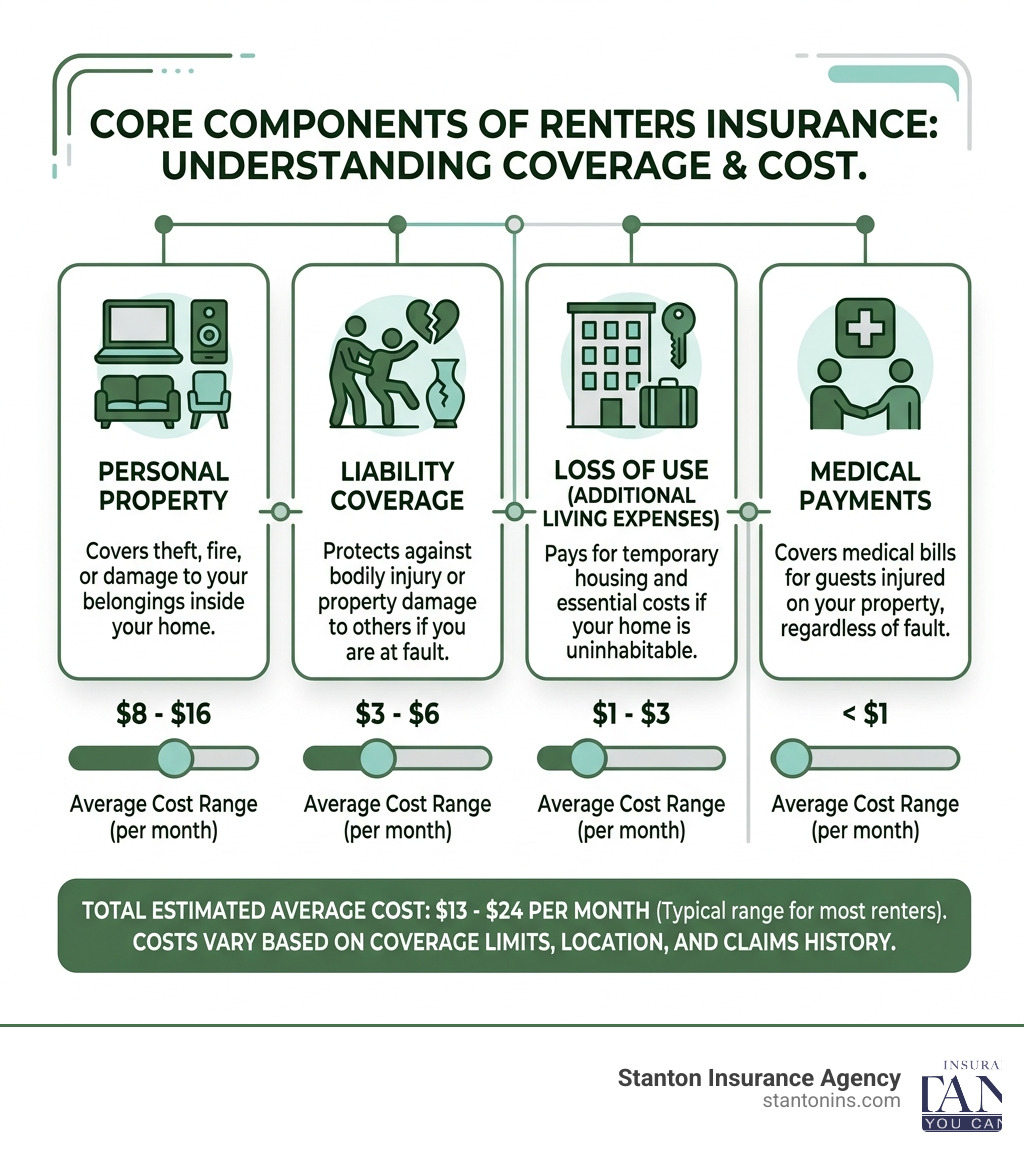
When calculating your needs, look at these four categories:
- Personal Property: The total value of your “stuff.” Most people underestimate this. Think about your laptop, furniture, designer clothes, and kitchen appliances. Standard policies start at $10,000, but $30,000 is a more common baseline for a one-bedroom apartment.
- Personal Liability: This protects you if someone is injured in your home or if you accidentally damage someone else’s property. Most landlords require at least $100,000, but tripling that to $300,000 often costs only $1 or $2 more per month.
- Loss of Use: If a fire makes your apartment uninhabitable, this coverage pays for hotel stays and extra food expenses.
- Medical Payments: This covers small medical bills if a guest has a minor injury at your place, regardless of who is at fault.
If you are unsure where you fall on the spectrum, our guide on How Much Is Enough Understanding Minimum Coverage Renters Insurance can help you find the sweet spot between being over-insured and under-protected.
How to Secure the Best Rates
Getting the lowest Renters Insurance Cost doesn’t mean you have to settle for “cheap” or unreliable coverage. It’s about being a savvy shopper.
One of the best ways to secure a great rate is to look for Cheap Renters Insurance Massachusetts options that still offer high-quality claims service. We always suggest getting a Renters Insurance Quotes Massachusetts comparison to see how different carriers weight your specific risks.
Don’t forget about Scheduled Personal Property. If you have a $5,000 engagement ring or a $3,000 professional camera, a standard policy might limit theft payouts for those specific items to $1,500. “Scheduling” these items ensures they are covered for their full value, often with no deductible.
Proven Ways to Reduce Your Renters Insurance Cost
If you want to drive your premium down even further, use these proven strategies:
- Multi-Policy Bundling: This is the “king” of discounts. If you bundle your renters insurance with your car insurance, you can often save 5% to 25% on both policies.
- Safety Devices: Does your apartment have smoke detectors, a fire extinguisher, or a burglar alarm? Tell your agent. These items reduce the risk of a total loss and earn you discounts.
- Gated Communities/High-Rises: Living in a building with a doorman or a gated entrance significantly lowers theft risk.
- Payment Discounts: Many carriers offer savings if you pay your annual premium in full rather than monthly.
- Paperless Billing & Autopay: Small discounts (often $5 to $10) are available just for signing up for electronic statements and automatic withdrawals.
- Claim-Free History: Staying claim-free for several years makes you a “preferred” risk, leading to lower rates over time.
For those on a tight budget, searching for Cheap Renters Insurance is a great start, but always ensure the policy includes the essentials.
Frequently Asked Questions about Renters Insurance
Is renters insurance cheaper than homeowners insurance?
Yes, significantly. While the average homeowners insurance policy can cost $1,800 to $2,500 per year, the average Renters Insurance Cost is only about $150 to $300. This is because renters insurance does not cover the actual structure of the building—the landlord is responsible for that. You are only paying to protect the items inside and your personal liability.
How much property coverage do I need for a one-bedroom apartment?
While every renter is different, most people in a one-bedroom apartment have between $20,000 and $30,000 worth of belongings. When you add up the cost of a bed, sofa, television, computer, and your entire wardrobe, the numbers climb quickly. We recommend erring on the side of caution; increasing your coverage from $20,000 to $30,000 usually only adds a few dollars to your monthly bill.
Does renters insurance cover my roommate’s belongings?
Generally, no. A standard renters insurance policy only covers the individuals named on the policy. Unless you are related by blood or marriage, or specifically added to the policy, your roommate needs their own separate coverage. Having separate policies is usually better anyway, as it prevents one person’s claim from affecting the other person’s insurance record.
Conclusion
Understanding Renters Insurance Cost is the first step toward securing your financial future. Whether you are a student in Boston or a professional in Manchester, the small monthly investment provides a massive safety net. At Stanton Insurance Agency, we pride ourselves on our local expertise and our commitment to exceeding customer expectations.
We know the New England market inside and out. We aren’t just a voice on the phone; we are your neighbors, and we want to ensure your valuable assets are protected with a plan that fits your budget.
Ready to see your actual numbers? Protect your assets with a personalized renters insurance quote today, or get started with Your Fast Pass To Protection Instant Renters Insurance Quotes. Don’t wait for a “reality check” to find out your landlord’s insurance doesn’t cover you—get protected now.