
How Much Does Liability Auto Insurance Cost? (2026 Quick Answer)
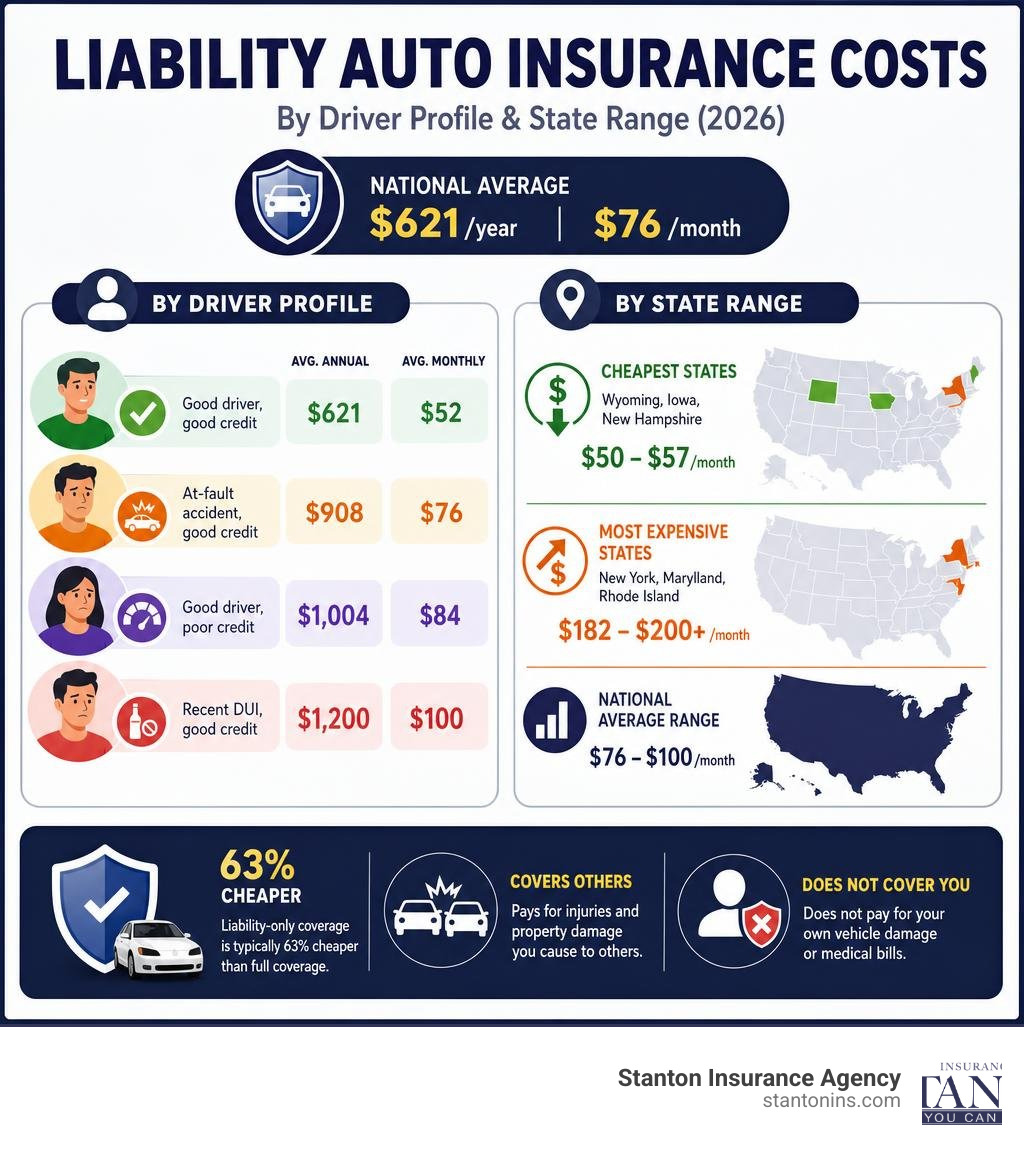
Liability auto insurance cost averages $621 per year (about $76 per month) nationwide for a driver with a clean record and good credit, as of June 2026.
Here’s a quick snapshot of what you can expect to pay:
| Driver Profile | Average Annual Cost | Average Monthly Cost |
|---|---|---|
| Good driver, good credit | $621 | $52 |
| At-fault accident, good credit | $908 | $76 |
| Good driver, poor credit | $1,004 | $84 |
| Recent DUI, good credit | $1,200 | $100 |
Rates also vary significantly by state:
- Cheapest states (e.g., Wyoming, Iowa, New Hampshire): as low as $50–$57/month
- Most expensive states (e.g., New York, Maryland, Rhode Island): $182–$200+/month
- National average: ~$76–$100/month depending on the data source
Liability-only coverage is typically 63% cheaper than full coverage — but it only covers damage and injuries you cause to others. It does not pay for your own vehicle or medical bills.
Even with those averages in mind, the number on your own quote can look very different. Your state, driving history, credit score, and the insurer you choose all push rates up or down — sometimes by hundreds of dollars a year. That’s what makes shopping for liability coverage feel confusing, especially when you’re trying to figure out whether you have the right amount of protection and not just the cheapest option.
I’m Geoff Stanton, President of Stanton Insurance Agency and a Certified Insurance Counselor (CIC) with over 25 years of experience helping Massachusetts and New Hampshire drivers make sense of liability auto insurance cost and find coverage that actually fits their lives. In this guide, I’ll walk you through everything you need to know — from what liability insurance covers to how to lower your premium without cutting corners on protection.
Liability auto insurance cost terms to learn:
What is Liability Car Insurance and What Does It Cover?
At its core, liability auto insurance is your financial shield against the damage you might cause to other people or their property while behind the wheel. It is a third-party coverage, meaning it never pays you directly; instead, it pays the other guy.
When you purchase a policy, your auto liability coverage is divided into two primary components:
- Bodily Injury (BI) Liability: If you cause an accident that injures another driver, their passengers, or pedestrians, BI pays for their medical bills, emergency care, rehabilitation, and lost wages. It also covers legal defense costs if the injured party decides to sue you.
- Property Damage (PD) Liability: If you run into another vehicle, a mailbox, a storefront, or a neighbor’s expensive cedar fence, PD covers the cost of repairing or replacing that property.
Think of liability insurance as a legal buffer. Without it, you would be personally responsible for paying every dollar of damage out of your own pocket. If you are sued, your savings, home, and future wages could be on the line.
What Liability Insurance Does Not Cover
While liability insurance is incredibly important, it is also highly misunderstood. Many drivers buy a liability-only policy and assume they are fully protected.
To keep your expectations aligned with reality, here is what is excluded from your liability coverage details:
- Your Own Vehicle’s Damage: If you hit a tree, slide on black ice into a guardrail, or get t-boned by an uninsured driver, your liability policy will not pay a single dime to fix your car.
- Comprehensive Claims: If your car is stolen, vandalized, cracked by a stray rock on the highway, or crushed by a falling tree branch during a New England nor’easter, liability coverage will not help.
- Your Own Medical Bills: Liability insurance does not cover medical payments or personal injuries for you or your passengers (though in Massachusetts, a separate coverage called Personal Injury Protection, or PIP, is mandatory to handle this).
If you want protection for your own vehicle, you must add physical damage coverages (collision and comprehensive), which transitions your policy from “liability-only” to “full coverage.”
Average Liability Auto Insurance Cost in 2026
When looking at the big picture, the national average liability auto insurance cost sits at roughly $621 per year (or about $76 per month) for a driver with a clean record and solid credit. However, insurance rates are highly localized. What a driver pays in rural New Hampshire is vastly different from what a driver pays in downtown Boston.

According to industry average cost reports, overall auto insurance rates have trended upward over the last few years due to rising vehicle repair costs, advanced vehicle technology, and severe weather events. While national averages give us a helpful baseline, your actual premium is determined by a mix of personal and regional factors.
Monthly vs. Annual Liability Auto Insurance Cost
When you buy car insurance, you typically have the option to pay your premium in monthly installments or as a single annual (or semi-annual) payment.
While the average monthly cost of liability insurance hovers around $68 to $76 per month (approximately $814 per year for a standard 50/100/50 policy), paying month-to-month can actually increase your total cost. Most insurance companies charge a small administrative or installment fee (usually $3 to $7) on every monthly bill.
If you choose to pay your annual premium upfront, you can unlock a “pay-in-full” discount, which typically saves you 5% to 10% on your total bill. For more details on how these payment plans affect your wallet, check out our monthly liability cost guide.
Factors That Influence Your Liability Auto Insurance Cost
No two drivers pay the exact same rate because insurance companies use complex algorithms to assess risk. According to industry liability cost analysis, several major factors heavily influence what you will pay:
- Driving Record: This is the most direct reflection of your risk on the road. A single speeding ticket or at-fault accident can raise your rates by 30% or more. A DUI is even more severe, raising the average liability premium by $642 per year (pushing a typical $68/month rate up to $121/month).
- Credit Score: In states where it is legally permitted, your credit-based insurance score is one of the heaviest pricing factors. Nationally, having poor credit can raise your liability rates by an average of $1,039 per year compared to having excellent credit.
- Age and Experience: Teenagers and young drivers (ages 16 to 25) are statistically far more likely to be involved in accidents. As a result, they pay an average of $100 per month for liability coverage, compared to $68 per month for mature adults and $58 per month for seniors.
- Vehicle Type: Even though liability insurance doesn’t cover your car, the type of vehicle you drive still matters. A heavy heavy-duty pickup truck or a high-performance sports car can cause significantly more damage to other vehicles and property than a compact sedan, resulting in higher liability premiums.
Massachusetts and New Hampshire Insurance Rules
Because we serve drivers in Massachusetts and New Hampshire, it is crucial to understand how our local state laws directly impact your liability auto insurance cost.
Massachusetts (MA) Rules
Massachusetts is a “no-fault” insurance state, which means if you are injured in an accident, your own Personal Injury Protection (PIP) coverage pays for your medical bills up to a certain limit, regardless of who caused the crash.
To legally drive in the Bay State, you must carry the following minimum compulsory coverages:
- Bodily Injury to Others: $20,000 per person / $40,000 per accident
- Personal Injury Protection (PIP): $8,000 per person, per accident
- Damage to Someone Else’s Property: $5,000 per accident (often written as 20/40/5 limits)
- Bodily Injury Caused by an Uninsured Auto: $20,000 per person / $40,000 per accident
According to industry rate reports, the average liability-only rate in Massachusetts is about $102 per month. That Massachusetts law strictly prohibits insurance companies from using your credit score to set auto insurance rates, which is fantastic news if you are working to rebuild your credit. For a deeper dive into local pricing, check out this guide on the Massachusetts average cost of auto insurance.
New Hampshire (NH) Rules
New Hampshire is famous for its “Live Free or Die” motto, and that philosophy extends to auto insurance. NH is the only New England state that does not legally require most drivers to buy car insurance.
However, if you choose not to buy insurance, you must be able to prove that you have the financial resources (financial responsibility) to pay for any damages or injuries you cause in an accident. If you do choose to buy auto insurance—which we highly recommend to protect your livelihood—state law requires you to meet minimum limits of 25/50/25:
- Bodily Injury: $25,000 per person / $50,000 per accident
- Property Damage: $25,000 per accident
- Medical Payments: $1,000 per person
- Uninsured Motorist: $25,000 per person / $50,000 per accident
Because New Hampshire has a highly responsible driving population and lower population density in many areas, its rates are incredibly competitive. The average cost for liability coverage in the Granite State is roughly $53 per month (about $500 to $635 annually). You can learn more about these local trends in this resource on the New Hampshire average cost of car insurance.
Liability-Only vs. Full Coverage: Cost and Protection
Deciding between a liability-only policy and full coverage is one of the most common dilemmas our clients face.
Nationwide, choosing a liability-only policy offers an average of 63% savings compared to full coverage. That is a massive chunk of change. However, that savings comes with a significant trade-off in protection.

To help you visualize the difference, we have put together a comprehensive liability only cost guide comparison table:
| Coverage Type | What It Covers | Average Monthly Cost (2026) | Who It’s Best For |
|---|---|---|---|
| Liability-Only | Bodily injury & property damage to others | ~$68 – $100 | Owners of older, low-value vehicles (worth under $5,000) who can afford to replace their car out of pocket. |
| Full Coverage | Liability + Collision + Comprehensive (covers your car too) | ~$179 – $244 | Owners of newer vehicles, financed/leased cars, or anyone who couldn’t easily afford to buy another car if theirs was totaled. |
If your car is worth $3,000, paying $1,200 a year for full coverage doesn’t make financial sense—you would pay more in premiums over a couple of years than the car is actually worth. But if your vehicle is worth $20,000, going liability-only is a massive gamble that could leave you empty-handed after a single patch of black ice.
Frequently Asked Questions About Liability Insurance
What happens if damages exceed my liability limits?
If you carry the state compulsory minimum limits in Massachusetts (such as $5,000 for property damage) and you accidentally rear-end a brand-new $60,000 electric vehicle, your insurance company will only pay up to your $5,000 limit.
You are personally responsible for the remaining $55,000. The other driver’s insurance company (or the driver themselves) can sue you, place a lien on your home, and garnish your future wages to collect the difference.
To protect your personal assets, we strongly advise buying limits higher than the state minimums. For most drivers, we recommend at least 100/300/100 limits. If you have significant assets like a home or retirement savings, you should also consider an umbrella insurance policy for extra security. To learn more about selecting the right limits, read our guide on how much liability do I need.
How can I lower my liability auto insurance cost?
You don’t have to slash your coverage limits to get an affordable rate. Here are the most effective ways to lower your premium:
- Bundle Policies: Combining your auto insurance with a home, condo, or renters policy is the single easiest way to save. Bundling can save you an average of 17% on your auto premium.
- Maintain a Clean Driving Record: Avoiding speeding tickets and at-fault accidents keeps you in the preferred tier of risk, saving you hundreds of dollars annually.
- Ask About Discounts: Insurance companies offer discounts for paperless billing, paying in full, having safety features on your vehicle, and being a good student.
- Consider Telematics: Many insurers offer usage-based programs that track your driving habits via a smartphone app. Safe drivers can save up to 40%.
For more actionable tips, check out our resource on cheap liability auto insurance.
Is liability-only insurance right for my vehicle?
It depends on three main things: your vehicle’s value, your financial situation, and your auto loan status.
First, if you lease or finance your car, your lender will legally require you to carry full coverage—liability-only is not an option. Second, if you own your car outright, calculate its value. If the annual cost of collision and comprehensive insurance is more than 10% of your car’s total value, switching to a liability-only policy might be a smart financial move. For a complete breakdown of when to make the switch, read our guide on liability auto insurance cost.
Conclusion
At Stanton Insurance Agency, we know that finding the right balance between a low liability auto insurance cost and strong financial protection can feel overwhelming. We don’t believe in one-size-fits-all insurance. Whether you are navigating the unique no-fault laws of Massachusetts or the financial responsibility rules of New Hampshire, our team is here to help you secure your valuable assets with trusted, personalized protection.
Ready to see how much you could save on your auto insurance without sacrificing the coverage you need? Get a personalized car insurance quote with us today, and let’s build a policy that gives you true peace of mind on the road.
