
What Is the Average Monthly Auto Insurance Cost in the U.S.?
Understanding your average monthly auto insurance cost is the first step to knowing whether you’re overpaying — and most drivers are surprised by how much rates can vary.
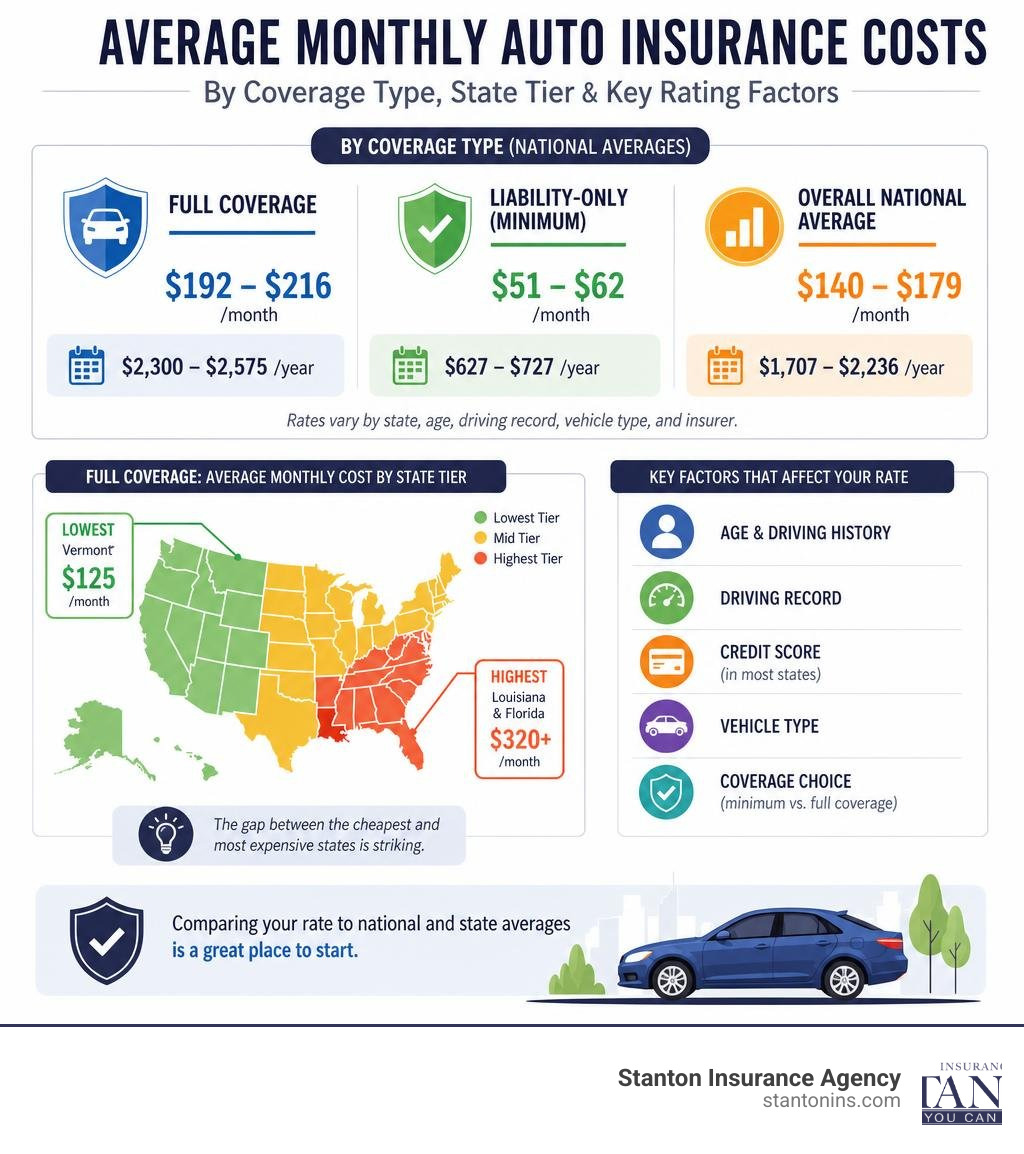
Here’s a quick snapshot of what Americans pay right now (July 2026):
| Coverage Type | Average Monthly Cost | Average Annual Cost |
|---|---|---|
| Full Coverage | $192 – $216/month | $2,300 – $2,575/year |
| Liability-Only (Minimum) | $51 – $62/month | $627 – $727/year |
| Overall National Average | ~$140 – $179/month | ~$1,707 – $2,236/year |
Rates vary by state, age, driving record, vehicle type, and insurer.
The gap between the cheapest and most expensive states is striking. Drivers in Vermont can pay as little as $125/month for full coverage, while drivers in Louisiana or Florida can pay well over $320/month — for the same type of policy.
A few things drive that spread:
- Your state’s laws and minimum coverage requirements
- Your age and driving history
- Your credit score (in most states)
- The type of vehicle you drive
- Whether you carry minimum coverage or full coverage
Most drivers searching for benchmarks are really asking: “Am I paying too much?” The honest answer is: it depends — but comparing your rate to national and state averages is a great place to start.
I’m Geoff Stanton, President of Stanton Insurance Agency in Waltham, Massachusetts, and I’ve spent over two decades helping families and individuals navigate average monthly auto insurance costs across Massachusetts and New Hampshire. In that time, I’ve seen how much rates can differ from one driver to the next — and how a little knowledge goes a long way toward finding the right coverage at the right price.
Basic average monthly auto insurance glossary:
Understanding the National Average Monthly Auto Insurance Cost
When you start digging into the numbers, you quickly realize that the “national average” is a useful starting point, but it rarely tells the whole story for your specific situation. According to data analyzed in the Average Car Insurance Cost: How Much Is Auto Insurance? guide, the national average for full coverage auto insurance is approximately $216 per month (or $2,575 annually).
However, if you only want to satisfy your state’s legal minimums, you could pay a national average of just $61 per month ($727 annually).
Why is there such a massive gap? And more importantly, why have these rates climbed so dramatically over the last few years?
Between 2022 and 2025, car insurance premiums across the country surged by 20% to 30%. While rates have finally begun to stabilize as we hit July 2026, they remain at historic highs. This upward trend is driven by several hard economic realities:
- Advanced Vehicle Technology: A simple fender bender isn’t so simple anymore. Modern bumpers are packed with parking sensors, lane-departure cameras, and radar systems. Replacing a damaged bumper on a new vehicle can easily top $3,000 today, compared to just $500 for an older, purely mechanical bumper.
- Skyrocketing Repair and Medical Costs: Inflation has hit auto repair shops and medical facilities hard. Higher labor rates, expensive replacement parts, and rising healthcare costs all bleed directly into the claims that insurance companies pay out.
- Severe Weather Events: From historic windstorms in New England to sweeping floods across the country, insurers have faced massive, multi-billion-dollar weather claims. To stay solvent, insurance companies must adjust their baseline rates.
Understanding these national benchmarks helps put your own insurance bill into perspective. If you are paying significantly more or less than these averages, it is almost certainly due to a specific combination of personal rating factors.
Key Factors That Influence Your Monthly Premiums
Insurance companies don’t just pull a number out of a hat. They use highly complex algorithms to assess how likely you are to get into an accident or file a claim. Every detail about you, your car, and your driving habits plays a role in shaping your average monthly auto insurance bill.

Here are the primary rating factors that insurers look at:
- Your Vehicle Type: What you drive matters just as much as how you drive. Vans and small SUVs are statistically the cheapest vehicles to insure because they are typically driven by families and have excellent safety ratings. On the flip side, high-performance sports cars and luxury electric vehicles (EVs) command much higher premiums due to their extreme repair costs and rapid acceleration capabilities.
- Annual Mileage: The logic here is simple: the less time you spend on the road, the lower your chances of getting into an accident. If you work from home or have a short commute, you may qualify for low-mileage discounts.
- Your Coverage Limits: Opting for higher liability limits (such as 100/300/100, which covers $100,000 in bodily injury per person, $300,000 per accident, and $100,000 in property damage) will naturally cost more than choosing your state’s bare minimum requirements. However, as we will discuss later, those higher limits offer vital protection for your personal assets.
- Your Deductibles: Your deductible is the amount you pay out of pocket before your insurance kicks in for comprehensive or collision claims. Choosing a lower deductible (like $250 or $500) means the insurance company takes on more risk, resulting in a higher monthly premium. Raising your deductible to $1,000 is one of the fastest ways to lower your monthly bill.
How Age and Gender Impact Your Average Monthly Auto Insurance
It is no secret that age is one of the most powerful factors in determining auto insurance costs. Statistically, younger drivers are much more likely to be involved in serious accidents. According to data from the Centers for Disease Control and Prevention (CDC), teen drivers are nearly three times more likely to be in a fatal crash than drivers aged 20 and older.
According to industry data, the age-based pricing curve looks like this:
- Teens (Ages 16–19): This is the most expensive demographic to insure. A 16-year-old male driver can face average rates as high as $860 per month for full coverage.
- Young Adults (Ages 20–25): Rates begin to drop once a driver hits 20, but young adults still pay a premium, averaging around $4,687 annually for full coverage.
- Adults (Ages 30–60): This is the “sweet spot” for auto insurance. Drivers in their 50s and 60s enjoy some of the lowest rates in the country, often averaging around $115 to $176 per month.
- Seniors (Ages 70+): Rates typically begin to creep back up slightly for older seniors as reflex times and eyesight naturally decline, though they rarely reach the extreme levels seen by teenagers.
Gender also plays a role in early driving years. Young men statistically engage in riskier driving behaviors, leading to more severe accidents. Where permitted by law, a 20-year-old male driver can pay up to $826 more per year than a female driver of the exact same age. However, this gender-based pricing gap completely disappears by the time drivers reach age 40.
It is also worth noting that several states—including Massachusetts—have banned insurance companies from using gender as a rating factor altogether.
How Driving History and Credit Scores Affect Your Average Monthly Auto Insurance
Your personal track record behind the wheel is the single best indicator of your future driving behavior. If you have a clean driving record, you will enjoy rates that sit well below the national average. But if you have a history of traffic violations or accidents, insurers will adjust your rates to reflect that added risk.
Consider how common driving infractions can impact your monthly rates:
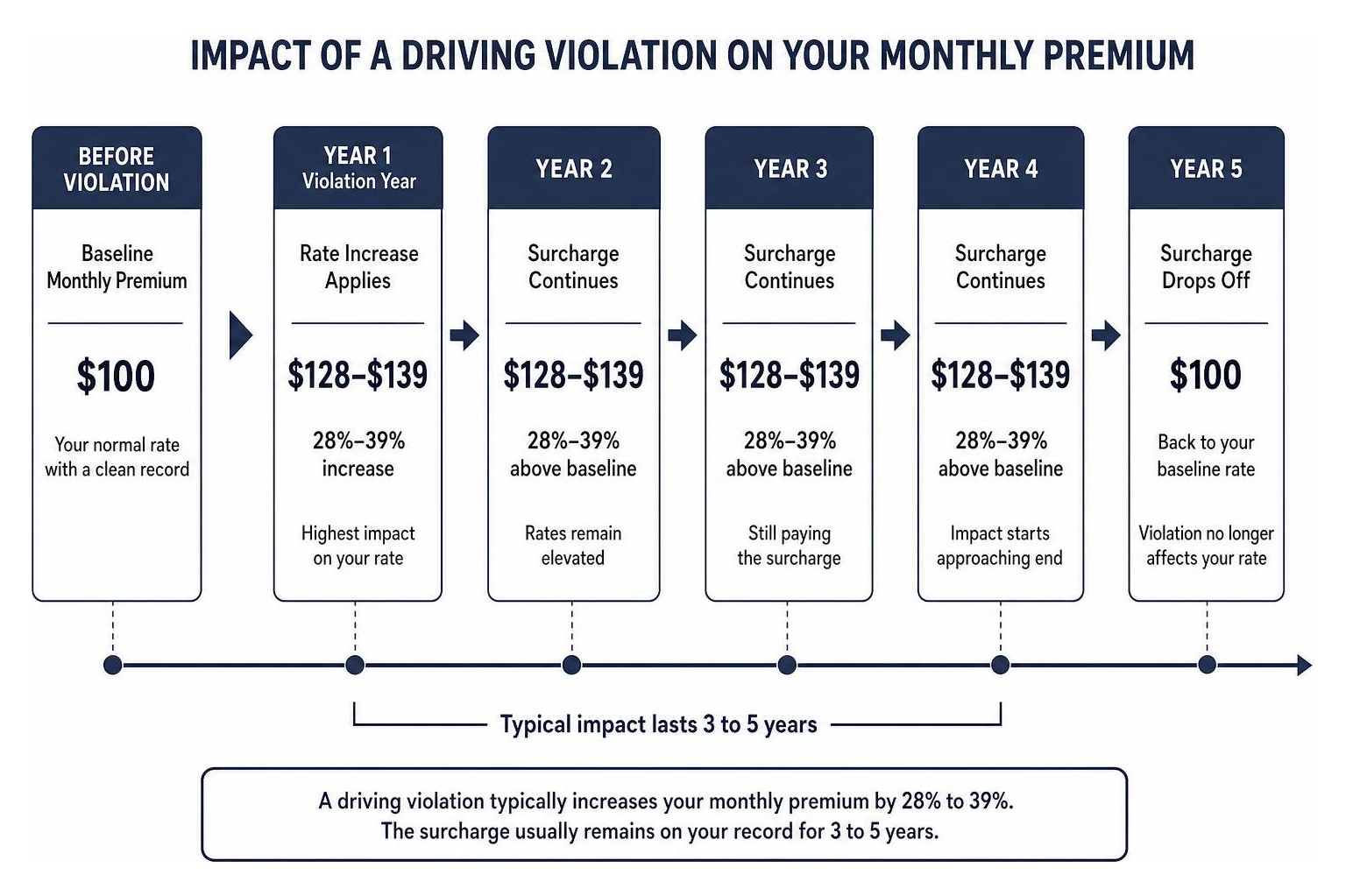
- Speeding Ticket: A single speeding ticket can increase your monthly premium by an average of 28% to 39%. This surcharge typically stays on your record for three to five years.
- At-Fault Accident: Causing an accident can raise your full coverage rates by roughly 41% to 49%, adding hundreds of dollars to your annual costs.
- DUI (Driving Under the Influence): A DUI is considered a major violation. It can cause your monthly premium to skyrocket by 67% to 89%, and in some states, a DUI will impact your insurance rates for up to ten years.
To visualize how these violations affect your wallet over time, consider this typical recovery timeline:
Beyond your driving history, your credit score can have an unbelievable impact on what you pay. In states where it is legal, drivers with poor credit pay an average of 70% more for auto insurance than those with excellent credit. In fact, in many states, moving from a poor credit tier to an excellent credit tier saves more money annually than going from a DUI conviction back to a clean driving record!
If you are wondering whether your current rate is fair based on your credit and driving history, our guide on Car Insurance Monthly Rates: Are You Paying Too Much? offers a deeper look into how these factors interlock.
Note: Credit-based insurance scoring is strictly banned in four states: Massachusetts, Hawaii, California, and Michigan.
Minimum Coverage vs. Full Coverage Costs
One of the most important decisions you will make when shopping for car insurance is choosing your coverage level. The terms “minimum coverage” and “full coverage” are thrown around constantly, but it is critical to understand exactly what they mean for your protection and your monthly budget.
- Minimum Coverage: This refers to the absolute bare minimum liability limits required by your state’s laws to drive legally. It only pays for bodily injury and property damage that you cause to other people. It does not pay a single dime to repair your own car if you hit a tree, get into a collision, or if your car is stolen.
- Full Coverage: While “full coverage” isn’t an actual legal term, it typically refers to a policy that includes state-mandated liability protection plus collision and comprehensive coverages. Collision covers damage to your vehicle from an accident, while comprehensive covers non-collision events like theft, vandalism, animal strikes, and weather damage.
As we noted in our Car Insurance Quotes Monthly Guide, full coverage costs roughly three times more than minimum coverage on average. While saving money with a minimum-liability policy is tempting, it can be a massive financial gamble. If you have assets to protect—like a home, savings, or a newer vehicle—carrying only minimum coverage could leave you personally liable for tens of thousands of dollars after a major accident.
Actionable Ways to Lower Your Monthly Payments
If your monthly auto insurance bill is making you wince, you aren’t powerless. There are several highly effective, actionable strategies you can use to bring those monthly costs down without sacrificing the protection you need:
- Raise Your Deductibles: If you currently have a $250 or $500 deductible for collision and comprehensive, consider raising it to $1,000. This simple adjustment can lower your monthly premium by 10% to 15%. Just make sure you keep that $1,000 set aside in an emergency fund in case you ever need to file a claim.
- Bundle Your Policies: One of the easiest ways to secure a massive discount is to bundle your auto insurance with your homeowners, renters, condo, or multi-family insurance. Most insurers offer multi-policy discounts ranging from 15% to 25%.
- Enroll in Telematics Programs: Many modern insurance policies offer opt-in telematics programs. By using a smartphone app or a small plug-in device to track your actual driving habits (like braking, speed, and mileage), safe drivers can secure discounts of up to 30% or more.
- Take a Defensive Driving Course: Completing an approved defensive driving or accident prevention course is a fantastic way to sharpen your skills behind the wheel while earning a guaranteed discount on your liability coverages.
- Pay Annually or Semi-Annually: If your budget allows, pay your six-month or annual premium in full rather than making monthly payments. Most insurance companies charge a small convenience fee for monthly billing, and paying upfront can save you 5% to 12% overall.
State-by-State Variations: Massachusetts vs. New Hampshire
Where you park your car at night has a massive impact on your average monthly auto insurance rates. Because insurance is regulated at the state level, every state has its own unique laws, minimum coverage requirements, and geographic risks that shape local premiums.
For drivers in New England, the contrast between Massachusetts and New Hampshire is particularly fascinating. Despite sitting right next to each other, these two states approach auto insurance in completely different ways.
Massachusetts Car Insurance Costs
Massachusetts—the Bay State—is known for its historic towns, bustling cities, and relatively complex auto insurance landscape. The average cost of full coverage car insurance in Massachusetts is roughly $151 to $163 per month, placing it right around the middle of the pack nationally.
Several unique regulations shape auto insurance in the Commonwealth:
- The Credit Score Ban: Massachusetts is one of the few states that strictly prohibits insurance companies from using your credit score to determine your auto insurance rates. This is a massive win for drivers with less-than-perfect credit, as their premiums are based purely on their driving history and other non-credit factors.
- Compulsory Coverage Requirements: To register a vehicle in MA, you must carry compulsory coverages, including Bodily Injury to Others ($20,000 per person/$40,000 per accident), Personal Injury Protection (PIP) up to $8,000, Bodily Injury Caused by an Uninsured Auto, and Damage to Someone Else’s Property ($5,000 limit).
- The Uninsured Driver Challenge: Despite strict laws, uninsured and underinsured drivers remain a reality on Bay State roads. Carrying optional coverages like medical payments and collision is highly recommended to protect yourself from drivers who carry no insurance at all.
For a deeper dive into what you can expect to pay locally, check out our detailed guide on How Much is Car Insurance Per Month in Massachusetts? or review the latest state data from the Average Cost of Car Insurance in Massachusetts for 2026 report.
New Hampshire Car Insurance Costs
Cross the border into the Granite State, and you’ll find a completely different approach to auto insurance. New Hampshire is famous for its “Live Free or Die” motto, and that philosophy extends directly to its car insurance laws.
- Is Insurance Mandatory? New Hampshire is the only state in the country that does not legally require most drivers to purchase car insurance.
- The Financial Responsibility Catch: While you don’t have to buy a policy, you are legally required to prove that you have the financial resources to pay for any bodily injury or property damage you cause in an accident. If you cause an accident and cannot pay, your driving privileges and vehicle registration will be suspended.
- A Low-Cost State: Because of its rural geography, lower population density, and competitive market, New Hampshire is consistently ranked as one of the cheapest states for car insurance in the country. According to the Average Cost of Car Insurance in New Hampshire for 2026 analysis, the average cost of full coverage in New Hampshire is approximately $130 to $132 per month.
Even though coverage is technically optional, the vast majority of Granite State drivers choose to carry insurance to protect their hard-earned assets.
Frequently Asked Questions About Auto Insurance Costs
Navigating car insurance can feel like trying to read a foreign language. To help you make sense of it all, we’ve compiled and answered some of the most common questions we hear from drivers in Massachusetts and New Hampshire.
What is a good monthly rate for car insurance?
A “good” monthly rate is entirely subjective and depends heavily on your driving profile and where you live. However, as a general rule of thumb in 2026:
- For an experienced driver with a clean record and good credit (outside of MA), a rate of $100 to $150 per month for a standard full coverage policy is considered excellent.
- If you are looking for liability-only coverage on an older vehicle, a monthly rate of $50 to $80 is a fantastic target.
- If you are insuring a teen driver or have a recent major violation (like a DUI), a “good” rate might look closer to $250 to $400 per month—the key here is shopping around to find the carrier that penalizes those risk factors the least.
Why is car insurance so expensive in Massachusetts?
If you live in the Bay State, you might wonder why your premiums feel so high. Several factors drive up costs in Massachusetts:
- High Population and Traffic Density: Massachusetts is one of the most densely populated states in the country. More cars on the road—especially in congested metro areas like Boston, Worcester, and Springfield—mean a statistically higher frequency of accidents.
- Severe New England Winters: Ice, snow, and pothole-ridden roads lead to an increased number of collision and comprehensive claims every winter.
- High Cost of Living and Repair Labor: The cost of auto body labor and medical care in Massachusetts is significantly higher than the national average, which directly inflates the size of insurance claims.
For a comprehensive breakdown of these regional cost drivers, read our article on Why is Car Insurance So Expensive in Massachusetts?.
Does New Hampshire require car insurance?
No, New Hampshire does not require you to carry auto insurance under normal circumstances. However, you must prove that you can meet the state’s financial responsibility requirements if you cause an accident.
Furthermore, the state will require you to purchase and maintain auto insurance (specifically filing an SR-22 certificate) if you are convicted of certain serious motor vehicle violations, such as a DUI, reckless driving, or driving without a license. If you do choose to buy insurance in New Hampshire, the policy must meet minimum liability limits of 25/50/25 ($25,000 for bodily injury per person, $50,000 per accident, and $25,000 for property damage).
Conclusion
At the end of the day, there is no single “average” price for auto insurance because there is no such thing as an average driver. Your average monthly auto insurance cost is a highly personalized number shaped by your vehicle, your driving habits, your location, and the choices you make when building your policy.
At Stanton Insurance Agency, we believe that you shouldn’t have to choose between saving money and protecting your family. As a local, independent agency based in Massachusetts, we don’t work for a single massive insurance corporation—we work directly for you. We take the time to understand your unique needs, compare quotes from a wide network of trusted regional and national carriers, and find the perfect balance of coverage and value.
Whether you are navigating the strict compulsory requirements of Massachusetts or looking for the best voluntary protection in New Hampshire, we are here to help you secure the trusted protection your valuable assets deserve.
Ready to see how much you could save on your monthly premium? Get a personalized auto insurance quote from Stanton Insurance Agency today, or reach out to our friendly team to review your current coverage!
