
What You’ll Actually Pay for Liability Car Insurance Per Month
How much is liability car insurance per month? For most U.S. drivers, the answer lands somewhere between $51 and $107 depending on your state, driving record, and insurer.
Here’s a quick snapshot of current national averages:
| Coverage Type | Average Monthly Cost |
|---|---|
| State minimum liability | $51 – $61 |
| Liability-only (broader average) | $68 – $76 |
| Liability-only (market median) | ~$100 – $107 |
| Full coverage | $177 – $203 |
A few things to know upfront:
- Liability-only is the cheapest legally required coverage you can buy.
- It costs roughly 61-63% less than full coverage on average.
- Rates vary widely by state — from around $26/month in Wyoming to over $300/month in parts of New York.
- Your driving record, credit score, age, and ZIP code all push your personal rate up or down from these averages.
If you’re a Massachusetts or New Hampshire driver, your numbers look a little different. Massachusetts drivers pay roughly $102-$106/month for liability-only coverage, while New Hampshire drivers tend to pay closer to $53-$57/month — well below the national average.
I’m Geoff Stanton, President of Stanton Insurance Agency in Waltham, Massachusetts, and as a Certified Insurance Counselor with over 25 years in the industry, I’ve helped hundreds of families in Massachusetts and New Hampshire understand exactly how much liability car insurance per month makes sense for their situation. In the sections below, I’ll walk you through everything that shapes your rate and how to make sure you’re getting the right coverage at the right price.
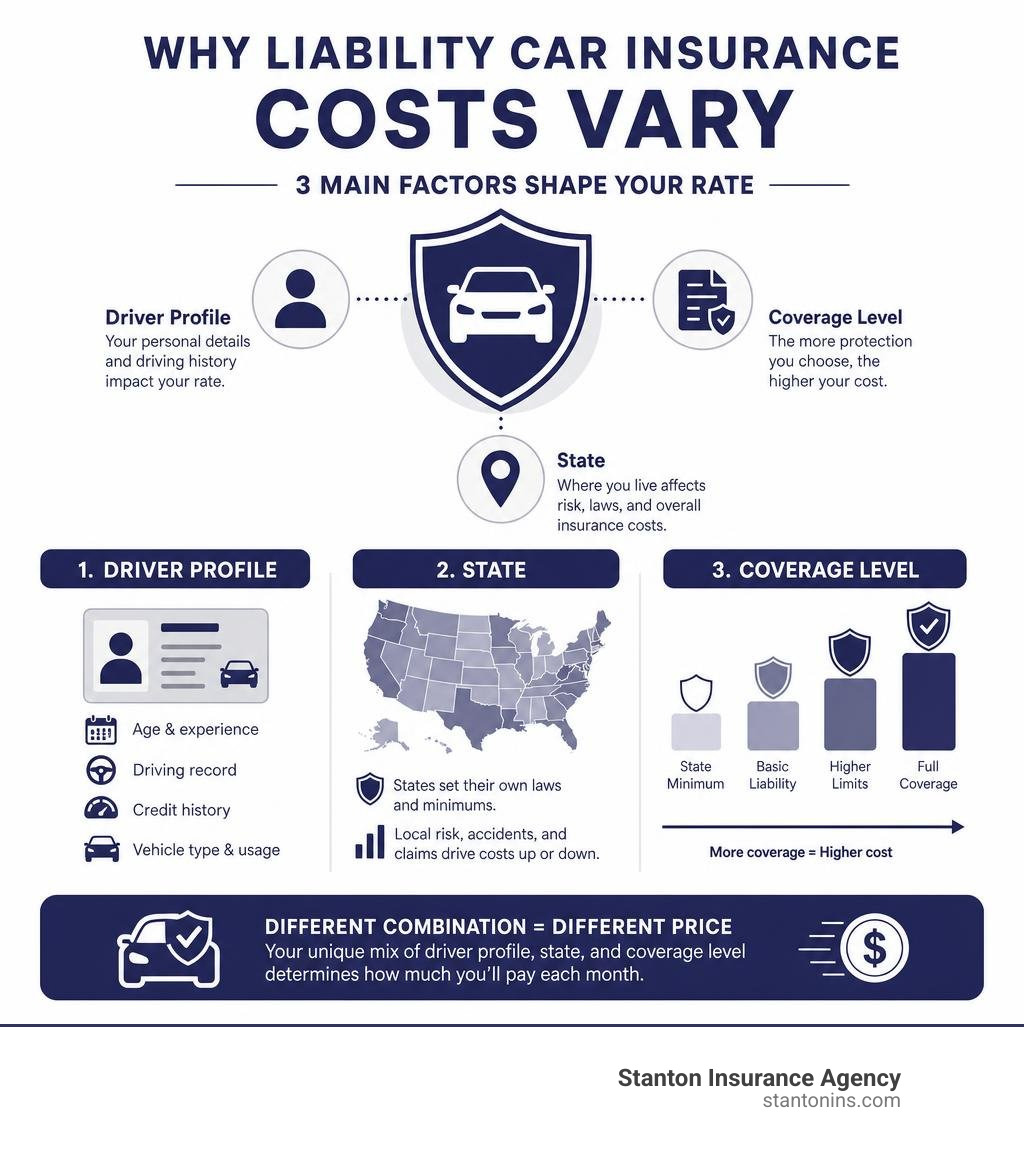
How much is liability car insurance per month terms to know:
How much is liability car insurance per month in 2026?
As of June 2026, the national average cost of liability-only car insurance is approximately $76 per month, though minimum coverage policies can be found for as low as $51 to $61 per month for drivers with pristine profiles. Based on a comprehensive National liability insurance cost analysis, the average annual premium for a minimum-limit policy sits around $621 to $814.
However, these figures represent a baseline. The actual premium you see on your monthly bill is determined by a rolling methodology that evaluates your specific risk profile. If you are a clean driver with excellent credit, you will secure rates well below these averages. Conversely, if the market is experiencing inflationary pressures on vehicle repairs and medical costs, overall rates will rise accordingly.
Why monthly liability averages range from about $51 to $107
The broad spread between the low end ($51) and the high end ($107) of monthly liability averages comes down to how different insurers evaluate risk and how states set their baseline rules. “Minimum coverage” is not a single, uniform product; it is a collection of coverages that must meet individual state mandates.
When quote engines analyze millions of driver profiles, they find that some insurance companies price their policies aggressively to attract low-risk drivers, while others charge higher rates to buffer against potential losses. Furthermore, converting an annual policy premium to a monthly payment plan often introduces small installment fees, which can push a $600 annual policy from a clean-record driver slightly above the clean $50-per-month mark.
How much is liability car insurance per month in Massachusetts and New Hampshire?
For those of us living and driving in New England, regional rules play a massive role in our monthly insurance bills.
In Massachusetts, the average monthly cost for liability-only coverage is approximately $102 to $106. The Bay State operates under a no-fault auto insurance system, which means your policy must include Personal Injury Protection (PIP) alongside standard bodily injury and property damage liability. Additionally, Massachusetts law strictly prohibits auto insurance companies from using your credit score to calculate your premiums. While this protects drivers with poor credit, it means clean-record drivers cannot use an excellent credit score to lower their rates further.
In contrast, New Hampshire is famous for being the only state in the country that does not legally mandate car insurance for most drivers. However, the state enforces strict financial responsibility laws. If you choose to buy insurance in the Granite State—which we highly recommend—your policy must include medical payments coverage (MedPay) and uninsured motorist coverage. According to official New Hampshire auto cost data, New Hampshire liability-only policies are highly affordable, averaging just $53 to $57 per month.
Is $100 per month a good price for liability-only car insurance?
If your insurance agent quotes you $100 per month for liability-only coverage, is that a good deal? The answer depends entirely on your geography and your personal driver profile.
For an experienced driver with a clean record living in New Hampshire, $100 per month is actually quite high. However, for a driver in Massachusetts—especially one living in a densely populated urban ZIP code like Boston or Worcester—$100 per month is very reasonable and sits right around the state average.
If you are a young driver, have a recent speeding ticket or at-fault accident on your record, or live in an area with high accident density, $100 per month is an excellent rate. For high-risk drivers, monthly liability costs can easily climb past $150 or $200.
Liability-only rates by state, insurer type, and coverage limits
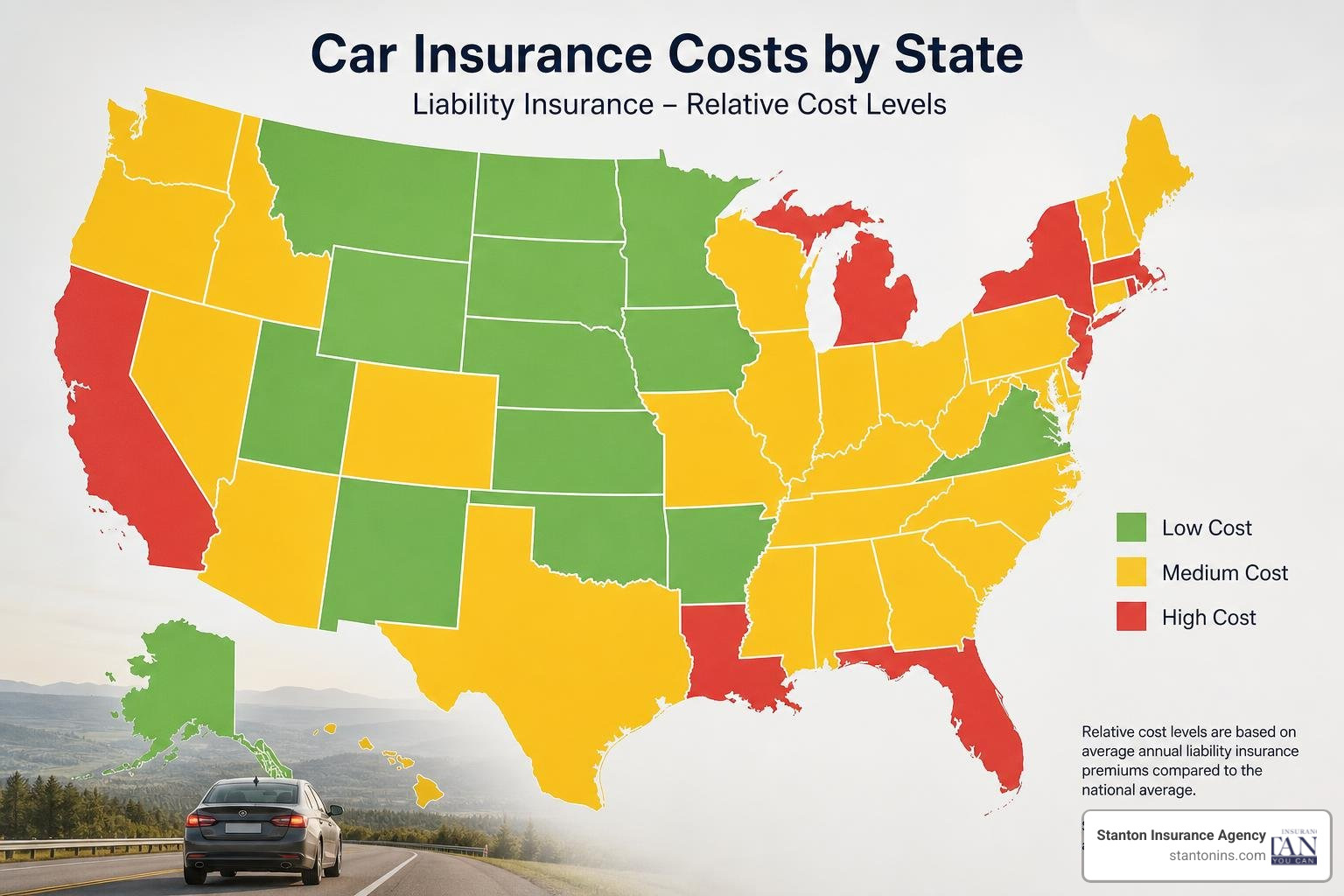
Where you garage your car is one of the most powerful variables in the rating equation. State-by-state variations exist because of differing insurance legal structures (such as tort versus no-fault systems), local litigation climates, population density, medical costs, and local vehicle repair rates.
Low-, medium-, and high-cost states for liability-only coverage
To help make sense of the national landscape, we can categorize states into three general pricing tiers:
- Low-Cost States (Average $87.56/month): These states typically feature lower population densities, lower litigation rates, and rural driving environments. Examples include Idaho, Wyoming, and New Hampshire.
- Medium-Cost States (Average $112.80/month): These states feature a mix of urban and rural corridors, moderate claim frequencies, and balanced regulatory environments. Examples include Pennsylvania, Ohio, and Texas.
- High-Cost States (Average $165.02/month): These states are characterized by dense urban populations, high rates of uninsured drivers, expensive medical care, and complex legal systems. Massachusetts, New York, and Florida fall into this higher-cost category.
Cheapest liability-only insurance options without naming a one-size-fits-all winner
When shopping for low cost liability car insurance, it is tempting to look for a single “cheapest” company. However, insurance carriers use proprietary underwriting algorithms, meaning the cheapest carrier for your neighbor might be the most expensive for you.
National insurers often leverage massive scale to offer competitive rates, but they may have stricter underwriting guidelines. Regional insurers, on the other hand, frequently offer highly personalized service and competitive rates tailored to local driving conditions. For families with military connections, specialized carriers can provide exceptionally low rates that are unavailable to the general public.
The smartest approach is to work with an independent agency that can compare quotes across multiple regional and national carriers to find the one with the strongest appetite for your specific risk profile.
State minimum liability coverage requirements drivers should know
Every state that mandates insurance requires minimum limits for bodily injury and property damage. These are usually expressed as a series of three numbers (e.g., 20/40/5).
- First Number: Maximum bodily injury coverage per person in an accident.
- Second Number: Maximum bodily injury coverage per accident (for all injured parties combined).
- Third Number: Maximum property damage coverage per accident.
Let’s look at the specific minimum requirements for our local states:
- Massachusetts Minimums (20/40/5): $20,000 bodily injury per person, $40,000 bodily injury per accident, and $5,000 property damage. It also requires $8,000 in Personal Injury Protection (PIP) and uninsured motorist coverage.
- New Hampshire Minimums (25/50/25): If you choose to buy insurance (or are required to due to a prior violation), you must carry $25,000 bodily injury per person, $50,000 bodily injury per accident, and $25,000 property damage, along with $1,000 in medical payments coverage.
Liability-only vs. full coverage: cost, savings, and trade-offs
Choosing between liability-only and full coverage is a classic balancing act between monthly savings and financial risk.
| Feature | Liability-Only Coverage | Full Coverage |
|---|---|---|
| Average Monthly Cost | $51 – $107 | $177 – $203 |
| Bodily Injury to Others | Yes | Yes |
| Property Damage to Others | Yes | Yes |
| Your Vehicle’s Damage (Collision) | No | Yes |
| Non-Collision Damage (Comprehensive) | No | Yes |
| Deductible Required | No | Yes (typically $500 – $1,000) |
| Lender/Lease Requirement | Rarely allowed | Mandatory |
Opting for cheapest liability only car insurance saves drivers an average of 61% to 63% compared to full coverage. However, this means you are absorbing 100% of the physical damage risk for your own vehicle.
What liability-only car insurance covers
Standard liability insurance is designed to protect your assets by paying for the damage you cause to other people and their property. It consists of two primary components:
- Bodily Injury Liability: Pays for the medical bills, lost wages, and legal pain and suffering of other drivers, passengers, or pedestrians injured in an accident where you are at fault.
- Property Damage Liability: Pays to repair or replace other people’s vehicles, fences, buildings, or telephone poles that you damage with your car.
It also covers your legal defense fees if you are sued as a result of a covered accident. For a deeper dive into these coverages, read our liability car insurance coverage guide.
What liability-only car insurance does not cover
It is vital to understand that liability insurance does not cover your own losses. If you are in an at-fault accident, your liability policy will not pay a single dollar to fix your car or cover your own medical bills.
Specifically, liability-only coverage excludes:
- Collision Damage: Repairs to your vehicle after hitting another car, tree, or guardrail.
- Comprehensive Damage: Damage from “acts of God,” including animal strikes, hail, fire, flood, vandalism, or theft.
- Uninsured/Underinsured Property Damage: Repairs to your vehicle if you are hit by a driver who has no insurance (unless you have a specific endorsement).
To learn more about who pays in various accident scenarios, check out our article: does liability insurance cover my car if I hit someone?
When liability-only is a smart choice
Dropping collision and comprehensive coverage is a highly effective way to lower your monthly premium, but it only makes sense under specific circumstances:
- The 8-Year or $5,000 Rule: If your vehicle is more than 8 years old or is worth less than $5,000, the annual cost of full coverage insurance plus your deductible may exceed the maximum payout you would receive if the vehicle were totaled.
- You Own the Vehicle Outright: If you finance or lease your car, your lender will contractually require you to carry full coverage.
- You Have Emergency Savings: You should only drop full coverage if you have enough cash set aside to immediately replace your vehicle if you wreck it.
For a detailed comparison to help you make this decision, read our guide on full coverage vs liability car insurance.
What factors affect monthly liability car insurance premiums?
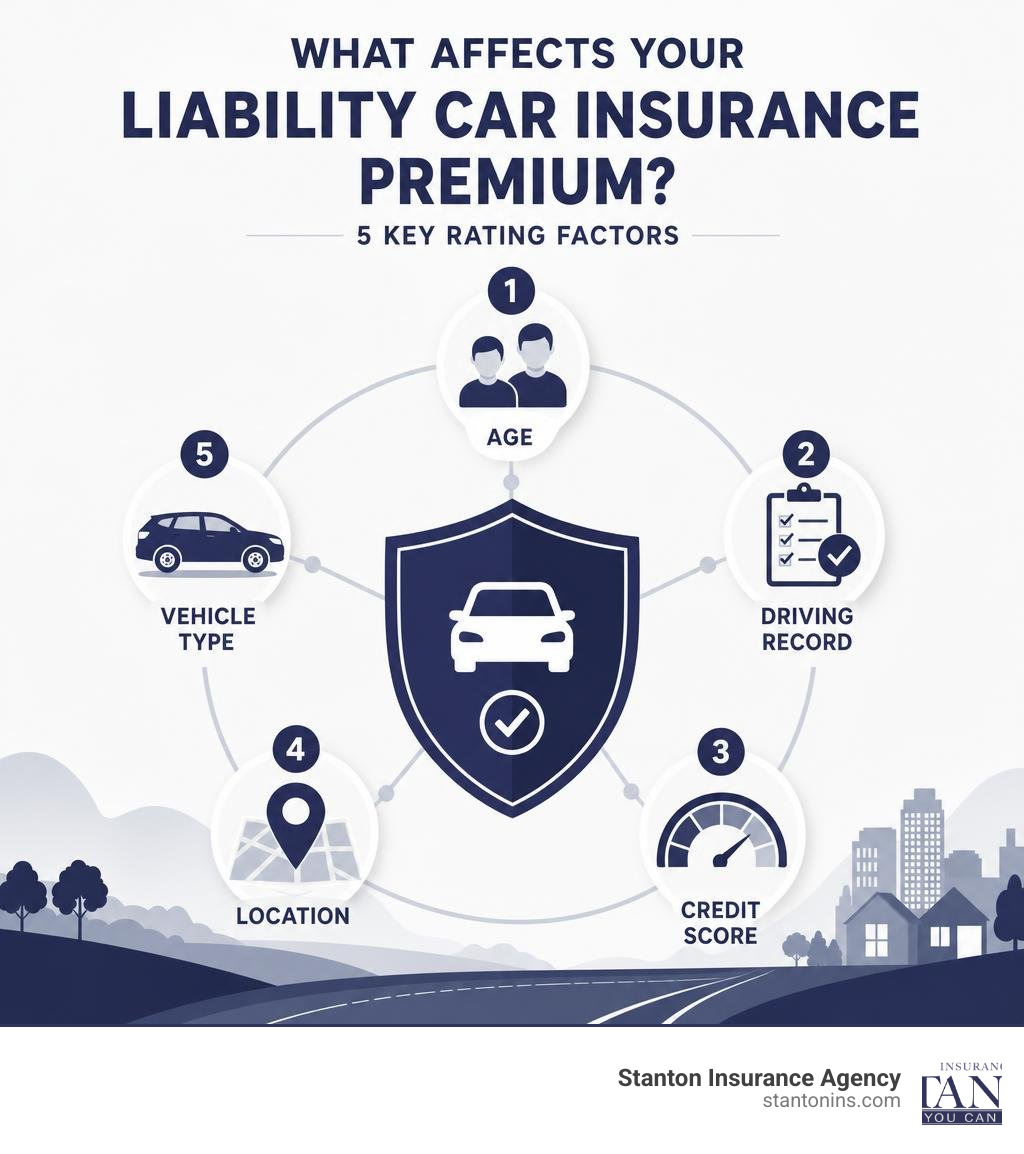
Auto insurance rates are highly personalized. Insurers use a wide range of variables to estimate the mathematical probability that you will file a claim.
How driving record changes liability-only rates
Your driving history is the single most accurate predictor of future accidents. If you have a clean record, you qualify for the lowest tier of rates. However, moving violations and accidents will cause your premiums to spike:
- Speeding Tickets: A single speeding ticket can increase your liability rates by an average of 39%.
- At-Fault Accidents: Causing an accident signals to insurers that you are a higher risk, which typically results in a surcharge on your policy for three to five years.
- DUIs: A driving under the influence conviction is the most severe common violation, often doubling your monthly premium and requiring high-risk SR-22 filings in some jurisdictions.
How credit score affects liability rates where allowed
In most of the United States, insurance companies use credit-based insurance scores to help price policies. Actuarial data shows a strong correlation between financial responsibility and safe driving habits. Drivers with poor credit can pay up to double the rate of drivers with excellent credit for the exact same coverage.
The Local Exception: If you live in Massachusetts, state law strictly prohibits insurance companies from using your credit history to determine your auto insurance rates. However, New Hampshire drivers are subject to credit-based insurance scoring, making credit health a key factor in Granite State premiums. For more information, read our average liability auto insurance cost guide.
How age and experience affect liability rates
Statistically, younger drivers are far more likely to be involved in serious accidents due to a lack of driving experience.
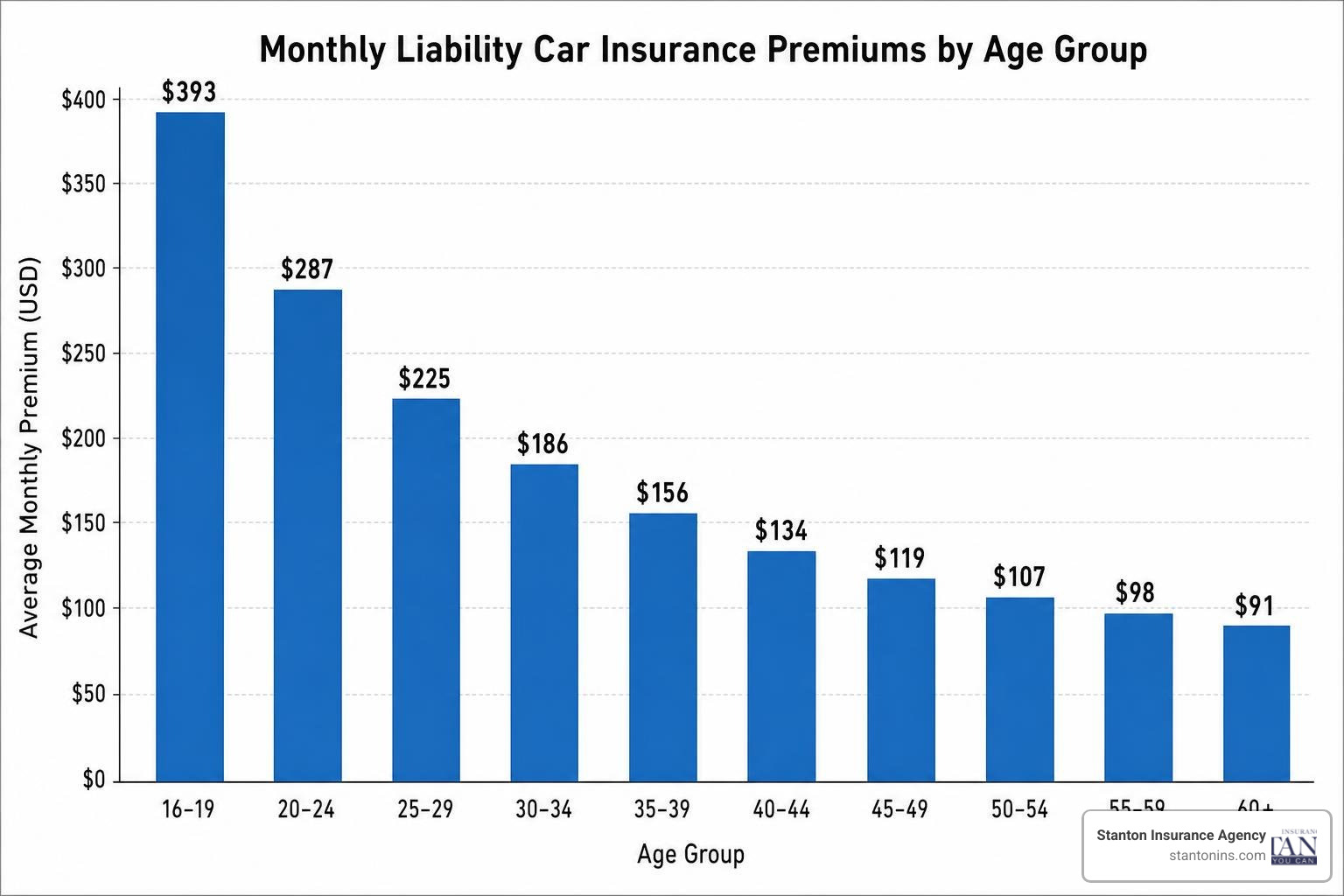
- Teens and Young Adults: Drivers under 25 face the highest premiums, with 18-year-olds often paying three to four times the national average.
- Adult Drivers (Ages 25-60): Rates stabilize and reach their lowest point during these years, assuming a clean driving record.
- Senior Drivers (Ages 65+): Rates may begin to tick upward slightly as age-related reaction times and health factors influence risk profiles.
Vehicle, garaging location, and usage factors
Your physical address and how you use your car also shape your rate:
- Garaging ZIP Code: Urban areas with dense traffic, high crime rates, and frequent street parking have higher claim rates, leading to higher premiums than quiet rural towns.
- Annual Mileage: If you only commute five miles a day, your exposure to accidents is much lower than someone driving fifty miles a day, which can earn you a low-mileage discount.
- Vehicle Safety and Repair Costs: Even with liability-only coverage, the weight, safety features, and design of your vehicle affect how much damage it can cause to other cars in a crash, impacting your property damage premium.
How to lower liability-only insurance premiums
Even if you are already looking for the absolute cheapest option, there are several highly effective strategies to drive your monthly liability bill even lower.
How much is liability car insurance per month after discounts?
By taking advantage of discount stacking, you can cut your monthly premium significantly. Common discounts include:
- Multi-Policy (Bundling): Combining your auto insurance with a homeowners or renters policy is the most effective discount, often saving you 15% to 20% on your auto premium.
- Multi-Car: Insuring more than one vehicle on the same policy.
- Paid-in-Full: Paying your entire six-month or annual term upfront instead of monthly eliminates billing fees and earns a percentage discount.
- Good Student: High school or college students with a “B” average or better can save substantially.
- Telematics / Usage-Based Insurance: Signing up for an app-based program that tracks your actual braking, speed, and mileage can earn you discounts of up to 40% for safe driving habits.
Explore more saving tips in our guide on cheap liability auto insurance.
Why buying only the minimum may not be cheapest long term
While buying the bare minimum legal limit is the cheapest way to get a piece of paper that lets you drive, it can be an incredibly expensive mistake in the long run.
Consider this: Massachusetts only requires $5,000 in property damage liability. If you cause a minor multi-car accident or slide on ice into a newer vehicle, the repair costs will easily exceed $5,000. Once your insurance policy limits are exhausted, you are personally responsible for the remaining balance. The other party’s insurance company can sue you, garnish your wages, or place a lien on your home.
Upgrading your limits to 100/300/100 ($100,000 per person, $300,000 per accident, and $100,000 property damage) often costs only a few dollars more per month. For a clear explanation of how to protect your assets, read how much liability insurance do I need for my car?
How to compare liability quotes the right way
To ensure you are getting an accurate, apples-to-apples comparison when shopping around:
- Keep Coverage Limits Identical: Do not compare a state-minimum quote from one company to a high-limit quote from another.
- Disclose Your History Honestly: Failing to mention a recent speeding ticket will result in an artificially low initial quote that will jump significantly once the insurer runs your official motor vehicle record.
- Watch for Hidden Fees: Ask if the quoted monthly price includes installment fees, or if there is a discount for automatic paperless payments.
For step-by-step guidance, refer to our liability insurance quote guide.
Frequently Asked Questions about liability car insurance per month
Is $200 per month for liability-only car insurance a lot?
Yes, $200 per month for liability-only coverage is significantly higher than the national average of $76. However, if you are a young driver, have multiple moving violations, a recent DUI, or live in a highly congested urban area, $200 may be the market rate for your risk tier. If you have a clean record and are paying this much, it is highly recommended to shop around.
How much cheaper is liability-only than full coverage?
On average, liability-only coverage is 61% to 63% cheaper than full coverage. This is because full coverage includes collision and comprehensive coverages, which obligate the insurance company to pay out thousands of dollars to repair or replace your own vehicle in the event of an accident, theft, or weather damage.
Does liability insurance cover my car if I hit someone?
No. Liability insurance only covers the bodily injuries and property damage of the other party when you are at fault. It will not pay a single dollar to repair your own car. To protect your own vehicle in an at-fault collision, you must carry collision coverage. For more details, see our auto liability coverage complete guide.
Conclusion
Determining how much is liability car insurance per month is not about finding a single national number—it is about understanding how your unique location, driving history, and coverage limits interact with local regulations. Whether you are navigating the no-fault requirements in Massachusetts or evaluating your financial responsibility options in New Hampshire, buying the right coverage is the only way to truly protect your hard-earned assets.
At Stanton Insurance Agency, we specialize in helping New England drivers find the perfect balance between highly competitive monthly premiums and robust asset protection. We work with a wide network of top-rated regional and national carriers to customize a policy that fits your budget and lifestyle.
Ready to see how much you could save? Get a car insurance quote with us today, or give our Waltham office a call to speak directly with an experienced local agent.
