
Why Your Car Insurance Price Estimate Can Feel Like a Mystery — And How to Fix That
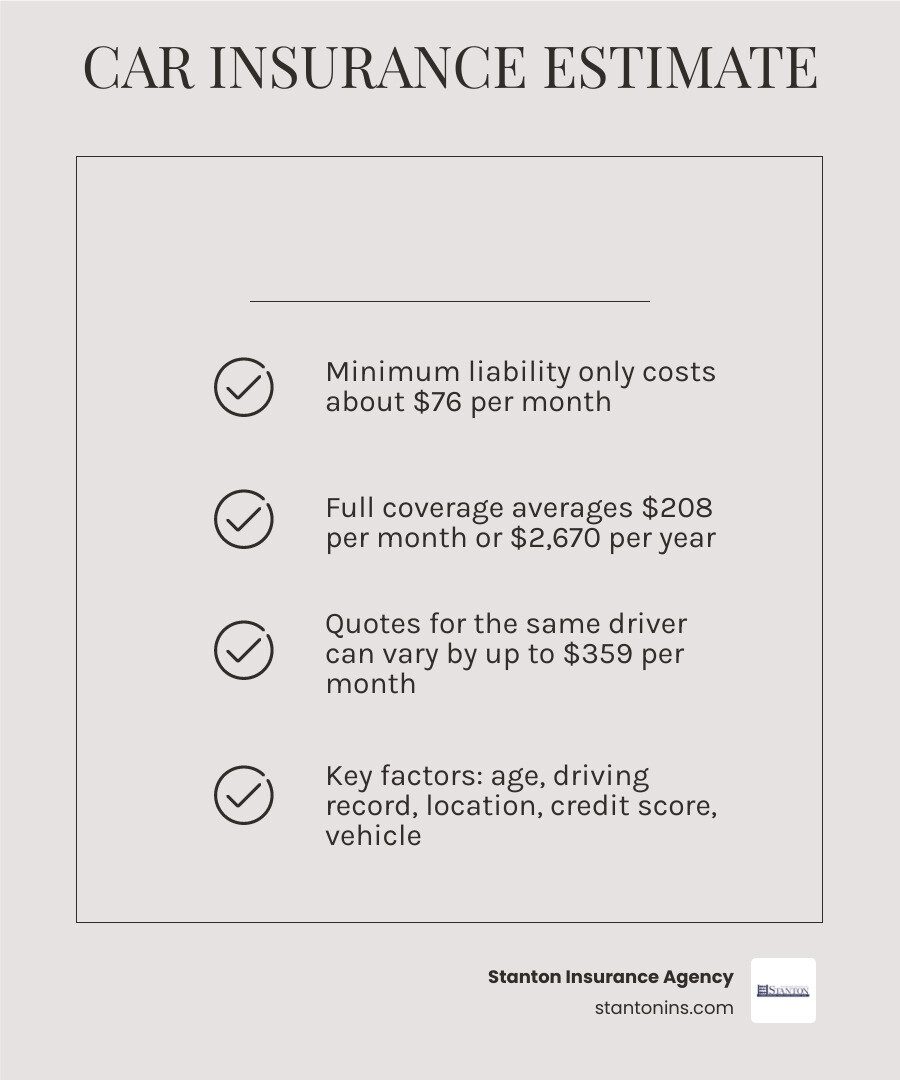
Getting a car insurance price estimate can feel overwhelming — but here’s what you need to know right now:
| Coverage Type | Average Monthly Cost | Average Annual Cost |
|---|---|---|
| Minimum liability only | $76/month | ~$912/year |
| Full coverage | $208/month | ~$2,670/year |
The biggest factors that move your estimate:
- Your age and driving record
- Where you live (state and ZIP code)
- Your vehicle’s make, model, and year
- Your credit score (in most states)
- The coverage limits and deductible you choose
Quotes for the same driver can vary by up to $359 per month from one company to the next — which means shopping around isn’t optional, it’s essential.
Beyond those quick numbers, your actual rate depends on a mix of personal, geographic, and vehicle-specific factors that insurers weigh differently. That’s what makes estimating your premium feel so unpredictable. In 2026, the national average sits at $2,670 per year for full coverage — but your number could be significantly higher or lower depending on your profile.
I’m Geoff Stanton, President of Stanton Insurance Agency in Waltham, Massachusetts, and a Certified Insurance Counselor (CIC) with over 25 years helping drivers in Massachusetts and New Hampshire navigate their car insurance price estimates with confidence. In this guide, I’ll walk you through exactly how estimates are calculated, what moves the number up or down, and how to make sure you’re getting the right coverage at a fair price.
Simple guide to Car insurance price estimate:
How is Your Car Insurance Price Estimate Calculated?
Every time you request a car insurance price estimate, you aren’t just getting a random number pulled out of thin air. Instead, insurance companies run your details through highly complex, proprietary algorithms designed to measure one key thing: risk.
In the insurance world, risk is the mathematical probability that you will file a claim, and how much that claim will cost the company. Because every insurance carrier uses its own unique formula to calculate this risk, the exact same driver can receive widely different quotes from different companies. In fact, full coverage quotes can differ by as much as $359 per month for the exact same vehicle and driver profile!
The Calculation Process
To determine your premium, insurers evaluate a combination of public data, your personal history, and mathematical models. They start with a baseline rate for your geographic area and then adjust that rate up or down using a series of “rating factors.”
Primary Rating Factors
- Driving History and Past Violations: Your track record on the road is the single most influential factor under your control. A clean record keeps you in the lowest risk tier, while accidents and tickets signal volatility to the insurer.
- Driver Age and Years of Driving Experience: Statistically, newer drivers are involved in more accidents. As you gain clean driving years, your risk profile drops, bottoming out around middle age before rising slightly again in your golden years.
- Vehicle Make, Model, and Safety Features: Insurers look at how much your car costs to repair, its crash-test ratings, and its likelihood of being stolen. Ironically, advanced high-tech safety features can sometimes increase your premium because those sensors and cameras are highly expensive to replace after a minor fender bender.
- Annual Mileage and Primary Vehicle Use: A car that sits in a garage in Waltham and is only driven 5,000 miles a year has a much lower statistical chance of getting into an accident than a vehicle commuting 20,000 miles a year down Route 128.
- Geographic Location and Local Claim Trends: Your ZIP code tells insurers about local population density, crime rates, litigation trends, and weather patterns. For instance, urban areas with high rates of auto theft or winter-weather collision claims will naturally command higher premiums than quiet, rural towns.
How Age and Driving Record Impact Your Car Insurance Price Estimate
Your age and your driving record are two of the most powerful levers dictating your final rate. Young drivers (ages 16 to 25) typically pay two to three times more than experienced drivers because they lack the years on the road that prove safe habits.
If you have a clean record, you enjoy the lowest baseline rates. However, a single driving mishap can cause those rates to skyrocket. A single speeding ticket can increase your premium by 20% to 30%, while an at-fault crash can hike your rates by 20% to 40% for three to five years. A DUI conviction is even more severe, often doubling your premium or making it difficult to secure standard coverage at all.
To help you visualize how these factors shift your baseline, here is a breakdown of average annual rates across different driver profiles:
| Driver Profile | Average Annual Rate (Clean Record) | Average Annual Rate (With Speeding Ticket) | Average Annual Rate (With DUI) |
|---|---|---|---|
| Young Driver (Age 18-21) | $3,850 | $4,620 | $5,390 |
| Adult Driver (Age 30-45) | $1,950 | $2,340 | $2,730 |
| Senior Driver (Age 65+) | $1,800 | $2,160 | $2,520 |
Note: These represent general industry trends as of 2026. Your personal quote will vary based on your specific location and insurer.
How Credit Score and Location Affect Your Car Insurance Price Estimate
Your credit history and where you park your car at night play massive roles in your premium calculation—but how they affect you depends entirely on which side of the state line you live on.
The Credit Score Factor: MA vs. NH
In most of the United States, insurance companies use credit-based insurance scores to price policies. Actuarial data shows a strong correlation between financial responsibility and safe driving habits. Consequently, having a poor credit score can increase your premium by 20% to 50% compared to having excellent credit.
However, Massachusetts is one of only four states in the country that completely prohibits the use of credit scores in setting auto insurance rates (along with California, Hawaii, and Michigan). If you live in Boston, Worcester, or Waltham, your credit score will not impact your premium by a single penny.
If you live in New Hampshire, however, insurance companies are legally allowed to use your credit history to evaluate risk. If you are a Granite State driver, maintaining a strong credit profile is a highly effective way to keep your auto insurance costs low.
Geographic and Regional Variations
Your local environment directly impacts your rates. Drivers in densely populated urban centers face higher risks of vandalism, theft, and multi-car gridlock accidents. Conversely, drivers in rural parts of New Hampshire or Western Massachusetts enjoy lower rates due to less traffic.
Furthermore, New England winters introduce unique hazards. Ice, heavy snow, road salt, and deer crossings all contribute to localized claim trends that insurers monitor closely. To see how these local elements shape regional pricing, you can read our deep-dive analysis on the Average Cost of Car Insurance in MA.
Understanding Coverage Types: Liability, Collision, and Comprehensive
When building a car insurance price estimate, you aren’t just buying “insurance”—you are selecting a customized package of distinct coverages. Balancing your budget with the protection of your personal assets is the key to choosing the right policy.
To explore these options in-depth, check out our Auto Insurance Cost Complete Guide.
Liability Coverage and State Mandates
Liability coverage is the foundation of any auto insurance policy. It does not pay for damage to your own car; instead, it pays for bodily injury and property damage you cause to others in an at-fault accident.
- Massachusetts Rules: In MA, liability insurance is strictly mandatory. You must carry minimum limits of 20/40/5 ($20,000 bodily injury per person, $40,000 bodily injury per accident, and $5,000 property damage).
- New Hampshire Rules: New Hampshire is famous for its “Live Free or Die” motto and is the only state in New England where auto liability insurance is not strictly mandatory for most drivers. However, if you choose not to buy insurance, you must be able to prove you have the financial assets to pay for damages if you cause an accident. If you do choose to purchase insurance (which we strongly advise), the state-mandated minimum limits are 25/50/25.
Why State Minimums Aren’t Enough
While buying minimum liability limits is the cheapest way to drive legally, it is highly risky. The average price of a brand-new car in 2026 is just under $50,000, and even a three-year-old used vehicle costs an average of $31,000 to replace. If you carry only a $5,000 or $25,000 property damage limit and total someone’s vehicle, you are personally on the hook for the remaining balance.
As independent agents, we almost always recommend carrying at least 100/300/100 limits ($100,000 per person, $300,000 per accident for bodily injury, and $100,000 for property damage) to shield your home, savings, and future wages from devastating lawsuits.
Collision and Comprehensive Protection
If you want your insurance policy to pay for damage to your own vehicle, you need physical damage coverage. This is what transforms a basic liability policy into “full coverage.”
- Collision Coverage: This pays to repair or replace your vehicle if you collide with another car, hit a guardrail, roll over, or hit an object.
- Comprehensive Coverage: Often called “other than collision,” this covers damage from events outside your control. This includes theft, vandalism, windshield cracks, fire, hail, floods, and animal strikes (such as hitting a deer on a dark New Hampshire highway).
Deductibles and Lender Requirements
Both collision and comprehensive coverages come with a deductible—the amount you agree to pay out of pocket before your insurance kicks in. Choosing a higher deductible (like moving from $250 to $1,000) reduces the insurance company’s risk, which can save you 15% to 30% on your premium.
That while collision and comprehensive are optional under state law, they are almost always required by banks and leasing companies if you finance or lease your vehicle. To see how these physical damage options affect your monthly budget, check out our guide on The Real Cost of Driving: What’s the Average Monthly Auto Insurance.
How to Estimate Costs Before Buying and Lower Your Premium
One of the most common financial mistakes car buyers make is falling in love with a vehicle, signing the paperwork, and only then calling their insurance agent. To prevent unpleasant budget surprises, you should always run a car insurance price estimate before you buy.
Using online tools can give you a solid baseline. To get started, you can read our guide on How to Use a Car Insurance Premium Calculator. You can also use reputable online auto insurance calculators to project your baseline expenses.
Estimating Costs for Electric Vehicles vs. Gas Cars
If you are considering making the switch to an electric vehicle (EV), you need to factor higher insurance costs into your total cost of ownership.
- Higher Premiums: On average, EVs cost 18% to 30% more to insure than traditional internal combustion engine vehicles.
- Higher Claim Frequency: EV drivers file insurance claims at a frequency rate 17% higher than gas-powered car drivers.
- Specialized Repairs: EVs feature high-tech battery packs, intricate sensors, and specialized drivetrains. If an EV is involved in an accident, repairing these components requires specialized mechanics and expensive parts, which drives up the cost of physical damage claims for insurance companies.
Actionable Ways to Lower Your Premium
You don’t have to accept a high insurance estimate as a permanent reality. There are several highly effective strategies you can use to bring your premium down:
- Adjust Your Deductibles: Raising your physical damage deductible from $250 to $1,000 can instantly save you 15% to 30% on your collision and comprehensive premiums. Just make sure you keep that deductible amount tucked away in an emergency savings account.
- Policy Bundling: One of the easiest discounts to secure is bundling. Combining your auto insurance with your homeowners, renters, or condo insurance can save you 15% to 25% across both policies.
- Take Advantage of Key Discounts:
- Multi-Vehicle: Insuring more than one car on the same policy is cheaper than maintaining separate policies.
- Safe Driver: Maintaining a clean record for three to five years unlocks significant safe-driver credits.
- Good Student: If you have a high school or college driver on your policy who maintains a “B” average or higher, you can save 10% to 20%.
- Low-Mileage: If your daily commute is short or you work from home, ask about low-mileage discounts.
- Anti-Theft: Vehicles equipped with GPS tracking or active alarm systems qualify for extra safety credits.
For a complete list of monthly saving strategies, dive into our Car Insurance Quotes Monthly Guide.
Frequently Asked Questions about Car Insurance Estimates
How often should I compare car insurance quotes?
We recommend reviewing and comparing your auto insurance options every 12 months, or whenever you face a major life milestone. Buying a home, getting married, moving to a new town, adding a teen driver, or paying off your car loan are all perfect opportunities to re-evaluate your coverage.
When you are ready to shop, you can easily Compare Car Insurance Quotes Today to see how your current rate stacks up against the market.
Why is my car insurance estimate so high?
If your quote is higher than expected, it is usually driven by one of a few common risk factors:
- Your Driving History: Recent speeding tickets, at-fault accidents, or coverage lapses signal higher risk.
- Your Location: Living in a densely populated urban ZIP code increases the statistical likelihood of claims.
- Your Vehicle: High-end luxury cars, sports cars, and electric vehicles cost significantly more to repair.
- Credit Score (NH Only): If you live in New Hampshire and have a poor credit-based insurance score, your rates will reflect that risk.
Can I estimate my insurance costs using an online tool?
Yes! Online calculators are excellent for getting a quick, high-level ballpark figure. However, keep in mind that online tools use generalized regional averages. To get a 100% accurate, binding quote that accounts for your exact driving history, vehicle identification number (VIN), and local policy discounts, you should always speak directly with a licensed independent insurance agent.
Conclusion
Finding the perfect balance between a low premium and robust financial protection doesn’t have to be a headache. While online calculators are incredibly useful for getting a quick car insurance price estimate, they can’t replace the personalized guidance of a local expert who understands the unique legal landscapes of Massachusetts and New Hampshire.
At Stanton Insurance Agency, we are an independent agency. We don’t work for a single insurance corporation; we work for you. We partner with multiple top-rated insurance carriers to shop your coverage, compare rates, and build a policy tailored to your unique life and budget.
Ready to stop guessing and secure the best rate possible? Get a fast, accurate, and personalized quote today through our Stanton Insurance Auto Insurance Services or reach out to our team directly. We are here to protect your drive, your assets, and your peace of mind!
