
How a Defensive Driving Discount Can Lower Your Car Insurance Premium
A defensive driving discount is one of the easiest ways to reduce what you pay for car insurance — and most drivers don’t know they qualify.
Quick answer: What is a defensive driving discount?
| What You Want to Know | The Short Answer |
|---|---|
| What is it? | A premium reduction offered by insurers when you complete an approved safe driving course |
| How much can you save? | 5% to 15% off applicable coverages, typically $50–$200 per year |
| How long does it last? | Usually 3 years, then you retake the course to renew it |
| Who qualifies? | Most drivers who complete a state-approved course voluntarily |
| Does it work in Massachusetts? | Massachusetts does not mandate this discount, but many insurers still offer it |
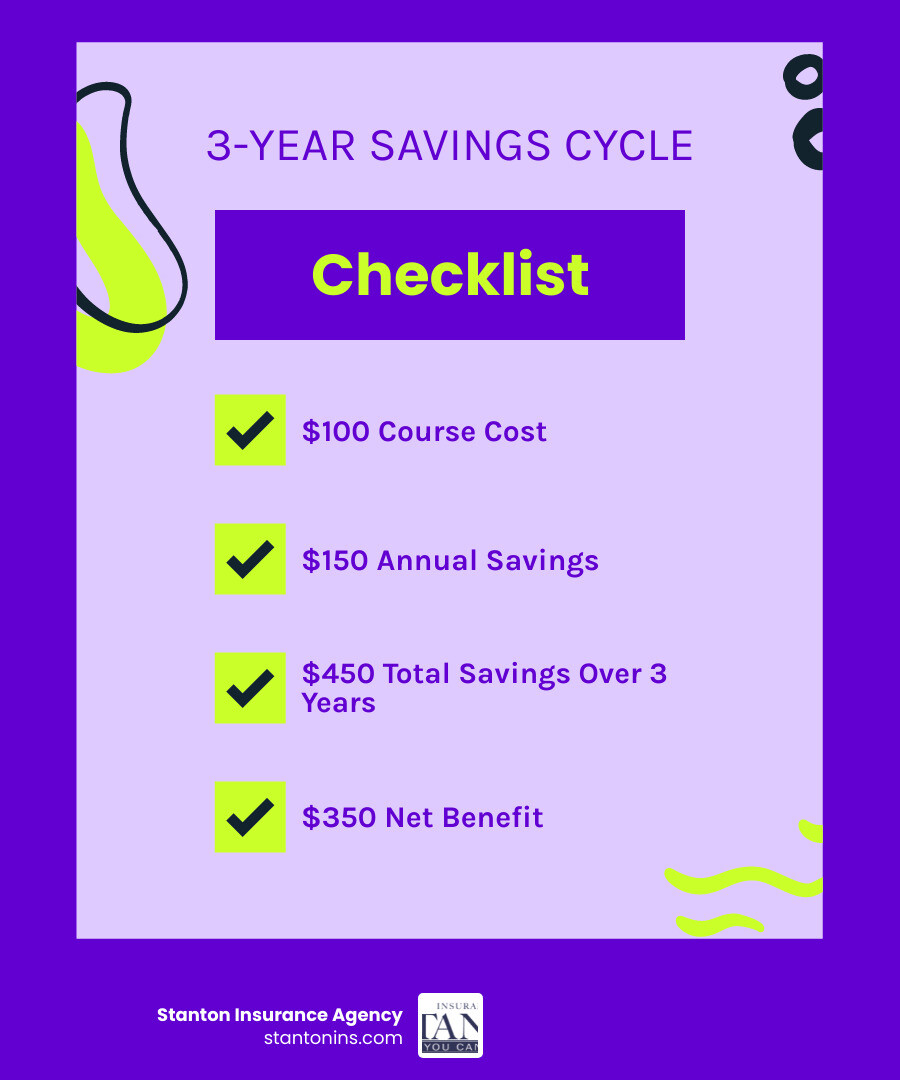
Here’s the thing: a 4-to-8-hour course can cut your premium by up to 15%, and the savings typically last three years. For most drivers, the course pays for itself within the first few months.
The benefits go beyond just money. These courses sharpen your hazard recognition, collision avoidance skills, and awareness of distracted driving risks — making you genuinely safer on the road, not just cheaper to insure.
And the process to claim the discount? It’s simpler than most people think.
I’m Geoff Stanton, President of Stanton Insurance Agency in Waltham, Massachusetts, and over my 25+ years in the industry I’ve helped countless policyholders identify savings opportunities — including the often-overlooked defensive driving discount that can meaningfully lower your auto insurance costs. Let me walk you through exactly how to qualify and claim it.
Handy Defensive driving discount terms:
What is a Defensive Driving Course?
A defensive driving course is a driver safety class designed to help you prevent accidents before they happen. Think of it as a refresher for the real world, not a retest of whether you know what a stop sign looks like.
Most approved courses cover topics such as:
- Hazard recognition
- Traffic laws and updates
- Safe following distance
- Collision avoidance techniques
- Distracted driving prevention
- Speed management
- Environmental and weather hazards
- Vehicle maintenance basics
- Drug and alcohol awareness
The goal is simple: help drivers spot problems earlier, make better decisions faster, and reduce the odds of a claim.
In Massachusetts and New Hampshire, these courses are often marketed as mature driver, accident prevention, or driver improvement programs. The label may change, but the purpose is the same: safer driving and, in many cases, lower premiums.
Many programs are available online or in a classroom format. Some focus on senior drivers, while others are open to adults of all ages. Good courses typically include practical scenarios like merging, reacting to sudden stops, dealing with bad weather, and avoiding common crash triggers such as fatigue or phone use.
These classes can also help you better understand how your policy responds after an accident. If you want a clear overview of what auto insurance actually covers, our guide to Your Car Insurance Explained From A to Z: What’s Covered? is a helpful companion.
And because safe driving changes with the seasons, our Summer Driving Tips article can help you apply defensive driving habits in everyday conditions.
How to Qualify for a Defensive driving discount
Qualifying for a Defensive driving discount usually comes down to five things:
- You take the course voluntarily.
- The course is approved by the state or accepted by your insurer.
- You complete the full class and pass any required quiz or exam.
- You submit proof of completion.
- You meet any insurer-specific eligibility rules.
Here are the most common requirements we see.
Voluntary completion matters
This is a big one. In many cases, the course must be taken voluntarily. If a judge, court, or motor vehicle agency required you to take it because of a ticket or violation, insurers often will not treat that same course as qualifying for a discount.
That distinction matters because a class for ticket dismissal and a class for insurance savings are not always interchangeable.
Age eligibility may apply
Some insurers offer this discount to drivers of all ages. Others reserve it mainly for mature drivers, often age 50, 55, or older. Research across the industry shows that age thresholds vary a lot by state and carrier.
For Massachusetts and New Hampshire, eligibility depends more on your insurer’s underwriting rules and accepted course list than on one universal statewide rule. That is why we always recommend checking first before enrolling.
Driving record can affect approval
A clean or relatively clean driving record may help. Some insurers are comfortable offering the discount broadly, while others tie it to a driver who has not had recent at-fault accidents or serious violations.
In practical terms, a driver with a spotless record, low mileage, and a completed course is usually in a stronger position than someone with recent claims activity.
The provider must be approved
Not every online driving course on the internet counts. Some are excellent for learning, but only certain providers are accepted for insurance purposes.
Before signing up, confirm:
- The course is approved in your state, if your state maintains an approval list
- Your insurer accepts that provider
- Online courses are allowed for the discount
- The certificate includes the information your insurer needs
For a broader overview of how discounts vary by insurer, this industry guide is useful: Defensive Driver Discounts: Save up to 15% (List by Insurer).
Principal and occasional drivers may both qualify
On some auto policies, the discount can apply to the principal operator. On others, occasional drivers may qualify too, depending on policy structure and underwriting rules. If more than one person in the household drives the vehicle, it is worth asking whether each eligible driver can complete a course.
That is one of those small phone calls that can produce a surprisingly nice renewal result.
State-Specific Rules and Savings Potential
Because Stanton Insurance Agency serves Massachusetts and New Hampshire, those are the only states we are focusing on here.

The most important thing to know is this: neither Massachusetts nor New Hampshire has a simple statewide rule that guarantees every driver a specific insurance discount percentage just for completing a defensive driving course.
That is very different from states like New York, where a formal accident-prevention program clearly spells out a 10% reduction for certain coverages for three years. We mention that only to show how much state rules can vary. For Massachusetts and New Hampshire drivers, the path is more insurer-specific.
Massachusetts requirements
In Massachusetts, defensive driving and mature driver courses are available through recognized organizations and driving safety providers. Examples of Massachusetts-specific course resources include:
- Massachusetts Defensive Driving Course – AAA Northeast
- Massachusetts Defensive Driving Course – Register Now | NSC
Massachusetts does not mandate a universal insurer discount for all drivers who complete one of these courses. However, many insurers still offer a discount, especially for mature drivers or drivers who complete an approved accident-prevention course.
That means the key questions are:
- Does your insurer offer the discount?
- Is your course provider on the accepted list?
- Is there an age minimum?
- Which coverages receive the discount?
In many cases, the discount applies to certain parts of the policy rather than the entire premium. Liability is the most common, though some insurers may also include collision or other applicable coverages.
New Hampshire driver improvement
New Hampshire also offers driver improvement and defensive driving resources, but the state does not have the same type of broad, fixed insurance discount rule that some other states do.
For course information, these New Hampshire resources are useful:
- Driver Improvement Courses | NH Division of Motor Vehicles
- New Hampshire Defensive Driving Course – Register Now | NSC
Again, the discount itself usually depends on insurer rules, not a single statewide mandate. Some carriers may accept online classes, some may prefer specific providers, and some may limit the discount to older drivers.
What this means in real life
For Massachusetts and New Hampshire drivers, the smartest approach is not to assume. Verify first.
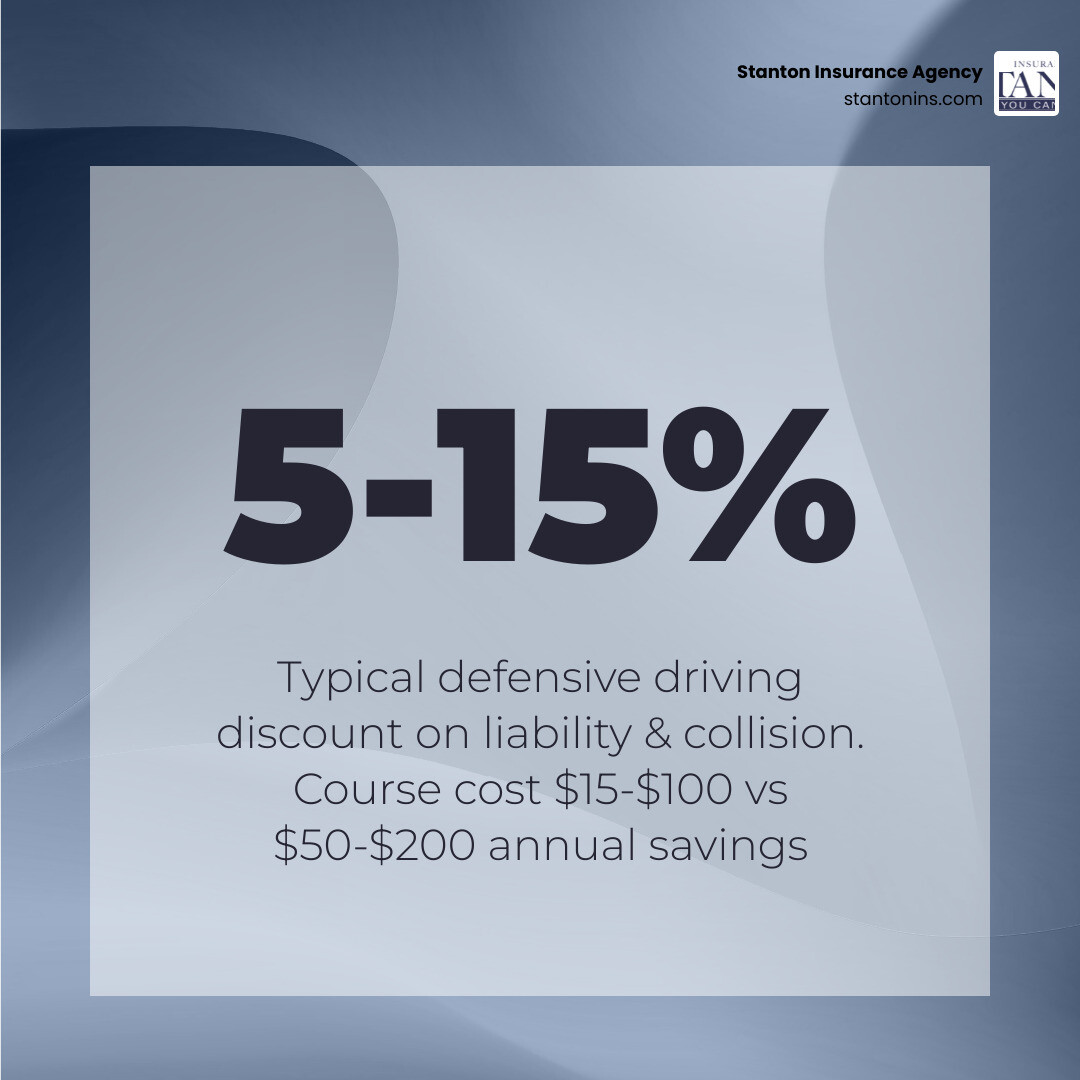
A course may still be very worthwhile even if the savings are modest. Across the broader market, defensive driving discounts often fall in the 5% to 15% range on applicable coverages, and many drivers save about $50 to $200 per year. Course costs commonly range from about $15 to $100, so the math often works in your favor.
Renewing Your Defensive driving discount
Most defensive driving discounts do not last forever. Usually, they last about three years.
After that, the discount often drops off automatically unless you:
- Retake an approved refresher course
- Submit a new certificate
- Meet any current eligibility rules at renewal
This catches people off guard all the time. They take the course once, enjoy lower premiums, and assume the discount will just stick around like a loyal golden retriever. It usually does not.
We recommend setting a reminder 60 to 90 days before the three-year mark so you have time to:
- Confirm the current approved provider list
- Recheck your insurer’s requirements
- Complete the course before renewal
- Send in your updated certificate
If you miss the deadline, the discount usually returns only at the next eligible policy change or renewal after the new proof is processed.
Maximizing Your Defensive driving discount with Other Savings
A defensive driving course works even better when paired with other discounts and smart coverage choices.

Ways to stack your savings may include:
- Bundling auto with home or renters insurance
- Maintaining a clean driving history
- Enrolling in a telematics or usage-based program
- Qualifying for low-mileage credits
- Reviewing deductibles and coverage limits carefully
- Insuring multiple vehicles on one policy
If you want a stronger foundation before comparing discounts, start with Car Insurance 101: Your Complete Guide to Coverage. Understanding what each part of your policy does makes it easier to judge whether a 5% or 10% discount is being applied where it matters most.
And if your goal is simply to lower costs without cutting important protection, our guide on 10 Auto Insurance Cost Hacks That Save Money is packed with practical ideas.
Step-by-Step Guide to Claiming Your Savings
Here is the simplest way to pursue a defensive driving discount in Massachusetts or New Hampshire.
1. Ask us or your insurer if the discount is available
Before paying for a course, confirm:
- Whether your policy qualifies
- Whether age restrictions apply
- Which providers are accepted
- Whether online classes count
- Which coverages receive the discount
- How long the discount lasts
This step prevents the classic mistake of taking a perfectly good course that your carrier will not credit.
2. Choose an approved provider
Use trusted state or course-provider resources, including:
- Massachusetts Defensive Driving Course – AAA Northeast
- Massachusetts Defensive Driving Course – Register Now | NSC
- Driver Improvement Courses | NH Division of Motor Vehicles
- New Hampshire Defensive Driving Course – Register Now | NSC
If you are shopping for broader savings at the same time, our article on The Smart Shopper’s Playbook: Finding the Best Car Insurance Deals Online can help you compare your options more effectively.
3. Complete the course in full
Most defensive driving classes take about 4 to 8 hours. Some are self-paced online. Others are completed in one session.
Typical topics include:
- Crash prevention habits
- Speed and space management
- Adapting to weather and road conditions
- Sharing the road safely
- Fatigue, distraction, and impairment risks
Make sure you complete all required sections and pass any final quiz if one is required.
4. Save your completion certificate
When you finish, keep digital and paper copies if possible. Your insurer may ask for:
- Your full name
- Course provider name
- Date of completion
- Course approval details
- Certificate number
This is not the time to discover the PDF vanished into the same dimension as missing socks.
5. Submit proof promptly
Send your certificate according to your insurer’s preferred process. This may be through:
- An online customer portal
- Your local agent
- Standard mail, in some cases
The earlier you submit it, the better. Many insurers apply the discount at renewal, so timing matters.
6. Confirm the premium change
After the certificate is processed, review your updated declarations page or renewal paperwork. Check that:
- The discount appears
- The effective date is correct
- The right driver received the discount
- The savings match what you were told to expect
If anything looks off, ask for clarification right away.
7. Set a renewal reminder
As soon as the discount is applied, mark your calendar for the likely expiration date in three years. That one tiny habit can help you keep the savings going.
Frequently Asked Questions about Defensive Driving Discounts
How much can I typically save with a defensive driving course?
Most drivers see a premium reduction between 5% and 15% on applicable coverages like liability, collision, and personal injury protection. For an average annual policy, this translates to savings of $50 to $200 per year, often paying for the cost of the course within the first six months.
The exact amount depends on:
- Your insurer
- Your age
- Your state
- Your driving record
- Which coverages the discount applies to
- Your underlying premium
A 5% discount on a lower-cost policy may feel modest. A 10% or 15% discount on a larger premium can produce meaningful three-year savings.
Does a court-ordered course qualify for an insurance discount?
No, insurance companies typically require that the course be taken voluntarily to qualify for a discount. If you are mandated by a judge or the DMV to take a course for ticket dismissal or to avoid license suspension, that specific completion usually cannot be used to trigger a new premium discount.
When in doubt, ask before enrolling. This is one of the most common points of confusion.
How long does the defensive driving discount last?
In most states, including Massachusetts and New Hampshire, the discount remains active on your policy for three years. After this period, the discount will automatically drop off your renewal unless you retake an approved course and submit a new certificate of completion to your agent.
Some insurers may vary slightly on timing, but three years is the most common cycle.
Are online courses accepted, or do I need a classroom course?
Often, yes, online courses are accepted, but not always. The deciding factor is whether the course is approved by the state or accepted by your insurer. In Massachusetts and New Hampshire, both online and classroom options may be available depending on the provider and program.
Always verify acceptance before enrolling.
Are there states where defensive driving discounts are not available?
Yes. Industry research shows that some states do not offer these discounts broadly, or they do not require insurers to provide them. For Stanton Insurance Agency readers, the key point is that Massachusetts and New Hampshire do not have a simple one-size-fits-all statewide discount mandate. Availability depends heavily on the insurer and the approved course.
Are there benefits besides the insurance discount?
Yes. In some states, defensive driving courses can also help with point reduction or driver improvement requirements. Those rules are highly state-specific.
For Massachusetts and New Hampshire drivers, the biggest universal benefit is safer driving. Better hazard recognition, improved reaction habits, and more awareness of risky behavior can reduce the chance of accidents, claims, and rate increases later on. That benefit is harder to measure than a discount, but it matters just as much.
Conclusion
A defensive driving discount is one of the simplest ways to trim auto insurance costs while becoming a safer, more confident driver. In Massachusetts and New Hampshire, the rules are not always posted in giant flashing letters, which is exactly why many drivers miss the savings.
The good news is that the process is straightforward:
- Verify eligibility
- Choose an approved course
- Complete it voluntarily
- Submit your certificate
- Review your updated premium
- Renew the discount every three years
At Stanton Insurance Agency, we help clients look beyond the obvious and find practical ways to protect what matters while keeping costs under control. If you want trusted guidance, local expertise, and personalized help reviewing your auto coverage, Secure your customized auto insurance quote today.
