
Why Personal Liability Coverage Is the Most Important Part of Your Home Insurance
What is personal liability for home insurance is one of the most important questions any homeowner can ask — and the answer could protect everything you’ve worked to build.
Here’s the short answer:
Personal liability coverage (Coverage E) is the part of your homeowners insurance that pays for injuries or property damage you accidentally cause to others — including legal fees, medical bills, and court judgments — both on your property and anywhere in the world.
What it covers at a glance:
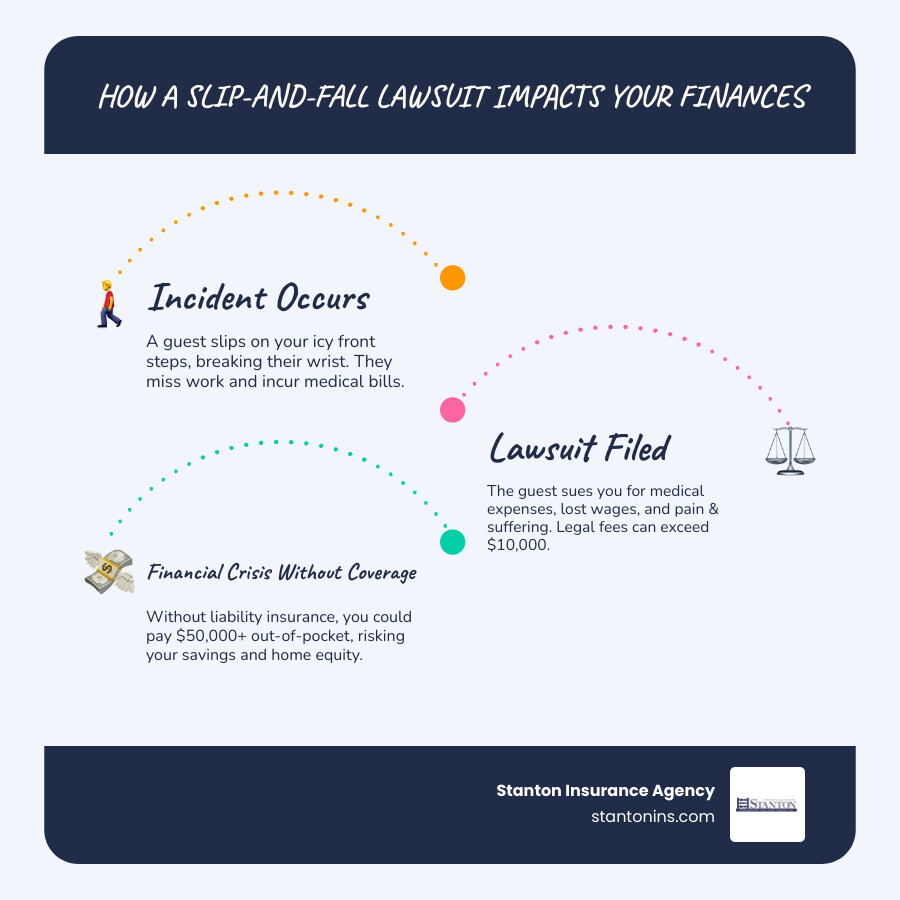
- A guest slips and falls on your front steps and sues you for medical bills and lost wages
- Your dog bites someone at the park
- A tree on your property falls and damages your neighbor’s roof
- You accidentally damage someone’s property while traveling
Key facts to know right away:
| Detail | |
|---|---|
| Standard coverage limit | $100,000 |
| Expert-recommended minimum | $300,000 |
| Maximum on most standard policies | $500,000 |
| Covers incidents off your property? | Yes — worldwide |
| Deductible required? | No |
Most homeowners don’t think about liability coverage until something goes wrong. By then, a single lawsuit can threaten your home, savings, and future income.
I’m Geoff Stanton, President of Stanton Insurance Agency in Waltham, Massachusetts, and a Certified Insurance Counselor (CIC) with over 25 years of experience helping homeowners understand what is personal liability for home insurance and how to choose the right limits. In that time, I’ve seen how the right liability coverage can be the difference between a manageable claim and a financial crisis.
Key what is personal liability for home insurance vocabulary:
- Personal Liability Insurance
- Personal Liability Umbrella Insurance Cost
- Liability Insurance 1 Million
What Is Personal Liability for Home Insurance?
When you buy a homeowners insurance policy, you are purchasing a package of coverages. Most people focus entirely on Section I, which protects the physical house (dwelling coverage) and the items inside it (personal property coverage). However, if a major accident occurs on your property, the physical damage to your home is often the least of your financial worries.
Section II of a standard homeowners policy focuses entirely on protecting you from legal and financial ruin. This section is where you will find What is Personal Liability in Home Insurance? protection, which is designed to step in when you or a resident family member are accused of causing bodily injury or property damage to someone else.
Most standard homeowners policies in Massachusetts and New Hampshire are written using standardized forms developed by the Insurance Services Office (ISO). This standard framework ensures that whether you live in Boston, Worcester, Concord, or Manchester, the core structure of your liability coverage remains highly consistent.
According to What Is Personal Liability Insurance?, one of the most surprising features of this coverage is its geographical versatility. It is not tied to the physical boundaries of your yard. Instead, personal liability coverage follows you, your resident relatives, and even your pets worldwide. If you are on vacation in Europe and accidentally knock over a priceless vase in a boutique, or if your dog breaks loose during a walk in a local park and injures a passerby, your home insurance liability coverage is there to protect you.
Defining What Is Personal Liability for Home Insurance (Coverage E)
To fully understand Personal Liability Coverage, we must break down its two primary components: Coverage E (Personal Liability) and the associated legal defense provisions.
When a claim is filed against you or you are sued, Coverage E serves two critical roles:
- Financial Indemnity: If you are found legally negligent for causing bodily injury or property damage to someone who does not live in your household, Coverage E pays the actual damages. This includes medical bills, physical therapy, lost wages for the injured party, and costs to repair or replace damaged property.
- Legal Defense: Perhaps even more importantly, your insurer will pay for your legal representation. The cost of hiring a defense attorney, paying court fees, and managing depositions can easily reach tens of thousands of dollars before a case even goes to trial. Your policy covers these defense costs in addition to your policy limit, meaning your legal fees won’t drain the pool of money available to settle the actual claim.
Coverage E vs. Coverage F: Liability vs. Medical Payments
A common point of confusion for homeowners is the difference between Coverage E (Personal Liability) and Coverage F (Medical Payments to Others). Both live within Section II of your homeowners policy, but they operate under completely different rules.
According to the Free Homeowners Policy Concepts Study Guide – New Hampshire Property & Casualty Exam, the easiest way to distinguish between the two is to look at fault.
- Coverage E (Personal Liability) is fault-based. For Coverage E to pay out, you must be found legally liable or negligent for the injury or damage. Because lawsuits and serious injuries require significant investigation, Coverage E handles large, adversarial claims.
- Coverage F (Medical Payments to Others) is no-fault coverage. It is designed to act as a friendly, immediate buffer for minor injuries that occur on your property. If a guest trips over a rug at your home and needs a few stitches, Coverage F will pay their medical bills directly, up to a small limit (typically $1,000 to $5,000), regardless of who was at fault. This quick, hassle-free payout often resolves small incidents before they escalate into formal lawsuits.
Here is a side-by-side comparison to help you see how these two coverages work in tandem:
| Feature | Coverage E: Personal Liability | Coverage F: Medical Payments |
|---|---|---|
| Primary Purpose | Protects your assets from lawsuits and large claims | Quickly settles minor medical claims to prevent lawsuits |
| Fault Required? | Yes, you must be legally negligent or liable | No, pays regardless of who is at fault |
| Typical Limits | $100,000 to $500,000 | $1,000 to $5,000 |
| Legal Defense Included? | Yes, insurer provides and pays for your lawyer | No legal defense is involved |
| Who Receives Payout? | The injured third party (via settlement or judgment) | The injured third party (directly for medical bills) |
What Does Personal Liability Insurance Cover?
Now that we have defined the framework, let’s look at how personal liability coverage applies in the real world. According to the Personal Liability Insurance Complete Guide, there are several common scenarios where this coverage is triggered:
- Slip-and-Fall Accidents: A classic example is a guest slipping on an icy driveway during a New England winter or tripping on a loose stair railing on your porch. If they break a bone, require surgery, and sue you for their medical expenses and lost wages, your liability coverage steps in.
- Dog Bites and Animal Liability: If your family dog bites a neighbor or knocks over an elderly person during a walk, causing an injury, you can be held strictly liable. Dog-related claims are among the most common and expensive liability claims nationwide.
- Property Damage to Others: If you are trimming a tree branch in your backyard and it crashes through your neighbor’s roof, or if your child accidentally throws a baseball through an expensive custom window next door, your policy covers the repair costs.
- Accidents Away From Home: If you are golfing at a course in New Hampshire and accidentally hit another golfer with an errant ball, or if you bump into someone on a crowded sidewalk and cause them to fall and injure themselves, your worldwide coverage applies.
According to What Is Personal Liability Insurance For Homeowners?, these real-world scenarios highlight why having adequate coverage is so critical. A single lapse in maintenance or a simple accident can instantly result in tens of thousands of dollars in medical and legal bills.
Legal Defense and Court Costs Coverage
One of the most valuable, yet frequently overlooked, benefits of personal liability insurance is the “duty to defend” clause.
Under standard insurance policies, your insurance company is legally obligated to defend you in court against any covered claim, even if the lawsuit against you is completely groundless, false, or fraudulent. For example, if a solicitor claims they fell on your sidewalk on a day when your security cameras prove no one visited your home, your insurer will still hire an attorney to represent you and get the case dismissed.
Furthermore, the legal defense costs are paid in addition to your policy limits. If you have a $300,000 liability limit and your insurer spends $50,000 on lawyers and court costs to defend you, your full $300,000 limit is still completely intact to pay any final settlement or judgment.
While local regulations can vary, standard policy frameworks across New England mirror these strict protections. For instance, legal standards in Massachusetts and New Hampshire, which align with provisions like 14VAC5-342-90. Personal liability coverage., outline that additional payments—such as court costs, pre-judgment interest, and even up to $250 for bail bonds or $50 a day for your loss of earnings when attending hearings at the insurer’s request—must be covered by the insurer over and above the policy’s liability limit. This ensures that the process of defending yourself in court does not bankrupt you.
What is Not Covered by Personal Liability Insurance?
While personal liability insurance is incredibly broad, it does have strict boundaries. It is designed to cover accidental, non-auto, non-business injuries to third parties.
To avoid unexpected gaps in your protection, it is vital to understand the primary exclusions built into a standard Homeowners Insurance policy:
- Intentional Injury or Damage: If you or a member of your household intentionally injures someone or damages their property, insurance will not pay. For example, if an altercation occurs and someone is physically harmed intentionally, liability coverage is completely void. Additionally, standard policies exclude intentional damage caused by any insured who is 13 years of age or older.
- Business Pursuits: Personal liability insurance is strictly personal. If you run a daycare out of your home, operate a consulting business, or see clients on your property, any injuries or damages arising from those business activities are excluded. You need dedicated commercial general liability insurance or an endorsement to cover home-based business risks.
- Auto Accidents: Any injuries or property damage resulting from the ownership, maintenance, or use of a motor vehicle are excluded. These claims must be handled by your auto insurance policy.
- Injuries to Household Residents: Personal liability coverage is designed to protect you from claims made by others. It does not cover injuries sustained by you, your spouse, or your children who live in your home. If your child falls down your stairs, their medical bills are covered by your health insurance, not your homeowners liability coverage.
- Contagious Diseases: Standard policies exclude liability arising from the transmission of contagious diseases.
- Specific Dog Breeds or Trampoline/Pool Exclusions: Depending on your specific carrier in Massachusetts or New Hampshire, certain high-risk items like trampolines or slide-equipped pools may be excluded unless specifically disclosed. Similarly, some insurers maintain list exclusions for specific dog breeds.
How Much Personal Liability Coverage Do I Need?
Determining how much personal liability coverage you need is one of the most critical decisions you will make when structuring your insurance portfolio.
A common and highly dangerous mistake is assuming that the standard liability limit included in your policy is automatically enough. Most standard homeowners policies default to $100,000 in personal liability coverage. While $100,000 sounds like a substantial amount of money, it can be exhausted in a matter of days if someone suffers a severe injury on your property.
Consider this: if a guest slips on your icy steps, requires spinal surgery, and misses six months of work, their medical bills and lost wages could easily exceed $200,000. If your policy limit is only $100,000, you are personally responsible for paying the remaining $100,000 balance out of your own pocket. This means your savings, investments, and even your home equity are at risk.
According to How much personal liability coverage do I need?, a great rule of thumb is to match your personal liability limit to your total net worth. Your net worth includes:
- The equity in your home
- Your savings and checking accounts
- Retirement accounts (IRAs, 401ks)
- Investments and college savings funds
- Future earnings and income streams
If your total assets exceed your liability limits, you are underinsured and exposed to devastating lawsuits.
Determining What Is Personal Liability for Home Insurance Limit Requirements
When looking at the numbers, the cost to increase your liability limits is incredibly affordable. According to the Personal Liability Insurance Cost Guide, jumping from the standard $100,000 limit to the expert-recommended minimum of $300,000 or even the policy maximum of $500,000 usually only costs an extra $20 to $50 per year.
Given how inexpensive it is to secure five times the amount of protection, carrying only the bare minimum is an unnecessary risk for any homeowner in Massachusetts or New Hampshire.
Extending Protection with Umbrella Insurance
What happens if your net worth is greater than $500,000? Standard homeowners policies generally cap their personal liability limits at $500,000. If your home equity, retirement accounts, and other assets exceed this amount, you need an extra layer of protection.
This is where a What is Umbrella Insurance? policy comes into play. An umbrella policy acts as an extra safety net that sits on top of your primary homeowners and auto insurance policies.
If you are sued for a major accident and the judgment exceeds your homeowners liability limit, your umbrella policy kicks in to cover the rest, typically starting at $1 million in coverage and going up from there.
According to Personal Liability Umbrella Insurance Cost, umbrella insurance is highly cost-effective. Because it only pays out after your primary policy limits are completely exhausted, a $1 million umbrella policy typically costs around $400 per year. It also provides broader coverage, protecting you against risks not covered by standard home policies, such as libel, slander, false arrest, and invasion of privacy.
Frequently Asked Questions About Home Insurance Liability
Do I need to pay a deductible for personal liability claims?
No. Unlike the property damage sections of your homeowners policy (Coverage A and Coverage C), where you must pay a deductible (such as $1,000 or $2,500) before your insurer pays to repair your home, there is no deductible for personal liability claims.
If a claim is covered under Coverage E or Coverage F, your insurance company will pay the injured party or cover your legal defense costs starting from the very first dollar, up to your policy limit.
Does personal liability cover dog bites off my property?
Yes, in most cases. Because personal liability insurance provides worldwide, off-premises coverage, your liability protection follows your dog. If your dog bites someone while you are walking them in a public park, or if they escape your yard and injure a neighbor down the street, your homeowners liability coverage will pay for the injured party’s medical bills and your legal defense if you are sued.
However, it is vital to check with your agent to ensure your specific dog breed is not excluded from your policy, as some insurance carriers maintain strict breed restriction lists.
How does renters personal liability compare to homeowners liability?
Renters insurance and homeowners insurance handle personal liability in a very similar way. Just like a homeowners policy, a renters policy includes personal liability coverage (Coverage E) that protects you if you are negligent for causing bodily injury or property damage to others.
According to What is Personal Liability Insurance for Renters?, renters need liability insurance just as much as homeowners do. While a tenant does not own the physical building, they can still be held legally responsible if a guest slips on a spilled liquid inside their apartment, or if they accidentally cause a fire that damages the landlord’s property and neighboring units.
Conclusion
Understanding what is personal liability for home insurance is the first step toward building a secure financial plan. Your home is likely your most valuable physical asset, but your savings, investments, and future income are what fund your life. A single accidental lawsuit should not be allowed to sweep all of that away.
At Stanton Insurance Agency, we have been helping families across Massachusetts and New Hampshire protect their hard-earned assets for decades. We believe in providing clear, honest advice and tailored insurance solutions that fit your unique lifestyle.
Whether you need to review your current homeowners policy, increase your liability limits, or explore the added security of an umbrella policy, we are here to help. Contact us today to secure the peace of mind you deserve.
Ready to protect your home and your future? Explore our Personal Insurance/Home Insurance options or reach out to our team of experienced advisors to get a personalized quote today.