
Navigating Teen Driver Insurance: Why Are Rates So High?
Getting your teenager their driver’s license is a huge milestone, but the sudden jump in your auto premium can be a massive financial shock. If you need a quick answer on how to handle teen driver insurance without breaking the bank, here is the bottom line:
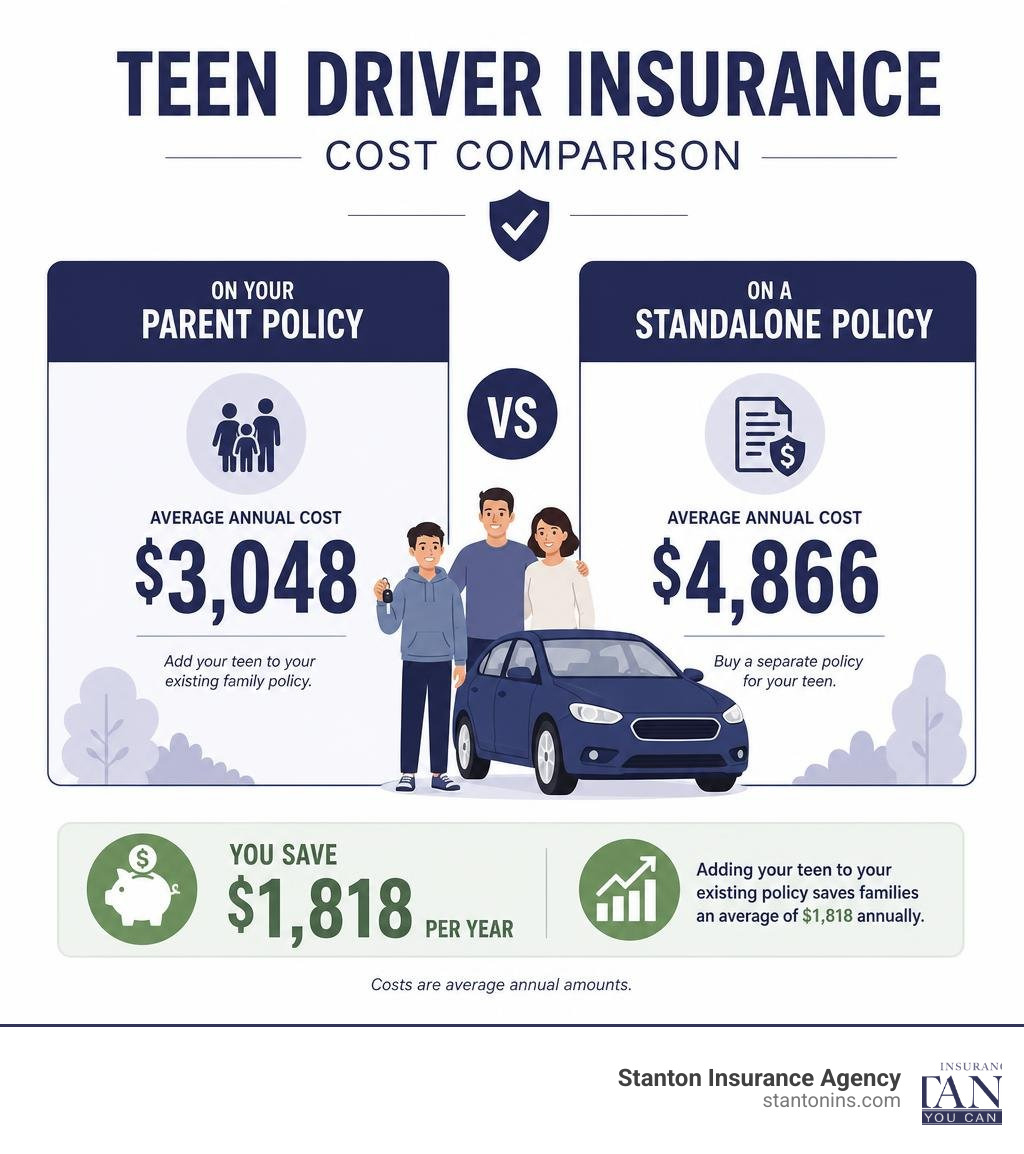
- Always add your teen to your existing policy. Buying a separate standalone policy for a teen costs an average of $4,866 per year, while adding them to your family policy costs about $3,048. This simple move saves families an average of $1,818 annually.
- Stack your discounts. You can offset up to 40% of the teen surcharge by combining a Good Student discount (5% to 15% off for maintaining a B average) with defensive driving courses and telematics programs.
- Keep the car title in your name. If you buy your teen a vehicle and title it in their name, many states will force you to purchase a costly standalone policy. Keep the title in your name to qualify for multi-car and family rates.
I am Geoff Stanton, President of Stanton Insurance Agency in Waltham, Massachusetts. As a Certified Insurance Counselor with over 25 years of experience in the insurance industry, I help local families navigate the complex world of teen driver insurance to find the perfect balance of robust liability protection and affordable rates.
Let’s look at how the math breaks down when managing your new driver’s coverage.
To find ways to save on your premium, it helps to understand why insurance companies charge so much for young motorists. Insurers rely on systemic risk patterns rather than individual driving history when pricing policies for newly licensed drivers. Because teenagers have no track record behind the wheel, they are placed into the highest risk tier.
The statistics justifying these high rates are stark:
- Teen drivers ages 16–17 have a motor vehicle crash rate more than double that of drivers ages 20–30 per 100 million miles driven.
- Approximately 20% of teen drivers experience an accident within their first year of solo driving.
- Distracted driving losses among motorists under the age of 20 account for 9% of all bodily injury claims, despite this age group representing only 3% of licensed drivers.
- Research shows that 6 out of 10 teen crashes involve some form of driver distraction, and 39% of high school students admit to texting or emailing while behind the wheel.
Because of these systemic risks, insuring a brand-new driver is often more expensive than insuring an experienced driver with a major violation on their record. According to Bankrate’s teen insurance cost analysis, a married couple pays an average of $2,515 per year for full coverage. Adding a 16-year-old to that policy causes the premium to jump by an average of $3,225, bringing the total to $5,740 annually.
To put this in perspective, a driver with a clean record who receives a DUI conviction faces an average annual premium of $5,287—which is $454 less than the cost of insuring an accident-free 16-year-old. Insurers view the prospective, systemic risk of an inexperienced teenager as a greater financial liability than the behavioral risk of an adult with a serious traffic violation.
Understanding these dynamics is key to planning your overall Auto Insurance Cost. When we look at how risk is assessed, we can better prepare for the financial transition of adding a young driver to our household.
Parent Policy vs. Standalone Policy: The Real Math
When your teen passes their road test, you face an immediate decision: should you add them to your existing household policy, or should they purchase their own standalone coverage?
For almost every family, the math points to a clear winner. Adding a teen driver to a family policy costs an average of $3,048 annually, compared to a staggering $4,866 per year for a separate, individual policy. By keeping your teen on your policy, they benefit from your established driving history, multi-car discounts, and bundled policy savings.
A standalone policy for a 16-year-old typically ranges from $4,500 to over $8,000 annually because the teen must carry the risk entirely on their own. Furthermore, if the vehicle’s title is registered in the teen’s name, many states—including Massachusetts—will force them to have a separate policy. Keeping the vehicle titled in the parent’s name is one of the easiest ways to ensure you can keep them on the family plan.
To help you visualize the financial difference, review our guide to young driver car insurance and consider the comparison below:
| Policy Structure | Average Annual Cost | Key Advantages | Key Disadvantages |
|---|---|---|---|
| Adding Teen to Parent Policy | $3,048 | Leverages parent’s good credit and driving history; qualifies for multi-car and bundling discounts. | Parent’s policy is vulnerable to rate hikes if the teen has an at-fault accident. |
| Standalone Teen Policy | $4,866 | Protects the parent’s policy from rate increases if the teen has an accident. | Significantly higher premiums; teen must qualify for coverage on their own. |
For families looking at the broader picture, the choice is clear. Unless there are extreme circumstances—such as a teen owning a high-value luxury vehicle independently—staying on the family policy is the most financially sensible route. You can explore more about these structural differences in WalletGrower’s teen car insurance breakdown.
How Age, Gender, and Geography Impact Teen Rates
Teen insurance rates are not static; they evolve as your driver gains experience. On average, rates drop by approximately 10% when a driver turns 19, 5% at age 20, and another 6% at age 21. By the time a driver reaches their mid-twenties with a clean record, their premiums will have decreased by 40% to 60% compared to their 16-year-old baseline.
Gender also plays a role in pricing, though its impact depends heavily on where you live. Nationally, the average monthly cost of car insurance is $614 for male teens and $580 for female teens, reflecting statistical trends that show young males are more likely to engage in risky driving behaviors. However, if you live in Massachusetts, state law prohibits insurers from using gender as a rating factor. In New Hampshire, gender remains a permissible rating variable.
Geography also dictates your coverage requirements. In Massachusetts, you must carry compulsory state minimum liability limits, which include $20,000 per person and $40,000 per accident for bodily injury. However, relying on these bare minimums is highly risky when insuring a teen. If your teen causes a multi-vehicle accident, those limits can be exhausted in minutes, leaving your personal assets exposed.
In New Hampshire, auto insurance is not compulsory, but drivers must demonstrate “financial responsibility” if they are at fault in an accident. For practical purposes, carrying robust liability coverage is just as essential in the Granite State. To understand how to protect your family assets, read about state minimum liability limits and why they are rarely enough for households with young drivers. If you want to dive deeper into coverage limits, check out our guide on how much liability insurance do I need for my car.
For a deeper dive into how these regional and demographic factors influence pricing, you can explore MoneyGeek’s guide to cheap teen coverage.
Smart Strategies to Lower Your Premiums
While the baseline costs of insuring a young driver are high, parents are not powerless. By combining behavioral incentives with smart policy adjustments, you can significantly reduce your monthly premiums.

Stacking Discounts on Teen Driver Insurance
The most effective way to combat rising premiums is to stack multiple discounts. Insurers offer several programs designed to reward safe habits and academic achievement:
- The Good Student Discount: Most insurance companies offer a 5% to 15% discount for full-time students who maintain a “B” average (3.0 GPA) or higher. Be sure to set a calendar reminder to resubmit your teen’s report card or transcript every six months, as automated systems may remove this discount mid-policy if verification is not received.
- Driver’s Education and Defensive Driving: Completing a state-approved driver’s education course is highly recommended. In Massachusetts, completing a certified program is a prerequisite for licensing under the Junior Operator License (JOL) law and can yield a 5% to 10% discount. You can review the official Mass.gov teen driving safety guidelines for more information on approved training. Additionally, taking advantage of defensive driving discounts for all household drivers can lower your overall premium.
- Telematics and Usage-Based Insurance: Enrolling your teen in a telematics program—where a mobile app or plug-in device monitors speed, braking, and phone distraction—can yield immediate savings of 15% to 30%. However, these programs require consistent participation. If your teen disables the app or turns off location services, the discount may be removed at your next renewal.
- Distant Student Discount: If your teen goes away to college (typically 100 miles or more from home) and leaves the family car behind, you can notify your insurer to receive a “student away at school” discount of 10% to 25% while keeping them covered when they return for school breaks.
Utilizing a Defensive driving discount is one of the most reliable ways to see immediate relief on your monthly statement.
Policy Adjustments and Vehicle Choice for Teen Driver Insurance
Beyond discounts, how you structure your policy and the vehicles you choose will have a massive impact on your bottom line.

- Choose the Right Vehicle: It can be tempting to buy your teen a cheap, older vehicle, but older cars lack modern safety features like electronic stability control and side-curtain airbags, which can actually drive insurance rates up. Conversely, high-performance sports cars or large SUVs with high rollover risks are incredibly expensive to insure. The sweet spot is a safe, mid-sized sedan or crossover with top safety ratings.
- Understand Driver-Vehicle Assignment: Some insurance companies use a “household rating” model, where every driver is rated across all vehicles. Others use a “driver-vehicle assignment” model, where they automatically assign the highest-risk driver (your teen) to the most expensive vehicle on the policy. If your insurer allows it, explicitly assign your teen to the oldest, lowest-value vehicle on your policy. This can reduce your comprehensive and collision premiums by 30% to 40%.
- Adjust Your Deductibles: Raising your comprehensive and collision deductibles from $500 to $1,000 can lower your physical damage premium by 8% to 12%. If your teen is driving an older vehicle worth less than $5,000, you may want to consider dropping collision and comprehensive coverage entirely, as the cost of the coverage may exceed the potential payout in a total loss. To learn more about balancing these options, read our comparison of full coverage vs. liability car insurance.
- Utilize Cost Hacks: There are several other structural adjustments you can make to your policy to find hidden savings. For a comprehensive list of strategies, check out these auto insurance cost hacks.
The 2025–2026 Rate Forecast: What Families Must Do Now
The insurance market has undergone significant changes over the last two years. In 2024, teen driver insurance rates rose by an average of 14% nationally. This upward trend continued through 2025 and into 2026, driven by a 22% increase in claims severity inflation since 2022. Advanced safety technologies—like cameras and radar sensors embedded in bumpers and windshields—have made minor fender-benders significantly more expensive to repair.
To protect your household from ongoing rate increases, families should take a proactive, step-by-step approach to optimize their coverage and secure the best available rates.
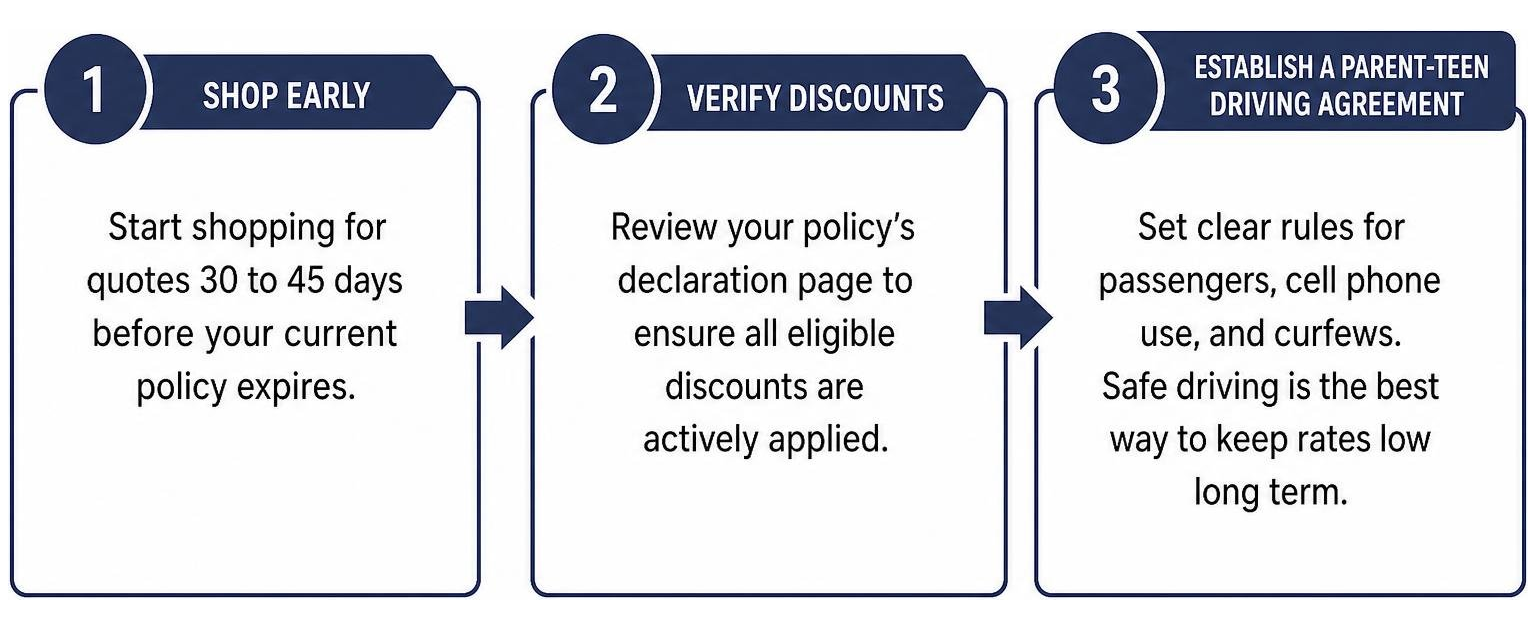
- Shop Early: Do not wait for your renewal bill to arrive. Start shopping for quotes 30 to 45 days before your current policy expires.
- Verify Your Discounts: Review your policy’s declaration page to ensure that all eligible discounts—such as good student, paperless billing, and multi-policy bundling—are actively applied.
- Establish a Parent-Teen Driving Agreement: Set clear rules regarding passenger limits, cell phone use, and curfews. Safe driving is the single best way to keep your insurance rates low over the long term, as an at-fault accident can increase your premiums by 20% to 40% for three to five years.
For a complete overview of how to prepare your household for these changes, read our comprehensive teen driver insurance guide.
Frequently Asked Questions About Teen Driver Insurance
Do I have to add my teen driver to my policy as soon as they get their learner’s permit?
In most states, including Massachusetts and New Hampshire, you do not need to pay to add your teen to your policy while they only hold a learner’s permit. They are typically covered under the parent’s policy while driving with a licensed adult in the vehicle. However, you must notify your insurance company and formally add them to the policy as a rated driver the moment they receive their provisional or junior operator’s license.
What happens to my insurance rates if my teen gets a speeding ticket or has an accident?
An at-fault accident or a moving violation like a speeding ticket will cause your premiums to spike significantly. A single speeding ticket can increase a teen’s insurance cost to an average of $701 per month for males and $664 for females. To protect your family from these sudden increases, ask your insurance agent about adding “accident forgiveness” to your policy before your teen starts driving. To understand the baseline requirements for coverage, you can read the bare minimum: a driver’s guide to essential car insurance coverage.
How long can my child stay on my car insurance policy?
As long as your child lives in your household, they can remain on your auto insurance policy indefinitely. If they move away for college, they can also remain on your policy. However, once they permanently move out of your home and establish their own residence, they must purchase their own auto insurance policy registered at their new address.
Conclusion
Insuring a young driver is undoubtedly one of the most expensive phases of parenthood, but it does not have to break your family’s budget. By keeping your teen on your policy, choosing a safe and sensible vehicle, and aggressively stacking discounts like the good student and telematics programs, you can find the right balance between robust protection and affordable premiums.
At Stanton Insurance Agency, we specialize in helping families in Massachusetts and New Hampshire navigate these milestones. We understand the local insurance landscape and work with a wide network of top-rated carriers to find customized coverage that fits your household’s unique needs. Managing your Liability auto insurance cost doesn’t have to be a guessing game.
Ready to see how much you can save on your family’s auto policy? Contact Stanton Insurance Agency today to speak with a local agent and get a personalized quote.