
What to Do After a Car Accident: Filing an Auto Insurance Claim Explained
Filing an auto insurance claim doesn’t have to be overwhelming — but knowing the right steps matters.
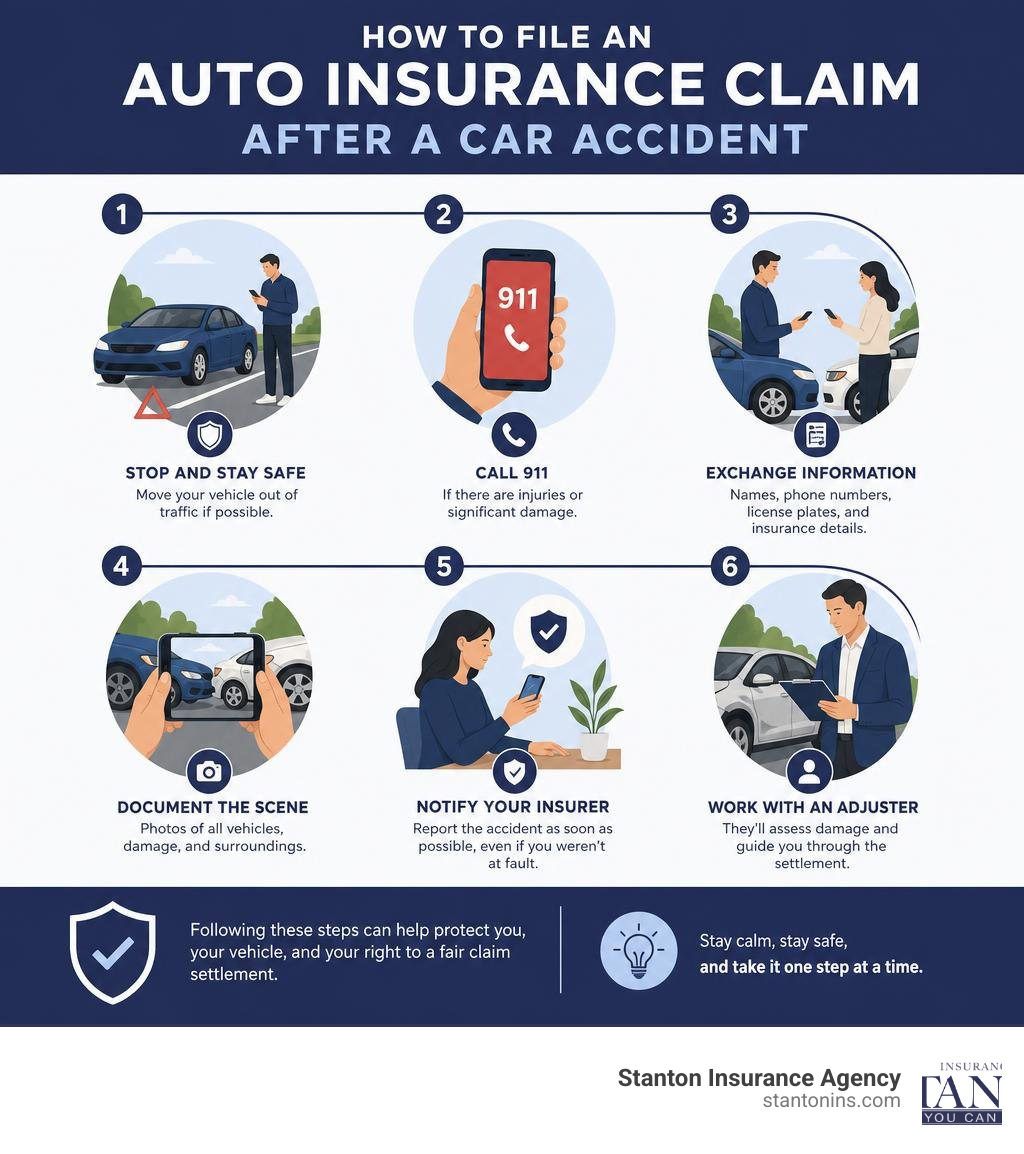
Here’s a quick overview so you can act fast:
- Stop and stay safe — move your vehicle out of traffic if possible
- Call 911 — if there are injuries or significant damage
- Exchange information — names, phone numbers, license plates, and insurance details
- Document the scene — photos of all vehicles, damage, and surroundings
- Notify your insurer — report the accident as soon as possible, even if you weren’t at fault
- Work with an adjuster — they’ll assess damage and guide you through the settlement
About 6 million car accidents happen in the U.S. every year. That’s millions of drivers suddenly needing to navigate a process they’ve never dealt with before — often while shaken and stressed. Most people buy auto insurance and never think about how to actually use it until the moment they need it most.
The good news? Once you know the steps, the process is straightforward.
I’m Geoff Stanton, President of Stanton Insurance Agency in Waltham, Massachusetts — I’ve been working in the claims department since 1999, which means I’ve spent over two decades helping drivers just like you through filing an auto insurance claim. In the sections below, I’ll walk you through everything you need to know, from the scene of the accident to your final settlement.
Simple filing auto insurance claim word guide:
Immediate Steps to Take After a Car Accident
The moments directly following an accident are often chaotic, but taking the correct steps immediately is vital. Your safety and your legal rights depend on what you do on the road.
First, prioritize safety. If the accident is minor and there are no serious injuries, move your vehicle to the side of the road, out of the path of oncoming traffic. Turn on your hazard lights. If you cannot move your vehicle, stay inside with your seatbelt fastened until emergency responders arrive, or move safely to a sidewalk.
Once you are out of immediate danger, call the police. Even for a minor fender bender, a police report is an invaluable piece of evidence when filing auto insurance claim details later. In Massachusetts and New Hampshire, having a law enforcement officer document the scene prevents disputes about what actually happened.

While waiting for the police, collect essential evidence:
- Exchange Information: Get the other driver’s name, address, phone number, driver’s license number, and license plate. Note their insurance company and policy number exactly as written on their insurance card.
- Document the Scene: Take clear photos and videos of the damage to all vehicles involved, the position of the cars, any skid marks, street signs, traffic lights, and current weather conditions.
- Gather Witness Details: If anyone saw the accident, ask for their name and contact information. Their unbiased statements can be crucial if fault is disputed.
- Avoid Admitting Fault: Keep conversations with the other driver polite but brief. Do not apologize or say “it was my fault,” as this can be used against you during the insurance investigation.
For a detailed look at navigating legal and medical steps immediately following a crash in the Boston area, you can read more from How to File an Auto Insurance Claim – Burns Jain Law .
Your Guide to Filing Auto Insurance Claim Fast
Once you are safely home, it is time to start the claims process. Over 80% of auto insurance claims are now filed online or via mobile apps, reflecting a massive shift toward digital claims processes. This digital evolution means you can submit photos, track your claim status, and communicate with your adjuster directly from your smartphone, significantly speeding up the timeline.
Before you submit anything, review your auto insurance policy. Understanding what coverages you have, what your deductibles are, and whether you have optional coverages like rental car reimbursement will help you set realistic expectations. For a comprehensive overview of how the entire claims lifecycle works from start to finish, refer to our Auto Insurance Accident Claim Complete Guide.

When you are ready to file, you will need to choose whether you are filing a first-party claim or a third-party claim. Let’s break down how these two paths differ.
Filing Auto Insurance Claim with Your Own Insurer (First-Party)
A first-party claim is one that you file directly with your own insurance provider. You typically utilize this option when you are at fault for an accident, when the accident was caused by an act of nature, or when you want your own insurer to handle the repairs quickly and subrogate against the at-fault driver’s insurance later.
Under your own policy, two primary coverages pay for physical damage to your vehicle:
- Collision Coverage: This pays to repair or replace your vehicle if it is damaged in a collision with another car or an object (like a tree or guardrail). If you hit an animal, however, the rules change. You can learn more about how physical damage coverage applies in specific wildlife scenarios by reading Does Hitting A Deer Fall Under Collision Coverage.
- Comprehensive Coverage: This covers damage caused by events outside your control, such as theft, vandalism, fire, weather events, or falling objects.
If you are injured in Massachusetts, which is a no-fault auto insurance state, your medical bills will initially be covered under your policy’s Personal Injury Protection (PIP) coverage. PIP pays for medical expenses, lost wages, and replacement services regardless of who caused the accident. New Hampshire, on the other hand, is not a traditional no-fault state, but drivers often carry Medical Payments (MedPay) coverage to handle immediate medical bills.
To understand how medical coverage interacts with other protective coverages on your policy, read our guide on the Difference Between PIP And Uninsured Motorist Coverage. While Massachusetts and New Hampshire have their own specific regulations, you can review general consumer guidance such as the Filing Claims Under Your Own Policy | Department of Financial Services to see how state departments typically outline these rights.
Filing Auto Insurance Claim with the Other Driver’s Insurer (Third-Party)
If another driver caused the accident, you have the right to file a third-party claim directly with their insurance company. In this scenario, you are seeking compensation from their liability coverages:
- Property Damage Liability: Pays for the repairs to your vehicle and any other property you own that was damaged in the crash.
- Bodily Injury Liability: Pays for your medical bills, lost wages, and pain and suffering resulting from injuries caused by their negligence.
The primary benefit of filing a third-party claim is that you do not have to pay your own deductible. However, the process can sometimes take longer because the other insurer must investigate the accident and officially accept liability before they will authorize payments for repairs or a rental car.
If the at-fault driver is driving without insurance or does not have enough coverage to pay for your damages, you will need to rely on your own policy’s uninsured or underinsured motorist coverages. To learn how to protect yourself against these drivers, check out our resource on Uninsured Motorist Coverage 101.
How Insurers Determine Fault and Assess Vehicle Damage
After a claim is filed, the insurance company assigns an insurance adjuster to investigate the incident. The adjuster’s job is to determine who was at fault and calculate the financial value of the physical damage.
To determine fault, adjusters review the police report, take recorded statements from both drivers, interview witnesses, analyze the physical damage patterns on the vehicles, and review any available traffic camera or dashcam footage.
Both Massachusetts and New Hampshire operate under modified comparative negligence rules (specifically the 51% bar). This means you can recover damages from the other driver as long as you are 50% or less at fault for the accident. However, your financial recovery will be reduced by your percentage of fault. For example, if your vehicle sustained $10,000 in damage, but the adjuster determines you were 20% at fault for failing to signal, you would only receive $8,000 from the other driver’s insurer.
To help you understand how different financial components work together during this assessment, we have put together this comparison table:
| Insurance Component | Who Pays / How It Works | Impact on Your Out-of-Pocket Costs |
|---|---|---|
| Deductible | The amount you pay out of pocket before your first-party collision or comprehensive coverage kicks in. | You must pay this directly to the repair shop. If you file a successful third-party claim, no deductible applies. |
| Rental Car Reimbursement | Optional coverage on your policy that pays for a rental vehicle while yours is being repaired. | Pays up to a daily limit (e.g., $30/day). If you are not at fault, the other driver’s liability insurance may reimburse this cost directly. |
| Subrogation | The legal process where your insurer pays for your repairs, then pursues the at-fault driver’s insurer for reimbursement. | If successful, your insurer will refund your paid deductible proportionally based on the recovery. |
Once fault is established, the adjuster will write an estimate for the repairs. Many insurers now utilize virtual estimation tools, allowing you to upload photos of the damage via a mobile app to receive an initial repair estimate within 48 hours. For more official answers to common questions about how claims are assessed in Massachusetts, you can read the Frequently Asked Questions about Auto Insurance Claims – Mass.gov or review the claim guidelines provided by Auto claims – Mapfre Insurance .
Your Rights: Repair Shops, Aftermarket Parts, and Total Losses
When it comes to getting your vehicle fixed, you have specific consumer rights in both Massachusetts and New Hampshire that you should be aware of.
- Choice of Repair Shop: You have the absolute right to choose any licensed repair shop you want. While your insurance company may recommend a network of “preferred” repair shops (which often offer guaranteed completion dates and lifetime warranties on their work), they cannot force you to use them. If you choose an independent shop that charges higher labor rates than the insurer’s standard regional rates, you may be responsible for paying the difference.
- Use of Aftermarket Parts: Insurance estimates are often calculated using “quality replacement parts” (also known as aftermarket or non-OEM parts) rather than Original Equipment Manufacturer (OEM) parts from your vehicle’s maker. Insurers are legally allowed to use these parts as long as they are equal in fit, quality, performance, and warranty to the original parts. If you insist on OEM parts for an older vehicle, you may have to pay the price difference out of pocket.
- Total Loss Determinations: If the cost of repairing your vehicle plus its salvage value exceeds a certain percentage of the vehicle’s pre-accident value (typically 75% to 80%), the insurer will declare the car a total loss. Instead of repairing it, they will pay you the Actual Cash Value (ACV) of the vehicle, minus any applicable deductible. ACV is defined as the fair market value of the car immediately before the crash, taking into account its age, mileage, wear and tear, and local market conditions.
- Diminished Value: Even after high-quality repairs, a vehicle that has been in an accident naturally loses resale value because of its accident history. If you were not at fault, you may be eligible to file a claim for this loss in value. To learn how this works, read our guide on the Automobile Diminished Value Claim.
Timelines, Deadlines, and Disagreeing with a Settlement Offer
The average time to settle a straightforward auto insurance claim in the United States is about 30 to 45 days. However, complex cases involving severe bodily injuries, disputed liability, or specialized vehicle parts can take significantly longer.
It is critical to be mindful of state-enforced deadlines, known as the statute of limitations. If you need to file a lawsuit to recover damages after an accident, you must do so within these strict timeframes:
- Massachusetts: 3 years from the date of the accident for both bodily injury and property damage claims.
- New Hampshire: 3 years from the date of the accident for both bodily injury and property damage claims.
If you disagree with the insurance company’s settlement offer—whether they are offering too little for your repairs or lowballing the actual cash value of your totaled vehicle—you have several avenues for dispute resolution:
- The Appraisal Clause: Most policies contain an appraisal provision. Under this clause, you and the insurance company each hire an independent appraiser. These two appraisers then select an umpire. A damage valuation agreed to by any two of these three individuals becomes binding.
- Mediation or State Complaints: If you believe your insurer is acting in bad faith or violating state fair claims practices, you can file an official complaint. For drivers in New Hampshire, you can access consumer resources through the New Hampshire Insurance Department or submit an official dispute directly via Filing a Complaint | New Hampshire Insurance Department – NH.gov . For local legal context on filing claims in NH, you can also review How to File a Car Accident Claim in New Hampshire .
Common Mistakes to Avoid When Filing a Claim
Filing a claim can be stressful, making it easy to make simple mistakes that can delay your payout or even lead to a claim denial. Here are the most common pitfalls to avoid:
- Delayed Reporting: Waiting too long to report an accident to your insurer can raise red flags. It gives the insurance company reason to believe the damage might have occurred after the accident or that you failed to protect the vehicle from further damage.
- Inadequate Documentation: Relying on memory instead of taking photos, gathering witness info, and obtaining a police report can severely hurt your claim if the other driver changes their story later.
- Admitting Fault at the Scene: Saying “I’m sorry” or telling the other driver “I didn’t see you” before an official investigation is completed can legally bind you to liability, even if the other driver was actually the one violating traffic laws.
- Ignoring Policy Limits and Deductibles: Assuming your policy covers everything without checking your declarations page can lead to unexpected out-of-pocket expenses.
- Failing to Mitigate Damage: If your car has a broken window after an accident and you leave it parked in the rain, causing severe water damage to the interior, the insurance company will likely deny coverage for the water damage because you failed to protect the vehicle from further loss.
Frequently Asked Questions about Auto Insurance Claims
Navigating the aftermath of a car accident often brings up many questions. Here are some of the most common questions we hear from drivers in Massachusetts and New Hampshire.
How long do I have to file a car insurance claim in Massachusetts and New Hampshire?
While the legal statute of limitations to file a lawsuit is three years in both states, your insurance policy requires you to report any accident “promptly” or “within a reasonable timeframe.” Delaying the report can result in your insurance company denying coverage if the delay compromises their ability to investigate the accident.
Will my insurance premium increase if I file a claim?
It depends on who was at fault and the severity of the accident. In Massachusetts, premium increases are governed by the Safe Driver Insurance Plan (SDIP) or an insurer’s private merit rating system, which applies surcharges for at-fault accidents and traffic violations. If you are determined to be more than 50% at fault and the insurance payment exceeds a certain financial threshold, you will likely see a surcharge on your renewal. If you are not at fault, your premium generally will not increase.
What happens if the other driver is uninsured or underinsured?
If you are hit by an uninsured or underinsured driver, your own policy’s Uninsured Motorist (UM) or Underinsured Motorist (UIM) coverage will step in to pay for your medical bills and bodily injury damages up to your policy limits. In Massachusetts, uninsured motorist coverage is mandatory. To learn how these coverages protect your financial well-being, read our guide on Uninsured Motorist Coverage 101.
Conclusion
At Stanton Insurance Agency, we believe that insurance is more than just a piece of paper — it is trusted protection for your most valuable assets. Whether you are driving through the busy streets of Waltham or cruising scenic routes in New Hampshire, our goal is to exceed your expectations by providing clear, honest guidance when you need it most.
If you want to ensure you have the right coverages in place before an accident ever happens, we are here to help. Get a personalized auto insurance quote from Stanton Insurance Agency today, or reach out to our team to review your current policy and secure your peace of mind on the road.