
Why Uninsured Motorist Coverage Protects Your Financial Future
Uninsured Motorist Coverage is auto insurance that pays for your injuries and damages when you’re hit by a driver who has no insurance or flees the scene. This coverage acts as your safety net when the at-fault driver can’t or won’t pay for the harm they’ve caused.
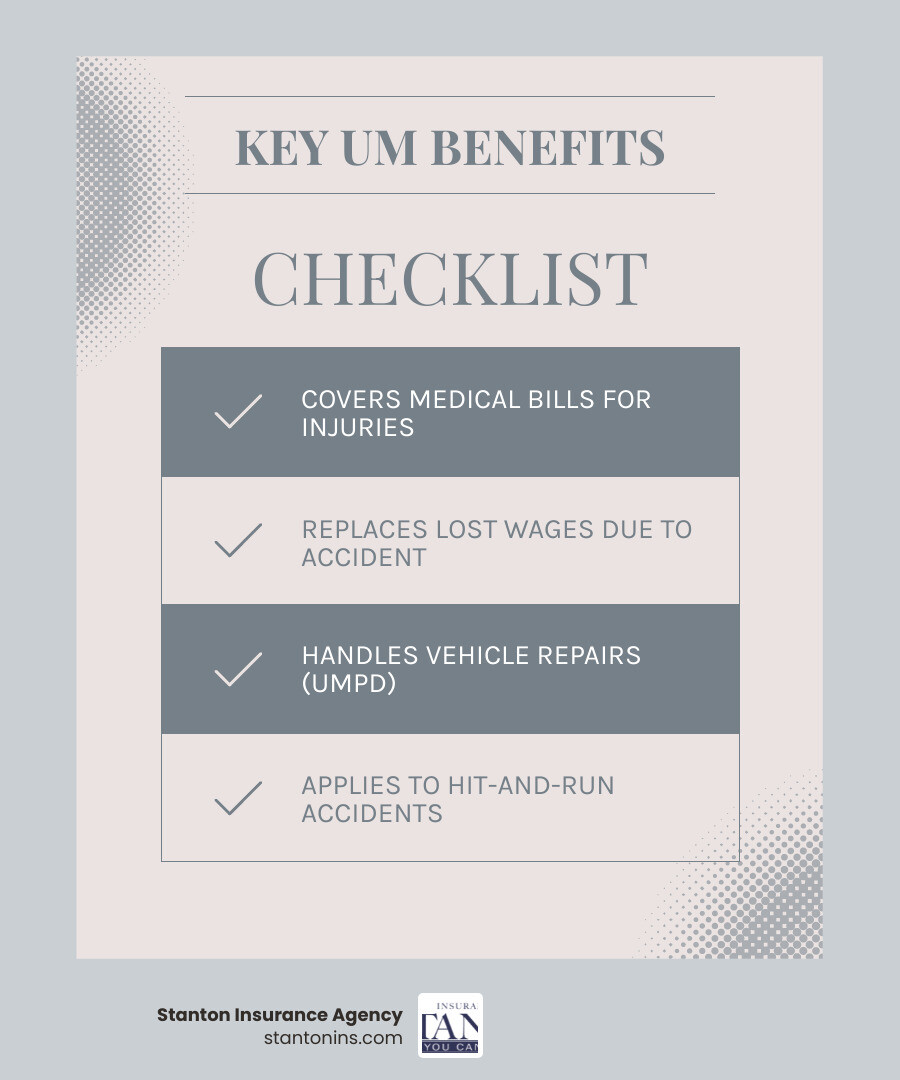
Quick Answer – What Uninsured Motorist Coverage Does:
- Covers medical bills when an uninsured driver injures you
- Pays for lost wages if you can’t work due to injuries
- Handles vehicle repairs in some states (called UMPD)
- Applies to hit-and-run accidents where the driver can’t be identified
- Protects passengers in your vehicle who get hurt
- No deductible for injury coverage in most cases
Nearly 13% of drivers nationwide don’t have auto insurance, according to recent studies. In some states, that number jumps to over 20%. This means that roughly one in eight drivers you encounter on the road has no way to pay for damages if they cause an accident.
The financial impact can be devastating. Without this coverage, you could face thousands in medical bills, lost income from missed work, and repair costs – all because someone else broke the law by driving uninsured.
As Geoff Stanton, President of Stanton Insurance Agency and a Certified Insurance Counselor, I’ve helped countless Massachusetts and New Hampshire families steer Uninsured Motorist Coverage claims over my 25+ years in the industry. Understanding this essential protection can mean the difference between a manageable insurance claim and financial hardship after an accident.
Find more about Uninsured Motorist Coverage:
What is Uninsured Motorist Coverage and How Does It Work?
Picture this: you’re driving home from work when another driver runs a red light and slams into your car. You’re hurt, your car is damaged, and then you find the worst news of all—the driver who caused the accident has no insurance. This is exactly when Uninsured Motorist Coverage becomes your financial lifeline.
Uninsured Motorist (UM) coverage is the part of your auto insurance policy that steps up when an at-fault driver can’t pay for the damage they’ve caused. Whether they have no insurance at all or they flee the scene in a hit-and-run, your own insurance company becomes your advocate, covering expenses that the other driver should have been responsible for.
Think of it as having a backup plan for other people’s bad decisions. When someone else’s irresponsibility puts you in harm’s way, your UM coverage ensures you won’t be left holding the bill for their mistakes.
Your Uninsured Motorist Coverage typically comes in two flavors, each protecting different aspects of your life after an accident:
Uninsured Motorist Bodily Injury (UMBI) takes care of the human cost of an accident. This includes your medical expenses, lost wages while you recover, and compensation for pain and suffering. It also extends protection to your passengers and even covers you if you’re walking or biking and get hit by an uninsured driver.
Uninsured Motorist Property Damage (UMPD) handles the stuff—your vehicle repairs, replacement costs, and other damaged property like fences or buildings. However, this coverage varies significantly from state to state, so it’s important to understand what’s available in your area.
The Difference Between Uninsured and Underinsured Motorist Coverage
Here’s where things get interesting. While Uninsured Motorist (UM) and Underinsured Motorist (UIM) coverage often come bundled together, they’re actually solving two different problems on today’s roads.
Uninsured coverage handles the straightforward scenario—the at-fault driver has absolutely no insurance. Zero. Nada. This also includes those frustrating hit-and-run situations where the driver disappears into the night, leaving you to pick up the pieces.
Underinsured coverage deals with a more subtle but equally expensive problem. The at-fault driver does have insurance, but their coverage limits are laughably low compared to your actual damages. With medical costs skyrocketing, it’s not uncommon for someone to carry the state minimum of $25,000 in coverage while your hospital bill alone reaches $75,000.
Let’s say your medical bills total $75,000, but the driver who hit you only carries $25,000 in liability coverage. Your UIM coverage can bridge that $50,000 gap, up to your policy’s limits. Without it, you’d be stuck trying to collect that money directly from the other driver—and good luck with that. Learn more about Uninsured/Underinsured Motorist BI to see how comprehensive this protection can be.
| Coverage Type | Covers Your Injuries | Covers Your Car’s Damage | When It Applies |
|---|---|---|---|
| Uninsured Motorist (UM) | Yes | Sometimes (UMPD) | At-fault driver has no insurance or hit-and-run |
| Underinsured Motorist (UIM) | Yes | Sometimes (varies) | At-fault driver’s insurance is insufficient |
| Collision Coverage | No | Yes | Regardless of fault; covers your car’s damage |
Understanding how Uninsured Motorist Coverage fits into your overall insurance picture is crucial. While collision coverage will fix your car regardless of who caused the accident, it won’t pay a dime toward your medical bills or lost wages. Comprehensive coverage protects against theft, vandalism, and acts of nature, but it’s also silent when it comes to injuries from uninsured drivers.
That’s what makes Uninsured Motorist Coverage so unique and essential—it’s specifically designed to fill the gap left by irresponsible drivers who either can’t or won’t take financial responsibility for the harm they cause.
What Uninsured Motorist Coverage Pays For
When you’re hit by a driver without insurance, the financial fallout can be immense. Uninsured Motorist Coverage is designed to handle these specific costs, which would normally be the responsibility of the at-fault driver’s liability insurance.
Think about it this way: you’re driving home from work, following all the rules, when someone runs a red light and crashes into you. After the dust settles, you find they have no insurance. Suddenly, you’re facing thousands of dollars in medical bills and a damaged car – all because someone else made a terrible decision. This is exactly when Uninsured Motorist Coverage becomes your financial lifeline.
What Does Uninsured Motorist Coverage Typically Cover?
Depending on your policy and state regulations, Uninsured Motorist Coverage can pay for a wide range of damages that could otherwise devastate your family’s finances.
Medical expenses form the backbone of your UMBI protection. This includes everything from emergency room visits and hospital stays to prescription medications, physical therapy, and ongoing rehabilitation. If you need surgery or specialized treatment months after the accident, your coverage continues working for you. The peace of mind knowing your medical care won’t be compromised by financial concerns is invaluable.
Lost wages protection kicks in when your injuries prevent you from earning your usual income. Whether you’re out of work for weeks or months, this coverage helps keep your household running. Your mortgage doesn’t stop because someone else drove without insurance, and neither should your ability to pay it.
Pain and suffering compensation recognizes that accidents cause more than just financial damage. The physical pain, emotional trauma, and reduced quality of life you experience deserve acknowledgment and compensation. This aspect of your coverage addresses the human cost of someone else’s negligence.
Vehicle repairs through UMPD coverage ensure you’re not stuck with a damaged car and no way to fix it. In some cases, there may be a small deductible, but it’s typically much less than what you’d pay out of pocket without any coverage. Your car is likely essential for getting to work, taking kids to school, and living your daily life.
Funeral expenses provide crucial support in the most tragic circumstances. While no one wants to think about fatal accidents, having this protection means your family won’t face additional financial burdens during an already devastating time.
It’s worth understanding how this differs from other coverage you might have. The distinction between Uninsured Motorist Coverage vs. Collision is important here. While Collision coverage applies regardless of who caused the accident, it won’t help with your medical bills or lost income. UMPD specifically applies when an uninsured driver is at fault, making it a targeted solution for a specific problem.
One question many people ask is whether Uninsured Motorist Coverage applies to hit-and-run accidents. The answer is yes – in most states, including Massachusetts and New Hampshire, your coverage extends to these frustrating situations where the at-fault driver flees the scene. This protection is especially valuable since hit-and-run drivers are often uninsured, which may be why they fled in the first place.
Uninsured Motorist Coverage in Massachusetts and New Hampshire
Insurance laws are state-specific, and understanding the rules in Massachusetts and New Hampshire is key to ensuring you’re properly protected. Each state has its own approach to Uninsured Motorist Coverage, and knowing these differences can save you from costly surprises down the road.
Uninsured Motorist Coverage Requirements in Massachusetts
If you live in Massachusetts, you’re in luck—Uninsured Motorist Coverage is automatically built into every Car Insurance in MA policy. The state doesn’t give you a choice here, and frankly, that’s a good thing. This mandatory protection ensures that every insured driver has a safety net when they encounter one of the estimated 3.5% of uninsured drivers on Massachusetts roads.
The Bay State requires minimum UM limits of $20,000 per person and $40,000 per accident for bodily injury coverage. While these amounts might sound substantial, they can disappear quickly when you’re dealing with serious injuries. A single emergency room visit can easily cost $10,000 or more, and that’s before any ongoing treatment or rehabilitation.
Here’s something important to know about Massachusetts: if you’re involved in a hit-and-run accident, your Uninsured Motorist Coverage will protect you, but only if there was physical contact between the vehicles. This means if someone cuts you off and you swerve into a tree to avoid them, but they don’t actually hit your car, your UM coverage won’t apply.
When it comes to property damage from an uninsured driver, Massachusetts handles things differently than many states. Instead of having separate Uninsured Motorist Property Damage (UMPD) coverage, damage to your vehicle is typically covered under your optional Collision coverage. This is why we strongly recommend carrying Collision coverage even though it’s not required by law.
For a complete breakdown of what’s included in your Massachusetts policy, the state provides detailed information at Part II – What is in my insurance policy – Mass.gov.
Uninsured Motorist Coverage Requirements in New Hampshire
New Hampshire marches to the beat of its own drum when it comes to auto insurance. It’s the only state that doesn’t require drivers to carry any auto insurance at all. Yes, you read that right—drivers can legally cruise the highways of the Live Free or Die state without a single dollar of coverage.
But here’s the catch: if you do choose to buy auto insurance in New Hampshire, Uninsured Motorist Coverage is mandatory. The state requires minimum limits of $25,000 per person and $50,000 per accident for bodily injury—slightly higher than Massachusetts minimums.
This creates a unique situation. While drivers without insurance are still financially responsible for any accidents they cause, the reality is that many uninsured drivers simply don’t have the assets to pay for damages out of pocket. If an uninsured driver with no savings and limited income causes a serious accident, you could be left holding the bag for thousands of dollars in medical bills and lost wages.
Given New Hampshire’s unusual insurance landscape, having robust UM and UIM coverage becomes even more critical. You’re sharing the road with drivers who may have chosen to go without any insurance protection whatsoever. For more insights into New Hampshire’s approach, you can review New Hampshire’s laws on the matter.
Choosing the right coverage limits can feel overwhelming, but here’s a rule of thumb that works well for most families: match your UM and UIM limits to your own liability limits. This ensures that the protection you provide for others mirrors the protection you have for yourself and your passengers. For detailed guidance custom to your specific situation, check out our comprehensive guide on How Much Uninsured Motorist Coverage Do I Need?.
Uninsured Motorist Coverage isn’t just about following the law—it’s about protecting your family’s financial future when someone else fails to take responsibility for theirs.
The Uninsured Motorist Claim Process
If you’re in an accident with an uninsured driver or a hit-and-run, the steps you take immediately after are crucial for a smooth claims process. I’ve seen too many situations where people didn’t know what to do in the moment, and it made their recovery much harder than it needed to be.
The good news is that your Uninsured Motorist Coverage is designed to work for you in these exact situations. But knowing the right steps can make the difference between a straightforward claim and months of complications.
Steps to Take After an Accident with an Uninsured Driver
Your safety comes first, always. Check if anyone is hurt and move to a safe spot if you can. Call 911 right away, even if the damage seems minor. You’ll need that police report for your Uninsured Motorist Coverage claim, especially if the other driver tries to leave the scene.
Gather every piece of information you can. Even if the other driver admits they don’t have insurance, get their name, phone number, and driver’s license details. Write down their license plate number, car make and model, and what they look like. If they claim they have insurance, ask for their insurance company and policy number—but don’t be surprised if it turns out to be expired or fake.
Talk to any witnesses who saw what happened. Their contact information could be invaluable later. Most people are willing to help if you ask politely.
Document everything with your phone. Take photos of both cars from different angles, the accident scene, street signs, and any injuries you can see. These pictures tell the story when memories get fuzzy later on.
Don’t let them talk you into a cash deal. It’s tempting when someone offers to pay you directly to “keep insurance out of it.” But that $500 they’re offering probably won’t cover your medical bills if you wake up sore tomorrow, let alone any hidden damage to your car. You have Uninsured Motorist Coverage for a reason—use it.
Call your insurance company as soon as you can. Let them know you were in an accident with an uninsured driver or that it was a hit-and-run. They’ll walk you through filing your UM claim and tell you exactly what they need from you.
Your insurance company will investigate to make sure the other driver was both at fault and truly uninsured. That’s why having a police report and good documentation makes such a difference. When you’ve done your homework, the claims process moves much faster.
What happens to the uninsured driver? They’re in for a rough time. In Massachusetts and New Hampshire, driving without required insurance means fines, possible criminal charges, and likely having their car towed. They’ll have to pay for their own car repairs out of pocket, plus they could face a lawsuit from you or your insurance company. It’s not a situation anyone wants to be in, which is exactly why you’re smart to have proper coverage.
Frequently Asked Questions about Uninsured Motorist Coverage
We understand that insurance can be a complex topic, and over our 25+ years helping Massachusetts and New Hampshire families, we’ve heard just about every question you can imagine about Uninsured Motorist Coverage. Let’s tackle the most common ones that keep our clients up at night.
Does an uninsured motorist claim affect my insurance rates?
This might be the question we hear most often, and honestly, it makes perfect sense why you’d worry about this. Nobody wants their rates to go up after they’ve been the victim of someone else’s poor choices.
Here’s the good news: a not-at-fault claim, including an Uninsured Motorist Coverage claim, typically won’t cause your rates to increase. Think about it from your insurance company’s perspective – you didn’t do anything wrong. An uninsured driver hit you, and your insurance is doing exactly what you pay it to do: protect you when others can’t or won’t.
That said, insurance companies do look at the bigger picture. If you’re filing multiple claims (even not-at-fault ones), some insurers might see you as someone who’s frequently in situations where accidents happen. But a single UM claim? You should be fine.
The best approach is always to have an honest conversation with your agent about your specific situation. Every policy and insurance company can be a little different, and we’re here to give you the straight answer about your particular circumstances.
Is there a deductible for uninsured motorist claims?
The answer depends on what type of Uninsured Motorist Coverage you’re using and where you live.
For Uninsured Motorist Bodily Injury (UMBI) claims – the coverage that pays for your medical bills, lost wages, and pain and suffering – there’s typically no deductible. Your insurance company will cover your eligible expenses right up to your policy limits without you paying anything out of pocket first. This is one of the real benefits of this coverage.
For Uninsured Motorist Property Damage (UMPD) claims, it gets a bit more complicated. Some states require a small deductible, usually somewhere between $200 and $300.
In Massachusetts, things work a little differently. When an uninsured driver damages your car, that damage is typically covered by your optional Collision coverage, which comes with whatever deductible you chose when you bought your policy (like $500 or $1,000). So while you might not have a direct UMPD deductible, your Collision deductible would still apply.
Do I need uninsured motorist coverage if I have good health insurance?
This is a great question, and we completely understand why people think their health insurance might be enough. After all, if you’ve got excellent health coverage, why pay for more?
The reality is that Uninsured Motorist Coverage does things your health insurance simply can’t do. Yes, your health plan will help with those hospital bills and doctor visits, but that’s just the beginning of what you might need after a serious accident.
Your health insurance won’t replace the wages you lose when you’re stuck at home recovering instead of at work earning a paycheck. It won’t compensate you for the pain and suffering you endure – the sleepless nights, the ongoing discomfort, the stress of dealing with a serious injury. And it certainly won’t cover your health insurance deductibles and co-pays, which can add up to thousands of dollars.
Here’s something else to consider: what about your passengers? Your Uninsured Motorist Bodily Injury Liability protects everyone in your car, including friends, family members, or coworkers who might not have health insurance as good as yours. When your teenager’s friend gets hurt in an accident caused by an uninsured driver, your UM coverage steps in to help them too.
Uninsured Motorist Coverage is designed to make you whole in ways that health insurance never could. It’s not just about paying medical bills – it’s about ensuring that someone else’s irresponsible decision to drive without insurance doesn’t become your financial nightmare.
Protect Yourself on the Road
You can be the safest driver in the world, always following traffic laws, using your turn signals, and keeping a watchful eye on the road ahead. But here’s the reality: you can’t control what other drivers do. And with nearly one in eight drivers on the road lacking insurance coverage, that’s a sobering thought.
Uninsured Motorist Coverage isn’t just another line item on your insurance policy—it’s your financial lifeline when everything goes wrong. It’s the difference between walking away from an accident with peace of mind versus facing months or even years of financial stress because someone else made the irresponsible choice to drive without insurance.
Think about it this way: you wouldn’t leave your house unlocked at night just because you live in a safe neighborhood. The same logic applies to your auto insurance. Uninsured Motorist Coverage is like having a security system for your financial well-being on the road.
The statistics are clear, but the personal impact is what really matters. We’ve seen families in Massachusetts and New Hampshire who thought they were adequately protected, only to find that their coverage fell short when they needed it most. A $25,000 medical bill from a serious accident can devastate a household budget, especially when you’re already dealing with lost wages and the stress of recovery.
At Stanton Insurance Agency, we’ve spent over 25 years helping our neighbors understand these critical protections. We don’t just sell insurance policies—we build safety nets for real families facing real challenges. When you work with us, you’re getting more than coverage; you’re getting someone who understands the unique risks of driving in New England and can help you make informed decisions about your protection.
Your financial future shouldn’t depend on hoping every other driver on the road is responsible. Let us help you review your current Uninsured Motorist Coverage limits and ensure they’re sufficient to protect what matters most to you and your family.
Ready to secure your peace of mind? Explore your Car Insurance options and get a personalized quote today.