
Why the Right Vehicle Insurance Agent Makes All the Difference
A vehicle insurance agent is a licensed professional who helps drivers choose, purchase, and manage auto insurance — and finding the right one can mean the difference between a policy that truly protects you and one that leaves costly gaps.
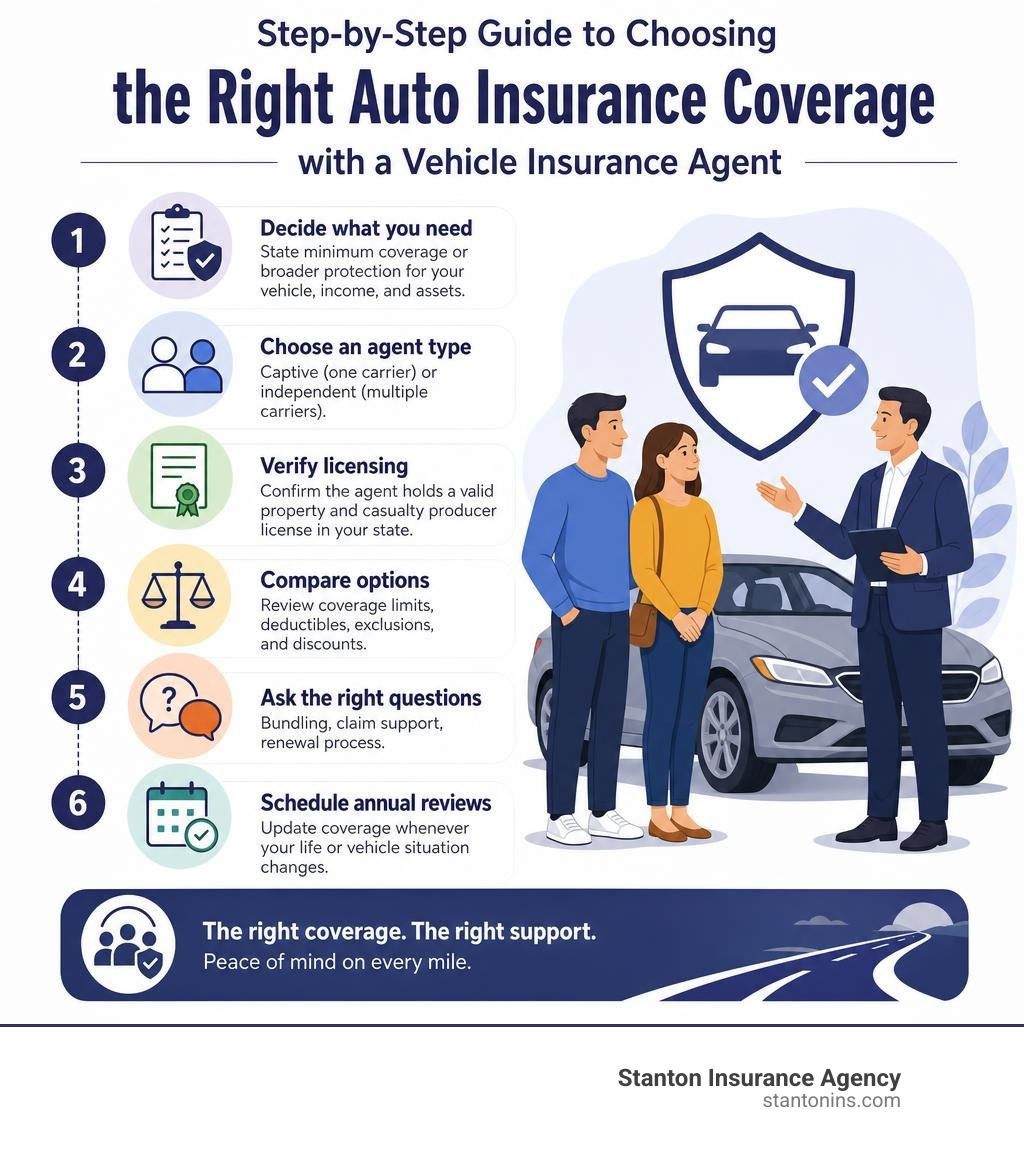
Here’s how to find and work with a vehicle insurance agent:
- Decide what you need — state minimum coverage or broader protection for your vehicle, income, and assets
- Choose an agent type — captive (one carrier) or independent (multiple carriers)
- Verify licensing — confirm the agent holds a valid property and casualty producer license in your state
- Compare options — review coverage limits, deductibles, exclusions, and discounts
- Ask the right questions — bundling, claim support, renewal process
- Schedule annual reviews — update coverage whenever your life or vehicle situation changes
Buying auto insurance isn’t just about finding the lowest price. The coverage you choose affects what happens after an accident — your out-of-pocket costs, your ability to repair or replace your vehicle, and your financial protection if someone is seriously injured. A knowledgeable agent helps you understand those stakes before you need to make a claim.
I’m Geoff Stanton, President of Stanton Insurance Agency and a Certified Insurance Counselor (CIC) with over 25 years of experience helping Massachusetts and New Hampshire drivers navigate their options as a vehicle insurance agent. At Stanton Insurance, we work with individuals and families to protect their cars, homes, and other valuables with coverage that fits their real lives.
Get a Car Insurance Quote from Stanton Insurance Agency
Vehicle insurance agent terms simplified:
SEO Metadata
- Title Tag: Vehicle Insurance Agent: Your Roadmap to the Best Coverage
- Meta Description: Learn how a vehicle insurance agent helps Massachusetts and New Hampshire drivers compare coverage, understand state requirements, and choose the right auto insurance policy.
- Suggested URL: https://stantonins.com/vehicle-insurance-agent/
What Is a Vehicle Insurance Agent and How Do They Help Drivers?

A vehicle insurance agent is a licensed insurance professional who helps drivers select, purchase, and maintain auto insurance coverage. In plain English, we help translate policy language into real-life decisions, such as: “If my car is hit in a parking lot, what happens?” or “If my teen driver has an accident, am I protected?”
A good agent helps with much more than getting a quote. We help drivers understand:
- State minimum insurance requirements
- Liability limits and why higher limits may be worth considering
- Collision and comprehensive coverage
- Deductible choices
- Discounts that may apply
- Policy updates after a move, new vehicle, household change, accident, or claim
Think of an agent as your guide through the insurance maze. Without one, it is easy to focus only on price and miss important details. With one, you can compare cost, coverage, and risk in a more practical way.
If you are looking for local guidance, our guide to Independent Insurance Agents Near You explains how local professionals can help match coverage to your needs.
Vehicle Insurance Agent vs. Insurance Broker
The terms “agent” and “broker” are often used casually, but they are not always the same. Licensing rules and business models can vary by state, so the most important thing is to ask how the professional works and which insurance carriers they can access.
| Feature | Vehicle Insurance Agent | Insurance Broker |
|---|---|---|
| Primary role | Helps customers secure coverage through insurance carriers the agency works with | Shops coverage and may act as an intermediary between customers and insurers |
| Carrier access | May represent one carrier or multiple carriers, depending on the agency model | Typically compares options from multiple insurance markets |
| Customer support | Assists with quotes, policy changes, renewals, billing questions, and claims guidance | Assists with market comparison and placement of coverage |
| Best fit | Drivers who want ongoing local service and policy support | Drivers seeking broad market comparison through a broker relationship |
| Key consideration | Ask whether the agent is captive or independent | Ask which markets are available and how compensation works |
The big takeaway: do not get stuck on the title alone. Ask what matters:
- Are you licensed?
- Which states do you serve?
- Which carriers can you quote?
- How do you help after the policy is issued?
- Will you review my coverage at renewal?
The Role of a Captive Vehicle Insurance Agent
A captive vehicle insurance agent generally represents one insurance company. That can be a good fit for some drivers, especially if they already like that company and want a direct brand relationship.
Typical advantages include:
- Deep knowledge of one carrier’s products
- Direct access to that carrier’s systems
- A consistent customer experience
- Familiarity with that carrier’s billing, claims, and underwriting process
The limitation is choice. If your premium increases, your household changes, or your vehicle needs no longer fit that carrier well, a captive agent may have fewer alternatives to offer. It is a bit like going to a restaurant with one item on the menu. If you love that item, great. If not, dinner gets awkward.
The Benefits of Working with an Independent Insurance Agency
An independent insurance agency can compare options from multiple insurance carriers. That gives Massachusetts and New Hampshire drivers more flexibility when looking for a balance of price, coverage, and service.
Working with an independent agency can help you:
- Compare available carrier options
- Match coverage to your vehicle, commute, household, and budget
- Review liability limits and deductibles
- Bundle auto with home, condo, or renters insurance when appropriate
- Adjust coverage as vehicles age
- Re-shop coverage when your renewal changes
- Get local support when life gets complicated
At Stanton Insurance Agency, we help customers protect cars, homes, personal property, and businesses. Our goal is trusted protection for valuable assets, not just a fast quote that looks good for five minutes.
You can also read more about choosing Best Independent Car Insurance.
Licensing and Education Requirements for Vehicle Insurance Professionals
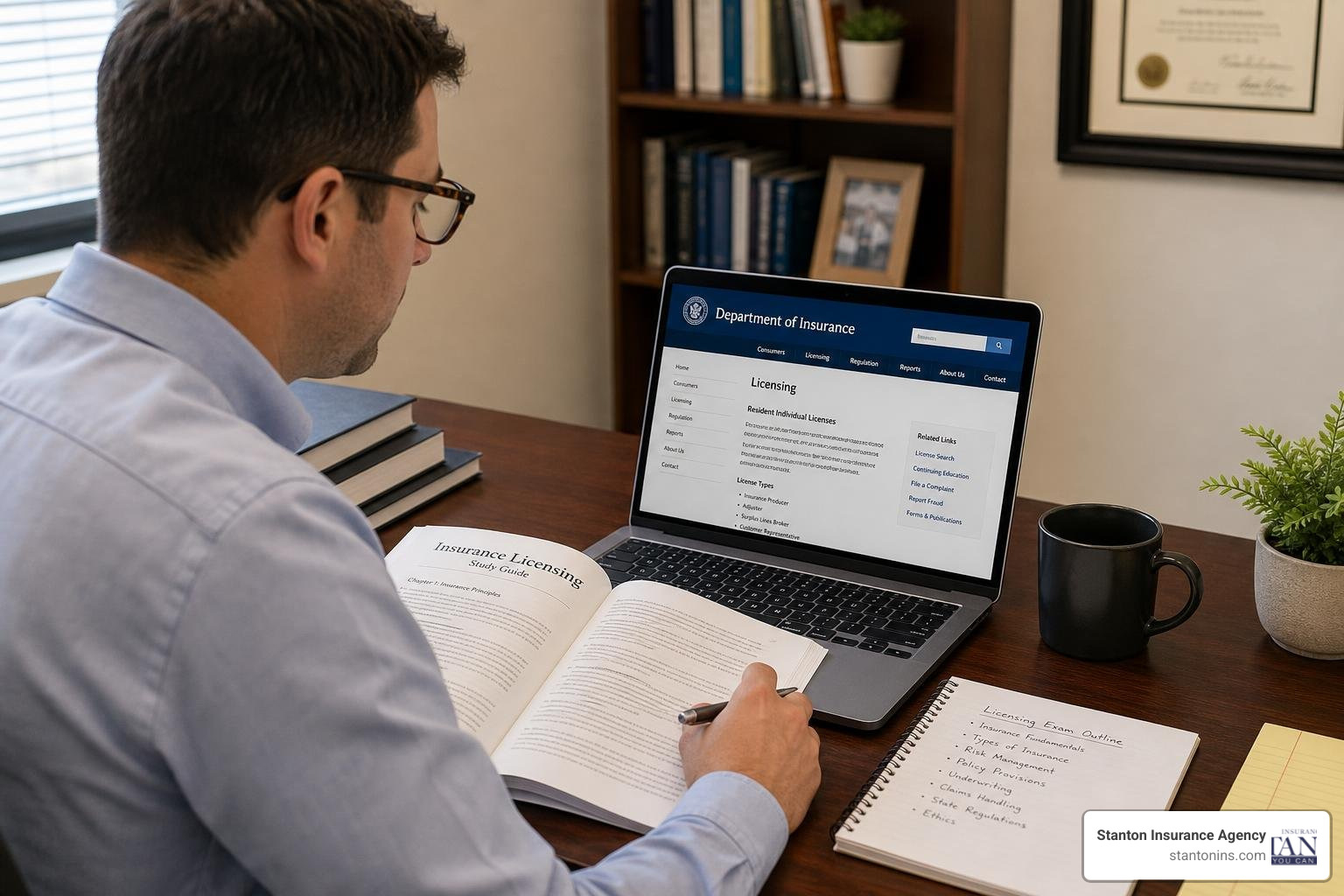
Vehicle insurance professionals must be properly licensed to sell or advise on auto insurance. Licensing is regulated at the state level, which means Massachusetts and New Hampshire each have their own rules, applications, renewals, and continuing education requirements.
For consumers, the key point is simple: work with a licensed insurance professional. Licensing helps ensure the person advising you has met state requirements and is accountable to insurance regulations.
Key Licensing Steps for Property and Casualty Insurance Agents
Most professionals who sell auto insurance need a property and casualty insurance producer license. While details vary by state, the general path often includes:
- Completing required pre-licensing education or exam preparation
- Passing the applicable property and casualty insurance licensing exam
- Submitting a license application through the required state or national licensing platform
- Completing any required background check or fingerprinting process
- Paying applicable licensing fees
- Maintaining the license through renewal and continuing education
- Following state insurance laws, advertising rules, and ethical standards
This matters because auto insurance is not just a product. It is a financial contract. The person explaining it should be qualified to help you understand what you are buying.
Massachusetts Vehicle Insurance Agent Licensing
Massachusetts insurance producers are regulated by the Massachusetts Division of Insurance. Professionals who sell auto insurance typically need a property and casualty producer license.
Licensing generally involves passing the appropriate exam, submitting an application, and meeting renewal and continuing education requirements. Massachusetts also regulates insurance companies and market conduct to help protect consumers.
Useful Massachusetts resources include:
If you are a Massachusetts driver, it is smart to work with an agent who understands the state’s compulsory auto insurance system, Registry-related insurance requirements, and optional coverage choices.
New Hampshire Vehicle Insurance Agent Licensing
New Hampshire insurance producers are regulated by the New Hampshire Insurance Department. Professionals who sell auto insurance typically need a property and casualty producer license.
Licensing generally involves passing the required exam, submitting an application, and completing ongoing renewal requirements. New Hampshire’s auto insurance environment is unique because the state does not require every driver to carry insurance in the same way many other states do. That makes professional guidance especially helpful.
Consumer resource:
A New Hampshire driver may say, “Do I really need insurance if the state does not always require it?” Our answer is usually: the law is only part of the question. Financial protection is the bigger issue.
How Consumers Can Verify an Insurance License
Before working with an insurance professional, you can verify their license if you want extra peace of mind.
Steps to take:
- Ask for the agent’s full name.
- Ask for the agency name.
- Confirm the state or states where the agent is licensed.
- Verify that the license is active.
- Make sure the license is appropriate for property and casualty insurance.
You can use official state insurance department resources or the NAIC State Based Systems License Lookup.
Massachusetts and New Hampshire Auto Insurance Rules Drivers Should Understand
Auto insurance is regulated by state, so Massachusetts and New Hampshire drivers should not assume the rules are the same. A vehicle insurance agent can help you understand what is required, what is optional, and what is wise for your situation.
Massachusetts Auto Insurance Basics
Massachusetts requires drivers to carry compulsory auto insurance. Core required coverages include:
- Bodily injury to others
- Personal injury protection
- Uninsured motorist coverage
- Property damage coverage
Massachusetts minimum requirements create a legal baseline, but the minimum may not be enough for every driver. If you own a home, have savings, drive a newer car, commute daily, or have a teen driver in the household, broader protection may be worth discussing.
Many Massachusetts drivers also consider optional coverages such as:
- Optional bodily injury liability
- Collision coverage
- Comprehensive coverage
- Substitute transportation or rental reimbursement
- Roadside assistance
- Loan or lease gap coverage, when available
Collision coverage can help repair or replace your vehicle after a covered crash. Comprehensive coverage can help with non-collision losses such as theft, vandalism, fire, falling objects, certain weather damage, and animal collisions. In New England, where deer, ice, wind, and tree limbs all seem to have personal vendettas against cars, this can matter.
New Hampshire Auto Insurance Basics
New Hampshire does not require auto insurance for every driver in the same way many states do. However, drivers are still financially responsible for injuries or damage they cause.
Some New Hampshire drivers may be required to file proof of insurance after certain violations, accidents, or license-related issues. Even when coverage is not legally required, many drivers choose auto insurance because one serious accident can create major out-of-pocket costs.
Common New Hampshire auto insurance coverage options include:
- Bodily injury liability
- Property damage liability
- Medical payments
- Uninsured and underinsured motorist coverage
- Collision coverage
- Comprehensive coverage
If you purchase auto insurance in New Hampshire, state rules affect the minimum limits and coverage structure. A local agent can help you understand how the policy works and what limits make sense for your household.
Why Minimum Coverage May Not Be Enough
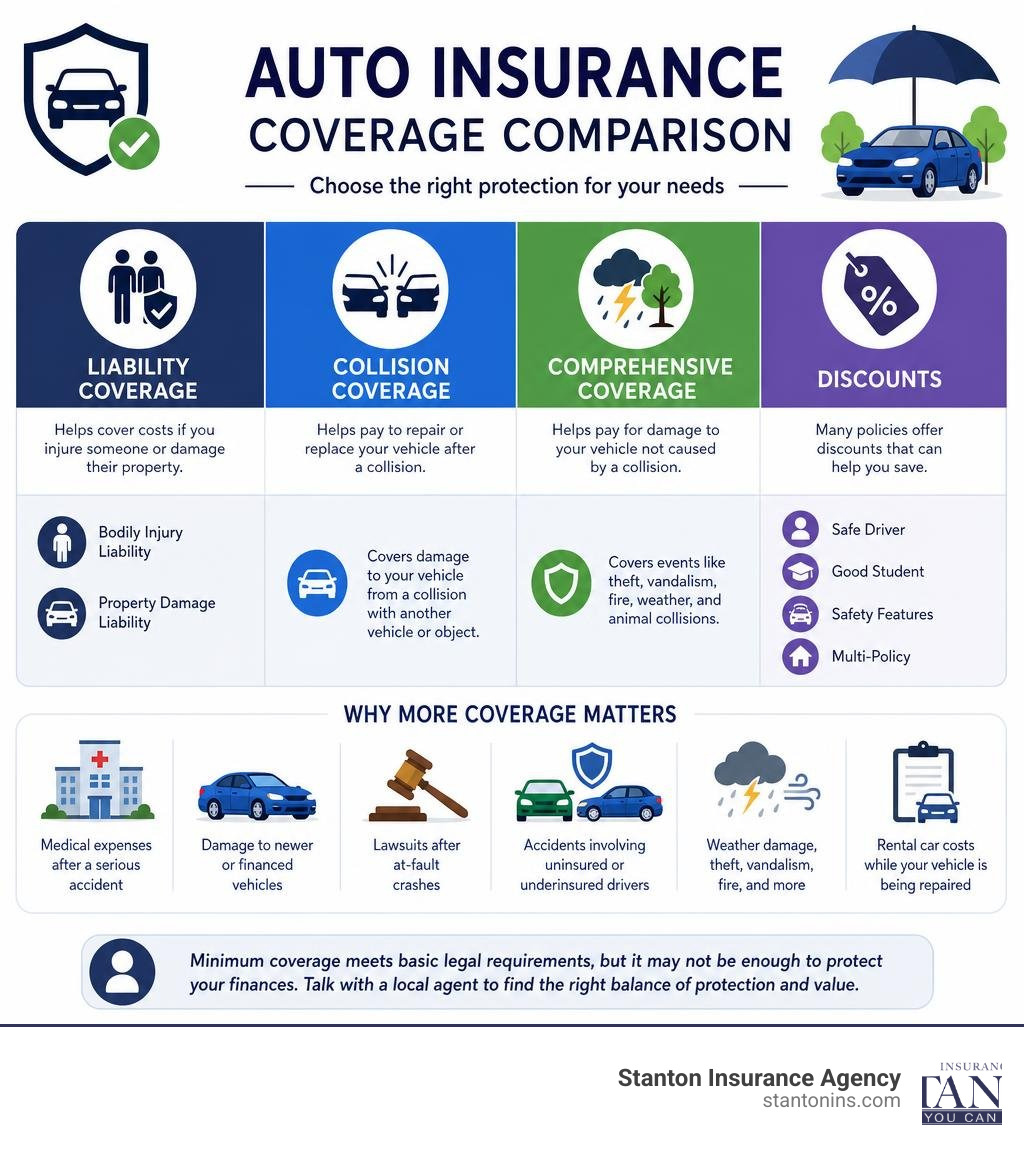
Minimum coverage is designed as a legal starting point, not a complete financial protection plan.
Common risks include:
- Medical expenses after a serious accident
- Damage to newer or financed vehicles
- Lawsuits after at-fault crashes
- Accidents involving uninsured or underinsured drivers
- Weather damage, theft, vandalism, fire, and animal collisions
- Rental car costs while your vehicle is being repaired
Choosing only the minimum may lower your premium, but it can increase your financial risk. Before reducing coverage, we recommend reviewing your options with a licensed vehicle insurance agent.
How a Vehicle Insurance Agent Helps You Compare and Save on Auto Insurance
Saving money on auto insurance is important. Nobody wants to pay more than necessary. But the cheapest policy is not always the best value.
A good agent helps compare the full picture:
- Premium
- Liability limits
- Deductibles
- Exclusions
- Optional endorsements
- Discounts
- Claims service
- Billing options
- Long-term fit
Sometimes a slightly higher premium buys significantly better protection. Sometimes a discount is available but has not been applied. Sometimes a deductible change makes sense. Sometimes it absolutely does not. Our job is to help you sort through those tradeoffs.
Smart Ways to Lower Your Auto Insurance Premium
Here are practical ways to reduce premium without blindly cutting protection:
Compare quotes from available insurance carriers
Rates can vary from company to company, even for the same driver.Bundle policies when appropriate
Combining auto with home, condo, or renters insurance may qualify for savings.Ask about multi-car discounts
Households with more than one vehicle may be eligible.Review student and driver training discounts
Good student and approved driver training discounts may help families with young drivers.Consider telematics or usage-based programs
If your driving habits fit, a safe driving program may help reduce premium.Choose deductibles carefully
A higher deductible can lower premium, but make sure you could comfortably pay it after a claim.Maintain continuous coverage
Gaps in coverage can make insurance more expensive or harder to place.Update annual mileage
If your commute changed or you work from home more often, tell your agent.Review physical damage coverage as vehicles age
Collision and comprehensive coverage may still be valuable, but the decision should be reviewed over time.Do not reduce liability limits too far
Lower limits may save money now, but they can leave you exposed after a serious accident.
Finding the Best Auto Insurance Agency Near You
Local expertise matters, especially in Massachusetts and New Hampshire. Auto insurance rules, registration questions, winter driving risks, and household needs can vary by state and community.
A local agency can help with:
- State-specific coverage rules
- Registry or DMV-related insurance questions
- Seasonal driving concerns
- Household driver changes
- Vehicle replacements
- Annual policy reviews
- Billing and claims questions
If you are comparing local options, these resources may help:
When Should You Contact a Vehicle Insurance Agent?
You should contact a vehicle insurance agent any time your risk profile changes. Translation: if your life changes, your insurance may need to change too.
Key moments to review coverage include:
- Buying or leasing a vehicle
- Moving to a new address
- Adding a teen driver
- Getting married
- Combining households
- Starting a new commute
- Working from home more often
- Paying off a car loan
- Driving for business or rideshare use
- Receiving a renewal with a premium increase
- After a claim or traffic violation
Do not wait until after an accident to find out your policy is outdated. Insurance reviews are a lot like dental cleanings: not always thrilling, but much better than dealing with a painful surprise later.
Questions to Ask Before Choosing a Vehicle Insurance Agent
Before choosing an agent, ask direct questions. A good insurance professional should welcome them.
Use this checklist:
Are you licensed in Massachusetts, New Hampshire, or both?
Make sure the agent is properly licensed where you live.Are you a captive agent or an independent agency?
This tells you whether they represent one carrier or can compare multiple options.Which types of auto insurance coverage should I consider beyond the state minimum?
Ask about liability, collision, comprehensive, medical payments, uninsured motorist coverage, and rental reimbursement.How do you help customers compare deductibles and liability limits?
The answer should involve your assets, vehicle value, driving habits, and comfort with risk.What discounts may apply to my policy?
Ask about bundling, multi-car, safe driver, student, driver training, telematics, and payment discounts.How often should I review my coverage?
At least annually, and whenever your household, vehicle, address, or driving habits change.Who do I contact if I need to file a claim?
Know the process before you need it.Can you help me bundle auto insurance with home, condo, or renters insurance?
Bundling can simplify your insurance and may reduce premium.How do you help if my rate changes at renewal?
A strong agency can review your policy, check for updates, and compare available options.
Frequently Asked Questions About Vehicle Insurance Agents
What is the difference between a vehicle insurance agent and an insurance broker?
A vehicle insurance agent helps customers purchase and manage auto insurance coverage through the carriers the agency represents. A broker may also help compare coverage options, but the specific role depends on state licensing rules and the business model. The most important question for consumers is whether the professional is licensed, transparent, and able to help compare appropriate coverage options.
Is it better to use a local vehicle insurance agent?
A local agent can be helpful because auto insurance rules vary by state. Massachusetts and New Hampshire drivers may benefit from working with someone who understands local coverage requirements, registration-related insurance questions, regional driving conditions, and common household insurance needs.
How do I verify whether my vehicle insurance agent is licensed?
You can verify licensing through official state insurance department resources or a national license lookup tool. Massachusetts drivers can contact the Massachusetts Division of Insurance, and New Hampshire drivers can contact the New Hampshire Insurance Department. You can also use the NAIC State Based Systems License Lookup.
Does New Hampshire require auto insurance?
New Hampshire does not require every driver to carry auto insurance in the same way many states do, but drivers are still financially responsible for damage or injuries they cause. Some drivers may be required to provide proof of insurance after certain incidents. Many New Hampshire drivers choose auto insurance to protect themselves from significant financial exposure.
What auto insurance coverage is required in Massachusetts?
Massachusetts requires compulsory auto insurance, including bodily injury to others, personal injury protection, uninsured motorist coverage, and property damage coverage. Many drivers also choose optional coverages such as collision, comprehensive, increased liability limits, and rental reimbursement.
Can a vehicle insurance agent help me save money?
Yes. A vehicle insurance agent can help identify discounts, compare available coverage options, review deductibles, and determine whether bundling policies makes sense. The goal is not only to reduce premium, but also to avoid coverage gaps that could cost more after an accident.
How often should I review my auto insurance policy?
Review your policy at least once a year and any time you buy a vehicle, move, add a driver, change your commute, pay off a loan, or experience a major life change. Regular reviews help keep your coverage aligned with your current needs.
Conclusion
A vehicle insurance agent helps you make informed decisions, not just buy a policy. The right agent can help you understand your state’s requirements, compare meaningful coverage options, identify discounts, and protect your vehicle and finances as life changes.
For Massachusetts and New Hampshire drivers, local guidance can make a real difference. Whether you are buying your first car, adding a teen driver, moving, reviewing a renewal, or simply wondering whether your current coverage still makes sense, we are here to help.
At Stanton Insurance Agency, we believe auto insurance should be clear, practical, and built around real life. Let us help you find coverage that protects what matters.
