
What Is Limited Collision Coverage? (The Short Answer)
What is limited collision coverage is one of the most common questions drivers ask when shopping for auto insurance — and it deserves a clear, direct answer before we go any deeper.
Limited collision coverage is a type of auto insurance that pays for damage to your vehicle only when you are 50% or less at fault for an accident — and only when the other vehicle involved can be identified. If you are more than 50% at fault, or if the other driver flees the scene, this coverage pays nothing.
Here is a quick breakdown:
| Feature | Limited Collision Coverage |
|---|---|
| Pays when you are at fault? | No — only if 50% or less at fault |
| Deductible | Often waived or reduced |
| Hit-and-run covered? | No |
| Other vehicle must be identified? | Yes |
| Cheaper than standard collision? | Yes |
It sits between no collision coverage and full (standard) collision coverage in terms of both cost and protection.
Auto insurance can feel overwhelming, especially when terms like “limited,” “standard,” and “broad form” collision all sound similar. But understanding the difference can save you real money — or cost you if you pick the wrong one.
I’m Geoff Stanton, President of Stanton Insurance Agency and a Certified Insurance Counselor (CIC) with over two decades of experience helping Massachusetts drivers understand questions exactly like what is limited collision coverage and whether it fits their needs. In the sections below, I’ll walk you through everything you need to know to make a confident decision.
What is limited collision coverage terms to remember:
- auto insurance collision coverage limits
- whats better limited collision or collision coverage
- what does car insurance cover
What is Limited Collision Coverage?

When we talk about what is limited collision coverage, we are looking at a specific “middle-ground” insurance product. For many of our clients in Massachusetts and New Hampshire, choosing between paying for full collision or having no coverage at all feels like a high-stakes gamble. Limited collision was designed to bridge that gap.
At its core, limited collision is a fault-based restriction. Unlike standard collision, which covers your car regardless of who caused the accident, limited collision is only “active” when you are the victim or at least not the primary cause of the crash.
To understand this better, we have to look at the three main pillars of this coverage:
- Fault-Based Restrictions: Your insurance company will only pay out if you are determined to be 50% or less at fault.
- Identified Third-Party Requirement: You must be able to identify the other driver. This means hit-and-runs are strictly off the table.
- Cost Savings: Because the insurance company takes on less risk (they don’t have to pay when you mess up), the premiums are significantly lower—often just a fraction of standard collision costs.
If you are curious about how this fits into the broader world of insurance, you can read more about what is collision insurance to see the full spectrum of options. Essentially, limited collision provides a safety net for when other people make mistakes on the road, without forcing you to pay the high premiums associated with covering your own potential errors.
When Does Limited Collision Coverage Pay for Repairs?
The most important thing to remember about what is limited collision coverage is the “50% rule.” In the insurance world, fault is often split. If you are rear-ended while sitting at a red light, you are 0% at fault. If you are merging and someone else is speeding, a claims adjuster might decide you are 30% at fault and they are 70% at fault.
Under limited collision, as long as your fault is 50% or less, your repairs are covered. This is a massive benefit because it allows you to file a claim directly through us (your own agency) rather than having to chase down the other driver’s insurance company.
Dealing with another person’s insurer can be a slow, bureaucratic nightmare. By having limited collision, you use your own policy to get your car back on the road quickly, and your insurer handles the “subrogation” (the fancy word for getting their money back from the at-fault party) behind the scenes. For a deeper dive into these scenarios, check out our guide on what-does-collision-insurance-cover.
Understanding the Limitations of What is Limited Collision Coverage
While the lower price tag is tempting, we always want our clients to understand the “fine print.” Limited collision is not a “fix-everything” policy. There are three major scenarios where this coverage will leave you hanging:
- Hit-and-Runs: If you come out of the grocery store and find your bumper crumpled with no note left behind, limited collision will not pay. Because the other driver cannot be identified, the “limited” criteria aren’t met.
- Single-Car Accidents: If you hit a patch of black ice and slide into a tree, or if you accidentally back into your own garage door, you are 100% at fault. In these cases, limited collision pays zero.
- Substantial Fault: If you are turning left and misjudge the distance of oncoming traffic, an adjuster might find you 60% at fault. Because you crossed that 50% threshold, your limited collision coverage becomes inactive for that claim.
Understanding these auto-insurance-collision-coverage-limits is vital before you make the switch from a standard policy.
Limited vs. Standard vs. Broad Form Collision
Navigating the different types of collision coverage is like choosing the right level of health insurance; you want enough to be safe, but you don’t want to pay for “extras” you don’t need.
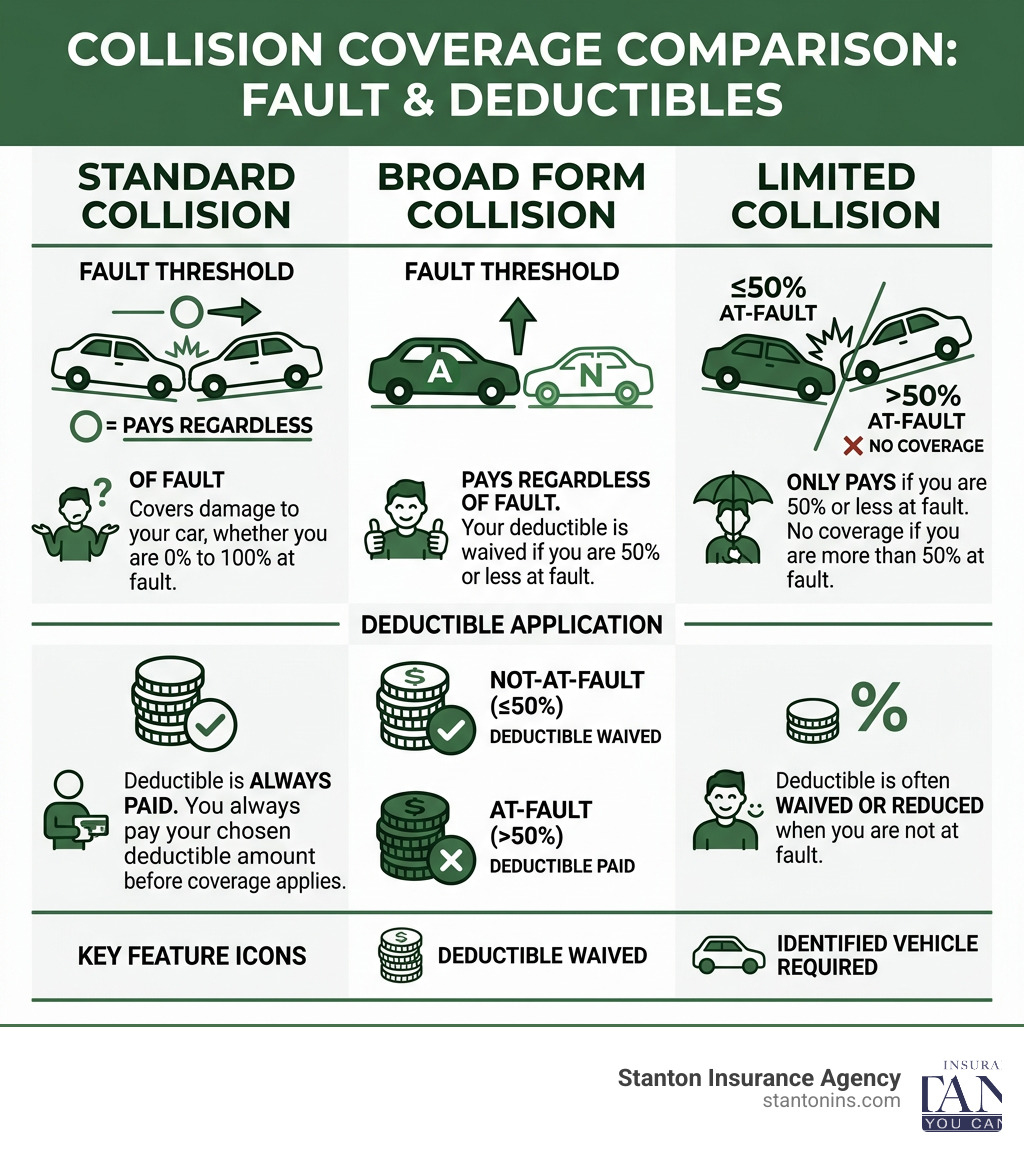
| Coverage Type | Pays if You Are at Fault? | Deductible? | Best For |
|---|---|---|---|
| Standard Collision | Yes | Always applies | New cars, financed vehicles |
| Broad Form Collision | Yes | Waived if <50% at fault | High-value cars, peace of mind |
| Limited Collision | No (Only if <50%) | Usually No Deductible | Older cars, budget-conscious |
Standard Collision
This is the “old reliable.” Whether you hit a pole, a deer, or another car, standard collision pays for your repairs (minus your deductible). It doesn’t matter if you were 0% at fault or 100% at fault. Most lenders require this if you have a car loan.
Broad Form Collision
Think of this as the “premium” version. Like standard collision, it pays regardless of fault. However, if you are not at fault (50% or less), the insurance company waives your deductible entirely. It’s the best of both worlds, but it comes with the highest premium.
Fault Determination
The biggest difference-limited-full-collision-coverage is simply who is holding the bill when a mistake happens. Standard and Broad Form ensure you are protected from your own mistakes. Limited collision only protects you from others’ mistakes.
Payout Scenarios for Different Coverage Types
Let’s look at a real-world example. Imagine you are driving through a busy intersection in Worcester or Manchester, and someone blows a stop sign and hits you. The police report and adjusters agree you are 0% at fault.
- With Standard Collision: You pay your $500 deductible, your car gets fixed, and eventually, your insurance company might get your $500 back from the other guy.
- With Broad Form: Your car gets fixed, and you pay $0 out of pocket because you weren’t at fault.
- With Limited Collision: Your car gets fixed, and you pay $0 out of pocket. In this specific scenario, limited collision works exactly like the more expensive broad form!
Now, imagine you are the one who blew the stop sign.
- Standard/Broad Form: Your car is fixed (minus your deductible).
- Limited Collision: You get a bill for the full cost of repairs.
This “all or nothing” nature is why we often ask clients, “whats-better-limited-collision-or-collision-coverage for your specific driving habits?”
How Fault and Deductibles Work in Limited Claims
When you file a claim under limited collision, the spotlight immediately turns to the “fault determination.” This isn’t just a casual conversation; it’s a legal and financial calculation.
In states like Massachusetts, we use a “modified comparative negligence” standard. For insurance purposes, this often boils down to the 51% rule. If you are 51% at fault, you are “substantially at fault,” and your limited collision coverage will not trigger.
The “deductible-free” benefit is the primary reason people love limited collision. In many policies, if you qualify for a limited collision payout, there is no deductible to pay. You get the full value of the repair from dollar one. This is a huge relief for drivers who might not have $500 or $1,000 sitting in a savings account for emergencies.
However, the trade-off is the risk of high out-of-pocket costs if you are found at fault. If your car is worth $8,000 and you total it in an at-fault accident while carrying only limited collision, you have effectively lost $8,000. For more on this comparison, see collision-vs-limited-collision.
The Role of Fault Determination in Limited Collision Claims
So, who decides if you were 49% at fault or 51% at fault? It’s a combination of:
- Police Reports: While not the final word, the officer’s assessment of citations issued is a major factor.
- Insurance Adjusters: They look at the point of impact on the vehicles, skid marks, and witness statements.
- State Standards: Massachusetts has specific “Standards of Fault” (211 CMR 74.00) that list common accidents—like rear-ending someone—where you are presumed to be at fault unless you can prove otherwise.
Being “substantially at fault” is the “cliff” of limited collision. One percent can be the difference between a $5,000 check and nothing.
State-Specific Rules: Massachusetts
Geography plays a huge role in what is limited collision coverage and how it’s handled. Massachusetts is one of the few states where this is a standard, highly regulated option.
Massachusetts Limited Collision Specifics
In the Bay State, limited collision is a great way to save on your premium, especially because of how our laws protect consumers.
- No Deductible: By law in MA, limited collision coverage generally carries no deductible. If you are not at fault, you are made whole.
- Identified Vehicle Requirement: This is a strict rule in MA. You must be able to provide the license plate, name, or description of the other vehicle involved to the point where they can be identified.
- Credit Score Ban: It’s worth noting that in Massachusetts, your credit score cannot be used to determine your insurance rates. This makes insurance more equitable, but it also means you have to look at coverage options like limited collision to find real savings. You can read more about the Massachusetts credit-based rating ban to see how this impacts you.
If you are wondering “do-you-need-collision-coverage” while living in a high-traffic area like Boston or Worcester, we usually suggest at least looking at the limited option rather than opting for “liability only.”
Is Limited Collision Coverage Right for You?
Deciding on what is limited collision coverage often comes down to a math problem. We like to help our clients perform a quick cost-benefit analysis.
- What is your car worth? If your car is worth less than $3,000, the cost of standard collision premiums plus a $500 deductible might equal the value of the car in just a few years.
- Can you afford a mistake? If you are 100% at fault and your car is totaled, do you have the savings to buy a replacement? If the answer is “no,” you might need standard collision.
- What is your risk level? If you have a 20-year clean driving record and mostly drive in low-traffic areas, limited collision might be a very smart bet.
Who Should Consider Limited Collision?
We typically recommend limited collision for:
- Owners of Older Vehicles: If your car is 10+ years old but still runs great, you want protection if someone else hits you, but you might not want to pay for full coverage.
- Low-Risk Drivers: If you are a defensive driver who rarely finds yourself in “close calls,” the limited option rewards your good habits with lower premiums.
- Budget-Conscious Owners: If you are looking to trim your monthly bills, switching from standard to limited collision can save you hundreds of dollars per year.
For a complete look at how this interacts with other coverages, check out our comprehensive-collision-coverage-complete-guide.
Frequently Asked Questions about Limited Collision
Does limited collision cover hit-and-runs?
No. This is the biggest “gotcha” for many drivers. Limited collision requires the other vehicle to be identified. If you are a victim of a hit-and-run, you would need Standard Collision to cover the damage to your car. However, in Massachusetts, your “Bodily Injury Caused by an Uninsured Auto” coverage (which is required) can help with medical bills if you are injured in a hit-and-run, even if your car repairs aren’t covered.
How much can I save with limited collision?
While every driver is different, the average cost of standard collision insurance is around $290 per year. Limited collision can often be 50% to 75% cheaper than that. Over five years, that’s over $1,000 in savings—which might be enough to cover a major repair out of pocket if you ever did have an at-fault accident.
What happens if I am 51% at fault?
If you are 51% at fault, your limited collision coverage will not pay a dime. You will be responsible for 100% of your own vehicle’s repair costs. This is why it’s called “limited”—the protection only exists within the “not-at-fault” safety zone.
Conclusion
At Stanton Insurance Agency, we believe that “trusted protection” means more than just selling a policy—it means making sure you actually understand what you’re buying. What is limited collision coverage? It’s a powerful tool for the right driver, offering a way to stay protected from the mistakes of others without breaking the bank.
Whether you are navigating the busy streets of Massachusetts or the winding roads of New Hampshire, we are here to provide the expert guidance you need to secure your valuable assets. Don’t leave your financial future to chance.
Get a quote for auto insurance today and let us help you find the perfect balance between protection and price. We aim to exceed your expectations by treating your car—and your budget—with the respect they deserve.
