
How Much Does Car Insurance Cost for Young Drivers in 2026?
Young driver insurance cost is one of the biggest financial surprises families face when a teen gets their license. Here’s a quick snapshot of what you can expect to pay in 2026:
| Age | Average Annual Cost (Full Coverage) |
|---|---|
| 16 | ~$7,200 – $9,800 |
| 17 | ~$5,900 |
| 18 | ~$5,200 – $7,100 |
| 19 | ~$3,900 |
| 21 | ~$2,900 |
| 25 | ~$2,000 – $2,970 |
Key facts at a glance:
- A 16-year-old on their own policy can pay nearly $10,000/year for full coverage
- Adding a teen to a parent’s policy is typically 62-68% cheaper than a standalone policy
- Rates drop significantly at ages 19, 21, and 25
- Young males pay more than females — an 18-year-old male averages roughly $850/year more than a female peer
- Massachusetts and New Hampshire have below-average rates for young drivers compared to states like Florida or Louisiana
These numbers are high — but they’re not set in stone. There are real, proven ways to bring them down.
I’m Geoff Stanton, President of Stanton Insurance Agency and a Certified Insurance Counselor (CIC) with over 25 years of experience helping Massachusetts and New Hampshire families navigate young driver insurance cost. I’ve seen how the right coverage choices can save families thousands of dollars a year.
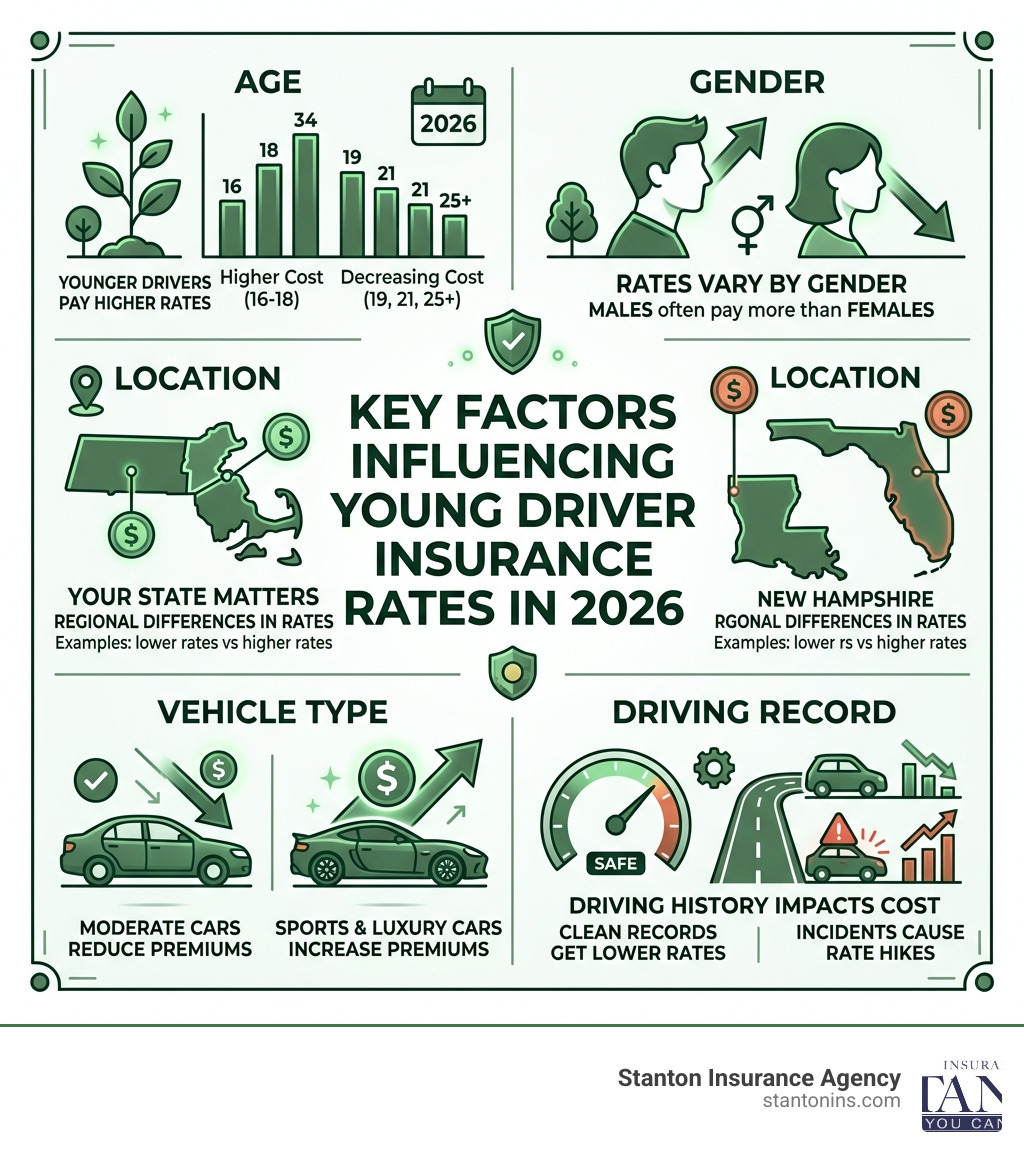
Young driver insurance cost terms made easy:
Understanding the Average Young Driver Insurance Cost in 2026

When we talk about the young driver insurance cost, we are looking at a market that treats inexperience as a significant liability. In 2026, the national average for an 18-year-old driver is approximately $514 per month ($6,168 per year). However, this number fluctuates wildly based on whether the driver is on a standalone policy or added to a family plan.
For a 16-year-old, the financial barrier is even higher. Minimum coverage nationally averages around $3,192 per year, but full coverage can skyrocket to over $9,000. These figures are based on Average Car Insurance Rates by Age and State (2026), which highlights that the youngest drivers consistently pay the highest premiums in the industry.
How Rates Change from Age 16 to 25
The good news is that time is your best friend. As drivers gain experience, the “youth surcharge” begins to evaporate. According to Average Cost of Car Insurance for 18-Year-Olds (2026) – ValuePenguin, an 18-year-old typically pays about 13% less than a 17-year-old.
We see the most dramatic price drops at specific milestones:
- Age 19: Rates can drop by as much as 30% compared to age 18.
- Age 21: Another significant dip of roughly 6% to 10% occurs as drivers move out of the “teen” bracket.
- Age 25: This is the magic number. By age 25, the average annual premium drops to approximately $2,010, as insurers finally view the driver as an experienced adult.
Risk Factors and Young Driver Insurance Cost
Why are the numbers so high? It isn’t just a “tax on youth”; it is based on grim statistics. The CDC reports that teens aged 16-19 are three times more likely to be involved in a fatal crash than drivers aged 20 and older.
As noted in How Much is Car Insurance for Teens? (2026 Rates), insurance companies price policies based on the likelihood of a claim. High-risk behaviors common in young drivers—such as speeding, distracted driving, and nighttime driving—lead to more frequent and more expensive claims. For insurers, a new driver is a “wildcard” with no track record of safety, necessitating a higher premium to offset the potential for a total-loss accident.
Why Age and Gender Impact Your Premiums

Insurance is a game of probability. We use data to predict how likely a driver is to get into an accident, and unfortunately for young drivers, the data isn’t in their favor. Age and gender remain two of the most influential factors in determining your rate, though their impact lessens as you get older.
Gender Differences in Rates
Statistically, young men are involved in more accidents and engage in riskier driving behaviors than young women. The Insurance Institute for Highway Safety (IIHS) notes that male drivers are 63% more likely to be involved in a fatal accident.
According to Cheapest Car Insurance for New Drivers in 2026, this translates to a “gender gap” in premiums. An 18-year-old male might pay $5,064 per year, while a female of the same age pays $4,483. This gap usually narrows to just 1% by the time drivers reach their 40s. It is important to note that some states, including Massachusetts, prohibit insurers from using gender as a rating factor, but in New Hampshire, it remains a standard part of the calculation.
The Impact of Driving Experience
Experience is not always synonymous with age. A 22-year-old who just got their license for the first time will often pay more than a 19-year-old who has been licensed since age 16. Insurers look for a “clean record” over a period of years.
If you are a new driver, your first goal should be to build a history of safe driving. For more on how to start this journey, check out our guide on New Driver New Ride How To Finance Your First Car And Get Insured/. Every year you go without a ticket or an at-fault accident, you are proving to the insurance company that you are a lower risk, which directly leads to lower premiums.
Regional Price Differences in MA and NH
Where you park your car at night matters almost as much as how you drive it. In New England, we have a unique regulatory landscape that affects the young driver insurance cost differently depending on which side of the state line you reside.
Young Driver Insurance Cost in Massachusetts
Massachusetts is a unique state for insurance. We have “age-neutral” and “gender-neutral” laws that prevent insurance companies from charging a higher rate based solely on your age or gender. However, don’t celebrate just yet—insurers can still use “years of driving experience” as a primary rating factor.
In Massachusetts, a 16-year-old’s monthly premium averages around $504. While this is lower than the national average for 16-year-olds, it still reflects the risk of having zero years of experience. For a deeper dive into local rates, see our Massachusetts Car Insurance Guide 2025/ and our breakdown of How Much Is Car Insurance Per Month In Massachusetts/.
Comparing New Hampshire and Massachusetts Rates
New Hampshire typically offers some of the most competitive rates in the region. According to Average Cost of Car Insurance in New Hampshire 2026 | Bankrate, the average cost for a 16-year-old is roughly $2,412 per year—significantly lower than the national average.
When we look at How Much Is Car Insurance For a New Driver in Massachusetts?, we see that Massachusetts drivers benefit from strict regulations that prevent the “sticker shock” seen in states like Florida, where an 18-year-old might pay $884 per month. In both MA and NH, the key to finding the best rate is working with a local agent who understands the specific town-by-town risk assessments used by regional carriers.
Proven Ways to Reduce Your Premiums
You aren’t stuck with a $500 monthly bill. There are several levers we can pull to lower the young driver insurance cost for your family.
- Good Student Discount: Most carriers offer a discount (usually 5-15%) for students who maintain a “B” average or a 3.0 GPA. This signals to the insurer that the driver is responsible.
- Defensive Driving Courses: Completing an approved safety course can shave 5% to 10% off the liability portion of your premium.
- Telematics (Safe Driving Apps): Many insurance carriers offer programs that monitor driving habits through mobile apps or plug-in devices. Safe habits (no hard braking, no late-night driving) can lead to discounts exceeding 15%.
- Higher Deductibles: If you have the savings to cover a $1,000 deductible instead of a $500 one, you can reduce your monthly premium significantly. Learn more in our How Much Car Insurance Complete Guide/.
Standalone Policy vs. Staying on a Parent’s Plan
This is the single most effective way to save money. Cheapest Car Insurance for New Drivers in 2026 indicates that adding a young driver to a parent’s policy saves an average of 68% compared to a standalone policy.
Why? It’s called “risk pooling.” When a teen is on a parent’s policy, the risk is spread across the more experienced drivers. Additionally, the family benefits from multi-car and multi-policy discounts (bundling auto with home or renters insurance). A standalone policy for a 16-year-old might cost $10,000, while adding them to a parent’s plan might only increase the family premium by $2,735.
Choosing the Right Vehicle
We know everyone wants the “cool” car, but your choice of vehicle is a massive factor in the young driver insurance cost.
- Avoid: Sports cars, luxury vehicles, and high-horsepower SUVs. These are expensive to repair and statistically more likely to be involved in high-speed crashes.
- Choose: Mid-sized sedans or small SUVs with high safety ratings. Older vehicles (5-10 years old) are often the sweet spot because they are safe but don’t require the expensive “gap insurance” or high collision premiums of a brand-new car.
For more tips on choosing your first vehicle, see New Driver New Ride How To Finance Your First Car And Get Insured/.
Frequently Asked Questions about Young Driver Insurance
At what age does car insurance typically become cheaper?
Rates begin to decline slightly every year after 16, but the most significant drops occur at age 19 (as teen risk factors decrease) and age 21. The most substantial “experience discount” kicks in at age 25, provided the driver has maintained a clean record.
Should young drivers stay on their parents’ policy or get their own?
In almost every scenario, staying on a parent’s policy is the more affordable choice. It allows the young driver to benefit from established loyalty discounts and multi-car savings. While credit scores can impact rates in New Hampshire, Massachusetts law prohibits their use in auto insurance rating, but the overall benefits of a family policy remain significant in both states. The only exception is if the parent drives a high-end luxury vehicle that would trigger a massive surcharge for the teen, in which case a separate policy for the teen’s older car might be cheaper.
How much does it cost to add a teen driver to a parent’s policy?
On average, adding a 16-year-old to a parent’s policy costs about $2,735 per year (roughly $228 per month). While this is a significant jump, it is thousands of dollars cheaper than the $7,000+ it would cost for that same teen to have their own policy.
Conclusion
Navigating the young driver insurance cost can feel like a daunting task, especially with the high premiums projected for 2026. However, by understanding the milestones of age, leveraging the savings of a family policy, and choosing the right vehicle, you can keep your family’s budget intact while ensuring your new driver is fully protected.
At Stanton Insurance Agency, we pride ourselves on being more than just a provider; we are your local experts in Massachusetts and New Hampshire. We understand the nuances of New England insurance laws and work tirelessly to find the discounts that national websites might miss. Whether you are looking for auto insurance costs for a new driver or want to explore motorcycle insurance for a young rider, we are here to help.
Don’t let high rates keep you off the road. Reach out to us today for a personalized quote that fits your family’s needs.