
Why Insurance for Teen Drivers Costs More — and What You Can Do About It
Insurance for teen drivers is one of the most expensive and confusing purchases a family can make. The moment your teenager gets their license, your insurance costs can jump by hundreds — sometimes thousands — of dollars a year.
Here’s a quick overview of what you need to know:
| Question | Quick Answer |
|---|---|
| Do you have to add your teen to your policy? | Yes, in almost every state — and in Massachusetts |
| How much does it cost? | Adding a 16-year-old costs about $2,735/year extra on average |
| Is a separate policy cheaper? | No — staying on a parent’s policy is almost always cheaper |
| When do rates go down? | Rates typically drop at 19, again at 20, and again at 21 |
| How can you save money? | Good student discounts, driver training, telematics apps, and smart vehicle choices all help |
The reason teen rates are so high comes down to risk. Drivers between 16 and 19 are involved in fatal crashes nearly three times as often as adult drivers, on a per-mile basis — despite driving fewer miles than any other age group. Insurers price that risk accordingly.
That doesn’t mean you’re helpless. There are real, proven strategies to manage the cost — and understanding your options is the first step.
I’m Geoff Stanton, President of Stanton Insurance Agency and a Certified Insurance Counselor (CIC) with over 25 years of experience helping Massachusetts families navigate insurance for teen drivers. As a father myself, I know how important it is to get this right — both for your budget and your teen’s protection.
Insurance for teen drivers terms at a glance:
- Car insurance quotes monthly
- how much is a down payment for car insurance
- Young driver insurance cost
Do You Have to Add Your Teenager to Your Policy?
In most cases, yes. If your teen lives in your household and is licensed or regularly drives your vehicle, your insurance company generally needs to know about them.
That does not always mean your premium changes the day your teen gets a learner’s permit, but it does mean you should call your agent before they start driving. Waiting until after an accident is the insurance version of doing homework in the car on the way to school: technically possible, but not recommended.
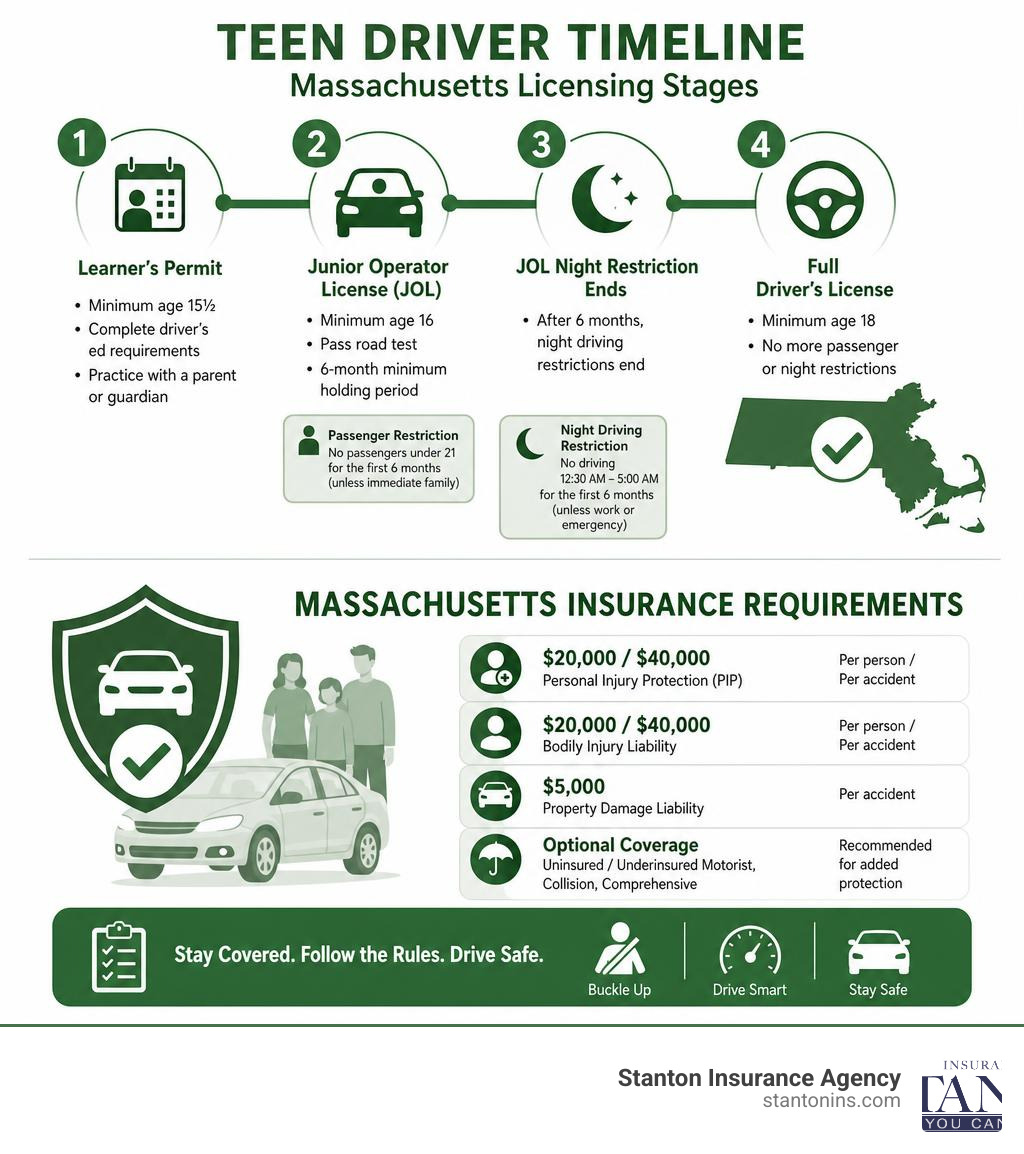
For Massachusetts families, teen drivers must follow state licensing rules, Junior Operator License restrictions, and insurance requirements. Mass.gov offers helpful safety guidance for new drivers here: Tips For Teen Driving | Mass.gov.
If you want a deeper look at required auto coverage in Massachusetts, we explain it here: More info about Massachusetts car insurance requirements.
In New Hampshire, the rules are different because the state does not require every driver to carry auto insurance in the same way Massachusetts does. However, drivers are still financially responsible for damage they cause, lenders may require coverage, and insurers still expect household drivers to be disclosed. For most families, carrying proper coverage is the practical and financially safer choice.
Legal Requirements for Teen Drivers
Teen insurance obligations usually depend on where your teen is in the licensing process:
| Teen driving stage | What parents should do |
|---|---|
| Learner’s permit | Notify your insurance agent or company before your teen drives your car |
| Licensed teen driver | Add the teen as a listed operator if required by the insurer |
| Teen has their own car | Make sure the vehicle is insured and titled/registered correctly |
| Teen moves away or goes to school | Ask whether a distant student or low-mileage rating applies |
In Massachusetts, all registered vehicles must have required auto insurance. If your teen is going to drive a household vehicle, your insurer needs accurate driver information. Not listing a teen driver can create major problems, including claim delays, denied claims, policy cancellation, or non-renewal.
Continuous coverage also matters. Gaps in insurance can make future coverage more expensive and may limit discount eligibility. For more on how young drivers affect premiums, visit our guide: More info about young driver car insurance.
How Coverage Works Under a Parent’s Policy
When you add your teen to your auto policy, they generally receive the same core protection as other covered drivers on the policy. That can include:
- Bodily injury liability
- Property damage liability
- Personal injury protection where applicable
- Uninsured or underinsured motorist coverage
- Collision coverage, if selected for the vehicle
- Comprehensive coverage, if selected for the vehicle
- Optional coverages such as rental reimbursement or roadside assistance, if included
Here is the important part: a teen listed on your policy may be rated in a few different ways.
Some insurers use driver-vehicle assignment, meaning the teen is rated primarily on a specific vehicle. Others use household-based rating, meaning the teen’s risk may affect the overall household premium because they technically have access to multiple vehicles.
That is why we encourage parents to ask direct questions, such as:
- Which vehicle is my teen being rated on?
- Will my teen be rated on the most expensive vehicle?
- Are all vehicles in the household available to the teen under the policy?
- Would changing which vehicle the teen drives lower the premium?
- Are our liability limits high enough now that we have a new driver?
Adding a teen is also a good time to review liability limits. A minimum-limit policy may satisfy legal requirements, but it may not be enough to protect your savings, home equity, or future income after a serious accident.
The Real Cost of Insurance for Teen Drivers

Adding a teen driver is expensive because insurers price for probability. Teen drivers have less experience, are more likely to misjudge road conditions, and are at higher risk for distracted driving. Among U.S. high school students, 39% have admitted to texting or emailing while driving. That is a scary number, especially for parents who have watched a teenager try to text, eat fries, and change a playlist at the same time.
According to national insurance cost analysis, it costs about $2,735 per year to add a 16-year-old to a parent’s car insurance policy, or roughly $230 extra per month. Other recent data found that the average full-coverage cost for a 16-year-old on a parent’s policy reached about $5,740 per year as of November 2025. You can read more about the national cost trend here: Why Teen Driver Insurance Averages $5,700 a Year.
Your actual cost may be higher or lower depending on:
- Your state and ZIP code
- The teen’s age
- The vehicle they drive
- Household driving records
- Coverage limits
- Deductibles
- Whether the car is financed or leased
- Available discounts
- Annual mileage
- Whether the teen is away at school
Massachusetts and New Hampshire families should also remember that premiums vary widely by carrier. The same teen, same vehicle, and same address can produce very different quotes.
Average Cost of Insurance for Teen Drivers by Age
Teen driver costs are highest at 16 and generally improve as the driver gains experience. Age is not the only factor, but it is a major one.
Here are national benchmark figures from recent industry research:
| Teen driver age | Common cost benchmark | What it means |
|---|---|---|
| 16 | About $2,735 extra per year to add to a parent’s policy; full-coverage household cost can average around $5,740 per year | Highest-cost year because the driver is newly licensed |
| 17 | About $234/month for minimum coverage and $262/month for full coverage on a family policy in one national analysis | Still expensive, but usually lower than age 16 |
| 18 | A married couple with an 18-year-old driver pays about $4,941 per year on average | Often lower than 16, but still far above adult-only rates |
For more age-specific research, see these national guides:
The big takeaway: adding a teen to a family policy is almost always cheaper than buying a separate standalone policy. Family policies can benefit from existing insurance history, multi-car discounts, multi-policy discounts, and broader household rating advantages.
When Do Teen Car Insurance Rates Decrease?
Teen car insurance rates usually begin to drop as the driver gets older and builds a clean driving record.
National rate data shows average decreases around key milestones:
| Age milestone | Typical rate trend |
|---|---|
| 19 | Rates may drop by about 10% on average |
| 20 | Rates may drop by another 5% on average |
| 21 | Rates may drop by another 6% on average |
| 25 | Many drivers see more meaningful improvement, assuming a clean record |
These are averages, not guarantees. A teen with accidents, tickets, or coverage lapses may not see the same improvement. A teen with clean driving, good grades, driver training, and safe vehicle choices is usually in a much better position.
The first few years matter. A clean record from 16 to 21 can make a major difference.
Best Car Insurance Coverages for Teens
The best policy for a teen is not always the cheapest policy. With a new driver in the household, the goal is to balance affordability with real protection.
A teen driver can cause damage that goes far beyond a bent bumper. Medical bills, lawsuits, vehicle repairs, and lost wages can add up quickly. That is why we often recommend reviewing your full insurance picture when a teen joins the policy.
If you are deciding between liability-only and broader protection, start here: More info about full coverage vs liability.
Essential Liability and Vehicle Protection
Here are the main coverage types to understand.
| Coverage | What it helps pay for | Why it matters for teens |
|---|---|---|
| Bodily injury liability | Injuries your teen causes to others | Medical claims can be financially devastating |
| Property damage liability | Damage your teen causes to another vehicle or property | Even a minor crash can involve expensive repairs |
| Collision | Damage to your own vehicle after a crash | Useful if the teen drives a newer or valuable car |
| Comprehensive | Theft, vandalism, fire, falling objects, animal strikes, weather damage | Important for vehicles you cannot afford to replace out of pocket |
| Uninsured/underinsured motorist | Injuries caused by a driver with no insurance or not enough insurance | Helps protect your household from other drivers’ lack of coverage |
| Roadside assistance | Towing, lockouts, jump starts, flat tires | Very helpful for inexperienced drivers |
In Massachusetts, required coverages are only the starting point. Minimum limits may be legal, but they may not be enough for a family with assets to protect.
If your teen drives an older, lower-value vehicle, liability-only coverage may be worth considering, especially if the car is paid off. But if the vehicle is financed, leased, newer, or expensive to replace, collision and comprehensive coverage are usually important.
For families focused on keeping premiums manageable, we also explain liability options here: More info about cheap liability options.
A useful rule of thumb: if you would struggle to replace the vehicle tomorrow, think carefully before dropping physical damage coverage.
How to Get Affordable Insurance for Teen Drivers

You may not be able to make teen insurance cheap, but you can make it smarter.
The best savings strategy is usually a combination of several smaller steps. One discount may help a little. Five good decisions together can make a real dent.
For more on safe driving and savings, see our guide: More info about defensive driving discounts.
Smart Discounts for Young Operators
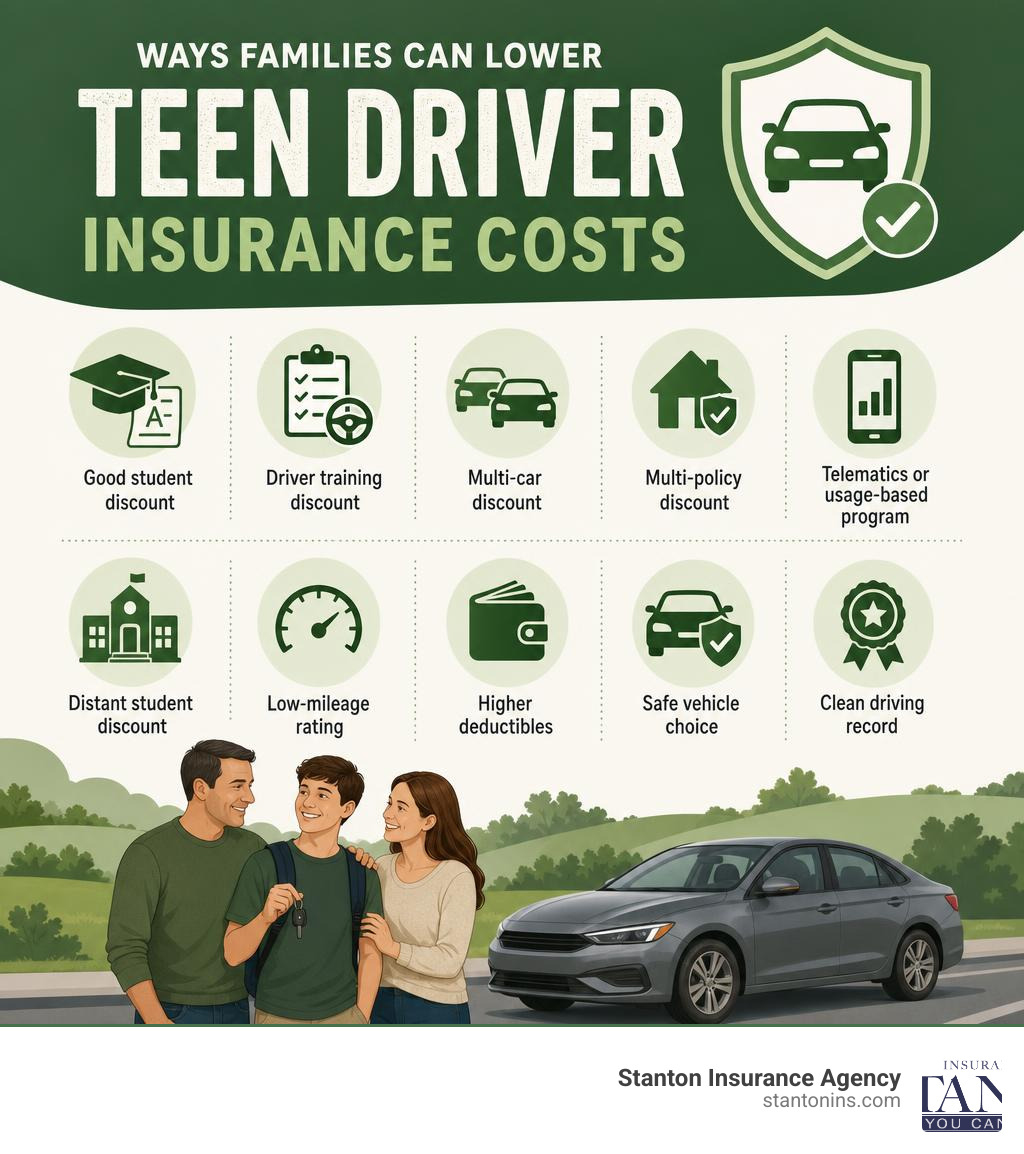
Ask about these discounts and rating strategies when adding your teen:
| Savings strategy | How it helps |
|---|---|
| Good student discount | Many insurers reward students who maintain good grades, often a B average or better |
| Driver training discount | Approved driver education or defensive driving programs may reduce premiums |
| Multi-car discount | Insuring more than one vehicle on the same policy can help |
| Multi-policy discount | Bundling auto with home, condo, or renters insurance may lower costs |
| Telematics or usage-based program | Safe driving apps or devices may reward careful driving |
| Distant student discount | May apply if your teen is away at school without a car |
| Low-mileage rating | Helps if the teen does not drive often |
| Higher deductibles | Can lower premiums, but only choose a deductible you can afford |
| Safe vehicle choice | Avoid sports cars, luxury vehicles, and high-performance models |
| Clean driving record | Avoiding tickets and accidents is one of the biggest long-term savings tools |
Vehicle choice deserves special attention. A practical, safe, moderately priced vehicle is usually better than a flashy car with high repair costs. Your teen may dream of something loud enough to wake the neighbors. Your insurance bill would prefer something boring, reliable, and full of airbags.
Before buying a car for your teen, quote the insurance first. The purchase price is only part of the cost.
Also consider these practical tips:
- Keep the teen on the family policy when possible.
- Compare quotes before and after adding the teen.
- Review coverage limits and deductibles.
- Ask whether the teen is assigned to a specific vehicle.
- Avoid unnecessary vehicle upgrades that increase insurance costs.
- Keep proof of good grades ready.
- Re-shop coverage if your teen turns 19, 20, or 21.
- Talk with your teen about distracted driving, passengers, speeding, and nighttime driving.
What If Your Teen Is Away at School?
If your teen goes away to school and does not take a car, you may be able to reduce costs without removing them from the policy entirely.
Ask about:
- Distant student discounts
- Student-away-at-school discounts
- Low-mileage rating
- Occasional driver status
- Whether the vehicle remains garaged at home
- Whether the teen will drive during holidays or summer break
Many insurers use distance thresholds, often around 100 miles from home, but rules vary by company. The key is to tell your agent exactly where the student is living, whether they have a car, and how often they will drive.
Do not remove a teen from the policy just because they are away at school if they will still drive family vehicles during breaks. If they come home for Thanksgiving and borrow the car to see friends, you want the coverage situation clear before the driveway is empty.
If your teen attends school out of state, including outside Massachusetts or New Hampshire, you should also confirm where the vehicle is primarily garaged. Insurance rating and registration rules can change when a car is kept in another state for an extended period.
Frequently Asked Questions About Teen Driver Insurance
Teen driver insurance brings up a lot of questions. Here are the ones we hear most often from families.
Can a Teen Get Their Own Car Insurance Policy?
Sometimes, but it is usually not the best option.
In most states, a minor cannot legally sign an insurance contract on their own. That means a 16- or 17-year-old usually needs a parent or guardian involved. Once a young driver turns 18, they may be able to buy their own policy, but standalone coverage is often much more expensive than staying on a parent’s policy.
A separate policy may make sense if:
- The teen owns and registers their own vehicle.
- The teen no longer lives at home.
- The teen is financially independent.
- The vehicle is garaged somewhere else.
- Family circumstances make a shared policy impractical.
For most households, however, adding the teen to the family policy is more affordable. It also keeps coverage easier to manage because billing, vehicles, drivers, and discounts are all in one place.
A young driver can often remain on a parent’s policy as long as they live in the household or meet the insurer’s eligibility rules. If they move out permanently, buy their own car, or establish a separate residence, it may be time for their own policy.
What Happens If a Teen Driver Gets a Ticket or Is in an Accident?
A ticket or accident can raise premiums significantly, especially for a teen. Teen rates are already high because of inexperience, so a violation adds risk on top of risk.
Common consequences include:
- Premium surcharges
- Loss of good driver discounts
- Loss of accident-free discounts
- Higher deductibles in some situations
- Policy non-renewal in serious cases
- Required driver retraining or state penalties
- Longer-term rate impact, often several years
Speeding tickets are especially problematic because speed is a major factor in severe teen crashes. At-fault accidents can be even more expensive because they involve claim payments and future risk.
If your teen has a ticket or accident:
- Tell your insurance agent promptly.
- Ask how long the surcharge may apply.
- Review whether accident forgiveness applies, if available.
- Consider a defensive driving or driver improvement course if appropriate.
- Revisit household driving rules.
- Compare quotes at renewal if the rate increase is steep.
This is also a good time for a parent-teen driving agreement. Set clear rules for passengers, phone use, nighttime driving, bad weather, and who pays for tickets. Nothing focuses a teenager’s attention quite like learning that “I forgot” is not a valid payment method.
Do You Need Insurance for a Teen with a Learner’s Permit?
Usually, a teen with a learner’s permit is covered under a parent’s policy while practicing in a household vehicle, but you should not assume. Notify your insurer or agent as soon as your teen gets a permit or begins driving.
Some companies do not charge for a permitted driver until they become licensed. Others want the driver listed earlier. The rules vary, and the safest approach is to ask before the first practice drive.
If you fail to disclose a teen driver and they cause an accident, you could face serious problems, including claim denial or policy cancellation depending on the situation and policy language.
If your teen is also getting their first vehicle, read this before you buy: More info about financing and insuring a first car.
Conclusion
Teen driver insurance is expensive, but it does not have to be confusing. The right approach is to plan early, disclose your teen driver, choose the right vehicle, look for every available discount, and carry coverage that protects your family financially.
The biggest takeaways are:
- Add your teen to your policy when required.
- Notify your insurer during the permit stage.
- Expect rates to be highest at 16 and improve with age and clean driving.
- Keep your teen on a family policy when possible.
- Choose a safe, practical vehicle.
- Ask about good student, driver training, telematics, multi-car, and distant student discounts.
- Review liability limits before your teen starts driving.
At Stanton Insurance Agency, we help Massachusetts and New Hampshire families find trusted protection for their vehicles, homes, and valuable assets. We can review your current policy, explain your teen driver options, and help you compare coverage in plain English.
Ready to make sure your new driver is properly covered? Get a personalized car insurance quote today.