
Why Property Investment Protection Can Make or Break Your Real Estate Portfolio
Property investment protection is the system of legal, financial, and operational strategies that shields your real estate assets from lawsuits, title defects, uninsured losses, and government actions that can erode your wealth.
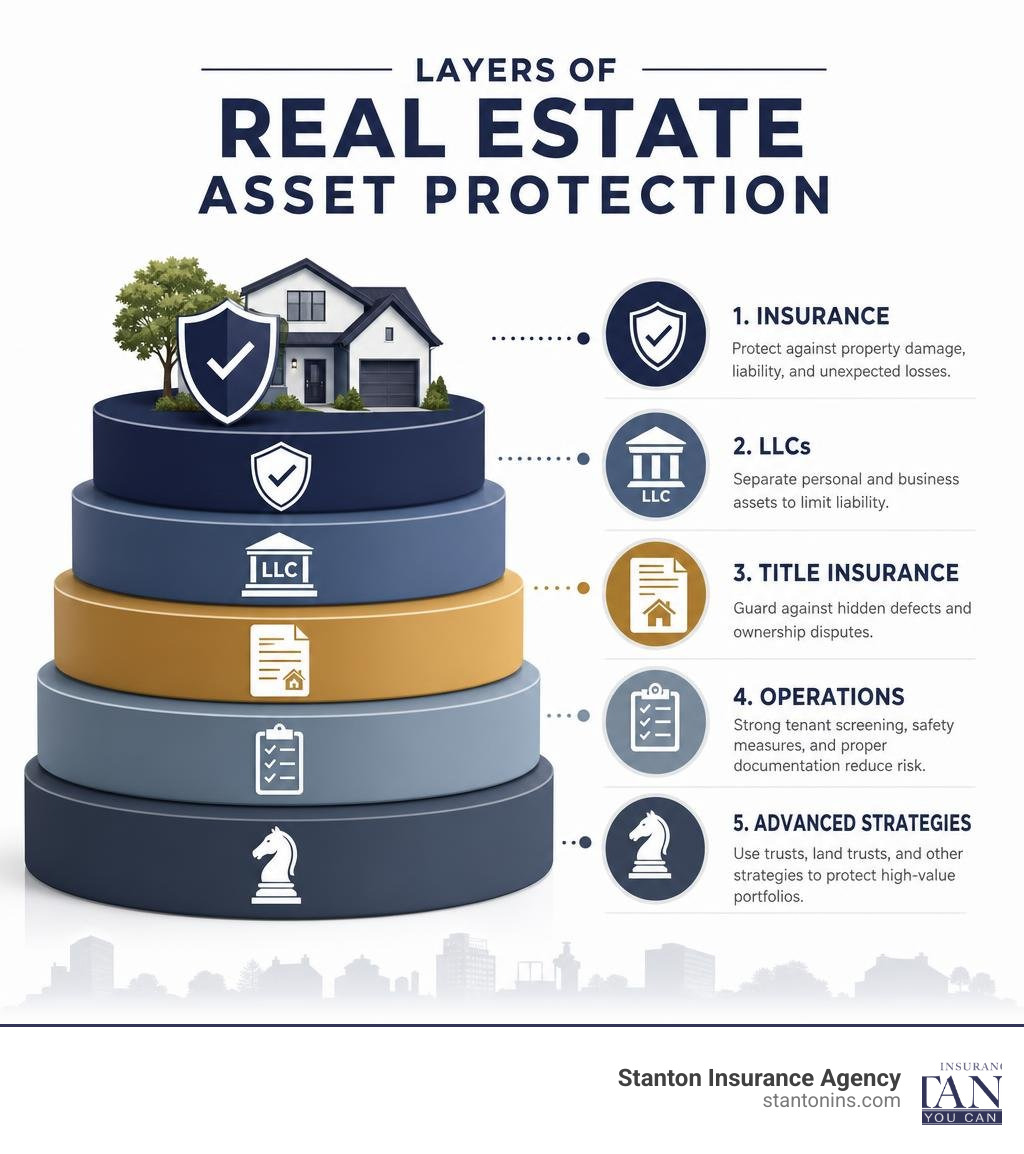
Here’s what a complete protection plan covers:
- Insurance — Landlord policies, premises liability, umbrella coverage, and specialized investor programs
- Legal entities — LLCs, Series LLCs, and trusts that separate your personal assets from property liabilities
- Title protection — Owner’s title insurance that guards against hidden defects and complex ownership histories
- Operational practices — Tenant screening, safety features, and proper documentation that prevent lawsuits before they start
- Advanced strategies — Land trusts, equity stripping, and asset protection trusts for high-value portfolios
- Regulatory protection — Legal remedies when government zoning actions reduce your property’s value
Real estate investing can build serious wealth — but it can also expose you to serious risk. The average liability lawsuit against a property owner starts at $1.5 million, and many investors are carrying far less coverage than that. A single tenant slip-and-fall, an undisclosed title defect, or a gap in your insurance policy can wipe out years of gains.
The good news? Most of these risks are preventable with the right layered approach.
I’m Geoff Stanton, President of Stanton Insurance Agency in Waltham, Massachusetts, and a Certified Insurance Counselor (CIC) with over two decades of experience helping small and medium-sized portfolio owners navigate property investment protection. In this guide, I’ll walk you through every layer of protection — from the right insurance programs to legal structures and operational best practices — so you can invest with confidence.
Key terms for Property investment protection:
The Core Pillars of Property Investment Protection
When we talk about shielding your hard-earned real estate assets, we are not talking about a single silver-bullet product. True property investment protection is a system of overlapping defenses. If a lawsuit or a natural disaster manages to breach your first line of defense, your second and third lines should stand firm to ensure your personal wealth remains completely untouched.
In places like Massachusetts and New Hampshire, property owners face a unique combination of risks. From harsh New England winters that cause burst pipes and ice-related slip-and-falls to the highly litigious environment of modern business, the threats are real. Operational risks, financial threats, and devastating liability lawsuits can easily compromise an unprotected portfolio. Because the average liability lawsuit starts at $1.5 million, carrying basic, low-limit insurance policies is a gamble you cannot afford to take.
To help you get started on the right foot, we recommend that you read our complete guide to landlord insurance to understand how basic coverage forms the bedrock of your defense.

Specialized Insurance as Property Investment Protection
Your first and most active line of defense is always high-quality, specialized insurance. While standard landlord policies are great for single-family homes, growing portfolios and unique occupancies require tailored solutions. Programs like One80 Intermediaries’ Property Investors Protection are designed specifically for active real estate investors, renovators, and property managers.
These specialized programs offer highly flexible features that standard commercial policies simply cannot match:
- No Location Limits: You can add an unlimited number of properties under a single, unified policy, simplifying your administration.
- Premises Liability Limits: Coverage typically extends up to $2 million per occurrence, providing a robust shield against major personal injury claims.
- Aggregated Portfolio Limits: For larger portfolios (often over 50 locations), aggregated limits can reach up to $5 million.
- Flexible Deductibles: Options range from a manageable $1,000 up to $25,000 for high-net-worth investors looking to lower their premium costs.
- Monthly Reporting Forms: Instead of guessing your annual exposure, you can adjust your coverage monthly to match your active acquisitions, renovations, or sales.
- Diverse Occupancy Coverage: These policies explicitly cover high-exposure situations such as student housing, vacant land liability, and mixed-use commercial/residential occupancy.
By partnering with an agency that understands these specialized programs, you ensure that your policy matches your business model. To learn more about how to design these programs for growing portfolios, learn about insuring your real estate empire.
Legal Entities for Property Investment Protection
If a claim exceeds your insurance limits, your legal entity structure is what keeps plaintiffs from targeting your personal bank accounts, primary residence, or other investments. Holding investment properties in your personal name is one of the most dangerous mistakes you can make. Instead, we use Limited Liability Companies (LLCs) to isolate liabilities.
There are three primary LLC structures used by real estate investors:
- Single-Member LLC: Ideal for solo investors. It provides solid personal liability protection while maintaining simple “pass-through” taxation on your personal tax return.
- Multi-Member LLC: Best when you are investing with partners. It requires a detailed Operating Agreement to define who manages the properties and how profits, losses, and liabilities are distributed.
- Series LLC: This advanced structure allows you to establish a “master” LLC with individual, isolated “sub-LLCs” (or series) underneath it. Each property is held in its own series, meaning a lawsuit against Property A cannot touch the equity in Property B.
While Series LLCs are highly efficient, you must ensure they are properly recognized and maintained under your local state laws. For instance, filing fees for forming an LLC vary widely by state. In Massachusetts, the initial filing fee is relatively high at $500, whereas in New Hampshire, it is much more affordable.
Regardless of which state your properties are in, you must maintain strict corporate hygiene. This means keeping separate bank accounts, never commingling personal and business funds, and signing all contracts explicitly in the name of the LLC. Failing to do so can allow a court to “pierce the corporate veil,” exposing your personal assets to business debts. To learn more about how to construct these entity boundaries, understand how to structure a liability shield.
Advanced Asset Protection and Equity Safeguards
As your portfolio grows and you accumulate significant equity, basic LLCs and standard insurance may no longer be enough. Plaintiffs’ attorneys are highly skilled at uncovering visible wealth. If they see a property with $1 million in clean, unencumbered equity, your property becomes an incredibly attractive target. Advanced asset protection is all about reducing your visible equity profile and separating your assets into highly secure, isolated compartments.
At this level, we also coordinate our legal structures with advanced tax strategies. For example, utilizing depreciation benefits and electing S-Corporation tax status for your management LLC can significantly reduce self-employment taxes while preserving your liability shield. To ensure you have an extra layer of financial security above your entities, you should explore umbrella policies for rental properties.

Land Trusts and Privacy
A land trust is a highly effective tool used to keep your property ownership private. In Massachusetts and New Hampshire, property ownership is a matter of public record. Anyone with an internet connection can search county registry databases to see exactly what real estate you own.
When you use a land trust, the title to the property is held in the name of the trust (e.g., “The 123 Main Street Trust”), with a third-party trustee listed on the public record. You, the investor, remain the private beneficiary.
- Lawsuit Deterrence: If a contingency-fee attorney searches public records to see if you are worth suing after a minor incident, they will find nothing in your personal name.
- The Garn-St. Germain Act of 1982: This federal law prevents mortgage lenders from enforcing “due-on-sale” clauses when you transfer a residential property (1-4 units) into a revocable trust where you remain the beneficiary.
- Combined Protection: A land trust by itself does not provide liability protection—it only provides privacy. However, when you name your LLC as the beneficiary of the land trust, you achieve the ultimate combination of absolute privacy and robust liability protection.
To see how these privacy layers fit into an active investing business, read about asset protection for rental property investors.
Equity Stripping and Offshore Structures
If you own high-value properties with substantial equity, “equity stripping” is an advanced strategy designed to make your properties look worthless to potential creditors.
Attorneys generally do not waste their time suing entities that have no equity to collect. Through equity stripping, you record a home equity line of credit (HELOC) or a mortgage against your property, payable to a separate, privately-owned LLC. To the public, the property appears heavily leveraged and unattractive to creditors, even though you control the secured debt.
For ultra-high-net-worth portfolios, these strategies can be paired with offshore structures, such as a Cook Islands Asset Protection Trust. Because offshore trustees are not subject to U.S. court orders, holding your equity-stripped proceeds or LLC membership interests in an offshore trust places them completely out of reach of domestic lawsuits. However, these strategies must be implemented during calm periods. Attempting to strip equity or move assets offshore after a lawsuit has been threatened or filed will be viewed by courts as a fraudulent transfer, which carries severe legal penalties. To explore how these advanced strategies work in detail, review the ultimate guide to asset protection.
Title Insurance and Regulatory Protections
Many real estate investors pour all of their energy into managing tenants and physical structures, completely overlooking the legal foundation of their investment: the property title. Investment properties often have highly complex ownership histories, especially if they were purchased as foreclosures, short sales, or distressed estate sales. These complex histories create numerous opportunities for documentation errors, unrecorded liens, and boundary disputes that can cloud your title and threaten your ownership equity.
Owner’s Title Insurance for Complex Histories
When you purchase a property with a mortgage, your lender will always require you to buy a Lender’s Title Insurance policy. A common and costly mistake among investors is assuming this policy protects them. It does not. A lender’s policy only protects the lender’s outstanding loan balance; it does not cover your down payment, your accumulated equity, or your rental income.
To protect your own financial interests, you must purchase an Owner’s Title Insurance policy. For a one-time premium paid at closing—which represents a tiny fraction of one percent of the property’s value—you secure lifetime protection.
For maximum safety, we highly recommend upgrading to an Enhanced Owner’s Title Insurance policy. While it typically costs about 10% more than a standard policy, it provides significantly broader coverage, including:
- Post-Closing Protection: Covers issues that occur after you buy the property, such as a neighbor building an encroaching structure.
- Permit and Zoning Violations: Covers the cost of correcting pre-existing, unpermitted building work or zoning violations left behind by the previous owner.
- Inflation Protection: Automatically increases your coverage limit as your property appreciates over time.
Before you close on any property, your title company should perform a rigorous preliminary title search to uncover outstanding tax liens, easement issues, or boundary disputes. To understand how to coordinate your physical property improvements with proper title protection, discover how to safeguard your building investment.
The Property Investment Protection Act and Government Actions
Sometimes, the greatest threat to your investment value isn’t a tenant or a storm—it’s the local government. Municipalities frequently change zoning laws, which can severely limit how you use your property or dramatically reduce its market value.
To address this, legal frameworks like the Property Investment Protection Act serve as a critical defense. This model legislation establishes that when a government zoning change or regulatory action directly diminishes the value of a private property investment, it is treated as a “regulatory taking.” Under this framework, property owners are entitled to:
- Just Compensation: Direct financial payment for the loss in property value.
- Condemnation Proceedings: Requiring the government to fully purchase the property at its pre-regulation market value.
- Assessed Valuation Reductions: Forcing local tax assessors to reduce the property’s assessed value to reflect the regulatory damage, lowering your property tax burden.
- Jury Determinations: Giving the property owner the right to have a jury decide the fair compensation amount. If the local authority cannot afford to pay, they must reinstate the prior zoning rules.
Operational Best Practices to Minimize Landlord Liability
The absolute best way to handle a $1.5 million liability lawsuit is to prevent it from ever being filed in the first place. This is where operational discipline comes into play. By running your rental business with professional, standardized procedures, you eliminate the safety hazards and legal missteps that plaintiffs’ attorneys love to exploit.
Tenant Screening and Property Management
Your tenants are the temporary caretakers of your investment. Placing the wrong tenant in your property can lead to unpaid rent, property damage, and severe legal liabilities.
A professional tenant screening process is vital. Leading property management companies reject roughly 30 percent of all applicants through rigorous background, credit, and income verification checks.
- Income Verification: Always verify income directly through tax documents or bank statements to spot sophisticated fake pay stubs.
- Background and Eviction Checks: Run comprehensive criminal and eviction history reports in compliance with all federal and state Fair Housing laws.
- Professional Management: If you do not have the time or expertise to manage properties strictly by the book, hiring a licensed, professional property management company is one of the smartest liability-reduction moves you can make.
To find the right insurance to back up your professional management team, find the best multi-family investment property insurance.
Safety Features and Fall Prevention
Physical property safety is a major component of property investment protection. In the United States, fire departments respond to an average of over 350,000 home structure fires every single year. Furthermore, slip-and-fall accidents are a leading source of landlord liability, with 20 percent of older adults who fall suffering severe injuries like broken bones or head trauma.
To keep your residents safe and insulate yourself from devastating injury claims, implement these safety standards:
- Smoke and CO Detectors: Install dual-sensor smoke detectors in every bedroom and carbon monoxide detectors near all gas appliances, testing them annually and documenting the results.
- Security Lighting: Use bright, motion-activated LED lighting in all common areas, walkways, and parking lots.
- Fall Prevention: Keep all stairways in perfect repair, install sturdy handrails, and ensure New England snow and ice are cleared from walkways immediately.
- Smart Technology: Install video doorbells (which typically cost between $60 and $250) to monitor property access and deter criminal activity.
To learn how maintaining these safety features can help you secure lower insurance premiums, explore affordable rental property insurance.
Building a Comprehensive Liability Shield
To successfully protect your wealth, you must combine all of these individual elements into a single, cohesive liability shield. The table below illustrates the difference between relying on basic insurance versus implementing a fully integrated, modern protection system.
| Protection Feature | Standard Landlord Insurance Only | Comprehensive Liability Shield |
|---|---|---|
| First Line of Defense | Basic property and liability policy | High-limit landlord policy + commercial umbrella policy |
| Entity Isolation | None (held in personal name) | Single-member, multi-member, or Series LLCs |
| Title Protection | Lender’s policy only | Enhanced Owner’s Title Insurance with post-closing coverage |
| Operational Controls | Informal screening and maintenance | Professional tenant screening + documented safety inspections |
| Equity Safeguards | Fully exposed property equity | Equity stripping, land trusts, or conservative DSCR loan leverage |
| Personal Guarantee Risks | Fully exposed personal assets | Personal guarantee protection or non-recourse debt |
Using Debt Service Coverage Ratio (DSCR) loans is another highly effective way to manage your equity exposure. Because DSCR loans are secured by the property’s rental income rather than your personal salary, they allow you to keep your properties leveraged conservatively, reducing the visible equity that plaintiffs can target while keeping your personal assets isolated.
Common Asset Protection Mistakes to Avoid
Even the most expensive asset protection plan can fail if it is not maintained correctly. Here are the most common mistakes we see real estate investors make, and how you can avoid them:
- Commingling Funds: Using your personal bank account to pay for property repairs, or depositing rent checks directly into your personal account. This completely destroys your LLC’s legal protection. Always use dedicated business accounts.
- DIY Legal Work: Using cheap, generic online templates to form your LLC or draft your Operating Agreement. Real estate laws are highly state-specific. Always work with an experienced asset protection attorney in Massachusetts or New Hampshire.
- The “Single Bucket” Approach: Placing all of your properties into a single LLC. If one tenant sues that LLC, the equity in every single one of your properties is at risk. Group your properties logically into separate LLCs.
- Ignoring Corporate Formalities: Failing to file annual reports, pay state fees, or keep basic written records of major business decisions.
- Choosing Insurance on Price Alone: Buying the cheapest policy available just to satisfy a lender. Saving a few hundred dollars on annual premiums can cost you millions if you experience a major claim with a policy full of restrictive exclusions. To find a trusted advisor who can help you avoid these traps, learn how to pick the perfect landlord insurance partner.
Frequently Asked Questions about Property Protection
Does a personal guarantee on a DSCR loan affect my liability shield?
No. A personal guarantee on a DSCR loan is a contract between you and your lender regarding the repayment of the debt. It does not affect your LLC’s liability shield against third-party tenant claims, slip-and-falls, or contractor disputes. Your personal assets remain protected from operational lawsuits, even if you have personally guaranteed the mortgage.
How does the Property Investment Protection Act protect against zoning changes?
The Act establishes that if a local government enacts a zoning change that reduces your property’s value, it is considered a regulatory taking. This gives you the legal right to demand direct financial compensation for the lost value, force the municipality to buy the property at its original value, or have a jury determine fair compensation. If the municipality cannot pay, they must reinstate your original zoning rights.
Why is owner’s title insurance necessary if I have a lender’s policy?
A lender’s title insurance policy only protects the bank’s financial interest in the property. It provides absolutely no protection for your down payment, your equity, or your rental income. An Owner’s Title Insurance policy is the only way to protect your personal investment from hidden title defects, liens, and boundary disputes.
Conclusion
Building a successful real estate portfolio takes years of hard work, discipline, and capital. But leaving that portfolio unprotected is like running through a legal minefield. By implementing a comprehensive, layered system of property investment protection—combining specialized insurance, strong legal entities, owner’s title insurance, and tight operational practices—you ensure that your wealth is safe from unexpected blows.
At Stanton Insurance Agency, we have been helping New England real estate investors secure their hard-earned assets since day one. Whether you own a single multi-family property in Waltham or a growing commercial portfolio across Massachusetts and New Hampshire, we are here to help you build a bulletproof defense.
Ready to secure your portfolio? Protect your portfolio with Stanton Insurance Agency’s business insurance solutions today.
