
Why Every Landlord Needs to Insure Rental Property the Right Way
Insure rental property correctly and you protect one of your biggest financial investments. Get it wrong — or skip it entirely — and a single fire, lawsuit, or bad tenant situation could cost you tens of thousands of dollars.
Here is a quick answer to the most common questions:
| Question | Quick Answer |
|---|---|
| What type of insurance do I need? | Landlord insurance (also called a dwelling fire policy) |
| Does homeowners insurance cover rentals? | No — standard homeowners policies do not cover tenant-occupied properties |
| Is it legally required? | Not by law in most states, but lenders almost always require it |
| What does it cover? | Property damage, liability, and loss of rental income |
| Who covers tenant belongings? | Renters insurance — the tenant’s own policy, not yours |
Being a landlord comes with real rewards. It also comes with real risks. A tenant slips on a broken stair. A kitchen fire makes the unit unlivable for three months. A pipe bursts and causes water damage throughout the building. In each of these situations, the wrong insurance policy — or no policy at all — leaves you holding the bill.
The good news is that rental property insurance is straightforward once you understand what it does and why it exists.
I’m Geoff Stanton, President of Stanton Insurance Agency and a Certified Insurance Counselor (CIC) with over two decades of experience helping Massachusetts landlords insure rental property the right way. In the sections below, I’ll walk you through everything you need to know to protect your investment without the confusion.
Insure rental property helpful reading:
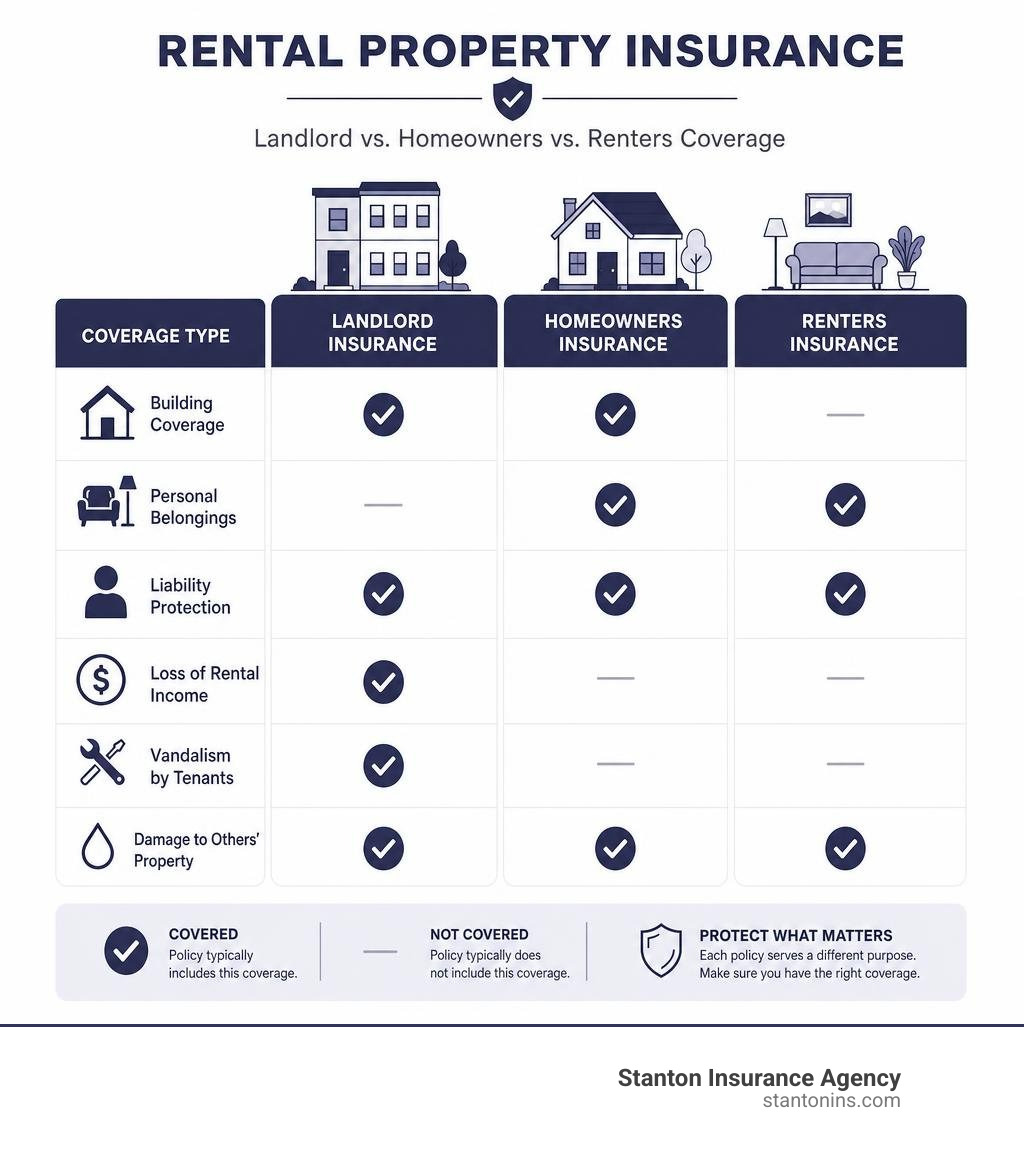
How to Insure Rental Property: Landlord Insurance vs. Homeowners Insurance

When you transition a property from a personal residence to an income-generating rental, your insurance needs shift dramatically. Many new real estate investors mistakenly assume that their existing homeowners insurance policy will stretch to cover tenants. Unfortunately, this is a costly misconception that often comes to light only after a major claim is denied.
To protect your asset, you must transition to a dedicated landlord insurance policy, historically referred to in the industry as a dwelling fire policy. While homeowners insurance is designed for owner-occupied properties, landlord insurance is specifically tailored to the unique risks of renting.
To learn more about the foundational differences, check out our More info about landlord insurance.
Why You Cannot Insure Rental Property with Standard Homeowners Insurance
Standard homeowners insurance policies are built on a simple premise: you live in the home, care for it daily, and notice problems before they spiral out of control. The moment you move out and hand the keys to a tenant, the risk profile changes in the eyes of insurance underwriters.
Because tenant-occupied properties statistically carry a higher frequency of liability claims and property damage, standard homeowners policies contain strict owner-occupancy clauses. If you attempt to file a claim on a rental property using a standard homeowners policy, the carrier will likely deny the claim due to the “business activity exclusion” and could even cancel your policy for misrepresentation.
To safeguard your financial future, you must secure specialized coverage. You can read more about why specialized coverage is necessary to Protect Your Rental Property Investment | Landlord Insurance Made Simple.
Understanding the Different Types of Rental Properties
Not all rental properties are created equal, and your insurance policy must match the specific physical structure and usage of your investment:
- Single-Family Homes: These are straightforward to cover under a standard dwelling fire policy (often called a DP-3 policy), which covers the structure, liability, and loss of rent.
- Condominiums: If you rent out a condo, you need a specialized landlord condo policy. This covers the interior walls, fixtures, and liability, working in tandem with the condo association’s master policy.
- Multi-Family Dwellings: Duplexes, triplexes, and four-unit buildings require policies that account for multiple occupied units. For larger properties, you may need to transition to commercial residential coverage. For more details on these structures, view our guide to Residential Landlord Insurance.
- Short-Term Rentals: Properties listed on platforms like Airbnb or VRBO in Massachusetts and New Hampshire require specialized short-term rental endorsements or commercial hybrid policies. Standard landlord policies are designed for long-term leases (usually 12 months) and may exclude coverage for high-turnover guest stays.
What Does Rental Property Insurance Cover?

Landlord insurance is designed to keep you from losing your mind—and your bank account—when things go wrong. A comprehensive policy provides a multi-layered shield that protects your physical building, guards you against devastating lawsuits, and keeps cash flowing even if your building is temporarily empty due to a disaster.
To understand how these layers fit together to protect your portfolio, see our guide on Safeguarding Your Investment: A Landlord’s Guide to Building Insurance.
Core Coverages: Dwelling, Liability, and Loss of Rent
A standard landlord policy is built upon three essential pillars of coverage:
- Dwelling Coverage: This protects the physical structure of the rental home, including the walls, roof, foundation, and any attached structures like decks or garages. It covers damage from covered perils such as fire, windstorms, hail, lightning, and explosions.
- Personal Liability: If a tenant, guest, or repair worker is injured on your property due to a maintenance oversight (like an icy sidewalk or a loose handrail) and sues you, liability coverage steps in. It pays for your legal defense, court fees, and any settlements or judgments up to your policy limit—typically starting at $300,000 but expandable up to $1 million or more.
- Loss of Rental Income: If a fire or severe windstorm makes your rental property uninhabitable, your tenants will move out, and your rental income will stop. However, your mortgage payments and property taxes will not. Loss of rent coverage reimburses you for the rental income you would have collected while the property is being repaired.
For regional insights on how these coverages operate in New England, you can explore Rental Property, Landlord Insurance in MA and CT.
Optional Coverages: From Equipment Breakdown to Service Lines
While the core policy covers major disasters, smart landlords customize their policies with optional endorsements to cover smaller, highly common headaches:
- Equipment Breakdown Coverage: Landlord policies do not cover mechanical failures. If your rental’s central HVAC system or water heater suddenly fails, this endorsement helps cover the costly repair or replacement. You can learn more about appliance protections through our breakdown of Landlord Kitchen Appliance Cover.
- Service Line Coverage: As a property owner, you are responsible for the utility lines (water, sewer, power) running from the street to your building. If a tree root crushes your sewer line, excavation and repair can cost thousands. Service line coverage protects you from this expense.
- Vandalism and Burglary: While fire is covered, intentional damage caused by vandals or thieves is often an optional add-on that we highly recommend for properties in high-density urban areas.
- Landlord Personal Injury: This covers legal claims against you for non-physical damages, such as wrongful eviction, invasion of privacy, libel, or slander.
Key Exclusions: What Landlord Insurance Does Not Cover
To avoid unpleasant surprises during a claim, you must understand what your policy does not cover. No insurance policy covers everything, and landlord insurance has several standard exclusions that require alternative risk management strategies.
For official guidance on understanding policy limits and exclusions in the Granite State, refer to the Rental Insurance | New Hampshire Insurance Department – NH.gov.
Natural Disasters and Maintenance Issues
Two of the largest gaps in standard landlord insurance involve natural disasters and basic property upkeep:
- Floods and Earthquakes: Standard policies do not cover rising surface water (floods) or earth movement (earthquakes). If your rental property is near a river, coastal area, or low-lying zone in Massachusetts or New Hampshire, you must purchase a separate flood insurance policy.
- Neglect and Lack of Maintenance: Insurance is designed for sudden and accidental occurrences. It is not a maintenance contract. If a roof leak occurs because you haven’t replaced 30-year-old shingles, or if mold develops due to a slow, unaddressed pipe leak, your claim will be denied.
- Wear and Tear: Gradual deterioration, rust, rot, and cosmetic aging are your financial responsibility as the property owner.
To understand the risks of neglecting proper building-wide coverage, read our article on why you shouldn’t Don’t Get Burned by Skipping Home Insurance for Apartments.
Tenant Damage vs. Normal Wear and Tear
One of the most frequent points of confusion for landlords is how insurance handles damage caused by tenants:
- Accidental Tenant Damage: If a tenant accidentally starts a grease fire in the kitchen or overflows a bathtub, your landlord policy will typically cover the resulting structural damage (subject to your deductible).
- Intentional Tenant Damage: If an angry tenant punches holes in the drywall, smashes windows, or spray-paints the interior before being evicted, standard landlord policies usually exclude this as “intentional acts.” You would need a specific vandalism endorsement to cover this, or you must recover the costs from the security deposit or a civil lawsuit.
- Normal Wear and Tear: Worn carpets, scuffed floorboards, and dirty walls are considered the cost of doing business and are never covered by insurance.
To help protect your tenants’ personal belongings—which your landlord policy never covers—it is highly beneficial to understand how renters policies operate. You can learn more via Renters Insurance | Mass.gov.
Determining Your Coverage Needs and Policy Valuation
Choosing the right coverage limits and policy structure is a balancing act between robust protection and monthly affordability. When we help landlords insure rental property portfolios, we start by evaluating how the insurance company values losses.
For a deeper look into how carriers evaluate and rate rental buildings, read The Landlord’s Guide: How Apartment Building Insurance is Rated.
Replacement Cost vs. Actual Cash Value
When setting up your dwelling coverage, you must choose between two primary valuation methods:
| Valuation Type | How It Works | Pros | Cons |
|---|---|---|---|
| Replacement Cost (RC) | Pays to rebuild or repair the property using modern materials of like kind and quality, without deducting for depreciation. | Full financial recovery after a disaster; peace of mind. | Higher monthly premiums. |
| Actual Cash Value (ACV) | Pays the cost to repair or replace the item, minus depreciation based on the age and condition of the property. | Lower monthly premiums. | Significant out-of-pocket costs to rebuild; payout may not cover actual construction bills. |
For most landlords in Massachusetts and New Hampshire, where historic homes are common and construction costs are high, we strongly recommend Replacement Cost coverage. To explore this topic in detail, read our Apartment Building Insurance Complete Guide.
How Much Does It Cost to Insure Rental Property?
On average, landlord insurance costs about 15% to 25% more than a standard homeowners policy for the same property. This premium reflects the increased liability risk and the fact that tenants are historically less likely to catch minor maintenance issues early.
Several factors will influence your specific premium:
- Age and Construction: Older New England homes with knob-and-tube wiring or older roofs cost more to insure.
- Location: Proximity to the coast (where wind hazards increase) or local fire hydrants will impact your rate.
- Deductible Amount: Choosing a higher deductible (e.g., $2,500 or $5,000) will lower your monthly premium, but you must ensure you have the cash reserves to cover that deductible if a claim occurs.
For budgeting tips and pricing factors, refer to How Much Does It Cost to Insure an Apartment Building.
Frequently Asked Questions about Landlord Insurance
Is rental property insurance required by law?
No state law in Massachusetts or New Hampshire legally mandates landlord insurance. However, if you have a mortgage, construction loan, or home equity line of credit on the property, your lender will absolutely require you to carry a landlord insurance policy (specifically a dwelling fire policy) to protect their financial interest in the asset. If you let the policy lapse, the lender can purchase “force-placed insurance,” which is highly expensive and offers minimal protection.
If you are looking for ways to keep your premiums manageable while meeting lender requirements, read our guide on Affordable Rental Property Insurance.
Can a landlord require tenants to have renters insurance?
Yes. In both Massachusetts and New Hampshire, landlords can legally require tenants to obtain and maintain a renters insurance policy as a condition of the lease agreement. This is a highly recommended best practice. It ensures that if the tenant’s personal belongings are destroyed in a fire, their own insurance covers the loss, reducing the likelihood of them attempting to sue you. Additionally, renters insurance includes personal liability, which can cover damages if the tenant accidentally damages your property.
For a detailed look at the legalities of this requirement in the Bay State, see Can a Landlord Require Renters Insurance in Massachusetts. Tenants in New Hampshire can also find tailored coverage options through resources like New Hampshire Renters Insurance.
How does loss of rental income coverage work?
If a covered peril (such as a fire or severe windstorm) makes your rental property entirely uninhabitable, your tenants have the right to break their lease or stop paying rent while they live elsewhere. When this happens, your loss of rental income coverage kicks in. The insurance company will reimburse you for the fair market rental value of the property for the duration of the repair process, typically up to 12 months (or a specific policy limit). This keeps your cash flow steady so you can continue paying your mortgage and property taxes.
This coverage does not apply if a tenant simply stops paying rent due to financial hardship or job loss; it must be triggered by physical damage from a covered peril. For landlords managing vacation or short-term properties, unique rules may apply under state-specific guidelines, such as those detailed in Short-Term Rental Insurance – Mass.gov.
Conclusion
To insure rental property correctly is to build a solid foundation for your real estate portfolio. Whether you own a single-family home in Manchester, a historic condo in Boston, or a multi-family apartment building in Worcester, the right insurance policy ensures that an unexpected accident does not wipe out your hard-earned equity.
At Stanton Insurance Agency, we specialize in taking the stress out of landlord coverage. Because we are an independent agency rooted in New England, we don’t force you into a one-size-fits-all policy. We work with multiple top-rated regional carriers to build a customized protection plan that fits your exact property type, risk tolerance, and budget.
Ready to protect your investment with a team that understands the local market? Contact us today to get started: Protect your investment with Stanton Insurance Agency
