
What You Need to Know About $100,000 Liability Renters Insurance
A $100,000 liability renters insurance policy is the most common coverage level required by landlords — and for good reason. Here’s what it means at a glance:
- What it is: Personal liability protection that pays for injuries, property damage, and legal costs if someone sues you
- Average cost: About $23 per month (with $40,000 in personal property coverage and a $1,000 deductible)
- Who requires it: Most landlords in Massachusetts, New Hampshire, and across the US include it in lease agreements
- Standard limits: $100,000 is the minimum most policies offer; $300,000 and $500,000 are also available
- What it covers: Guest injuries, accidental property damage to others, and legal defense costs — even outside your apartment
Most renters don’t realize how quickly a single liability claim can add up. A guest who slips on a wet floor and needs surgery could easily generate $35,000 or more in medical bills — before any legal fees enter the picture. At just $23 a month, a $100,000 liability policy is one of the most affordable financial safety nets available to renters.
I’m Geoff Stanton, President of Stanton Insurance Agency and a Certified Insurance Counselor (CIC) with over 25 years of experience helping Massachusetts and New Hampshire renters find the right $100,000 liability renters insurance coverage for their needs. In the sections below, I’ll walk you through exactly what this policy covers, what it doesn’t, how much it should cost, and whether $100,000 is truly enough protection for your situation.
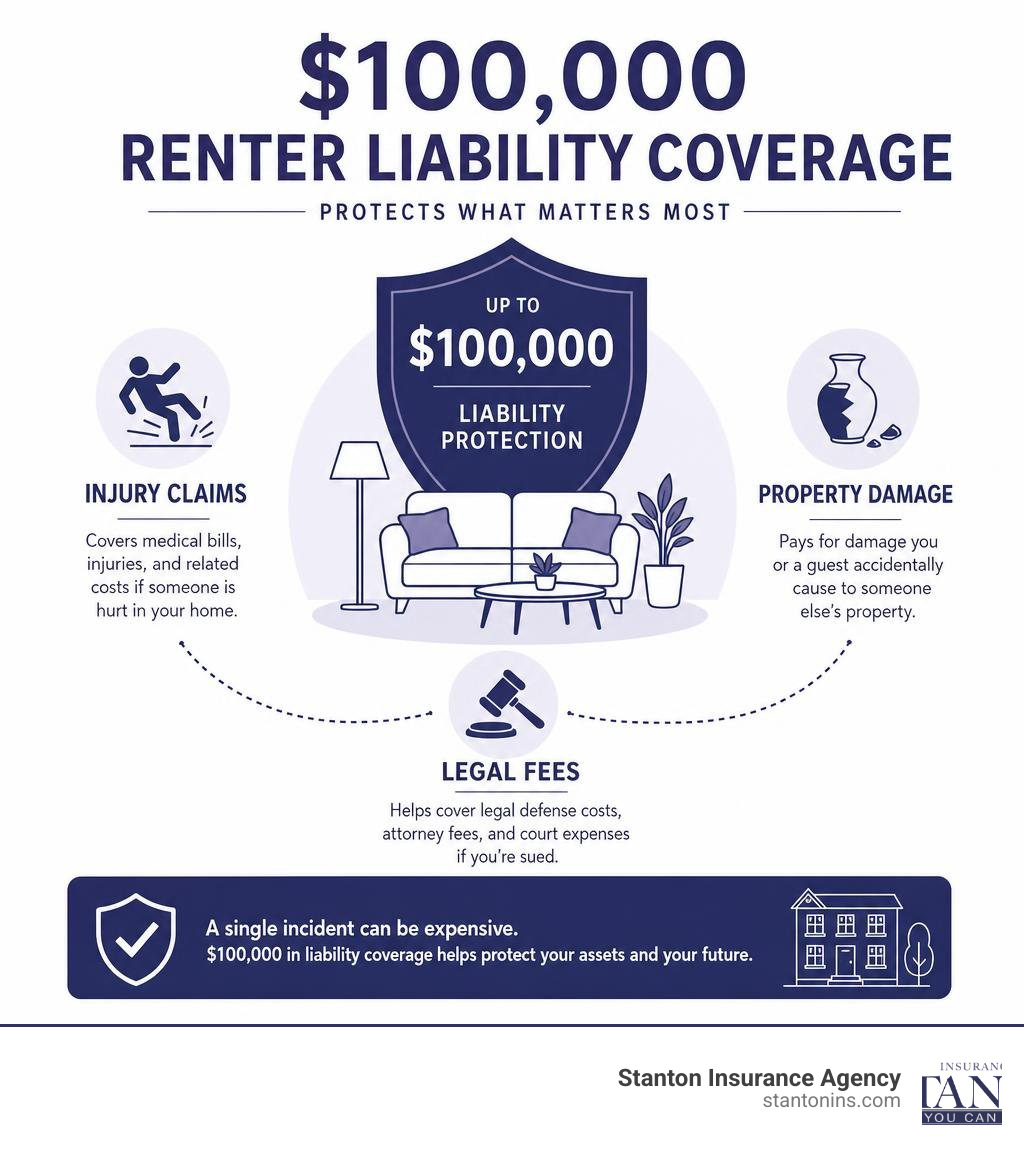
$100 000 liability renters insurance vocabulary:
Understanding Personal Liability Coverage for Renters
When you rent an apartment in Boston, Worcester, Manchester, or anywhere else in our beautiful New England region, you probably focus on the fun stuff: where to put the couch, how to organize your kitchen, and which local coffee shop will become your morning staple. But as independent agents, we always remind our clients that renting also comes with real-world risks.
That is where Personal Liability Coverage comes into play.
Unlike personal property coverage—which protects your physical belongings like your laptop, clothes, and furniture—personal liability coverage is designed to protect your financial future. If a guest is injured inside your rental unit, or if you accidentally cause damage to someone else’s property, you could be held legally and financially responsible.
To understand how this works, it helps to look at what this coverage actually does. If a claim is made against you or you face a lawsuit, personal liability insurance helps pay for:
- Bodily Injury: Medical bills, surgical costs, and rehabilitation fees for a guest who is injured on your premises.
- Property Damage: The cost to repair or replace someone else’s property that you accidentally damaged.
- Legal Defense: Lawyer fees, court costs, and settlement amounts if you are sued over a covered incident.
For a deeper dive into how this protection functions on a daily basis, explore our guide on What is Personal Liability Insurance for Renters?.
What is Covered Under $100 000 Liability Renters Insurance?
A standard $100,000 liability renters insurance policy packs a surprising amount of protection into a very affordable package. Here is a breakdown of the primary scenarios where this coverage steps in to protect you:
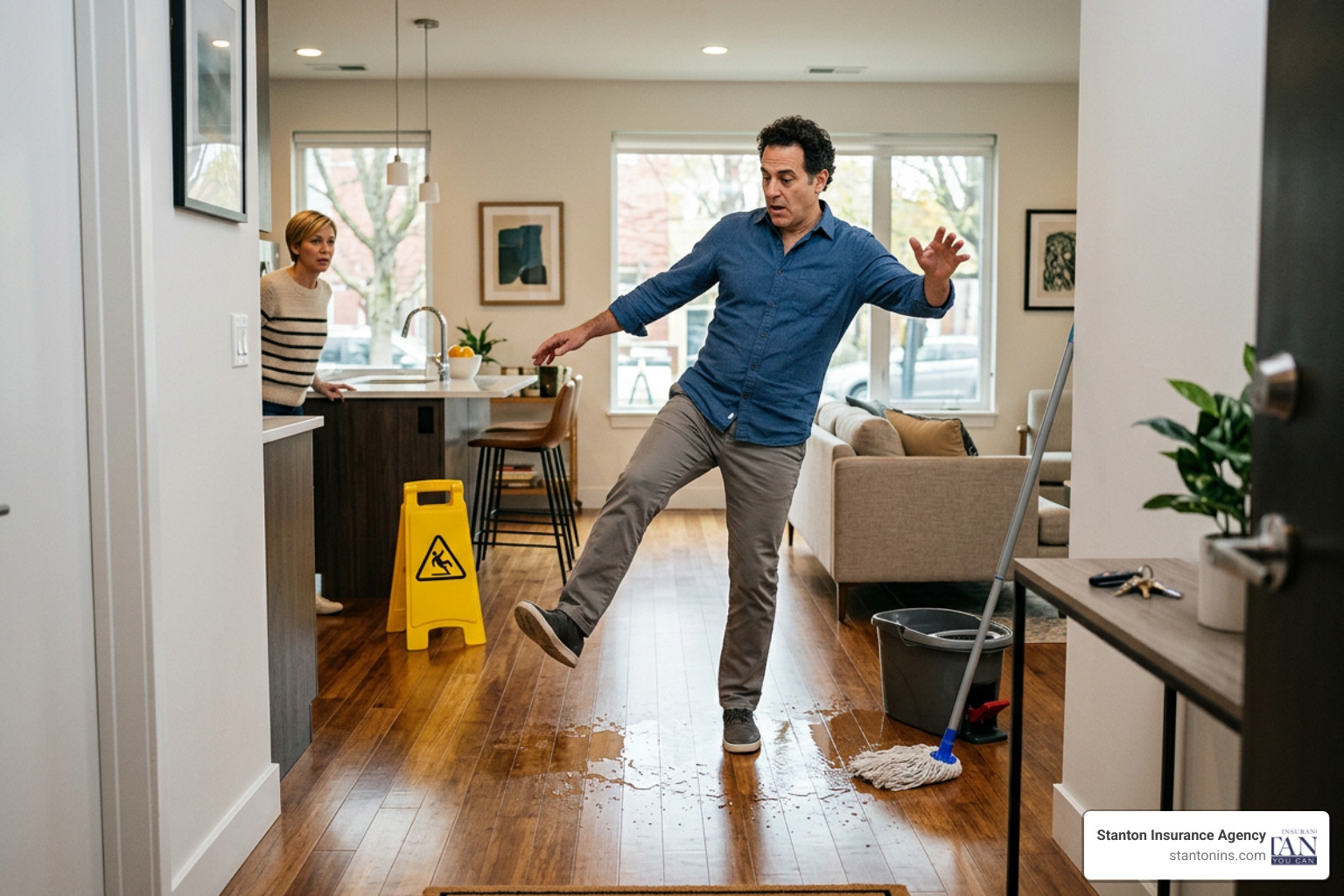
- Slip-and-Fall Incidents: Imagine you are hosting a watch party for the big game. A guest spills a drink on your hardwood kitchen floor, and before you can grab a towel, another friend slips, falls, and fractures their wrist. Your policy’s liability portion can cover their emergency room visit, follow-up surgeries, and physical therapy.
- Accidental Property Damage: Let’s say you are visiting a friend’s house in New Hampshire and accidentally drop their high-end digital camera, shattering the lens. Or perhaps your washing machine hose leaks and causes water damage to the ceiling of the apartment directly below you. Because liability coverage follows you worldwide, your policy can pay to repair or replace that damaged property.
- Dog Bites and Pet Liability: If your dog bites a visitor inside your home or nips someone at a local park, you could face massive medical and legal claims. A standard renters policy typically covers these expenses up to your policy limits, provided your dog’s breed is not specifically excluded by your carrier.
- Legal Defense Fees: This is perhaps the most overlooked benefit. Even if a lawsuit against you is completely groundless, hiring a defense attorney in Massachusetts or New Hampshire can easily cost tens of thousands of dollars out of pocket. Your insurance provider will pay for your legal defense, and those attorney fees are typically paid in addition to your $100,000 liability limit.
To learn more about how medical and injury expenses are handled, check out our article: Does Renters Insurance Cover Personal Injury?.
What is Excluded from $100 000 Liability Renters Insurance?
While a $100,000 liability renters insurance policy is incredibly robust, it does not cover everything. Understanding these boundaries is critical to avoiding devastating coverage gaps.
- Intentional Damage or Injury: If you purposely damage someone’s property or cause physical harm to another person, your insurance will not cover you. Liability coverage is strictly for accidental occurrences.
- Auto Accidents: If you get into a car crash on the Massachusetts Turnpike, your renters insurance will not pay for the damages. That is what your auto insurance policy is for.
- Business Pursuits: If you run a business out of your apartment—such as a home daycare, a professional tutoring service, or a beauty salon—any liability claims arising from those business activities are excluded. You would need a commercial general liability policy to protect those endeavors.
- Your Own Injuries and Property: Personal liability coverage only pays for damage and injuries caused to others. If you trip over your own rug and break your arm, or if your own laptop gets ruined when you spill coffee on it, your liability coverage will not pay a dime. Your medical insurance covers your injuries, and your personal property coverage handles your belongings.
- Roommate Belongings and Liability: Unless your roommate is a relative or is explicitly listed on your policy, they are not covered. Do not assume your policy covers their actions or their stuff; they need to secure their own renters policy.
For a complete breakdown of how standard policies are structured, read through A Comprehensive Guide to Renters Insurance Basic Coverage.
Why Landlords Require $100 000 Liability Renters Insurance

If you have signed a lease in Massachusetts or New Hampshire recently, you probably noticed a clause requiring you to maintain a renters insurance policy with at least $100,000 in personal liability coverage. Landlords do not do this to make your life difficult; they do it to protect their own financial interests and keep the rental ecosystem running smoothly.
When a tenant causes major damage to a rental property—such as accidentally starting a kitchen fire or letting a bathtub overflow—the landlord’s commercial property insurance will typically pay to repair the building structure. However, the landlord’s insurance company will then attempt to recover those costs from the negligent tenant.
If the tenant has a $100,000 liability renters insurance policy, the tenant’s insurance company can pay for the damages, shielding both the landlord and the tenant from catastrophic out-of-pocket losses.
Furthermore, if a guest is injured inside your apartment, they may decide to sue both you (the tenant) and the landlord. When you have active liability coverage, your insurer steps in to handle the claim, which reduces the likelihood of the landlord’s insurance being dragged into a costly legal dispute.
Requiring this coverage has become an industry standard because it ensures that tenant-caused mishaps do not result in unpaid repair bills or endless lawsuits. To understand how landlord policies and renters policies work together, take a look at our resource on Renters Insurance Coverage.
Evaluating the Cost and Adequacy of a $100K Policy
Now that you know what a $100,000 policy does, let’s talk about the numbers. How much does this protection actually cost, and is $100,000 truly enough to keep you safe?
The overall cost of your renters insurance policy is determined by several primary “premium drivers.” These include where you live, the amount of personal property coverage you choose, your deductible, and—depending on your state—your credit history.
To give you an idea of how these factors interact, here is a comparison table showing how deductibles and credit scores can influence renters insurance costs:
| Profile / Deductible | Excellent Credit Premium (Annual) | Poor Credit Premium (Annual) |
|---|---|---|
| $500 Deductible | ~$335 | ~$1,191 |
| $1,000 Deductible | ~$270 | ~$980 |
| $2,000 Deductible | ~$245 | ~$890 |
Note: The table above reflects national trends. However, as we will discuss below, Massachusetts residents enjoy unique protections regarding credit score usage.
For a deeper dive into the national data and rate structures, you can read How Much Is Renters Insurance for $100,000 in Coverage? 2026 Rates.
How Much Does $100 000 Liability Renters Insurance Cost?
On a national level, the average cost of a renters insurance policy with $100,000 liability renters insurance, $40,000 in personal property coverage, and a $1,000 deductible is $23 per month, which translates to about $270 per year.
If you only need a basic policy—say, $15,000 to $20,000 in personal property coverage alongside your $100,000 liability limit—your monthly cost could easily drop to $12 to $15 per month.
Because the liability portion of a renters policy represents a relatively small percentage of the overall premium, adding this essential protection is incredibly inexpensive. It is quite literally the cost of a couple of fancy coffee drinks per month to protect yourself from a $100,000 lawsuit.
To see how these averages are calculated and explore different coverage tiers, check out How much is renters insurance for $100,000 in liability coverage?.
Regional Cost Differences in Massachusetts and New Hampshire
As a local agency operating in Massachusetts and New Hampshire, we closely monitor how our regional insurance rules affect your wallet.
In Massachusetts, renters insurance rates are highly stable, but they are heavily influenced by your specific ZIP code. Living in a densely populated area of Boston or Worcester will naturally carry a slightly higher premium than renting a quiet home in the Berkshires.
However, Massachusetts has a major consumer protection advantage: it is one of the few states that completely prohibits insurance companies from using your credit history to calculate renters insurance premiums. This means that even if you have a poor credit score or are actively rebuilding your credit, your rates will not be penalized.
In New Hampshire, insurance companies are permitted to use your credit history to help determine your premium. If you have an excellent credit profile in cities like Manchester, Concord, or Nashua, you can secure incredibly low rates. Conversely, if your credit history is less than perfect, you may pay a bit more.
To get a highly localized understanding of what you can expect to pay in the Bay State, take a look at our local guides:
- How Much is Renters Insurance in Massachusetts?
- The Real Deal What You’ll Pay for Renters Insurance in MA
Is $100,000 in Liability Coverage Enough?
While $100,000 is the standard minimum required by landlords, we often advise our clients to consider whether it is truly enough.
Think about it this way: if a guest slips in your kitchen, breaks their hip, requires multiple surgeries, and misses three months of work, their medical bills and lost wages can easily exceed $100,000. If you are sued and the judgment is $250,000, your insurance company will pay the first $100,000, but you will be personally responsible for the remaining $150,000. That means your savings, future wages, and personal assets could be at risk.
The Golden Rule of Liability Insurance: Your liability limit should, at a bare minimum, match your total net worth (including your savings, investments, and valuable personal property).
The good news? Upgrading your liability coverage is incredibly cheap. Moving from $100,000 to $300,000 in liability coverage typically only adds $2 to $4 per month to your premium. For the price of a single vending machine snack, you can triple your financial protection.
For more details on assessing your liability limits, read How Much Is Renters Insurance For $100 000 Or $100K?.
Frequently Asked Questions about Renters Liability
Navigating insurance policies can feel like learning a foreign language. Here are some of the most common questions we hear from renters in Massachusetts and New Hampshire.
Does $100 000 liability renters insurance cover dog bites?
Yes, standard renters liability insurance generally covers dog bites and animal-related injuries, but there are two major caveats you must keep in mind:
- Breed Exclusions: Many insurance carriers maintain a list of “high-risk” dog breeds (such as Pit Bulls, Rottweilers, German Shepherds, and Dobermans) and will exclude liability coverage for these breeds. If your dog is on this list, you may need to purchase a separate animal liability policy.
- Bite History: If your dog has a history of aggression or has bitten someone in the past, your carrier may exclude pet liability altogether or decline to renew your policy.
Always be completely honest with your agent about the pets living in your home to ensure you have valid coverage.
Can I get same-day proof of $100 000 liability renters insurance?
Absolutely! In 2026, the insurance buying process is faster than ever. If you are standing in your new landlord’s office and realize you forgot to secure your policy, we can help you set up coverage and generate a digital certificate of insurance (proof of coverage) in just a few minutes. You can easily show this proof on your phone or email it directly to your property manager so you can get your keys without delay.
How does my credit score affect my renters insurance premium?
As mentioned earlier, the answer depends entirely on which side of the state line you live on:
- In Massachusetts: Your credit score has zero impact on your renters insurance rates. State regulations prohibit carriers from using credit-based insurance scores to price renters policies.
- In New Hampshire: Your credit score plays a significant role. Renters with excellent credit histories will qualify for the most competitive rates, while those with poor credit scores may see higher premiums.
Conclusion
Securing a $100,000 liability renters insurance policy is about far more than just checking a box on your lease agreement. It is an incredibly affordable way to protect your hard-earned savings, safeguard your future earnings, and give yourself absolute peace of mind as you settle into your rental home.
At Stanton Insurance Agency, we are proud to serve as your trusted, local insurance experts across Massachusetts and New Hampshire. Because we are an independent agency, we do not work for a single insurance company—we work for you. We will take the time to understand your unique situation, compare rates from top regional carriers, and build a customized policy that fits your budget perfectly.
Ready to secure your peace of mind? Contact us today to get your customized Stanton Insurance Agency Renters Insurance quote!