
Why Renters Insurance Property Coverage Is Something Every Tenant Needs to Understand
Renters insurance property coverage protects the personal belongings inside your rental home — and most renters don’t realize they need it until it’s too late.
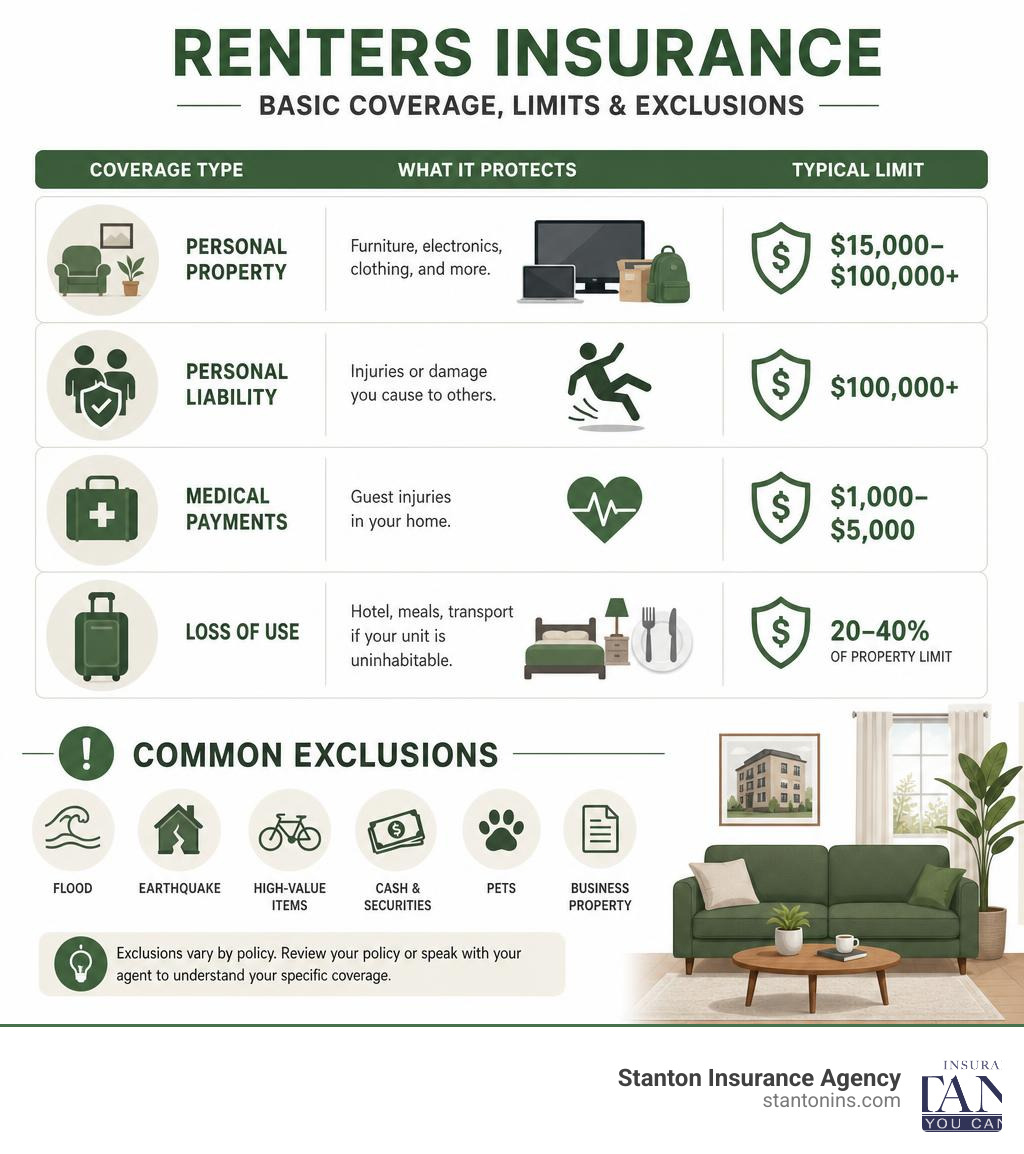
Here’s a quick snapshot of what standard renters insurance covers:
| Coverage Type | What It Protects | Typical Limit |
|---|---|---|
| Personal Property | Furniture, electronics, clothing, and more | $15,000–$100,000+ |
| Personal Liability | Injuries or damage you cause to others | $100,000+ |
| Medical Payments | Guest injuries in your home | $1,000–$5,000 |
| Loss of Use | Hotel, meals, transport if unit is uninhabitable | 20–40% of property limit |
Your landlord’s insurance covers the building — not your stuff. If a fire, theft, or burst pipe destroys your belongings, you’re on your own without a renters policy. For most renters, that’s a serious financial gap.
Renters insurance is also more affordable than most people expect. A basic policy runs around $15 per month for roughly $35,000 in coverage, according to the National Association of Insurance Commissioners (NAIC).
I’m Geoff Stanton, President of Stanton Insurance Agency and a Certified Insurance Counselor (CIC) with over 25 years of experience helping Massachusetts and New Hampshire residents find the right renters insurance property coverage for their needs. In this guide, I’ll walk you through exactly how these policies work so you can make a confident, informed decision.
Learn more about Renters insurance property coverage:
What Renters Insurance Covers for Tenants
When you sign a lease for an apartment in Boston, a condo in Manchester, or a multi-family home in Worcester, you are agreeing to take care of the space. But while your landlord is legally responsible for maintaining the physical structure of the building, they are not responsible for what is inside your four walls.
That is where a standard Renters Insurance policy comes in. Often referred to as tenant insurance, this policy is designed to protect your personal assets and shield you from devastating out-of-pocket expenses. To make sure you are fully prepared, you should review the official Massachusetts Renters Insurance Guidance to understand how local regulations protect you.
A basic renters policy is actually a package of four core coverages:
- Personal Property Coverage: Protects your physical belongings.
- Personal Liability Protection: Covers legal and medical costs if you are held responsible for injuring someone or damaging their property.
- Medical Payments to Others: Covers minor medical bills for guests injured in your home, regardless of who was at fault.
- Loss of Use (Additional Living Expenses): Pays for temporary housing and living costs if a covered event makes your rental uninhabitable.
Many landlords in Massachusetts and New Hampshire now make renters insurance a mandatory lease requirement. They want to ensure that if a tenant accidentally starts a fire or causes a major water overflow, there is a policy in place to handle the damages and prevent costly legal battles.
Personal Property Coverage
Think about everything you own. If you were to tip your apartment upside down, everything that falls out is your personal property. This includes your furniture, clothing, electronics, appliances, books, kitchenware, sports gear, and musical instruments.
Under a standard policy, your belongings are protected against a specific list of “covered perils” (sudden, unexpected events). These typically include fire, smoke damage, theft, vandalism, windstorms, hail, lightning, and accidental water discharge from plumbing or appliances.
One of the most valuable features of this policy is off-premises coverage. This means your belongings are protected even when they are not inside your apartment. If your laptop is stolen from your car while parked at a trailhead in the White Mountains, or if your suitcase is stolen while you are traveling abroad, your renters insurance can help pay to replace those items. This off-premises protection also frequently extends to items you keep in a local self-storage unit, though often at a reduced limit (usually 10% of your total personal property limit).
To explore these protections in deeper detail, take a look at our guide on What Does Renters Insurance Cover?
Liability, Medical Payments, and Loss of Use
While protecting your physical belongings is crucial, the financial protection provided by the other parts of a renters policy is arguably even more important.
- Personal Liability: If a guest trips over a rug in your living room and breaks their leg, or if you accidentally leave a candle burning and cause a fire that damages neighboring units, you could be held legally liable. Personal liability coverage helps cover your legal defense fees and any court-ordered settlements or judgments. Most policies start with a minimum of $100,000 in liability coverage, but we often recommend increasing this to $300,000 or more to fully protect your future earnings and assets. To understand how this shields your finances, check out our article on What Is Personal Liability Insurance for Renters?
- Medical Payments: This is designed to act as a quick, “no-fault” safety net. If a visitor cuts their hand while helping you prep dinner and needs stitches, medical payments coverage can pay for their emergency room visit (typically up to $1,000 to $5,000) without the need for a lawsuit. Interestingly, this coverage can also apply to pet liability, such as if your dog bites someone inside or outside your home.
- Loss of Use (Additional Living Expenses): If a severe winter storm causes a pipe to burst and floods your apartment, making it unlivable while repairs are completed, you won’t have to sleep in your car. Loss of use coverage pays for your temporary housing (such as a comparable hotel or short-term rental), excess meal expenses (since you can’t cook at home), and extra transportation costs. This coverage is usually capped at 20% to 40% of your total personal property limit.
What Renters Insurance Does Not Cover
As comprehensive as renters insurance is, it is not a catch-all. There are several strict exclusions that every tenant in New England should know.
First and foremost, renters insurance never covers the physical structure of the building. If a storm damages the roof or windows of your apartment building, that repair falls entirely on your landlord’s commercial property policy.
Additionally, standard renters policies do not cover:
- Flood Damage: Damage caused by rising surface water, river overflows, or coastal storm surges is excluded. If you live in a flood-prone area, you must purchase a separate flood insurance policy.
- Earthquakes: Earth movement is excluded but can sometimes be added as an optional endorsement.
- Pests: Infestations of bedbugs, mice, rats, or termites are considered maintenance issues and are never covered.
- Mold and Wear and Tear: Gradual deterioration, mold (unless directly caused by a sudden, covered water leak), and general neglect are excluded.
- Roommate Property: Unless your roommate is a relative or is explicitly named on your policy declarations page, their belongings are not covered by your policy. They must purchase their own.
- Motor Vehicles: Cars, motorcycles, and boats are not covered under renters insurance; they require dedicated auto, motorcycle, or watercraft policies.
- Business Inventory: If you run a business out of your apartment, your commercial inventory and business data are generally excluded or limited to a very small amount (like $2,500 on-premises and $250 off-premises).
For those living in New Hampshire, you can find excellent state-specific details via the New Hampshire Rental Insurance Guidance.
Renters Insurance Property Coverage: Belongings, Limits, and Sublimits
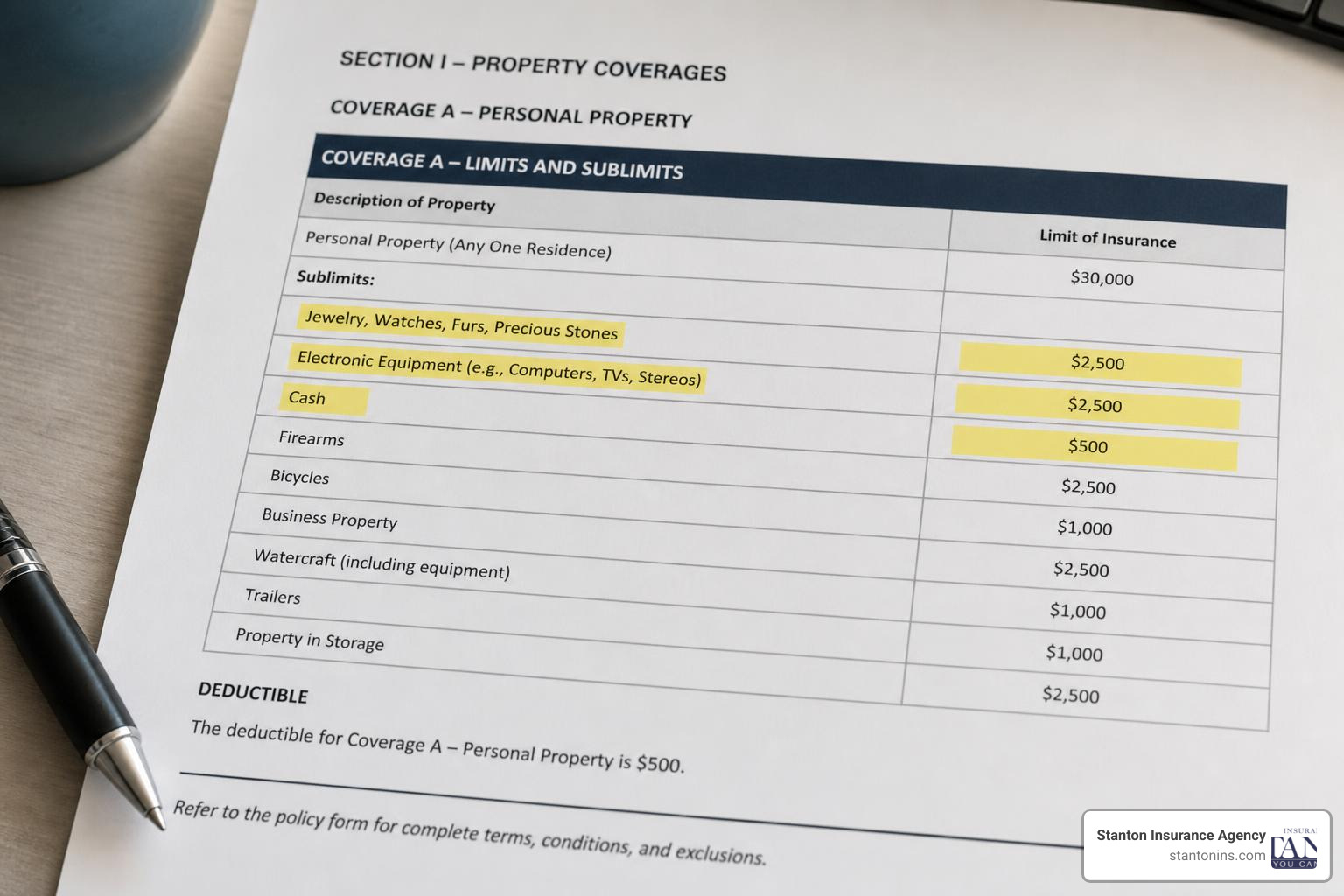
When you purchase renters insurance property coverage (also known as contents insurance), you must select an overall personal property limit. This is the maximum amount your insurance company will pay out in the event of a total loss, such as a fire that destroys the entire building.
However, many renters are surprised to learn that their policy has “sublimits” or “special limits” for certain categories of high-value items. Even if you have a $50,000 overall personal property limit, your policy will place strict caps on payouts for specific items if they are stolen or damaged.
To help visualize how standard property limits, sublimits, and optional add-ons work together, review the table below:
| Property Type | Standard Sublimit (Theft Only) | How to Fully Protect It |
|---|---|---|
| Jewelry, Watches, & Furs | $1,000 to $1,500 | Scheduled Personal Property Endorsement |
| Firearms | $2,000 to $2,500 | Scheduled Property Floater |
| Electronics & Computers | $3,000 | Increased Category Limits |
| Bicycles | $1,500 to $2,500 | Scheduled Property Floater |
| Cash & Digital Currency | $200 | Keep in a secure bank account |
| Silverware & Goldware | $2,500 | Scheduled Property Endorsement |
If you own items that exceed these standard sublimits, you will want to speak with us about “scheduling” those items individually on your policy to ensure they are fully covered.
What Types of Personal Property Are Covered?
Standard renters insurance property coverage is designed to protect a wide array of everyday household goods. This includes:
- Furniture & Decor: Sofas, beds, dining tables, rugs, and lamps.
- Electronics: Laptops, smartphones, TVs, gaming consoles, and tablets.
- Clothing & Footwear: Everyday apparel, winter coats, shoes, and designer items.
- Sports & Outdoor Gear: Bicycles, skis, camping gear, and golf clubs.
- Specialty Items: Musical instruments, tools, and collectibles.
This coverage also extends to specific situations. For example, if you are a college student living in a dorm, your parents’ renters policy might cover your belongings up to a certain percentage. Military members can also find policies that cover their specialized gear and uniforms, even when deployed.
Furthermore, if you make temporary improvements or alterations to your rented space (such as installing high-end light fixtures or custom shelving), standard policies will often allow you to apply up to 10% of your personal property limit to cover those tenant improvements.
Learn more about protecting your belongings with our guide to Renters Insurance Coverage.
Common Dollar Limits and Sublimits
Sublimits are designed to keep insurance premiums affordable for everyone. If policies automatically covered unlimited jewelry or cash, basic renters insurance would cost significantly more.
Some of the most common industry sublimits include:
- Cash and Coins: Usually capped at $200. This includes physical currency, bank notes, and even digital currency stored on physical drives.
- Jewelry, Watches, and Furs: Typically limited to $1,000 or $1,500 total for theft losses. If an engagement ring worth $5,000 is stolen from your dresser, a standard policy will only pay out up to the sublimit.
- Firearms: Often limited to $2,500 for theft.
- Silverware, Goldware, and Pewter: Usually capped at $2,500 for theft.
- Bicycles: Often limited to $1,500 or $2,500 per loss.
- Business Property: Typically capped at $2,500 for items used for business purposes while on the premises, and as low as $250 or $500 for items located off-premises.
If you have items that exceed these values, you can purchase a “Scheduled Personal Property” endorsement. This adds the item specifically to your policy at its appraised value, often with no deductible applied to claims for that item.
Covered Perils That Trigger Property Claims
Renters insurance is typically a “named-perils” policy. This means your belongings are only covered if they are damaged or destroyed by one of the specific events listed in your policy documents.
The standard 16 named perils include:
- Fire or lightning
- Windstorm or hail
- Explosion
- Riot or civil commotion
- Damage caused by aircraft
- Damage caused by vehicles (not owned by you)
- Smoke damage
- Vandalism or malicious mischief
- Theft
- Volcanic eruption
- Falling objects
- Weight of ice, snow, or sleet
- Accidental discharge or overflow of water or steam (from plumbing, heating, or AC)
- Sudden and accidental tearing, cracking, burning, or bulging of a hot water system
- Freezing of plumbing or appliances
- Sudden and accidental damage from artificially generated electrical current (power surges)
If an event is not on this list, it is generally not covered unless you have purchased an “open-perils” policy, which covers everything except specifically excluded events.
How Much Renters Insurance Coverage You Need and What It Costs in 2026
Determining how much renters insurance property coverage you need is a balance between your budget and the actual value of your belongings. Many renters make the mistake of underestimating what they own, assuming their old furniture and clothes aren’t worth much. But if you had to buy everything new tomorrow, the total cost would surprise you.
To see how affordable these policies can be, check out our resources on How Much Is Renters Insurance? and How Much Is Renters Insurance in Massachusetts?.
How to Calculate Your Personal Property Coverage
The absolute best way to calculate your coverage needs is to create a detailed home inventory.
Here is a simple, step-by-step process to get it done:
- Go Room by Room: Start in one corner of your apartment and work your way through. Open every closet, drawer, and cabinet.
- Take Video and Photos: Record a video walkthrough of your apartment, detailing your electronics, furniture, and clothing racks.
- Document Key Details: For expensive items (like laptops, TVs, and appliances), write down the brand, model, serial number, purchase date, and purchase price.
- Keep Receipts: Store digital copies of receipts for major purchases in a cloud-based folder or email them to yourself.
- Estimate Clothing and Kitchenware: Don’t count every t-shirt, but estimate a total replacement cost for your wardrobe and kitchen cabinets.
- Calculate the Total: Add up the values to find your target personal property limit. If your total comes to $27,000, you should round up and purchase a $30,000 policy to give yourself a safety margin.
Actual Cash Value vs. Replacement Cost
When setting up your renters insurance property coverage, you will have to make a critical choice in how your claims are settled: Actual Cash Value (ACV) or Replacement Cost Value (RCV).
- Actual Cash Value (ACV): This settlement method pays you the depreciated value of your item at the time of the loss.
- Replacement Cost Value (RCV): This method pays you the actual cost to buy a brand-new, comparable item today, without any deduction for depreciation.
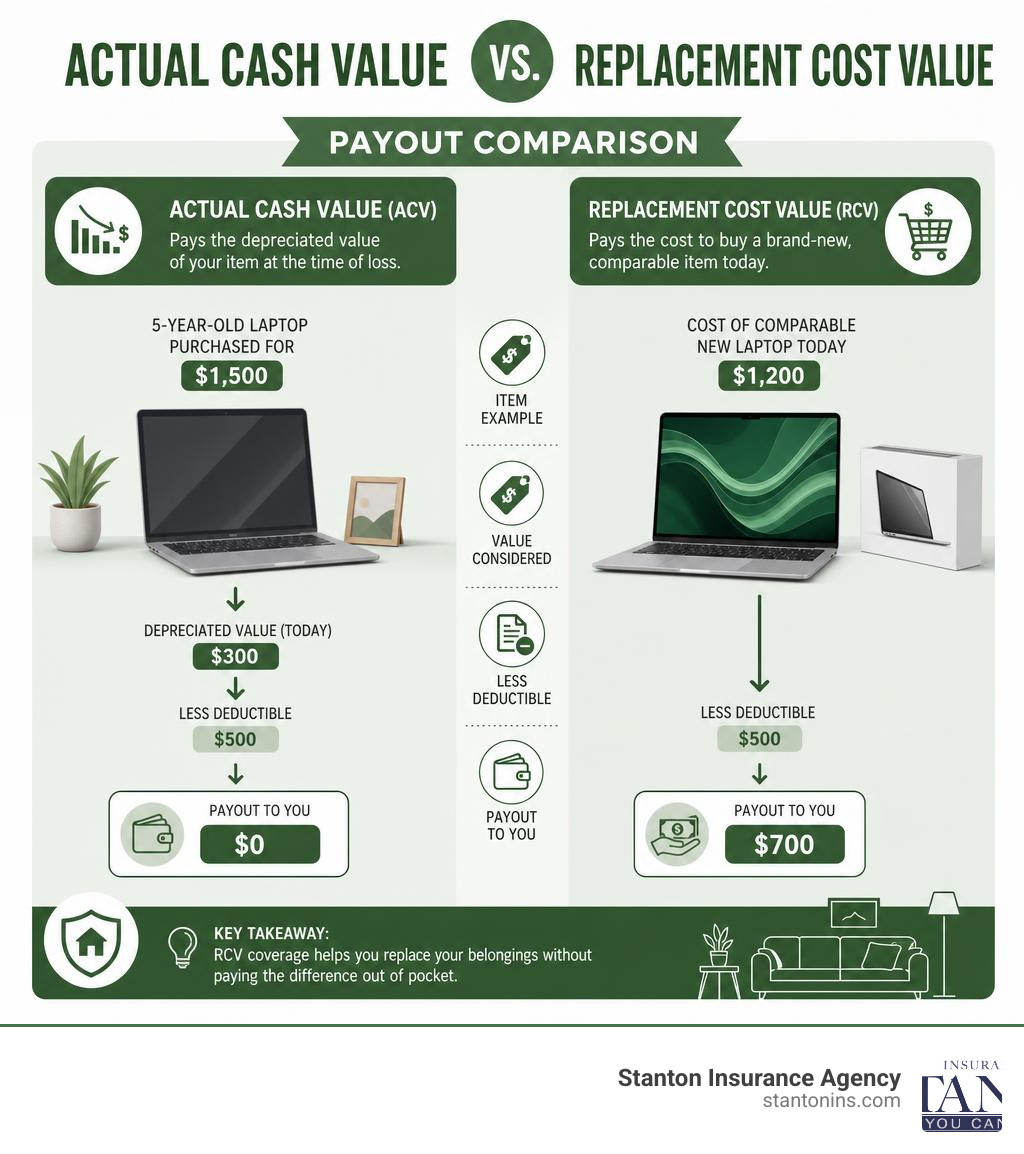
Let’s look at a real-world example. Say you bought a high-end laptop for $1,500 five years ago, and it is destroyed in a fire.
- Under an ACV policy, the insurer will calculate that the laptop has depreciated significantly over five years. They might determine its current “yard-sale” value is only $300. After you pay your $500 deductible, you would receive $0.
- Under an RCV policy, the insurer will look at what a comparable new laptop costs today—let’s say $1,200. After subtracting your $500 deductible, they will pay you $700, allowing you to actually replace your computer.
While RCV coverage typically adds about 10% to 15% to your monthly premium, we almost always recommend it because it provides vastly superior protection when you actually have to file a claim.
Average Renters Insurance Cost in 2026
Renters insurance remains one of the greatest values in the entire insurance industry. In 2026, the average cost of renters insurance in Massachusetts and New Hampshire ranges between $15 and $28 per month, depending on your location and coverage limits.
According to industry data, average monthly premiums scale as follows:
- $30,000 in contents coverage: ~$22 per month
- $50,000 in contents coverage: ~$28 per month
- $100,000 in contents coverage: ~$43 per month
Your actual premium will depend on several factors, including:
- Your Location: Apartments in historic, wood-framed buildings in Boston or Portsmouth may cost slightly more to insure than modern buildings with built-in sprinkler systems.
- Your Deductible: Choosing a higher deductible (like $1,000 instead of $500) will lower your monthly premium.
- Your Claims History: A history of multiple property claims can increase your rates.
- Safety Devices: Installing smoke detectors, deadbolts, and security systems can earn you discounts of 5% to 15%.
- Bundling: Combining your renters policy with your auto insurance can save you 15% to 25% across both policies.
For more details on finding budget-friendly rates, check out our guide on Cheap Renters Insurance and our Renters Insurance Policy Cost Guide
Optional Add-Ons, Endorsements, and Filing a Renters Insurance Claim

Once you have your basic policy in place, you can customize it with optional endorsements to fit your specific lifestyle. And if disaster does strike, knowing how to navigate the claims process will ensure you get your payout as quickly as possible.
To get started on protecting your space, you can get a fast quote using Your Fast Pass to Protection Instant Renters Insurance Quotes.
Optional Coverage Worth Considering
Standard policies can be enhanced with several valuable add-ons:
- Water Backup Coverage: Standard policies exclude damage from backed-up sewers or drains. This endorsement covers your belongings if a sump pump fails or a drain backs up and floods your apartment.
- Scheduled Personal Property: As mentioned, this is essential for fully insuring jewelry, fine art, high-end bicycles, or musical instruments that exceed standard sublimits.
- Identity Theft Protection: Helps cover the legal fees, credit monitoring services, and lost wages associated with restoring your identity if it is stolen.
- Home Business Endorsement: Increases the coverage limits for business equipment and liability if you operate a small business or remote office from your rental.
- Umbrella Insurance: If you need more than the standard $300,000 or $500,000 in liability coverage, a personal umbrella policy can provide an extra $1 million or more of protection.
Explore all your personal coverage options on our Personal Insurance Renters Insurance page.
How to File a Renters Insurance Claim
If you experience a theft, fire, or water damage, follow these steps to file a successful claim:
- Ensure Safety First: Make sure everyone is safe and prevent further damage if possible (e.g., shut off the main water valve if a pipe bursts).
- File a Police Report: If your items were stolen or vandalized, call the police immediately. You will need a copy of the police report to submit to your insurer.
- Notify Your Landlord: Let your landlord know about any structural damage or building-wide emergencies.
- Document the Damage: Take clear, detailed photos and videos of the damaged items and the area where the incident occurred. Do not throw anything away until an adjuster has reviewed it.
- Contact Stanton Insurance Agency: Reach out to us as soon as possible to start your claim. We will help you submit your home inventory, receipts, photos, and the police report.
- Keep Track of Living Expenses: If you are forced to stay in a hotel, keep every receipt for lodging, meals, and travel to submit for Loss of Use reimbursement.
Mistakes That Can Reduce or Delay Your Payout
To ensure a smooth claims process and avoid a partial or full denial, avoid these common pitfalls:
- Delaying the Report: Always notify us and your insurance carrier immediately after a loss. Waiting weeks to file a claim can raise red flags.
- Not Having a Home Inventory: Trying to recall every item you owned after a fire is incredibly stressful and often leads to leaving thousands of dollars on the table.
- Discarding Damaged Items: Keep all damaged property until your insurance adjuster tells you it is okay to throw it away.
- Assuming Roommates Are Covered: Never assume your roommate’s items are protected under your policy. They must have their own coverage.
- Ignoring Sublimits: If you don’t schedule your $6,000 engagement ring, you will only receive the standard $1,500 sublimit payout after a theft.
Frequently Asked Questions About Renters Insurance Property Coverage
Does Renters Insurance Cover Belongings Stolen From a Car or Storage Unit?
Yes! Your personal property is covered worldwide under a standard renters policy. If your bike is stolen from a rack at work, or if your laptop is stolen from your car while you are dining in downtown Portsmouth, your renters insurance can help replace it. However, keep in mind that off-premises theft claims are still subject to your deductible, and some policies cap off-premises coverage at 10% of your total personal property limit.
Does Renters Insurance Cover Roommates, Pets, or Other People’s Property?
Generally, no. A standard renters insurance policy only covers the “named insured” (you) and any relatives living with you. Unrelated roommates must purchase their own individual policies to protect their belongings and liability.
Regarding pets: renters insurance covers your liability if your dog bites a guest, but it does not cover damage your pet does to your own belongings or the apartment structure (such as scratching up doors or carpet). It also does not cover your pet’s medical bills; for that, you would need dedicated pet insurance.
Can a Landlord Require Renters Insurance in Massachusetts or New Hampshire?
Yes, landlords in both Massachusetts and New Hampshire are legally permitted to require tenants to carry renters insurance as a condition of their lease. They will typically require a minimum of $100,000 in personal liability coverage and ask to be listed as an “Additional Interest” or “Interested Party” on your policy so they are notified if the policy is cancelled or modified.
To learn more about local landlord-tenant insurance rules, read Do I Need Renters Insurance in Massachusetts? and Can a Landlord Require Renters Insurance in Massachusetts?.
Conclusion
Protecting your rental home shouldn’t be stressful or expensive. With a basic renters insurance policy, you can secure valuable peace of mind knowing that your clothes, furniture, electronics, and financial future are protected against life’s unexpected turns.
Whether you are renting a cozy studio in Manchester, NH, or a spacious apartment in Boston, MA, our team at Stanton Insurance Agency is here to provide the trusted local guidance you need. We can help you build a personalized inventory, choose between actual cash value and replacement cost, and find all the discounts you qualify for.
Ready to safeguard your hard-earned belongings? Get renters insurance guidance from our local experts today, or contact us to receive a personalized quote tailored to your New England home.