
What a Car Insurance Estimate Calculator Actually Tells You
Using a car insurance estimate calculator takes the guesswork out of budgeting for auto coverage — and it takes less than five minutes. Here’s what you need to know right away:
Quick answer: How to estimate your car insurance cost
- Gather your basics — your ZIP code, vehicle year/make/model, annual mileage, and driving history
- Choose a coverage level — minimum liability, standard, or full coverage
- Enter your details into an online calculator to see a ballpark monthly premium
- Compare estimates across multiple insurers — quotes can vary by up to $359/month for the same driver
- Adjust deductibles and limits to find the right balance between cost and protection
| Coverage Type | Average Monthly Cost (U.S.) |
|---|---|
| Minimum Liability | $76/month |
| Full Coverage | $208/month |
The gap between those two numbers is real — and so is the financial risk of choosing the wrong one. The average new car costs just under $50,000 today. A bare-minimum policy often won’t cover that.
The right estimate isn’t just about finding the cheapest number. It’s about finding the right coverage for your life, your car, and your assets.
I’m Geoff Stanton, President of Stanton Insurance Agency in Waltham, Massachusetts, and a Certified Insurance Counselor (CIC) with over 25 years of experience helping drivers find coverage that actually protects them — not just satisfies a legal checkbox. In that time, I’ve seen how a well-used car insurance estimate calculator can be the starting point for smarter, more confident coverage decisions. Let’s walk through exactly how to use one.
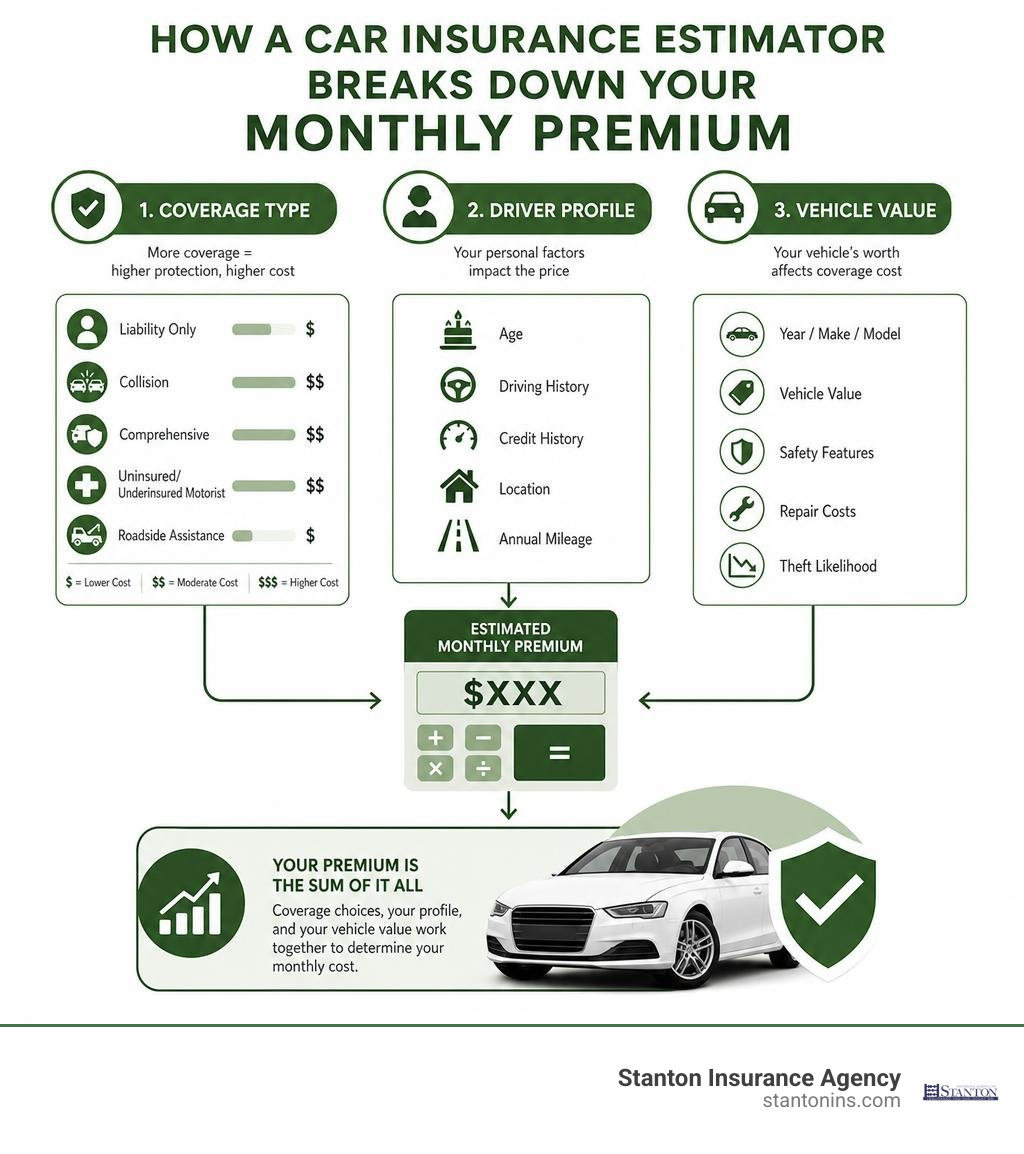
Car insurance estimate calculator terms explained:
- Car insurance premium calculator
- Car insurance price estimate
- Auto insurance comparison quotes online
How a Car Insurance Estimate Calculator Calculates Your Premium
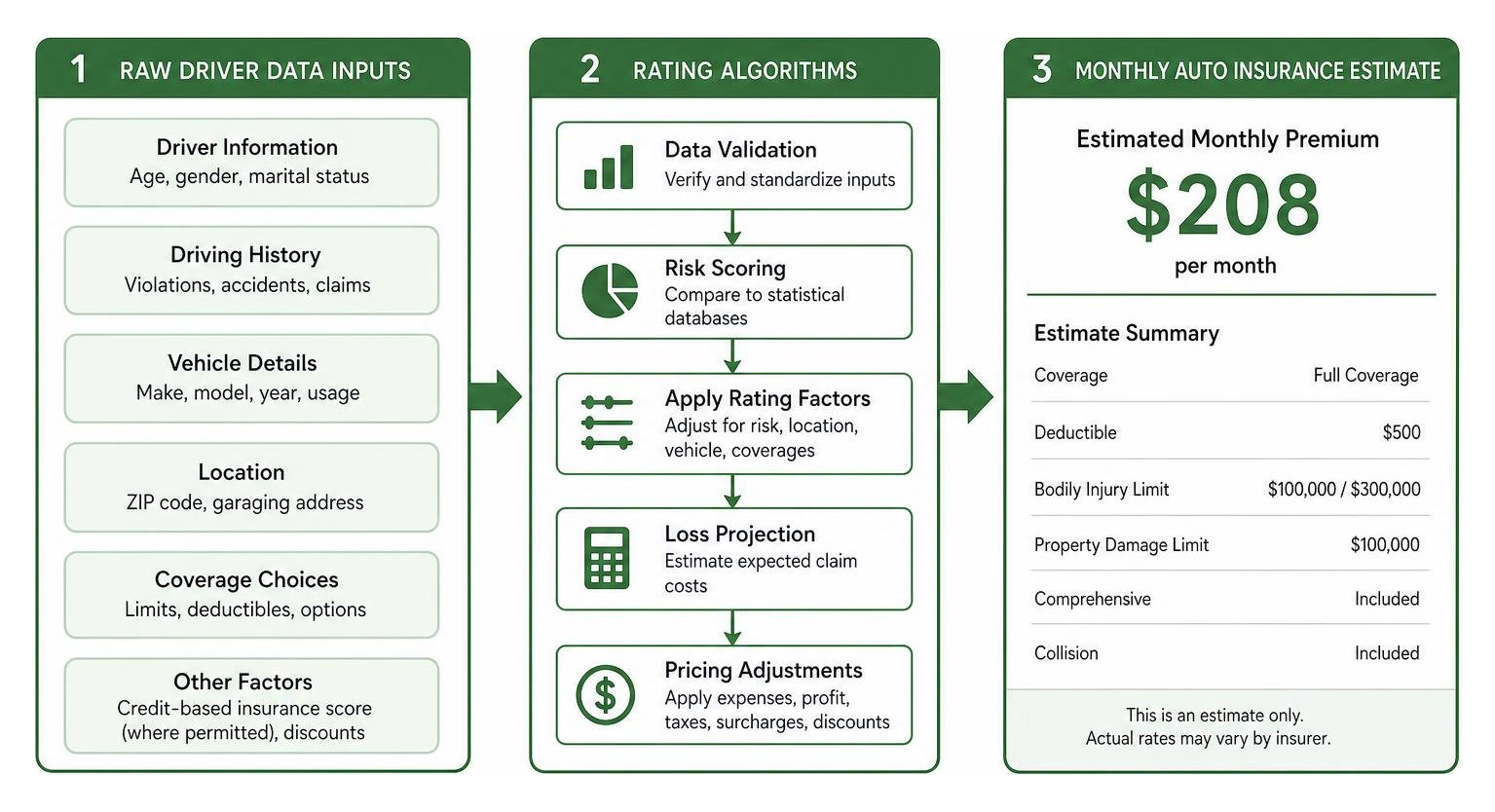
Ever wonder what happens behind the scenes when you plug your information into an auto insurance estimator? It isn’t pulling numbers out of thin air. Instead, complex rating algorithms analyze your profile against massive statistical databases of past claims, local repair costs, and risk probabilities.
At its core, a car insurance estimate calculator establishes a baseline cost based on broad actuarial categories. From there, underwriting variables fine-tune that baseline figure. For example, if drivers operating your make and model in your specific ZIP code file frequent claims, the pricing formula elevates the underlying loss projection. Conversely, selecting higher deductibles or lower coverage limits pulls the final price back down. Understanding this mechanic is the key to Demystifying Your Drive How to Use a Car Insurance Premium Calculator.
Essential Data Inputs for a Car Insurance Estimate Calculator
To generate a precise estimate rather than a generic guess, online tools rely on several primary inputs:
- Driver Demographic Inputs: Your age, gender (where legally permitted), and household composition. Young drivers aged 16 to 25 statistically experience higher accident rates, driving premiums up two to three times higher than those for experienced adult drivers.
- Annual Mileage & Vehicle Usage: Someone commuting 25 miles down Route 128 every weekday carries greater risk exposure than someone driving 4,000 miles a year to the local grocery store.
- Vehicle Identification Number (VIN) or Specific Year/Make/Model: The exact vehicle specs inform the system about crashworthiness, built-in safety gear, and local replacement values.
- Driving History Records: Speeding tickets, at-fault accidents, or moving violations within the past three to five years heavily impact your rate. In fact, a single at-fault accident can raise premiums by 20% to 40%.
Gathering these details ahead of time ensures you get an accurate preview. Learn more about organizing your details in our guide on How to Estimate Your Car Insurance Price Without Losing Your Mind.
Customizing Coverage Limits in Your Car Insurance Estimate Calculator
The toggles you move inside a calculator directly dictate your financial safety net. Adjusting coverage tiers instantly demonstrates how individual line items alter your monthly bill:
- Bodily Injury Liability: Pays for medical bills and legal defense if you injure someone else. Raising limits from state minimums ($20k/$40k in Massachusetts) to standard recommended limits ($100k/$300k) often costs less than $25 to $30 more per month.
- Property Damage Liability: Covers damage you cause to another person’s vehicle or property. With a three-year-old vehicle averaging $31,000 to replace and new cars hovering around $50,000, state minimum property damage limits (like $5,000 in MA) leave massive unprotected gaps.
- Collision Insurance: Repairs or replaces your own vehicle following a crash, regardless of fault.
- Comprehensive Insurance: Covers non-collision incidents such as theft, vandalism, falling tree branches, or striking an animal.
- Personal Injury Protection (PIP) / Medical Payments: Pays immediate medical expenses for you and your passengers. PIP is mandatory in Massachusetts.
For an exhaustive breakdown of policy options, read our How Much Car Insurance Complete Guide.
Here is how monthly estimates typically vary across standard policy levels:
| Coverage Level | Typical Policy Limits | Average Monthly Premium | Key Protection Included |
|---|---|---|---|
| State Minimum | Legal limits only (e.g., 20/40/5 in MA) | $76 / month | Basic liability only; no protection for your own car. |
| Standard Coverage | 50/100/50 limits + $1,000 deductible | $145 / month | Better liability limits + collision/comprehensive protection. |
| Full Coverage (Recommended) | 100/300/100 limits + $500 deductible | $208 / month | High liability limits, physical damage coverage, and PIP/uninsured protection. |
Key Rating Factors That Impact Auto Rates
Insurers build risk profiles by weighing several primary risk categories. No single factor determines your quote in isolation; rather, insurers evaluate how these factors combine to predict the probability of future claims. To understand the complete picture, explore our article on What Factors Affect Your Car Insurance Premium A Complete Guide.
Driver Age, Location, and Credit Score Rules
Where you live and your personal history significantly shape your premium:
- Age and Experience: Teen drivers face the highest rates due to limited time behind the wheel. Rates generally stabilize around age 25 and stay lower through age 65.
- Geographic ZIP Code: High-density urban areas see 30% to 50% higher insurance rates than quiet suburban or rural towns due to increased traffic congestion, higher accident rates, and greater risks of vehicle theft.
- Credit-Based Insurance Scores (State Rules Matter): Nationally, poor credit can increase auto insurance premiums by 20% to 50%. However, Massachusetts state law strictly prohibits insurance companies from using credit scores to determine auto insurance rates. In New Hampshire, credit checks are permitted for rating purposes. For localized cost insights, check How Much is Car Insurance Per Month in Massachusetts.
Vehicle Make, Model, and Tech Repair Costs
The car parked in your driveway directly influences your auto estimate. While safety ratings work in your favor, advanced technology can make repairs surprisingly expensive:
- Repair Complexity: Modern bumpers are no longer simple metal or plastic covers; they house delicate ultrasonic sensors, radar modules, and lane-departure cameras. A minor fender bender that once cost $500 to repair can now exceed $3,000 due to sensor recalibration.
- Vehicle Replacement Value: Exotic sports cars and high-end luxury EVs carry steep price tags for parts and labor, driving up full coverage premiums.
- Theft Rates: Frequently stolen vehicle models trigger higher comprehensive rates in high-risk locations.
Check out our Average Vehicle Insurance Complete Guide to see how different car models affect overall ownership costs.
Determining How Much Coverage You Actually Need
Selecting coverage isn’t just about meeting legal requirements; it’s about safeguarding your financial stability. If you cause a severe multi-car collision, legal judgments against you can target your savings, home equity, and future wages if your liability limits fall short.
To calculate your ideal coverage depth, match your total asset exposure against your policy limits. If your net worth exceeds standard liability maximums ($250,000/$500,000), adding a personal umbrella insurance policy provides an additional layer of protection (often $1 million or more) for a modest annual fee. Read our detailed guide on Auto Insurance Cost Complete Guide to learn more.
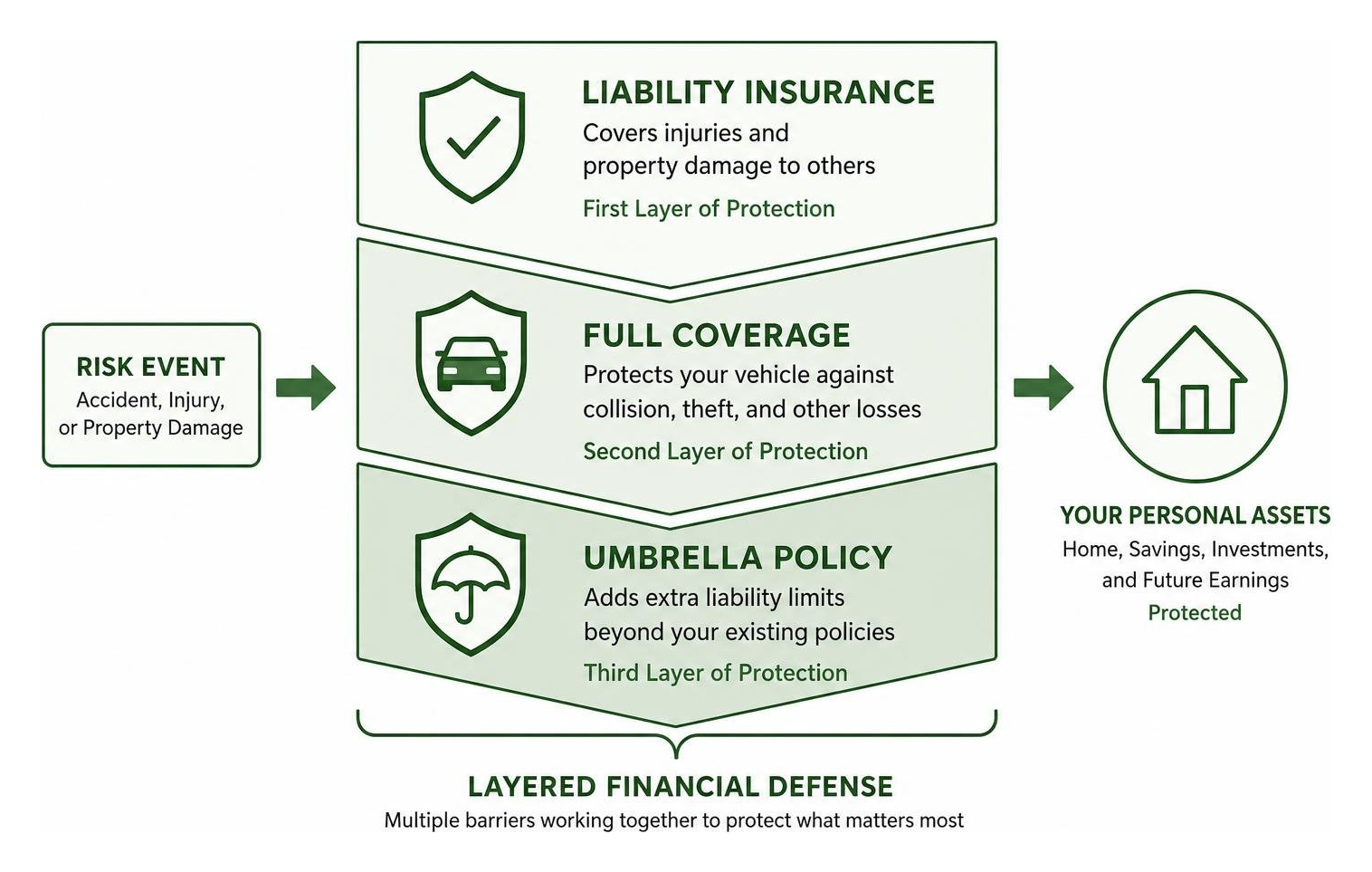
Minimum Liability vs. Full Coverage Costs
Is minimum coverage worth the short-term monthly savings? For most drivers, the answer is no.
- State Minimum Liability: Costs roughly $76 per month across the country. However, if you cause $45,000 in damage to a new luxury car and carry only $5,000 or $25,000 in property damage liability, you remain personally liable for the difference.
- Full Coverage: Averages $208 per month ($1,771 per year nationally in 2026). It combines robust liability coverage with collision and comprehensive protection for your own automobile. Lenders and leasing companies almost always require full coverage to protect their financial stake in the vehicle.
For deeper perspective on auto expenses, explore The Real Cost of Driving What’s the Average Monthly Auto Insurance.
Regional Rules in Massachusetts and New Hampshire
Drivers in New England must navigate distinct legal requirements across state lines:
Massachusetts Rules
Massachusetts mandates compulsory minimum auto coverages:
- Bodily Injury to Others: $20,000 per person / $40,000 per accident
- Personal Injury Protection (PIP): $8,000 per person, per accident
- Damage to Someone Else’s Property: $5,000 limit
- Bodily Injury Caused by Uninsured Auto: $20,000 per person / $40,000 per accident
Note: The mandatory $5,000 property damage limit in MA is notoriously inadequate for modern accidents, which is why local drivers regularly upgrade to $100,000 or higher. Review full regional details in our Massachusetts Car Insurance Guide 2025.
New Hampshire Rules
New Hampshire is unique because it does not mandate car insurance for every driver. However, drivers must demonstrate proof of financial responsibility. If you choose to buy insurance in NH, state law requires minimum coverage limits of 25/50/25, plus $1,000 in Medical Payments and matching Uninsured Motorist coverage.
Proven Hacks to Lower Your Estimated Premiums
If your car insurance estimate calculator outputs a number higher than your budget allows, don’t worry. You can take concrete steps to lower your rate without sacrificing necessary protection:
- Bundle Auto with Home or Renters Insurance: Combining auto coverage with home, condo, or renters insurance with the same provider can save you 15% to 25% across your policies.
- Adjust Physical Damage Deductibles: Raising your collision and comprehensive deductible from $250 or $500 to $1,000 can reduce your physical damage premium by 15% to 30%. Just keep that higher dollar amount accessible in your emergency fund.
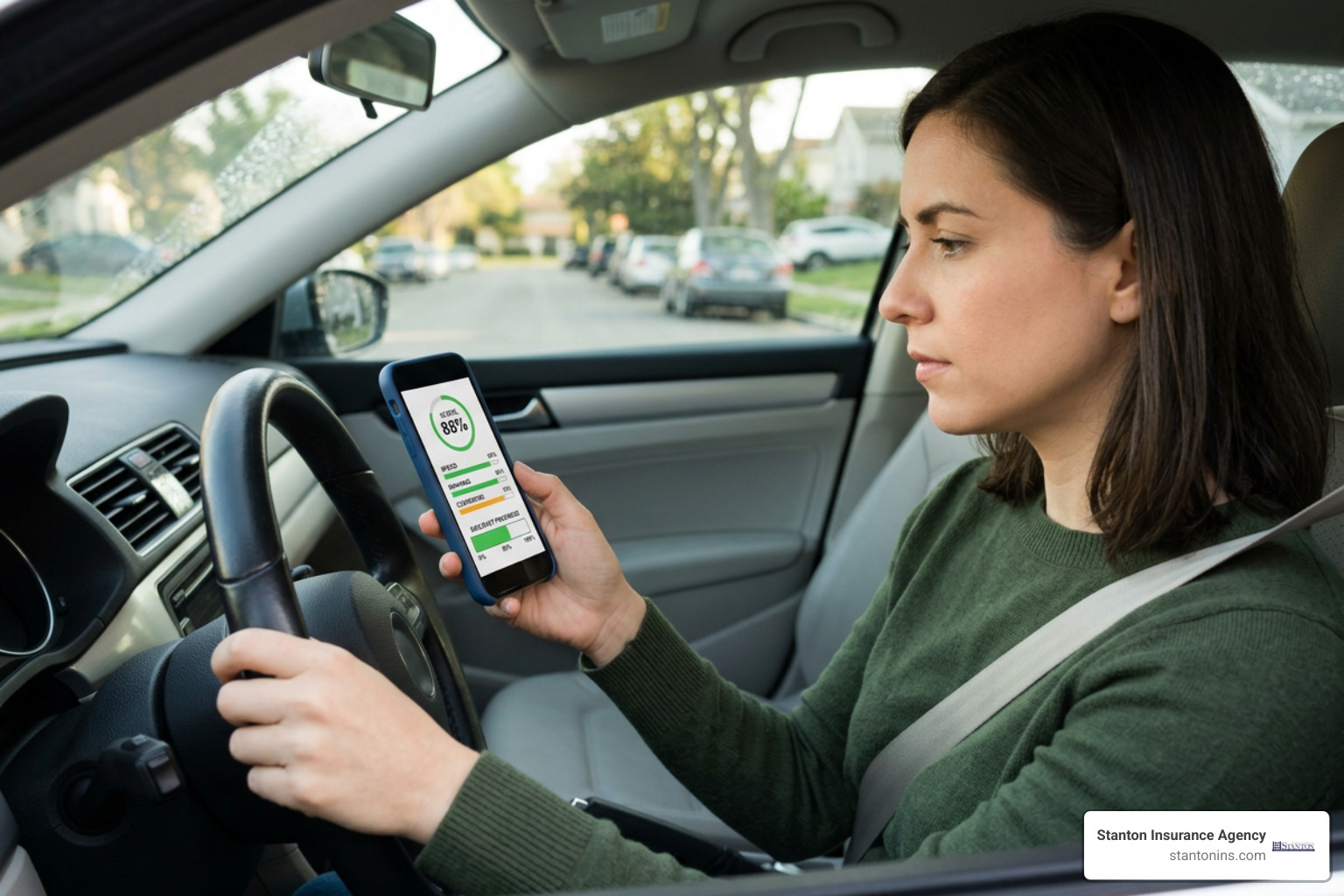
- Enroll in Telematics / Usage-Based Programs: Installing a mobile driving app or plug-in device allows your insurer to measure actual driving habits—such as hard braking, cornering speed, and late-night driving. Safe drivers frequently unlock discounts of 10% to 40%.
- Claim Student and Low-Mileage Discounts: Full-time high school or college students maintaining a “B” average or better can save 10% to 20% through good student discounts.
Discover more savings tips in our round-up of 10 Auto Insurance Cost Hacks That Save Money. When you’re ready to secure customized estimates, review our guide on how to Get Your MA Car Insurance Quote Online A Step-by-Step Guide.
Frequently Asked Questions About Car Insurance Estimates
How accurate is an online car insurance calculator?
An online calculator provides a strong baseline estimate based on the broad data inputs you provide. However, final binding rates require direct underwriting verification. During official quoting, insurers pull official Motor Vehicle Reports (MVR), review Comprehensive Loss Underwriting Exchange (C.L.U.E.) claim histories, and verify garaging addresses. As long as your self-reported inputs match your official records, online estimates are typically accurate within a narrow margin.
Why are car insurance estimates higher in urban areas?
Urban locations experience higher population density, increased traffic volume, higher theft rates, and frequent fender benders. Insurance companies track claim rates by ZIP code, so living in a densely populated city inevitably leads to higher base insurance rates than living in a quiet rural town.
How often should drivers recalculate auto insurance rates?
We recommend reviewing and recalculating your auto insurance rates every 6 to 12 months, or whenever a major life change occurs. Key rate-changing events include moving to a new address, buying a car, getting married, adding a new driver, paying off an auto loan, or seeing an old moving violation drop off your driving record.
Conclusion
Using a car insurance estimate calculator gives you the clarity you need to make smart coverage choices. But remember: numbers on a screen are just the starting point. Finding the right balance of affordable premiums and dependable protection requires looking closely at your real-world needs, your personal financial exposure, and local state laws.
At Stanton Insurance Agency, we help drivers throughout Massachusetts and New Hampshire navigate these options with confidence. As an independent agency, we work for you—not a single insurance company—comparing rates across multiple top-tier carriers to build a policy tailored to your life.
Ready to see what proper coverage looks like for your budget? Find custom rate estimates and tailored coverage with Stanton Insurance Agency or reach out to our team today for a personal policy review!