
When Car Insurance for High Risk Drivers Feels Impossible to Find
If you’re shopping for car insurance for high risk drivers, here’s a quick look at your best options and what to expect:
| Provider Type | Best For | Typical Premium vs. Standard |
|---|---|---|
| Standard carriers (Major national brands) | Minor violations, first offense | 20% to 50% higher |
| Non-standard carriers (Specialty insurers) | Multiple violations, DUI, lapses | 50% to 200% higher |
| Assigned risk pool (e.g., MAIP in Massachusetts) | Denied by all other carriers | Highest rates available |
Being labeled a high-risk driver is frustrating — especially when you’re doing everything right now but still paying for past mistakes. You may have a speeding ticket, an at-fault accident, a DUI, or even just a gap in coverage. Any of these can cause standard insurers to reject your application outright or quote you rates that feel impossible to afford.
The reality is that more drivers fall into the high-risk category today than ever before. And while your options may feel limited, they aren’t gone.
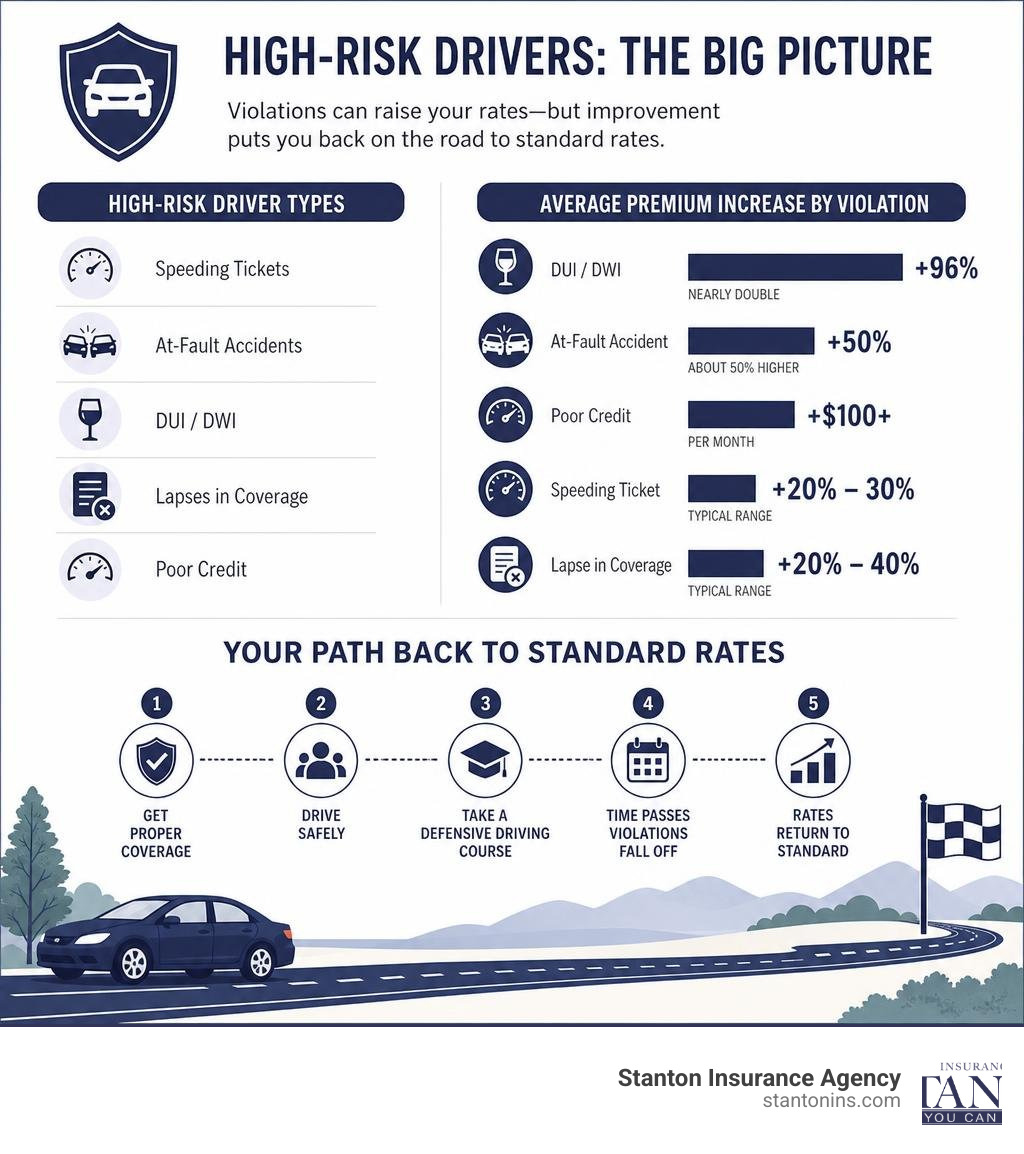
Rates after a DUI can nearly double — jumping around 96% above standard pricing. A single at-fault accident can raise your premium by roughly 50%. Poor credit alone can add over $100 per month to your bill. These aren’t small numbers for a middle-aged homeowner already juggling a mortgage and other expenses.
The good news? High-risk status is temporary. Most violations fall off your record within 3 to 5 years, and the right insurer can help you stay covered — and even save money — in the meantime.
I’m Geoff Stanton, President of Stanton Insurance Agency in Waltham, Massachusetts, and over my 25+ years in the industry I’ve helped many Massachusetts and New Hampshire drivers navigate car insurance for high risk drivers and find coverage that actually fits their budget. Let’s walk through the best options available to you right now.
Car insurance for high risk drivers vocab explained:
What is Car Insurance for High Risk Drivers and Who Needs It?
When we talk about car insurance for high risk drivers, we are referring to non-standard auto insurance. This is coverage specifically designed for individuals whom insurance companies view as highly likely to file a future claim or default on their premium payments.
Think of “high-risk” as an underwriting label rather than a completely different type of insurance policy. Your policy will still cover bodily injury liability, property damage, and physical damage (collision and comprehensive) if you choose to purchase them. However, because you carry a higher statistical probability of costing the insurance company money, your premium is adjusted upward to compensate for that risk.

Many drivers are surprised to learn that they have been categorized as non-standard. You do not need a rap sheet of major traffic violations to earn this label. Something as simple as a 30-day lapse in your coverage history — even if you did not own a vehicle during that time — can instantly push you into the high-risk tier.
If you find yourself in this situation, navigating the insurance market on your own can feel overwhelming. That is why working with local professionals who understand the regional landscape is so critical. For a deeper look at how to find local expertise, check out The Ultimate Guide to Finding Vehicle Insurance Agencies Near Me.
Why Standard Carriers Deny Car Insurance for High Risk Drivers
Standard insurance companies operate on highly calibrated risk-assessment algorithms. Their business model is built around insuring “preferred” or “standard” drivers — those with clean driving records, continuous coverage history, and stable credit profiles.
When an applicant presents multiple risk factors, the standard carrier’s system flags them. The insurer calculates that the probability of a claim payout exceeds the premium they can legally charge under state-approved rate filings. Rather than taking on what they perceive as an unprofitable risk, they will deny the application or issue a policy non-renewal at the end of the current term.
Furthermore, some standard carriers simply do not have the administrative infrastructure to handle state-mandated filings, such as financial responsibility certifications, which frequently accompany high-risk drivers.
Who Qualifies as a High-Risk Driver in New England?
Risk classification is highly regional. What makes you high-risk in one state might not apply in another. Since we specialize in Massachusetts and New Hampshire, let’s look at how our local rules define this category.
In Massachusetts, risk is heavily governed by the Safe Driver Insurance Plan (SDIP). The state uses a point system to track traffic violations and at-fault accidents. If you accumulate too many points, standard carriers will steer you toward the non-standard market. Additionally, because Massachusetts is a compulsory insurance state, you must carry coverage to register a vehicle, meaning the state has built safety nets for drivers who cannot find voluntary coverage. For more details on local coverage dynamics, read this Massachusetts High-Risk Driver Guide.
New Hampshire operates differently. It is famously the only state that does not mandate auto insurance for all drivers. However, if you are convicted of certain violations — such as a DUI or leaving the scene of an accident — the state will legally require you to prove financial responsibility. At that point, you are officially classified as high-risk, and finding an affordable policy becomes a necessity to keep your driving privileges. You can read more about these specific state rules at this New Hampshire High-Risk Driver Guide.
Key Factors That Label You a High-Risk Driver
Insurance companies evaluate a broad range of both driving and non-driving factors to determine your risk profile. Understanding these factors can help you identify exactly why your rates are elevated and how long you might remain in the non-standard tier.

The primary reasons a driver is classified as high-risk include:
- DUI/DWI Convictions: Operating a vehicle under the influence is considered the single most severe risk indicator by underwriters.
- Multiple Speeding Tickets or Moving Violations: A pattern of minor violations indicates risky driving behavior.
- At-Fault Accidents: Causing one or more collisions demonstrates a higher likelihood of future liability claims.
- Coverage Lapses: Going without auto insurance for even a short period makes you statistically more likely to be involved in an accident once you get back on the road.
- Poor Credit Score: In states where it is legally permitted, a low credit-based insurance score is strongly correlated with a higher frequency of claims.
Understanding how insurance lapses and uninsured driving are treated locally is essential. In Massachusetts, driving uninsured is a serious offense that carries steep penalties and guarantees a high-risk label. You can learn more about these local regulations by reading Massachusetts Car Insurance: The Scoop on Uninsured Drivers and Insured Vehicles.
Driving Violations and Record Duration
The severity of your driving violation dictates how long it will haunt your insurance rates. For minor traffic violations, such as a single speeding ticket or failure to stop, the infraction typically remains on your motor vehicle record (MVR) and impacts your insurance premiums for 3 to 5 years.
Major violations, however, are a different story. An at-fault accident will generally influence your rates for up to 5 years. A DUI conviction or a license suspension can trigger premium surcharges and filing requirements that last anywhere from 5 to 7 years, and in some cases, even longer depending on state-specific lookback periods. For a comprehensive overview of how these timelines work nationally, you can refer to High-Risk Auto Insurance | Bankrate.
Non-Driving Risk Factors
It isn’t just your behavior behind the wheel that determines your risk category. Underwriters also look at demographic and financial data to predict claim frequency.
- Credit-Based Insurance Scores: Actuarial studies show that drivers with lower credit scores file more frequent and more costly claims. Consequently, in states where this practice is legal, having poor credit can increase your premium by $100 or more per month. However, there is a major local exception: Massachusetts legally prohibits insurance companies from using credit scores to determine auto insurance rates. If you live in New Hampshire, your credit score will still impact your premium, but in Massachusetts, your driving record reigns supreme.
- Age Limitations: Due to a statistical lack of experience, teen drivers and young adults under the age of 25 are automatically placed in higher-risk categories. Similarly, elderly drivers over the age of 70 may face higher premiums as reaction times and physical frailty become underwriting considerations.
How Much Does High-Risk Coverage Cost vs. Standard Insurance?
There is no sugarcoating it: high-risk auto insurance is expensive. Standard carriers offer baseline rates to drivers with pristine records, but once violations or non-driving risk factors are introduced, those rates climb quickly.
To give you a realistic idea of what to expect, we have compiled the average premium increases associated with various driving and financial incidents:
| Driving Incident | Average Premium Increase |
|---|---|
| Clean Record | Baseline Rate |
| Speeding Ticket | 20% to 30% Increase |
| At-Fault Accident | 50% Increase |
| DUI Conviction | 96% Increase |
| Poor Credit Score | 40% to 80% Increase (NH only) |
These percentages translate directly into real-world dollars. For example, while a standard driver might pay an affordable rate for basic liability coverage, a driver with a DUI conviction can expect to pay nearly double, adding an average of $1,680 per year to their policy. A single speeding ticket can add an average of $431 annually to your premium.
If you are trying to budget for these increases and want to understand how baseline liability costs are calculated, our Average Liability Auto Insurance Cost Guide provides an excellent breakdown of standard pricing structures.
The exact cost of your policy will ultimately depend on whether you require minimum liability limits or full coverage (which adds collision and comprehensive protection). While minimum coverage is the cheapest way to stay legal, high-risk drivers should carefully weigh the risks of being underinsured, especially if they have personal assets to protect.
Understanding SR-22 and State-Specific Requirements
If your license has been suspended or revoked due to a major violation, the state will likely require you to obtain an SR-22 certificate before your driving privileges can be reinstated.
Contrary to popular belief, an SR-22 is not an insurance policy. It is a financial responsibility certificate filed electronically by your insurance company directly with the state’s Department of Motor Vehicles (DMV). This certificate serves as official proof that you carry at least the minimum liability insurance required by law.
If you are a New Hampshire resident and have been ordered to file this certificate, we have compiled everything you need to know about the process, costs, and timelines in our guide on SR22 Insurance NH.
If you fail to maintain your policy, the insurance company is legally obligated to notify the DMV immediately, which will result in the automatic suspension of your driver’s license. Typically, an SR-22 filing must be maintained continuously for three years.
Massachusetts Auto Insurance Plan (MAIP)
While New Hampshire utilizes the SR-22 system, Massachusetts does not. Instead, the Commonwealth uses the Massachusetts Auto Insurance Plan (MAIP) to handle drivers who cannot obtain coverage through the voluntary market.
If you have been rejected by multiple standard and non-standard insurance companies in Massachusetts, you cannot simply drive uninsured. Instead, you must apply for coverage through MAIP. This is the state’s assigned risk pool, which acts as a last resort for high-risk drivers.
Under MAIP, your application is randomly assigned to a licensed auto insurance carrier operating in the state. That carrier is legally required to issue you a policy. However, because MAIP is designed for the highest-risk profiles, the premiums are typically the most expensive in the state. To learn more about how this system works and how to apply, visit the official Massachusetts Auto Insurance Plan (MAIP) – Mass.gov resource.
How to Lower Your Rates for Car Insurance for High Risk Drivers
While being labeled a high-risk driver is tough on your wallet, it is important to remember that this status is entirely temporary. There are several proactive steps you can take starting today to lower your premiums and transition back to standard rates over time.
Here are the most effective strategies to reduce your high-risk auto insurance costs:
- Complete a Defensive Driving Course: Many insurance companies offer a discount of 5% to 10% if you complete an approved accident-prevention or defensive driving course. This is an easy way to offset the cost of a recent ticket.
- Enroll in Telematics Programs: Many modern insurers offer usage-based insurance (UBI) programs. By installing a mobile app or a small device in your car, the insurer tracks your actual driving habits — such as speed, braking, and mileage. If you drive safely and avoid late-night trips, you can earn substantial discounts.
- Maintain Continuous Coverage: Avoid lapses at all costs. If you do not own a vehicle but occasionally drive or want to keep your coverage history active, ask us about a non-owner car insurance policy. It is highly affordable and prevents you from being categorized as high-risk due to a gap in coverage.
- Improve Your Credit Score (New Hampshire Only): Since New Hampshire allows insurers to use credit history, paying down balances and making on-time payments can directly lower your insurance tier over time.
- Adjust Your Deductibles: If you carry collision and comprehensive coverage, raising your deductible from $500 to $1,000 can lower your monthly premium payments significantly. Just make sure you keep that deductible amount set aside in an emergency fund in case you need to file a claim.
- Shop Around with Specialty Carriers: Not all insurance companies view risk the same way. Some non-standard specialty carriers offer much better rates for drivers with imperfect records than standard household names. For a broader look at the national carrier landscape, you can read this High-Risk Car Insurance Guide.
Frequently Asked Questions About High-Risk Auto Insurance
How long do violations stay on my driving record?
In both Massachusetts and New Hampshire, minor traffic violations such as speeding tickets typically stay on your driving record and affect your insurance rates for 3 to 5 years. Major violations like at-fault accidents generally impact your rates for up to 5 years. Serious offenses, including DUI/DWI convictions, can influence your premiums for 7 to 10 years, depending on the severity of the incident and state lookback laws.
Can I get insurance if my license is suspended?
Yes, you can. In fact, if you need to get your license reinstated, the state will often require you to obtain insurance first. If you do not own a vehicle, you can purchase a non-owner policy with an SR-22 filing (in New Hampshire) to satisfy the state’s financial responsibility requirements and begin the reinstatement process.
What is the difference between standard and non-standard insurance?
Standard insurance is designed for drivers with clean to average driving records and is offered by mainstream carriers at highly competitive rates. Non-standard insurance is tailored for drivers with multiple violations, major accidents, DUI convictions, or coverage lapses. Non-standard policies are written by specialty carriers, carry higher premiums, and may feature more restrictive payment terms or limited coverage options.
Conclusion
Finding affordable car insurance for high risk drivers can feel like an uphill battle, but you do not have to fight it alone. At Stanton Insurance Agency, we believe that an imperfect driving record shouldn’t price you off the road.
As an independent agency based in Massachusetts and serving both MA and NH, we have access to a wide network of standard and specialty non-standard insurance carriers. We don’t just plug your information into a computer and hand you a generic quote; we take the time to understand your unique situation, compare rates across multiple providers, and build a personalized coverage plan that protects your assets without breaking your budget.
Ready to find coverage that fits? Let our local independent agents do the shopping for you. Get started today by visiting Stanton Insurance Agency Auto Insurance and requesting a free, no-obligation quote.
