
What Is Renters Insurance for Students — and Do You Need It?
Renters insurance for students is a low-cost policy that protects your personal belongings, covers your liability, and pays for temporary housing if something goes wrong in your dorm or apartment.
Here’s a quick answer to the most common questions:
| Question | Quick Answer |
|---|---|
| Do dorm students need it? | Maybe — parents’ homeowners may cover up to 10% of their policy limit, but deductibles are high |
| Do off-campus students need it? | Yes — parents’ policies typically do not cover off-campus apartments |
| What does it cover? | Theft, fire, water damage, liability, and temporary housing costs |
| How much does it cost? | $12–$25 per month for $15,000–$30,000 in coverage |
| Is it required? | Not by law, but most off-campus landlords require proof of liability coverage |
College is expensive enough without a stolen laptop or a burst pipe wiping out your savings. Nearly 20 million students attend college in the U.S. each year, and most of them carry thousands of dollars in electronics, textbooks, and gear — often with little or no insurance protection. Theft is the single most common reason students file insurance claims, yet many assume their parents’ policy has them fully covered. Often, it doesn’t.
I’m Geoff Stanton, President of Stanton Insurance Agency and a Certified Insurance Counselor (CIC) with over two decades of experience helping families in Massachusetts and New Hampshire navigate personal lines coverage — including renters insurance for students heading off to school for the first time. In this guide, I’ll walk you through exactly what you need to know to make a smart, confident decision.
Easy Renters insurance for students glossary:
Why Renters Insurance for Students Is Essential for College Life
The Reality of Campus Life
Stepping onto a college campus in Massachusetts or New Hampshire brings an incredible sense of freedom. Whether you are moving into a high-density residence hall in Boston or a shared rental house in Durham, you are suddenly surrounded by hundreds of other students.
While this environment is fantastic for your social life, it is also a hotbed for unexpected accidents. High-density living significantly increases the risk of accidental fires (often sparked by a forgotten microwave or overloaded power strip), plumbing mishaps from the floor above, and opportunistic theft. Dorm rooms and student apartments are rarely fortresses, and with people constantly walking in and out, your expensive belongings are more exposed than ever before.
The Financial Risk
Think about what you carry in your backpack or keep on your desk right now. A modern college student’s inventory almost always includes a high-end laptop, a smartphone, perhaps a tablet or gaming console, expensive winter outerwear, and several textbooks that cost a small fortune.
If you were to walk into your room tomorrow and find that your laptop and backpack had been stolen, replacing them out-of-pocket could easily top $3,000. For most college students surviving on a tight budget, a sudden expense of this size is a devastating financial blow that can disrupt an entire semester.
Peace of Mind
Having a dedicated insurance policy in place means you do not have to spend your semester worrying about “what-ifs.” If a pipe bursts in your building or someone walks off with your computer at the campus library, you have a safety net to fall back on. This allows parents and students alike to focus on what actually matters: classes, exams, and enjoying the college experience.
To learn more about why securing this coverage is a crucial first step for your academic journey, read our detailed guide on Why Every College Student Needs Tenant Insurance Right Now.

What Does Renters Insurance Cover?
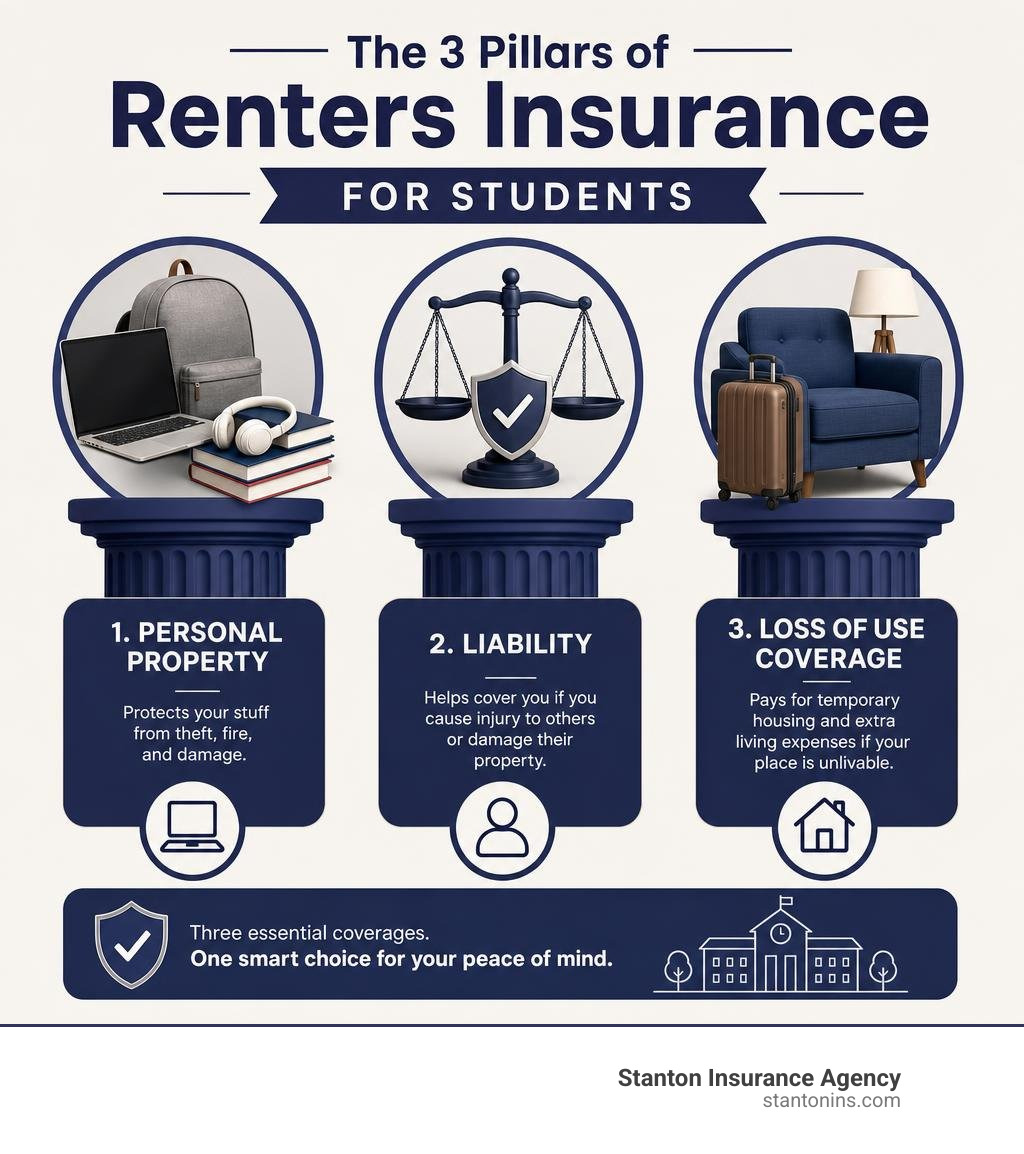
A standard policy for student renters is divided into three core areas of protection:
- Electronics: Your digital life is covered. This includes laptops, smartphones, tablets, gaming consoles, e-readers, and high-end headphones.
- Academic Materials: Textbooks are notoriously expensive. Policies cover your books, specialized laboratory equipment, art supplies, and musical instruments.
- Everyday Essentials: From your winter coat and shoes to your bed frame, desk, and kitchenware, your physical property is protected.
- Liability Protection: If you accidentally cause damage to the property or if someone is injured in your space, this coverage steps in. For example, if you leave a bathroom faucet running and it floods the apartment below, liability coverage helps pay for the repairs.
- Medical Payments: This covers minor medical bills if a guest slips and falls in your apartment, regardless of who was at fault, helping to resolve minor incidents quickly without litigation.
- Additional Living Expenses (Loss of Use): If a fire or severe water damage makes your rental completely uninhabitable, this coverage helps pay for your temporary hotel stay, increased food costs, and relocation expenses.
For a comprehensive, item-by-item breakdown of what is and isn’t covered under these policies, explore our resource on What Does Renters Insurance Cover.
Common Perils and Exclusions
It is important to understand that renters insurance does not cover “everything.” Instead, it covers losses caused by specific events known as covered perils.
Standard student policies typically cover losses resulting from:
- Theft and vandalism
- Fire and smoke damage
- Windstorms and lightning
- Water damage from sudden plumbing failures (such as a burst pipe or a sprinkler-head discharge)
Regulatory Context
Depending on where you attend school, state laws and consumer protections can vary. For students attending college in New Hampshire, it is highly beneficial to review the Rental Insurance Guide from the New Hampshire Insurance Department to understand regional guidelines, policy requirements, and consumer rights.
Common Exclusions
Standard renters insurance policies strictly exclude certain events. The most notable exclusions are:
- Floods: Damage caused by rising surface water or natural disasters is not covered. You would need a separate flood policy for this.
- Earthquakes: Ground movement requires a specific policy endorsement.
- General Wear and Tear: Slow deterioration, mold from neglected maintenance, or cosmetic damage is not covered.
- High-Value Limits: Extremely expensive items like jewelry, high-end musical instruments, or custom road bikes often have “sub-limits” (e.g., a $1,500 maximum payout for jewelry). If you own items that exceed these limits, you will need to “schedule” them separately on your policy.
Dorms vs. Off-Campus Apartments: How Parents’ Insurance Fits In
Living Arrangements Matter
Where you sleep at night dictates the type of insurance coverage you need. Living in an on-campus dorm room is viewed very differently by insurance companies compared to renting an off-campus apartment in a college town like Boston, Amherst, or Durham.
Landlord Requirements
If you choose to move off-campus, you will quickly find that landlords are highly protective of their properties. The vast majority of off-campus property management companies and landlords in Massachusetts and New Hampshire require proof of personal liability insurance (typically a minimum of $100,000) before they will hand over your keys. They want to ensure that if a tenant accidentally starts a kitchen fire, there is an insurance policy active to cover the structural repairs.
You can explore how these requirements shape your policy options by visiting Renters Insurance Coverage.

Dorm Room Coverage Under Parents’ Homeowners Policies
If a student is living on-campus in a school-owned dorm room, they may already have a baseline level of protection through their parents’ existing homeowners insurance policy.
- The “Away-from-Home” Provision: Most standard homeowners policies include an “off-premises” or “away-from-home” clause. This extends personal property coverage to dependent students who are temporarily living away from the primary residence to attend school full-time.
- The 10% Limit Rule: This coverage is not unlimited. Homeowners policies typically cap off-premises coverage at 10% of the primary personal property limit. For example, if the parents’ home insurance policy has a total personal property limit of $100,000, the student’s belongings in the dorm are only covered up to a maximum of $10,000. While $10,000 sounds like a lot, it can quickly be exhausted if you have to replace a computer, tablet, phone, clothes, and furniture all at once.
- The Deductible Hurdle: This is the biggest drawback of relying on a parents’ homeowners policy. Homeowners deductibles are usually quite high—often ranging from $1,000 to $2,500. If a student’s $1,200 laptop is stolen from their dorm, and the parents’ policy has a $1,000 deductible, the insurance company will only write a check for $200. Furthermore, filing that claim on the primary homeowners policy could cause the parents’ home insurance premiums to rise, which easily wipes out that $200 benefit.
For students and parents in the Bay State, you can learn more about how local policies handle these dorm room limitations in our guide to Renters Insurance MA.
Why Off-Campus Housing Requires Standalone Renters Insurance for Students
Once a student moves out of the dorms and signs a lease for an off-campus apartment or house, the dynamic changes completely.
- Lease Mandates: Because parents’ homeowners policies rarely extend liability coverage to a separate rental property under a student’s name, off-campus students must secure their own standalone renters policy to satisfy the landlord’s lease requirements.
- Roommate Exclusions: If you are living with roommates, a parent’s homeowners policy will absolutely not cover their belongings, nor will it cover shared common spaces if a roommate’s negligence causes damage.
- Standalone Advantages: Purchasing a dedicated student renters policy is incredibly advantageous. These policies feature very low deductibles (often just $250 or $500) and completely isolate any claims. If a student needs to file a claim for a stolen bicycle, it remains on their own insurance record and will not impact their parents’ primary homeowners policy or premium rates.
To map out the simple steps of securing your very first independent policy, check out From Zero to Covered: A First Timer’s Renters Insurance Handbook.
Coverage Comparison: Dorm vs. Off-Campus
| Feature | Parents’ Homeowners Insurance (Dorm Room) | Standalone Renters Insurance (Off-Campus Apartment) |
|---|---|---|
| Primary Target | On-campus dorms only | Off-campus apartments, houses, and dorms |
| Coverage Limits | Typically capped at 10% of parents’ personal property limit | Full policy limit selected by the student (e.g., $15,000+) |
| Deductibles | High (usually $1,000 to $2,500+) | Low (typically $250 to $500) |
| Landlord Liability | Rarely satisfies off-campus lease requirements | Specifically designed to meet landlord liability mandates |
| Claim Impact | Claims can increase parents’ homeowners premiums | Claims are isolated to the student’s personal insurance history |
How Much Does Renters Insurance for Students Cost?
Affordable Protection
One of the best things about renters insurance is how incredibly budget-friendly it is. For the price of a couple of takeout meals or a streaming subscription, students can secure comprehensive protection for all their belongings.
On average, college students can expect to pay between $12 and $20 per month (roughly $150 to $240 per year) for a robust policy that provides $15,000 in personal property coverage, $100,000 in liability protection, and a manageable $500 deductible.
To explore detailed pricing breakdowns and learn how to get the most value out of your coverage, read our resources on How Much is Renters Insurance and the Renters Insurance Cost Complete Guide.
How to Determine Your Coverage Needs
Before purchasing a policy, you need to figure out exactly how much coverage you actually need. Over-insuring means you are paying too much, while under-insuring leaves you financially exposed.
- Create a Personal Property Inventory: Spend 15 minutes walking through your room. Take photos of your electronics, clothes, shoes, and furniture. Write down the make, model, and serial numbers of your high-value items (like your laptop and phone) and estimate what they would cost to buy brand-new today.
- Understand Replacement Cost vs. Actual Cash Value (ACV):
- Replacement Cost: If your three-year-old laptop is stolen, a replacement cost policy will pay you the amount it costs to buy a brand-new, equivalent laptop today.
- Actual Cash Value (ACV): An ACV policy only pays you what your used laptop was worth at the time it was stolen (which, due to depreciation, might only be a few hundred dollars). We highly recommend choosing Replacement Cost coverage, especially for technology and electronics.
- Scheduling High-Value Items: If you own an expensive gaming computer, professional camera gear, or a high-end bicycle, these items may exceed the standard sub-limits of a basic policy. You can easily add a “scheduled personal property” rider to your policy to ensure they are fully covered for their exact value.
If you are a student or parent in Massachusetts, you can get a customized, highly accurate rate estimate by visiting Renters Insurance Quotes Massachusetts.
Factors That Influence Your Monthly Premium
Several factors play a role in determining your specific monthly premium:
- Geographic Location: Rates can vary depending on the zip code of your college rental. Cities with higher crime rates or areas prone to severe winter weather in Massachusetts and New Hampshire may have slightly higher base premiums.
- Building Security and Safety Features: If your apartment building has secure keycard access, deadbolt locks, smoke detectors, fire extinguishers, or a fire sprinkler system, you may qualify for safety discounts.
- Your Deductible Choice: Your deductible is the amount you agree to pay out-of-pocket before your insurance coverage kicks in. Opting for a higher deductible (like $500 or $1,000) will lower your monthly premium, while choosing a lower deductible (like $250) will raise your monthly cost slightly but save you money during a claim.
To find the most competitive rates in your area, take a look at our guide to Cheap Renters Insurance Massachusetts.
Key Factors to Consider Before Buying Student Renters Insurance
Policy Limits
When shopping for a policy, double-check that the personal property limits align with your inventory. Additionally, ensure that the personal liability limit meets or exceeds the requirements outlined in your lease agreement (most landlords require at least $100,000 in liability).
Deductible Selection
Be realistic about your deductible. If you choose a $1,000 deductible to save a few dollars a month on your premium, do you actually have $1,000 sitting in a savings account ready to go if your phone and laptop are stolen tomorrow? If not, a lower deductible of $250 or $500 is a much safer bet for a student budget.
Policy Independence
It is always best to maintain your own separate policy rather than trying to combine coverage with roommates. To learn more about setting up your own independent protection, visit Renters Insurance.
Roommate Policies: To Share or Not to Share?
When you move into an off-campus apartment with friends, splitting the cost of a single renters insurance policy might sound like a smart way to save money. However, sharing a policy is a trap that often leads to major complications.
- Claims Complications: If a roommate files a claim for a stolen item, that claim goes on the shared policy. Because both of your names are on the policy, that claim will go onto your permanent insurance record, potentially raising your insurance rates for years to come.
- Liability Risks: If your roommate accidentally causes damage to the property, a shared policy could leave you legally and financially entangled in the aftermath.
- Split Limits: If you share a policy with a $15,000 personal property limit, that limit must be divided between both of your belongings. If a major fire occurs, you will likely find yourselves severely underinsured.
The Verdict: Every roommate should carry their own individual renters insurance policy. This keeps your liability, claims history, and personal property entirely separate and protected. You can secure your own individual coverage today by visiting Your Instant Renters Insurance Quote: Protect Your Stuff Today.
Comparing the Best Options for Renters Insurance for Students
When looking for the best policy, you have a few different paths you can take:
- Local Independent Agencies: Working with an independent agency like us at Stanton Insurance Agency is often the smartest route. We don’t write for just one insurance company; instead, we compare rates and coverage options from multiple top-tier regional and national carriers to find the absolute best fit for your budget and needs.
- Worldwide Coverage: Always verify that your policy includes “off-premises” or worldwide coverage. This ensures that if your laptop is stolen while you are studying at a local coffee shop, riding the train, or spending a semester studying abroad, your belongings are still fully protected.
- Specialized Student Options: Some carriers offer policies specifically tailored for college life, featuring low deductibles and no credit checks.
We can help you compare these specialized options against standard policies from major national carriers to ensure you get the best possible protection.
Frequently Asked Questions about Renters Insurance for Students
Do college students living in dorms need their own renters insurance?
While some students living in on-campus dorms may have baseline coverage under their parents’ homeowners insurance, a standalone renters policy is often highly beneficial. It offers much lower deductibles (often $100 to $250), prevents claims from raising parents’ primary home premiums, and provides dedicated liability protection that homeowners policies may limit.
Does student renters insurance cover my laptop if it is stolen on campus?
Yes, as long as your policy includes “off-premises” or worldwide personal property coverage. This ensures your belongings are protected against covered perils (like theft) whether they are in your apartment, in a backpack at the campus library, or with you while traveling.
Can roommates share a single renters insurance policy?
While some insurance companies allow roommates to be listed on a single policy, it is highly discouraged. A shared policy means any claim filed by a roommate will appear on your insurance history, and coverage limits must be split between both of your belongings, often leaving you underinsured. Individual policies are the safest and cleanest option.
Conclusion
Protect Your Future
College is a massive investment of time, effort, and money. Do not let an unexpected accident, a burst pipe, or a stolen laptop derail your academic focus and financial stability.
Take Action
Securing renters insurance for students is incredibly fast, simple, and affordable. For the price of a few cups of coffee a month, you can protect your tech, your textbooks, and your peace of mind.
Partner with Local Experts
At Stanton Insurance Agency, we specialize in helping students and families across Massachusetts and New Hampshire find tailored, budget-friendly insurance coverage that provides robust protection. We understand the local market, landlord requirements, and the unique challenges of student life.
Get Covered Today
Don’t wait until after an incident occurs to think about insurance. Contact our team today or request a quote online to secure your peace of mind at Stanton Insurance Agency Renters Insurance.