
Why Tenant Insurance for Students Is One of the Smartest Moves You Can Make in 2026
Tenant insurance for students is a low-cost policy that protects a student’s personal belongings, covers liability, and pays for temporary housing if something goes wrong — whether they live on campus or off.
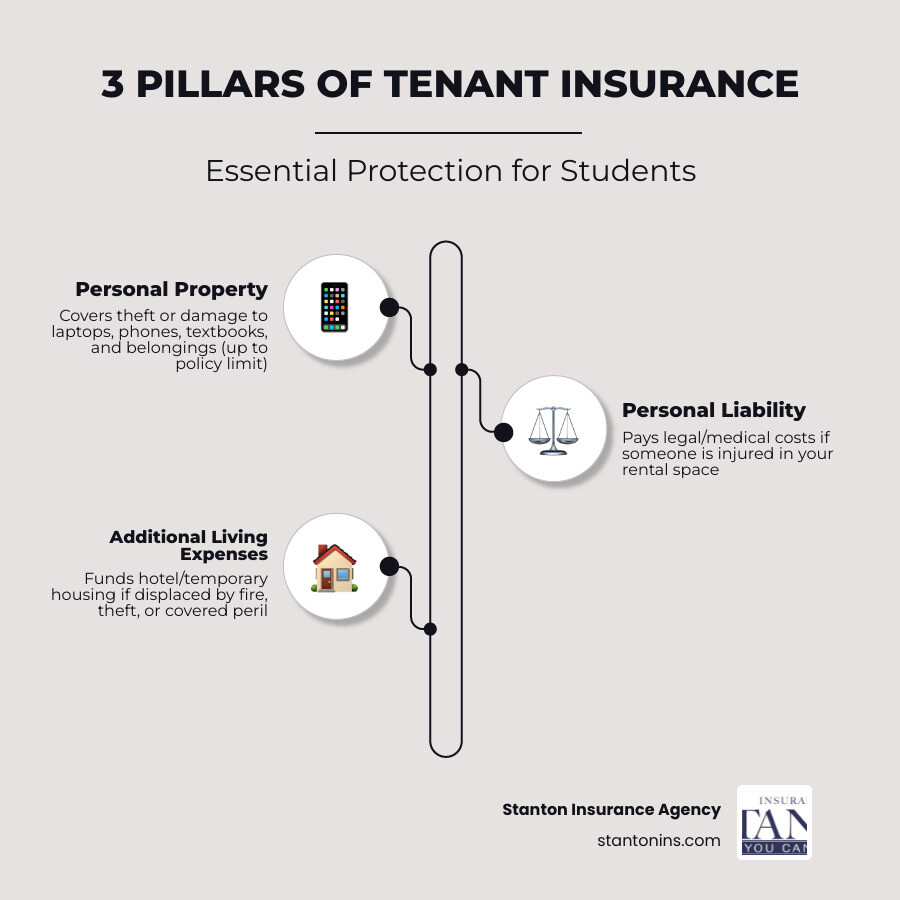
Here’s what it covers at a glance:
| Coverage Type | What It Does |
|---|---|
| Personal Property | Replaces stolen or damaged belongings like laptops, phones, and textbooks |
| Personal Liability | Covers legal or medical costs if someone is injured in your space |
| Additional Living Expenses | Pays for a hotel or temporary housing if you’re displaced by a covered event |
College is expensive enough. A single theft, fire, or accident can wipe out hundreds — or thousands — of dollars in gear and savings. Consider this: burglaries and theft account for 44% of all criminal activity on college campuses. And campuses are among the top five most common locations for laptop and phone theft, according to FBI research. Most students don’t realize their landlord’s insurance covers only the building — not a single item they own.
The good news? A solid tenant insurance policy typically costs as little as $15 to $30 per month.
I’m Geoff Stanton, President of Stanton Insurance Agency and a Certified Insurance Counselor (CIC) with over two decades of experience helping Massachusetts and New Hampshire families find the right coverage — including tenant insurance for students heading off to school. In this guide, I’ll walk you through exactly what you need to know to make a smart, confident decision.
Tenant insurance for students terms you need:
What is Tenant Insurance for Students and Why is it Essential?

When we talk about tenant insurance for students, we are looking at a specialized form of Renters Insurance designed to bridge the gap between “living at home” and “adulting” in a college environment. Whether you are in a high-rise in Malden or a shared house in Durham, New Hampshire, this policy serves as your financial safety net.
Many students mistakenly believe that their landlord’s insurance policy protects them. In reality, the landlord’s policy only covers the physical structure of the building. If a pipe bursts and ruins your $2,000 gaming laptop, the landlord is generally not responsible for replacing it. That is where What Does Renters Insurance Cover? becomes the most important question you can ask before move-in day.
According to the Renters Insurance | Mass.gov resources, these policies are vital because they provide three distinct layers of protection: personal property, personal liability, and additional living expenses (ALE). For a student, this means that even if a kitchen fire makes your apartment uninhabitable, you won’t be left sleeping on a library couch; your policy can help cover the cost of a hotel.
Protecting Your Tech and Textbooks
Your backpack is likely the most expensive thing you carry. Between a modern laptop, a smartphone, and noise-canceling headphones, you are often walking around with $3,000 worth of technology. Add to that the fact that students at four-year universities spend an average of more than $1,200 each year on textbooks, and the stakes get even higher.
The FBI has noted that college campuses are one of the top five most common destinations for electronics theft. It takes only a few seconds for someone to walk off with a laptop while a student is grabbing a coffee refill. With Personal Insurance Renters Insurance, you aren’t just buying a piece of paper; you’re buying the guarantee that a stolen laptop doesn’t mean a failed semester because you can’t afford a replacement.
Understanding Liability and Living Expenses
While most students focus on their “stuff,” the liability portion of the policy is arguably more important. Personal Liability Insurance for Renters protects you if you are found legally responsible for someone else’s injury or property damage.
Imagine you’re hosting a small study group and a friend trips over a loose rug, breaking their arm. Or perhaps you forget to put water in your instant mac-and-cheese, sparking a microwave fire that triggers the sprinkler system, damaging three floors of the building. Without liability coverage, you (or your parents) could be on the hook for tens of thousands of dollars in medical bills or restoration costs. Furthermore, if that fire forces you out of your home, your policy’s “loss of use” coverage helps pay for those unexpected hotel stays and meals.
Does Your Parents’ Homeowners Policy Provide Enough Coverage?

One of the most common questions we hear at Stanton Insurance Agency is: “Aren’t they already covered under my home insurance?” The answer is a classic insurance “maybe,” but with some very significant “buts.”
While many homeowners policies extend some coverage to students living on-campus, there are often strict limitations. For instance, many policies apply a 10% limit for “off-premises” personal property. If your home contents limit is $100,000, your student might only have $10,000 of coverage at school. While that sounds like a lot, it may not cover a total loss situation if they have high-end furniture, electronics, and a bike.
There is also the “deductible hurdle.” Most homeowners policies in Massachusetts and New Hampshire have deductibles of $1,000 or $2,500. If your student’s $900 laptop is stolen, filing a claim on the parents’ policy results in a $0 payout because the loss is less than the deductible—and it might cause the parents’ premiums to rise. A dedicated NH Renters Insurance policy often has a much lower deductible, sometimes as low as $100 or $250.
The Rental Insurance | New Hampshire Insurance Department – NH.gov blog points out that once a student moves into an off-campus apartment, they are often no longer considered part of the “household” for insurance purposes, meaning the parents’ policy might provide zero coverage.
On-Campus vs. Off-Campus Tenant insurance for students
The rules of the game change depending on where the student sleeps.
- On-Campus (Dorms): Most colleges do not require insurance, but they also explicitly state in their housing contracts that they are not responsible for stolen or damaged student property.
- Off-Campus (Apartments): This is where it becomes mandatory. Most landlords in cities like Boston, Malden, or Manchester now include a clause in the lease requiring tenants to carry insurance.
If you’re wondering, Can a Landlord Require Renters Insurance in Massachusetts?, the answer is a resounding yes. Landlords want to ensure that if you cause a fire, there is an insurance company available to pay for the repairs, rather than a lengthy legal battle with a college student who has no assets.
Calculating Coverage: How Much Do You Actually Need?
Determining how much coverage to buy requires a quick “mental walk-through” of the apartment. Don’t just think about the big items; think about the cost of replacing your entire wardrobe, your kitchen supplies, and your bedding. Most students find that $10,000 to $20,000 in property coverage is a safe starting point.
When choosing a policy for Renters Insurance Massachusetts, you will face a choice between two types of reimbursement:
| Feature | Actual Cash Value (ACV) | Replacement Cost Value (RCV) |
|---|---|---|
| Definition | Pays what the item is worth today (depreciated). | Pays what it costs to buy a new version today. |
| Example | Your 3-year-old laptop is stolen. You get $300. | You get $1,200 to buy a new, similar laptop. |
| Cost | Slightly cheaper premiums. | Highly recommended for students. |
We almost always recommend Replacement Cost coverage. Students don’t usually have the extra cash sitting around to make up the difference between a depreciated check and the price of a new computer.
Scheduling Valuables: Laptops, Bikes, and Jewelry
Standard policies have “sub-limits” for certain categories. For example, a policy might limit jewelry coverage to $1,000 or $1,500. If you have a high-end mountain bike or a professional-grade camera for your film major, you may need a “scheduled endorsement” or a “floater.”
This add-on provides broader protection for that specific item, often covering accidental damage (like dropping your laptop) and “mysterious disappearance,” which standard Renters Insurance MA might not cover. Many of these endorsements even provide worldwide coverage, protecting your gear while you’re studying abroad in Europe or on spring break.
The Real Cost of Tenant insurance for students in 2026
Let’s talk numbers. In April 2026, the cost of tenant insurance for students remains one of the best bargains in the financial world. On average, students in our region pay between $15 and $30 per month. That is roughly the cost of two streaming service subscriptions or a single pizza delivery.
When looking at How Much is Renters Insurance in Massachusetts?, several factors influence your specific rate:
- Location: An apartment in a high-crime area or an older building with no sprinklers may cost more.
- Deductible: Choosing a $500 deductible instead of a $250 deductible will lower your monthly premium.
- Coverage Limits: Increasing your liability from $100,000 to $300,000 usually only costs a few extra dollars a year.
- Security Features: Having a deadbolt, smoke detectors, or a central alarm system can earn you discounts.
For a detailed breakdown of local pricing, you can check out The Real Deal What Youll Pay for Renters Insurance in MA.
Roommate Risks and Shared Policies
It is a common myth that one policy covers everyone in the apartment. This is almost never true. Unless you are related to your roommate or in a legally recognized domestic partnership, you usually need your own individual policy.
If you try to share a policy, you run into “claim complications.” If your roommate’s guest gets injured, whose liability coverage pays? If your roommate moves out and takes the TV, is it theft or a civil dispute? To avoid these headaches, we always advise that each tenant secures their own coverage. If you’re still asking Do I Need Renters Insurance in Massachusetts? while living with three friends, the answer is yes—and so do they.
Frequently Asked Questions about Student Renters Insurance
Does tenant insurance cover my roommate’s belongings?
No. A standard policy only covers the “named insured” (you) and sometimes resident relatives. Your roommate is considered a separate legal entity. If their laptop is stolen, your insurance company will not cut them a check. Each roommate should purchase their own policy to ensure they are protected and to prevent disputes during the claims process.
Is tenant insurance required by law in MA or NH?
Technically, no state law in Massachusetts or New Hampshire requires you to have renters insurance. However, it is “contractually required” in almost all modern lease agreements. Landlords have the legal right to deny your application or evict you if you fail to maintain the insurance levels required by your lease.
What common perils are excluded from a standard policy?
Standard policies are great, but they aren’t “all-risk.” They typically exclude damage from floods (rising water from the ground), earthquakes, and intentional acts (you can’t break your own TV on purpose and get a new one). If you are renting a basement apartment in a flood-prone area of Malden or Portsmouth, you should strongly consider a Personal Flood Insurance add-on, as a standard policy will not cover water coming in from the street.
Conclusion: Secure Your Semester Today
As you prepare for the upcoming semester, don’t let a preventable accident derail your education. Tenant insurance for students is the ultimate “set it and forget it” tool for financial peace of mind. For the price of a few lattes a month, you protect your tech, your textbooks, and your future from the unexpected risks of campus life.
At Stanton Insurance Agency, we specialize in helping students and their families navigate these choices with ease. We understand the local markets in Massachusetts and New Hampshire, and we know exactly what local landlords require.
Don’t wait for a burst pipe or a stolen backpack to realize you’re unprotected. Get Your Instant Renters Insurance Quote Protect Your Stuff Today and spend your semester focusing on your grades—not your replacement costs. Reach out to us today to secure your space and your stuff!