
Auto Insurance Cost in 2026: What You’re Likely to Pay
Auto insurance cost varies widely depending on where you live, how you drive, and what coverage you choose. Here’s a quick snapshot of what most U.S. drivers pay in 2026:
| Coverage Type | Average Monthly Cost | Average Annual Cost |
|---|---|---|
| Full Coverage | $225/month | $2,697/year |
| Minimum Coverage | $68/month | $820/year |
Key facts at a glance:
- The cheapest state for full coverage is Idaho at $1,476/year
- The most expensive state is Louisiana at $4,135/year
- A DUI on your record can nearly double your premium
- Poor credit can raise your rate by up to 76%
- Drivers in Massachusetts and New Hampshire face their own unique pricing rules
These numbers are national averages. Your actual rate could be higher or lower depending on your age, vehicle, driving record, and ZIP code.
Auto insurance isn’t one-size-fits-all — and for most households, it’s one of the bigger recurring expenses in the budget. Understanding what drives the price is the first step to making sure you’re not overpaying.
I’m Geoff Stanton, President of Stanton Insurance Agency and a Certified Insurance Counselor (CIC) with over 25 years of experience helping Massachusetts and New Hampshire families navigate auto insurance cost and coverage decisions. As a 4th generation owner of an independent agency, I’ve seen how the right information — and the right policy — can make a real difference for drivers at every stage of life.
Related content about auto insurance cost:
Auto Insurance Cost in 2026: National Averages and State-by-State Differences
National averages are useful, but they are only a starting point. Your actual premium depends on your state, town, ZIP code, vehicle, drivers in the household, coverage limits, deductibles, and insurance history.
In 2026, several national analyses show the same broad pattern: full coverage usually costs several times more than minimum coverage, and location can dramatically change the price. A driver in a lower-cost state may pay less than half what a similar driver pays in a higher-cost state.
For Massachusetts and New Hampshire drivers, that means two things:
- You should not assume a national average is your exact target price.
- You should compare quotes using your own address, vehicle, and coverage needs.
Average Full Coverage and Minimum Coverage Costs
The national 2026 benchmark is about:
| Coverage Type | Average Monthly Cost | Average Annual Cost |
|---|---|---|
| Full coverage | $225 | $2,697 |
| Minimum coverage | $68 | $820 |
Full coverage usually means a policy that includes liability coverage plus physical damage coverage for your own vehicle, such as collision and comprehensive. Minimum coverage usually means the lowest coverage required to legally drive in your state, although New Hampshire works differently, which we will cover below.
Some national cost studies show slightly different averages. For example, one 2026 analysis lists full coverage closer to $2,317 per year and minimum coverage around $621 per year, while another shows full coverage around $2,356 per year and minimum coverage around $722 per year. Those differences usually come from methodology: driver age, vehicle type, coverage limits, ZIP code mix, deductibles, and whether the data uses quotes or written premiums.
The takeaway is simple: use national averages as a benchmark, not a bill. Your quote is personal.
Cheapest and Most Expensive States for Auto Insurance Cost
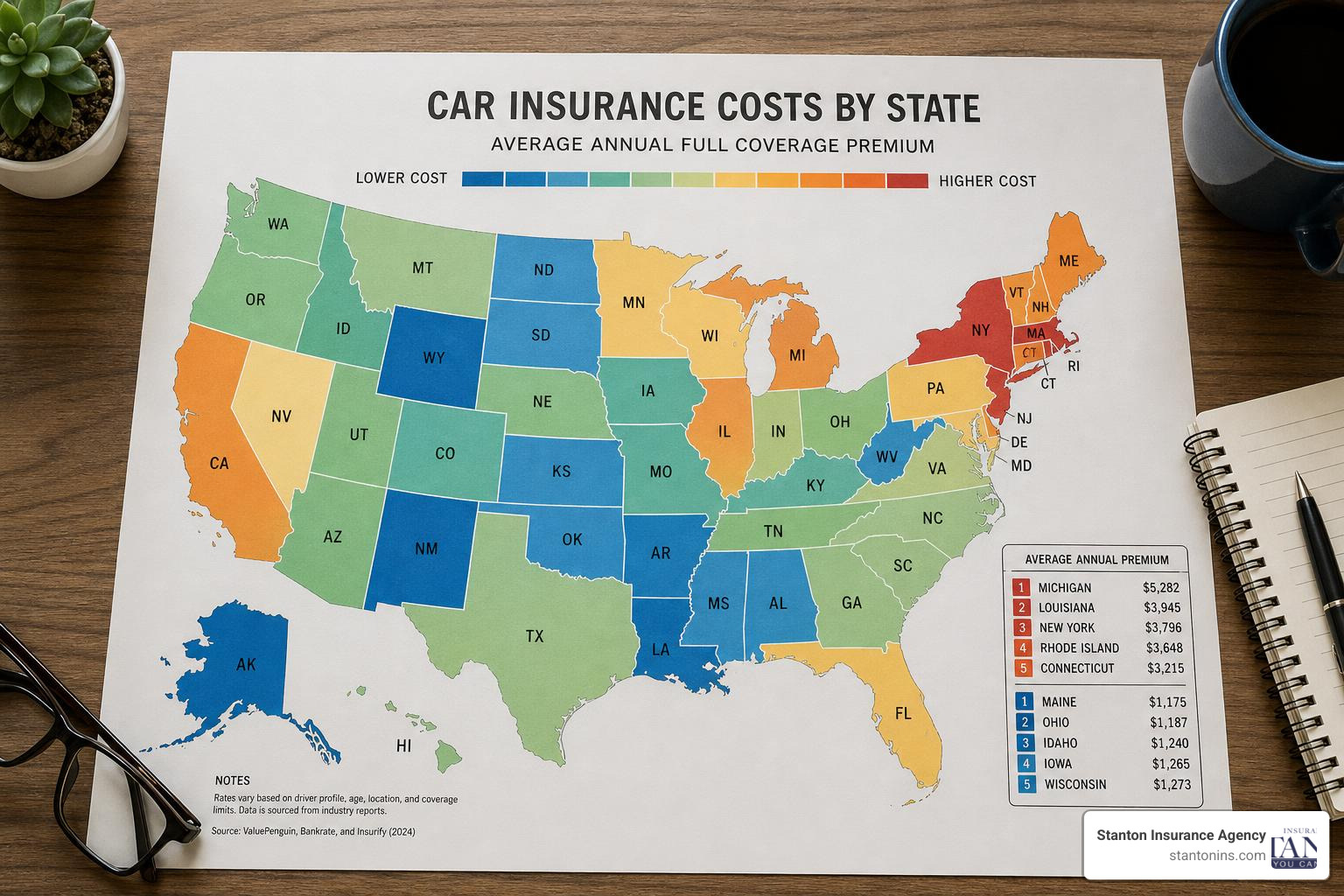
Auto insurance prices vary sharply by state. National 2026 data places Idaho among the cheapest states for full coverage at about $1,476 per year, while Louisiana is among the most expensive at about $4,135 per year.
Here is a simplified national comparison:
| Lower-Cost States for Full Coverage | Average Annual Full Coverage | Higher-Cost States for Full Coverage | Average Annual Full Coverage |
|---|---|---|---|
| Idaho | $1,476 | Louisiana | $4,135 |
| Vermont | $1,610 | New York | $4,090 |
| Hawaii | $1,678 | Florida | $3,884 |
| New Hampshire | About $1,694 in some 2026 analyses | Other high-cost states vary | Often $3,000+ |
New Hampshire often appears on lower-cost lists nationally. Massachusetts is usually not the cheapest state, but its pricing rules are very different from many other states because insurers cannot use certain rating factors, such as credit and gender, when setting Massachusetts private passenger auto rates.
Why Car Insurance Rates Vary So Much by State
Car insurance is local. Two drivers can have the same age, vehicle, and driving record but pay different rates because they live in different places.
Common reasons state and local rates vary include:
- State minimum coverage requirements
- Whether the state uses no-fault or tort-based claim rules
- Traffic density and accident frequency
- Medical costs after crashes
- Vehicle repair costs
- Weather losses, including hail, flooding, and storms
- Uninsured or underinsured driver rates
- Vehicle theft and vandalism rates
- Legal costs and claim settlement trends
- Local labor and parts costs
Even within Massachusetts or New Hampshire, your garaging address matters. A vehicle kept in a dense urban area may cost more to insure than the same vehicle kept in a quieter rural town. That is not the insurance company being nosy; it is the math looking at claim frequency and severity in your area.
What Full Coverage and Minimum Coverage Really Include
The terms “full coverage” and “minimum coverage” are convenient, but they can be misleading. “Full coverage” does not mean every possible loss is covered. “Minimum coverage” does not mean you are financially safe. It only means the policy meets the basic legal requirement where applicable.
For a deeper primer, see our guide to auto insurance cost basics.
What Full Coverage Usually Includes
A full coverage policy typically includes several parts:
- Bodily injury liability: Helps pay for injuries you cause to others in an at-fault accident.
- Property damage liability: Helps pay for damage you cause to someone else’s vehicle or property.
- Collision coverage: Helps repair or replace your vehicle after a crash, regardless of fault, subject to your deductible.
- Comprehensive coverage: Helps cover non-collision losses, such as theft, vandalism, fire, falling objects, and certain weather damage.
- Uninsured motorist coverage: Helps protect you if an uninsured driver injures you.
- Underinsured motorist coverage: Helps when the at-fault driver has insurance, but not enough.
- Medical payments or personal injury protection: Helps with medical costs, depending on state rules and policy structure.
If your vehicle is financed or leased, your lender or leasing company will usually require collision and comprehensive coverage. They may also require specific deductibles. After all, they have a financial interest in the car too. They are not lending you money out of pure automotive enthusiasm.
What Minimum Coverage Usually Includes
Minimum coverage usually focuses on liability and state-required benefits. Depending on the state, it may include:
- Bodily injury liability
- Property damage liability
- Personal injury protection
- Uninsured motorist coverage
- Medical payments coverage
Minimum coverage generally does not pay to repair your own vehicle after an at-fault accident. It also will not replace your car if it is stolen unless you carry comprehensive coverage.
This is where many drivers get surprised. A minimum policy may be legal, but if you total your own car, the repair or replacement cost could land squarely in your lap.
When to Choose More Than the Minimum
You may want more than minimum coverage if:
- Your vehicle is newer or valuable
- You have a loan or lease
- You rely on your car for work or family transportation
- You do not have enough savings to replace the car
- You have household assets to protect
- You have teen drivers in the home
- You drive frequently or commute long distances
- You want protection against theft, vandalism, weather, or animal collisions
- You are concerned about lawsuits after a serious accident
For older vehicles, dropping collision or comprehensive may make sense if the car’s value is low and you can absorb the loss. But do the math first. If saving $200 a year creates a $6,000 replacement problem, that “savings” may be more of a trapdoor than a discount.
Personal and Vehicle Factors That Change Your Premium
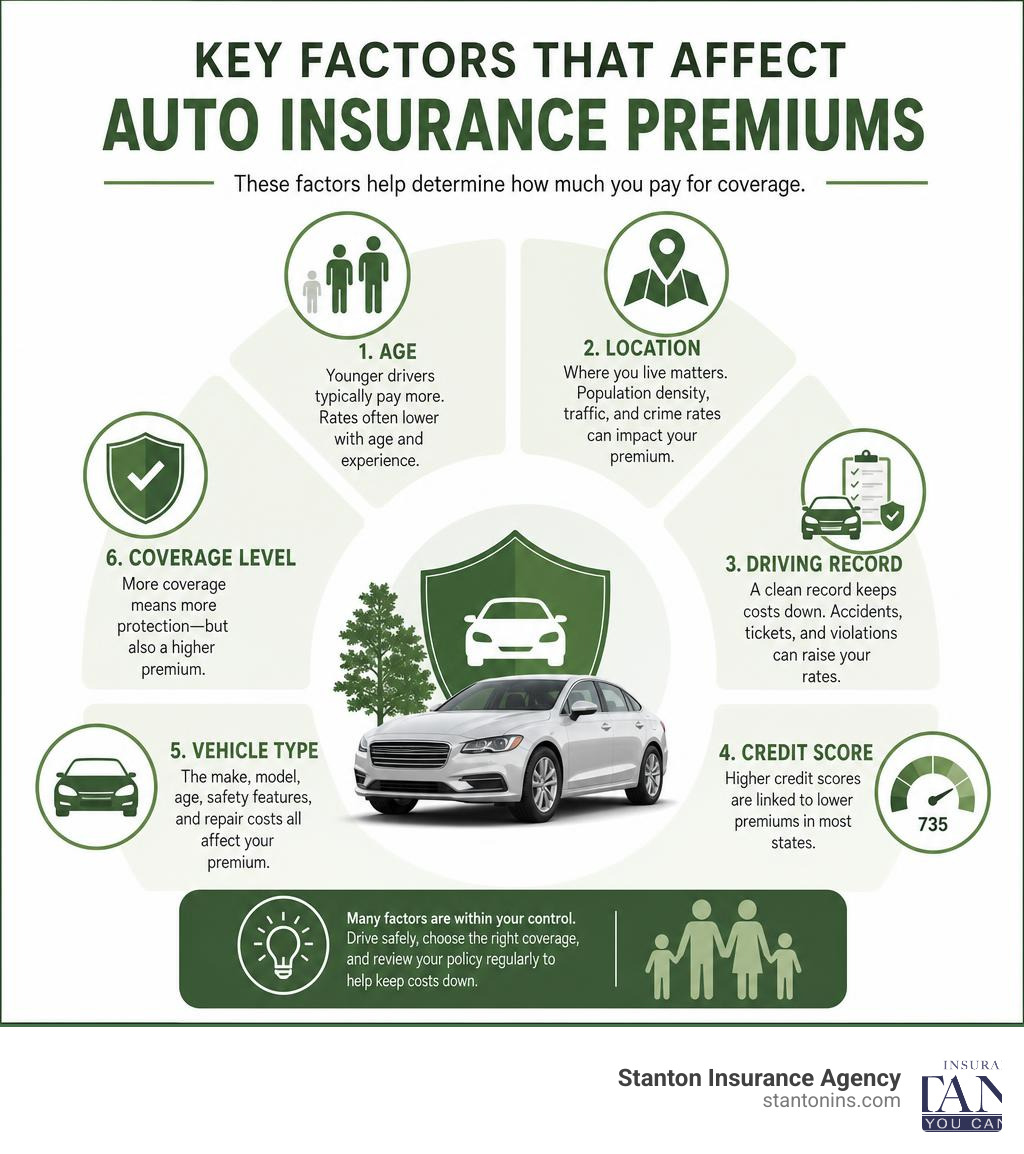
Auto insurance pricing is based on risk. Insurers look at the likelihood of a claim and the likely cost if one happens. The exact formula varies by company and state, but the core factors are fairly consistent.

How Age, Credit, and Driving History Affect Auto Insurance Cost
Driving history is one of the biggest pricing factors. National research shows:
- A DUI can increase full coverage rates by about 96% compared with the national average.
- An at-fault accident can raise rates significantly, often for several years.
- A speeding ticket can increase premiums, though the impact varies by state and insurer.
- Poor credit can raise full coverage rates by roughly 76% compared with good credit in states where credit-based insurance scoring is allowed.
Massachusetts drivers should note an important exception: Massachusetts does not allow credit-based insurance scoring for private passenger auto rating. Massachusetts also does not allow gender-based rating. So while credit and gender may affect prices in many states, they are not used the same way in Massachusetts.
Age also matters. Teen drivers usually pay the most because they are statistically more likely to be involved in crashes. Rates often improve as drivers gain experience and maintain clean records. Senior drivers may see pricing change again later in life, depending on driving patterns and claims data.
How Location, Mileage, and Insurance History Affect Rates
Your premium can also change based on:
- Garaging address: Where the vehicle is kept overnight.
- Annual mileage: More miles usually means more exposure to accidents.
- Commute use: A daily highway commute may price differently than occasional pleasure use.
- Business use: Personal policies may not cover certain business uses properly.
- Continuous coverage: A lapse in insurance can make coverage harder or more expensive.
- Prior claims: Claim history can affect eligibility and pricing.
- Payment method: Paying in full may reduce billing fees or qualify for a discount.
- Household drivers: All licensed household members may need to be disclosed.
If something changes, tell your agent. A shorter commute, a student away at school, or a vehicle no longer used daily can sometimes affect the premium.
How Vehicle Make and Model Affect Premiums
The car matters. A lot.
Insurers look at:
- Manufacturer’s suggested retail price
- Repair costs
- Parts availability
- Crash-test performance
- Theft rates
- Safety technology
- Cost to recalibrate sensors and cameras
- Vehicle weight and damage potential
- Engine size and performance
- Whether the vehicle is electric, hybrid, luxury, or sports-oriented
A practical family vehicle with strong safety ratings may cost less to insure than a luxury SUV or high-performance coupe. Electric vehicles can sometimes cost more to insure because specialized parts, battery systems, and advanced sensors may increase repair costs.
Safety features can help, but modern technology cuts both ways. A bumper is no longer just a bumper when it contains cameras, radar, and sensors. One minor parking-lot crunch can turn into a surprisingly sophisticated repair bill.
Why Rates Are Rising and How to Lower Your Cost
Auto insurance costs have risen sharply in recent years. National reporting shows premiums increased roughly 23% from 2023 to 2026, with some states seeing larger jumps.
Recent Increases in Car Insurance Rates
Several forces are pushing premiums higher:
- Repair parts cost more.
- Labor costs at repair shops have increased.
- Vehicles contain more expensive technology.
- Medical costs after accidents are higher.
- Severe weather has created more claims.
- Theft trends have affected certain vehicles.
- Claim severity has increased.
- Legal and settlement costs have risen.
- Reinsurance costs have gone up for insurers.
In plain English: claims are more expensive. When the cost to repair cars, treat injuries, and settle claims rises, premiums eventually follow.
That does not mean every driver’s rate increases the same way. A clean-record driver in New Hampshire with a modest vehicle may see a very different change than a Massachusetts household adding a teen driver and a newly financed SUV.
Practical Ways to Reduce Premiums
Here are practical steps that can help lower auto insurance cost:
Compare quotes regularly
Shop at renewal or at least once a year. Pricing changes, and the best fit two years ago may not be the best fit today.Bundle policies when it makes sense
Combining auto with home, condo, or renters insurance may qualify for a multi-policy discount.Raise deductibles carefully
Higher collision and comprehensive deductibles can lower premiums, but only choose a deductible you could comfortably pay after a claim.Keep a clean driving record
Avoiding tickets, accidents, and impaired driving is one of the best long-term savings strategies.Avoid coverage lapses
Continuous insurance history can help with eligibility and pricing.Review vehicle use and mileage
If you drive less than before, update your policy.Ask about driver assignments
In multi-car households, driver-to-vehicle assignments can matter.Pay in full if possible
Some policies offer savings or lower installment fees for paying the full term upfront.Review optional coverages
Rental reimbursement, roadside assistance, loan/lease gap coverage, and original equipment coverage may be valuable, but they should match your needs.Work with an independent agency
We can help compare options and explain tradeoffs, not just chase the cheapest number.
For more savings ideas, read our guide to 10 auto insurance cost hacks.
Discounts to Ask About Before You Renew
Before renewing, ask about:
- Safe driver discounts
- Good student discounts
- Multi-car discounts
- Multi-policy discounts
- Defensive driving discounts
- Anti-theft device discounts
- Paperless billing discounts
- Autopay discounts
- Low-mileage discounts
- Usage-based or telematics programs
- Student-away-at-school discounts
- Senior driver discounts
- Affinity or group discounts
Discounts vary by state and insurer. Not every discount is available on every policy, but it never hurts to ask. The worst answer is “no,” which is still cheaper than not asking.
How Massachusetts and New Hampshire Drivers Should Compare Quotes
Massachusetts and New Hampshire are neighbors, but their auto insurance systems are very different. If you move across the border, do not assume your old coverage setup still makes sense.
Massachusetts Pricing Rules and Shopping Tips
Massachusetts requires compulsory auto insurance. A standard Massachusetts private passenger auto policy includes required coverages such as bodily injury to others, personal injury protection, bodily injury caused by an uninsured auto, and property damage liability.
Massachusetts also has important rating rules:
- Credit-based insurance scoring is not used for private passenger auto rates.
- Gender is not used as a rating factor.
- Territory, driving record, vehicle, coverage choices, and other approved factors can affect price.
- Managed competition allows insurers to set their own rates subject to state oversight.
Massachusetts minimum limits may satisfy the law, but they can be low compared with the cost of a serious accident. Many drivers choose higher liability limits for better financial protection.
The Massachusetts Division of Insurance encourages drivers to shop around, and its guidance is worth reviewing: Massachusetts shopping guidance.
For local help, see:
- Average cost of car insurance in MA
- Massachusetts quote help
- How much is car insurance per month in Massachusetts
- Why is car insurance so expensive in Massachusetts
New Hampshire Pricing Rules and Shopping Tips
New Hampshire is unusual because it generally does not require all drivers to carry auto insurance. However, drivers are still financially responsible if they cause an accident.
That distinction matters. “Not required” does not mean “not responsible.” If you cause injuries or property damage and do not have insurance, you may have to pay out of pocket. Certain drivers may also be required to file proof of financial responsibility, such as an SR-22, after specific violations or incidents.
When New Hampshire drivers buy auto insurance, policies must meet state requirements for the coverages included. New Hampshire policies commonly include liability, uninsured motorist coverage, and medical payments coverage according to state rules.
For official state information, review New Hampshire auto cost data.
For local guidance, see:
How to Compare Quotes Accurately
Comparing quotes only works if you compare the same thing. A cheap quote with lower limits, missing coverage, or higher deductibles may not really be cheaper. It may just be thinner.
Use this checklist:
- Same drivers listed
- Same garaging address
- Same vehicles and VINs
- Same annual mileage
- Same vehicle use
- Same liability limits
- Same uninsured and underinsured motorist limits
- Same collision and comprehensive deductibles
- Same rental reimbursement choice
- Same roadside assistance choice
- Same loan/lease gap coverage choice, if needed
- Same policy term
- Same payment plan
- Same accident and violation history
- Same discounts applied
Also look beyond price. Ask about claims service, billing flexibility, coverage exclusions, renewal stability, and whether the policy fits your actual life.
For help understanding monthly quote comparisons, see our monthly quote guide
Frequently Asked Questions About Auto Insurance Cost
What Is the Average Auto Insurance Cost Per Month?
In 2026, the national average is about $225 per month for full coverage and $68 per month for minimum coverage.
Your actual monthly cost may be higher or lower based on:
- State and ZIP code
- Vehicle make and model
- Driving record
- Age and experience
- Coverage limits
- Deductibles
- Household drivers
- Annual mileage
- Discount eligibility
Massachusetts and New Hampshire drivers should use these numbers as a benchmark, then get personalized quotes based on their actual policy needs.
Is Full Coverage Worth the Higher Auto Insurance Cost?
Full coverage may be worth it if:
- Your vehicle is newer
- Your car is financed or leased
- You could not easily pay to repair or replace the vehicle
- You want protection against theft, vandalism, weather, and animal collisions
- You have a long commute
- Your household depends on the vehicle daily
It may be less necessary for an older, low-value vehicle that you could afford to replace. Even then, keep liability limits in mind. Dropping collision and comprehensive is one decision; carrying too little liability is another and can be much riskier.
How Often Should I Shop for Car Insurance Quotes?
We recommend reviewing your policy at every renewal and shopping at least every 6 to 12 months if price is a concern.
You should also compare quotes after major changes, such as:
- Moving
- Buying a vehicle
- Adding a teen driver
- Getting married
- Changing commute distance
- Paying off a loan
- A ticket or accident aging off your record
- A major premium increase
- Buying a home or renters policy that could be bundled
The goal is not to switch constantly. The goal is to make sure your coverage and price still make sense.
Conclusion
Auto insurance cost in 2026 is shaped by national trends, state rules, local risk, your driving record, your vehicle, and the coverage you choose. The national average is about $2,697 per year for full coverage and $820 per year for minimum coverage, but your real number depends on your own situation.
For Massachusetts drivers, pricing rules around credit and gender make the market different from many other states. For New Hampshire drivers, the state’s financial responsibility system creates its own unique decisions. In both states, the smartest move is to compare carefully, understand your limits, and avoid choosing a policy based on price alone.
At Stanton Insurance Agency, we help drivers protect what matters with coverage that fits real life, not just a spreadsheet. If you want local guidance, clear explanations, and help comparing your options, we are here to help.
Get started here: Get help with auto insurance