What Does Liability Insurance Cost for Small Businesses in 2026?
Liability insurance cost is one of the first questions every small business owner needs to answer — and the range is wider than most people expect.
Here is a quick snapshot of what small businesses typically pay:
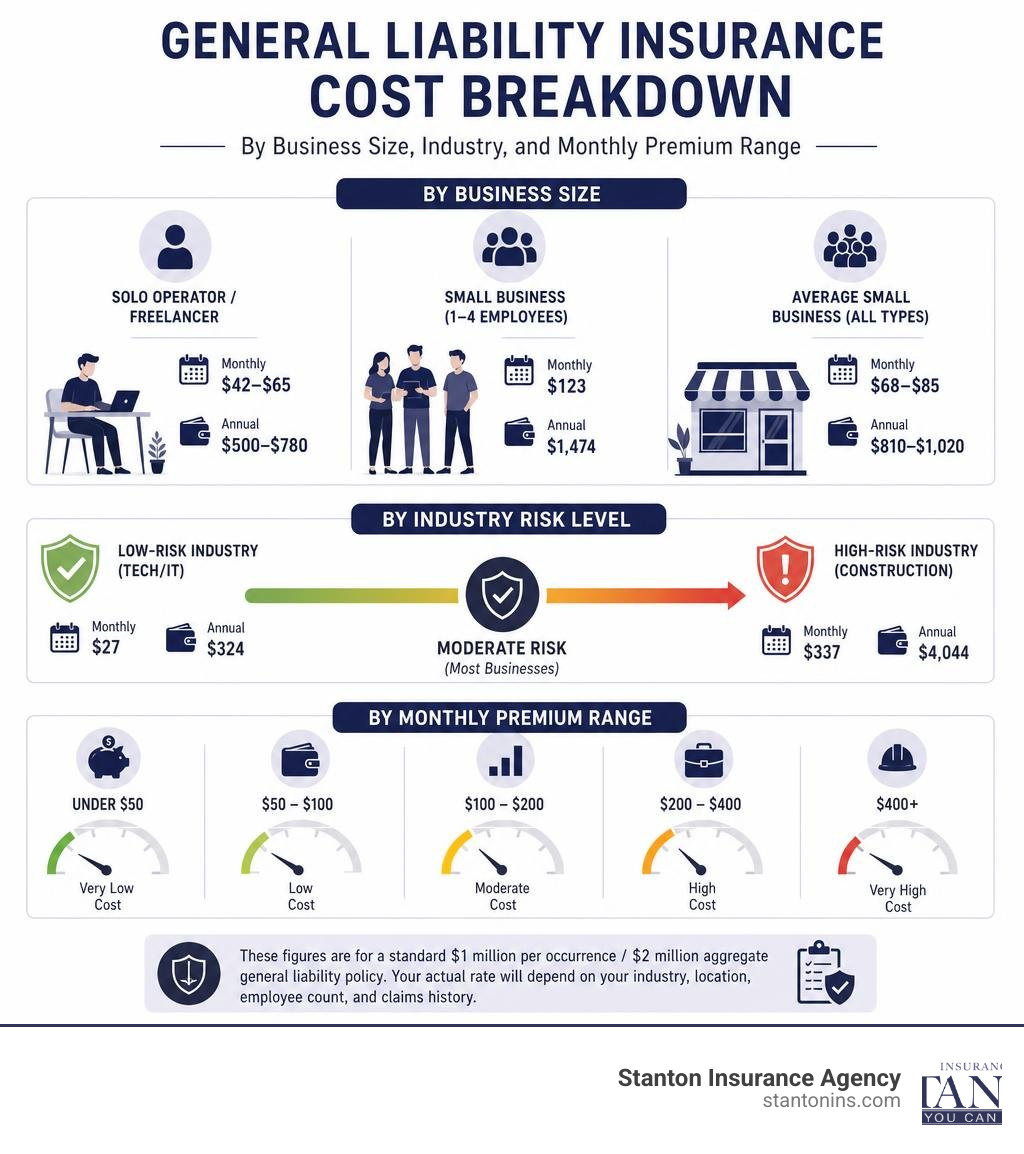
| Business Type | Average Monthly Cost | Average Annual Cost |
|---|---|---|
| Solo operator / freelancer | ~$42–$65 | ~$500–$780 |
| Small business (1–4 employees) | ~$123 | ~$1,474 |
| Low-risk industry (Tech/IT) | ~$27 | ~$324 |
| Average small business (all types) | ~$68–$85 | ~$810–$1,020 |
| High-risk industry (Construction) | ~$337 | ~$4,044 |
These figures are for a standard $1 million per occurrence / $2 million aggregate general liability policy. Your actual rate will depend on your industry, location, employee count, and claims history.
Running a business always involves risk. A customer slips on a wet floor. A contractor accidentally damages a client’s property. A social media post triggers an advertising injury claim. Any one of these events — without the right coverage — can turn into a five- or six-figure legal bill overnight. That is why understanding your liability insurance cost before something goes wrong is one of the smartest financial moves you can make as a business owner.
This guide breaks down the real numbers, the factors that drive premiums up or down, and what you can do right now to get the best protection at the most competitive price.
I’m Geoff Stanton, President of Stanton Insurance Agency and a Certified Insurance Counselor (CIC) with over 25 years of experience helping small and medium-sized businesses in Massachusetts and New Hampshire manage their liability insurance cost and build smart commercial coverage programs. In the sections below, I’ll walk you through everything you need to know to make a confident, well-informed decision.
Liability insurance cost terms made easy:
- Car insurance quotes monthly
- how much is a down payment for car insurance
- how much is liability car insurance per month
What is the Average Liability Insurance Cost for Small Businesses?
When you begin researching commercial protection, looking at broad national averages can sometimes feel like trying to hit a moving target. Enterprise-level corporations pay millions of dollars in premiums, which skews standard mathematical averages upward. To get a realistic expectation for your budget, it is far more practical to look at median costs. The median represents the exact middle point of the market, meaning half of all policyholders pay less than this amount, and half pay more.
According to comprehensive data compiled in the Business Insurance Statistics in US 2026 report, the median monthly cost of a standalone general liability policy for a small business is roughly $42 to $45. However, when averaging out all small business policyholders across various risk categories, the average rate settles between $65 and $85 per month. On an annual basis, this means most small business owners pay between $500 and $1,500 for foundational protection.
How you choose to structure your payments also plays a direct role in your final liability insurance cost. Most commercial insurance providers offer two primary payment methods:
- Monthly Installments: This option spreads the financial impact over 10 or 12 smaller payments, which can help keep your monthly cash flow predictable. However, carriers often charge a small administrative billing fee (typically $3 to $8 per installment) for this convenience.
- Annual Prepayment: Paying your entire annual premium upfront is one of the easiest ways to save. Most commercial insurers offer a 5% to 10% discount for prepaying, and you completely avoid monthly administrative fees. For a growing business, this simple adjustment can put hundreds of dollars back into your operating budget.
Key Factors That Influence Your Liability Insurance Cost
Commercial insurance is not a one-size-fits-all utility. Underwriters determine your premium using sophisticated, data-driven formulas designed to measure the exact risk profile of your daily operations. By understanding these key variables, you can take proactive steps to manage your business’s risk and lower your expenses.
How Coverage Limits and Deductibles Shape Your Premium
The coverage limits you select are among the most direct levers controlling your premium. Most small business owners start with a baseline policy featuring a $1 million per occurrence limit and a $2 million aggregate limit. The “per occurrence” limit is the maximum amount your insurer will pay for a single claim, while the “aggregate” limit is the total amount the policy will pay out over a single policy year.
According to historical data from leading national carriers, a standard $1 million/$2 million policy averages about $69 per month, or $824 per year. If your business works with larger commercial clients, operates under strict municipal contracts, or leases a physical storefront, you may be required to carry higher limits, such as a $2 million per occurrence and $4 million aggregate policy. Upgrading your coverage to these higher limits generally adds 15% to 30% to your base premium. For a detailed breakdown of how these higher limits are priced, read Your Guide to 1M Liability Insurance Premiums.
Your deductible is another powerful tool for adjusting your premium. By raising your deductible—the amount your business pays out of pocket before your insurance coverage kicks in—you assume a slightly higher share of the initial risk. Moving your deductible from $500 to $1,000 or $2,500 can reduce your monthly premium by 10% to 20%. When you request a customized Liability Insurance Quote, your agent can run multiple deductible scenarios to help you find the perfect balance between monthly savings and out-of-pocket exposure.
The Impact of Employee Count and Business Size on Liability Insurance Cost
Your team size is directly proportional to your operational footprint and, consequently, your liability risk. Every employee represents another set of hands interacting with customers, operating equipment, or working on client property.
To see how scale affects your premium, look at how average monthly costs rise alongside employee count:
- Solo Operators & Freelancers: Micro-businesses with no payroll often pay the absolute lowest rates, averaging around $65 per month.
- Micro-Businesses (1 to 4 Employees): Businesses with a small team pay an average of $123 per month ($1,474 annually).
- Small Businesses (5 to 9 Employees): As a team grows, the complexity of operations increases. Adding just a few employees can cause premiums to climb by an additional $200 or more per month—representing a 168% increase over micro-business rates.
For a deeper dive into how these metrics define your legal and financial protection, check out our Liability Insurance Definition Guide.
How Claims History and Years in Business Affect Your Liability Insurance Cost
Insurers view your past claims history as a highly reliable indicator of future losses. If your business has maintained a clean three-year claims record, underwriters will reward you with their most competitive preferred tier pricing. On the other hand, if your business has a history of frequent liability claims, carriers will apply risk surcharges ranging from 25% to 55% per claim.
Your time in business also carries significant weight under commercial underwriting guidelines. Startups and brand-new companies lack a proven track record of safety, operational stability, and risk management. Because of this, newer businesses are often placed in higher-risk pricing categories for their first two years. Once your business matures and establishes a clean loss history, your overall risk profile improves, unlocking lower rates at renewal. To understand the fundamental mechanics of these pricing models, see our Liability Insurance Definition.
How Rates Vary by Industry and Location
While internal business decisions play a major role in your premium, two of the most powerful drivers of your liability insurance cost are completely external: what your business does and where you are located.
Industry Risk and Its Direct Effect on Liability Insurance Cost
Underwriters group businesses into specific industry classifications based on their inherent physical and financial risks.
- Low-Risk Industries (Tech, IT, Professional Services): These businesses primarily operate behind desks or remotely. Because they face virtually no physical exposure to the public, their average general liability premiums start as low as $20 to $27 per month.
- Mid-Range Industries (Retail, E-Commerce, Consulting): Retail storefronts face moderate risk due to customer foot traffic (slip-and-fall hazards) and product liability. These businesses typically pay between $42 and $60 per month.
- High-Risk Industries (Construction, Contracting, Restaurants): Businesses that perform physical labor on client sites or handle hot food and alcohol face substantial risk. A general contractor, plumber, or roofer can expect average premiums to start around $337 per month, reflecting the high frequency and severity of property damage and bodily injury claims in these fields.
When you are ready to see how your specific industry classification translates to a real premium, you can easily request a customized Liability Insurance Quote tailored to your unique trade.
Geographic Location: Massachusetts and New Hampshire Rate Variations
Your physical business address dictates the legal, regulatory, and environmental risks your insurer must account for. Densely populated urban centers with active litigation climates naturally command higher premiums than rural areas.
In the Northeast, both Massachusetts and New Hampshire sit in the upper tier of commercial insurance costs nationwide, with average local premiums frequently running 20% or more above the national average.
In Massachusetts, businesses operate in a highly litigious legal landscape with strict consumer protection statutes and high medical costs, both of which drive up settlement sizes. In New Hampshire, businesses must navigate unique state-specific liability frameworks. Furthermore, businesses in both states must contend with severe winter weather. Months of snow, ice, and freezing temperatures dramatically increase the frequency of slip-and-fall claims on sidewalks and parking lots. Local underwriters factor these regional weather hazards directly into your premium. If you want to explore localized commercial programs, check out the resources available on Stanton Insurance Agency Business Insurance.
What Does General Liability Insurance Cover and Exclude?
To evaluate whether your premium is a good value, you must understand exactly what your general liability policy protects—and where your business remains financially exposed.
| What is Covered | What is Excluded |
|---|---|
| Third-Party Bodily Injury: Medical expenses, ambulance rides, and legal defense if a customer slips, falls, or is injured on your business premises. | Employee Injuries: On-the-job injuries to your own staff (this requires a separate Workers’ Compensation policy). |
| Third-Party Property Damage: The cost to repair or replace a client’s physical property if you or your employees accidentally damage it while working. | Professional Advice & Mistakes: Financial losses resulting from your professional recommendations, consulting, or design errors (requires Professional Liability). |
| Personal & Advertising Injury: Legal protection against claims of libel, slander, copyright infringement, trademark violations, or deceptive advertising. | Commercial Auto Incidents: Accidents that occur while driving company-owned vehicles or personal vehicles for business purposes (requires Commercial Auto). |
| Immediate Medical Payments: A fast-acting, no-fault coverage limit (typically up to $5,000) designed to pay for minor customer injuries quickly, often preventing lawsuits. | Damage to Your Own Business Property: Damage to your physical office, tools, inventory, or equipment due to fire, theft, or natural disasters (requires Commercial Property). |
| Legal Defense Costs: Attorney fees, court administrative costs, and court-ordered settlements or judgments, up to your policy limits. | Intentional Acts & Faulty Workmanship: Damage caused intentionally, or the cost to tear out and redo poor-quality work. |
While general liability is the essential foundation of any commercial risk management plan, relying on it as your sole line of defense can leave dangerous gaps in your protection.
Comparing General Liability to Other Business Insurance Policies
To build a comprehensive financial firewall around your business assets, it is helpful to understand how general liability compares to and integrates with other essential commercial lines. According to the data in the Business Insurance Statistics in US 2026 report, most small businesses find that combining coverages is the most cost-effective approach.
- Professional Liability (Errors & Omissions): While general liability focuses on physical risks (bodily injury and property damage), Professional Liability covers financial harm caused by your professional advice, omissions, or mistakes. For example, if a consultant gives advice that costs a client $100,000 in lost revenue, general liability will not help, but a Professional Liability policy will.
- Business Owner’s Policy (BOP): For eligible small-to-medium businesses, a BOP is the most cost-effective way to purchase coverage. It bundles general liability, commercial property insurance, and business interruption insurance into a single package. Buying a BOP typically saves you 10% to 20% compared to purchasing each policy individually.
- Workers’ Compensation: Legally mandated in 49 states—including Massachusetts and New Hampshire—as soon as you hire your first employee. This policy covers medical expenses and lost wages for your staff if they are injured on the job, shielding your business from direct employee lawsuits.
Practical Ways to Lower Your Liability Insurance Cost
Protecting your hard-earned business assets does not mean you have to overpay. By taking an active, organized approach to risk management, you can steadily drive down your commercial premiums.

Here are five highly effective ways to lower your liability insurance cost without sacrificing coverage:
- Bundle Your Policies into a BOP: If your business qualifies, package your general liability and commercial property coverages into a Business Owner’s Policy to unlock immediate multi-line discounts.
- Prepay Your Premium Annually: Eliminate monthly administrative billing fees and secure a lower base rate by paying your entire annual premium upfront.
- Optimize Your Deductibles: If your business maintains stable cash reserves, raising your deductible from $500 to $1,000 or $2,500 can lower your monthly premium by up to 20%.
- Implement Formal Safety Protocols: Establish written safety guidelines, conduct regular safety audits, and keep meticulous logs of winter sidewalk maintenance. Proactive risk management shows underwriters that you are a low-risk client.
- Verify Your Class Codes: Make sure your business is classified under the correct industry code. A simple administrative error that labels an office-based consultant as a field contractor can unnecessarily inflate your premium by thousands of dollars.
Frequently Asked Questions About Liability Insurance Cost
Is general liability insurance tax deductible?
Yes. The IRS treats general liability insurance premiums as an ordinary and necessary business expense. This means you can typically deduct 100% of your premiums on your federal tax return, effectively lowering your net liability insurance cost.
How does general liability compare to liability car insurance cost?
While general liability covers your overall business operations, personal or commercial auto liability is strictly designed to cover vehicular accidents. For context, the average cost of car insurance in the United States is $807 per year ($67 per month) for minimum coverage, while full coverage averages $2,677 per year ($223 per month). If you use vehicles for business purposes, you will need a dedicated commercial auto policy, as personal auto policies typically exclude business-related accidents. For more details on vehicle-specific rates, you can explore our comprehensive liability car insurance cost guide and read about the general Liability Car Insurance Cost.
What is the cheapest way to get a liability insurance quote?
The most effective way to secure a competitive rate is to work with an independent insurance agency. Unlike captive agents who represent only a single brand, independent agents can shop your business profile across multiple highly rated commercial carriers to find the best coverage at the most competitive price. You can start this process today by requesting a customized Liability Insurance Quote.
Conclusion
Your business is the product of your hard work, passion, and financial dedication. While managing operational expenses is critical, cutting corners on your liability protection is a high-stakes gamble that can result in devastating out-of-pocket losses. The goal is not simply to find the absolute cheapest policy, but to secure high-quality, reliable protection tailored to your actual risk exposure.
At Stanton Insurance Agency, we specialize in helping business owners throughout Massachusetts and New Hampshire navigate the complexities of commercial coverage. As an independent agency, we partner with the region’s top-tier carriers to build customized insurance programs that protect your valuable assets without breaking your budget.
Ready to secure your business’s financial future? Contact our local team today to explore your options and request a tailored quote for your business insurance.