
What Is Renters Insurance With No Deductible — And Should You Get It?
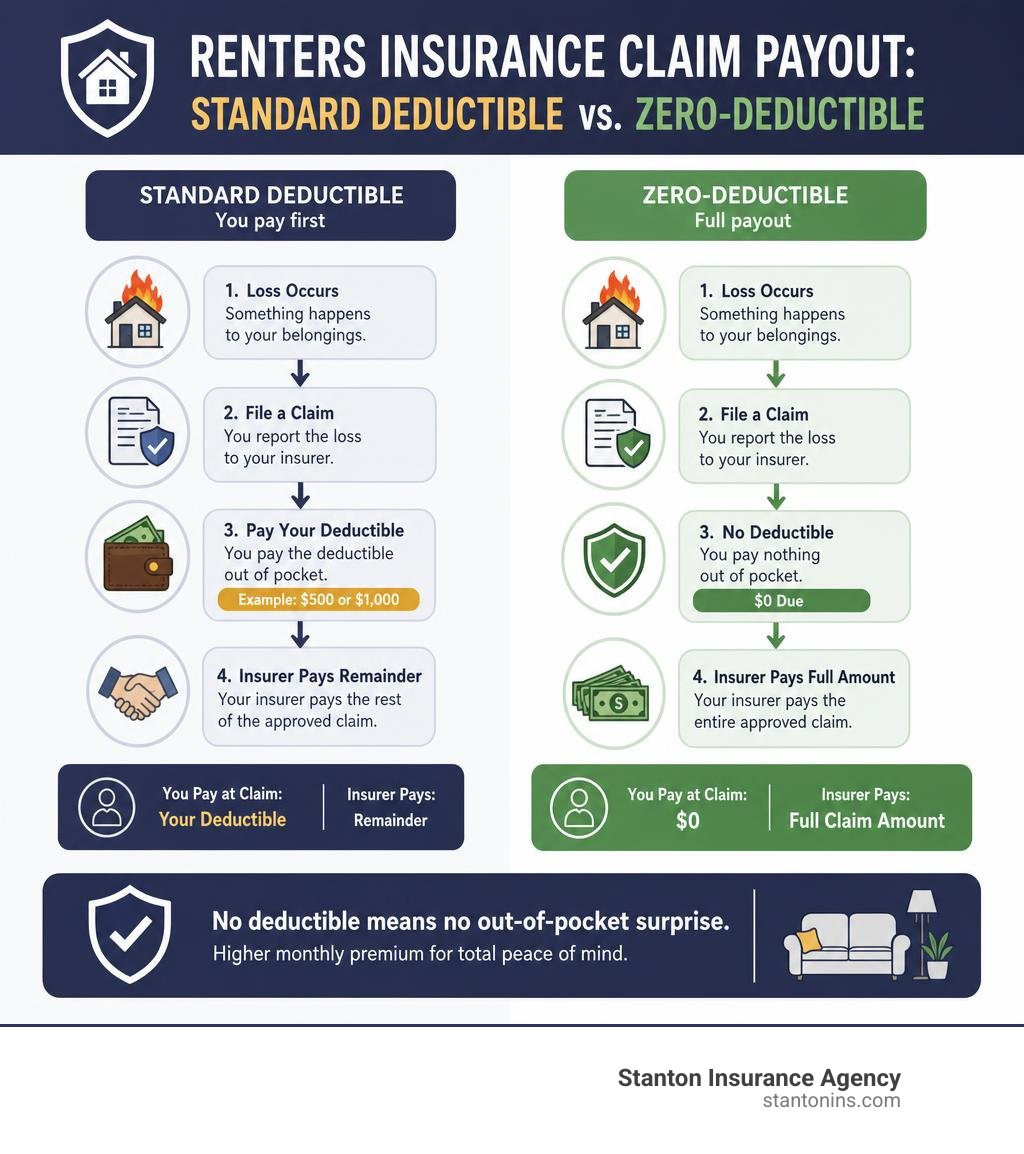
Renters insurance with no deductible means that when you file a claim, your insurance company pays the full amount — you pay nothing out of pocket first. Most standard renters policies require you to cover a set amount (typically $500 to $1,000) before your insurer steps in.
Here’s the quick answer:
| Policy Type | You Pay at Claim | Insurer Pays | Monthly Premium |
|---|---|---|---|
| $1,000 deductible | $1,000 | Remainder | Lowest |
| $500 deductible | $500 | Remainder | Moderate |
| $0 (no deductible) | $0 | Full claim amount | Highest |
A no-deductible policy costs more per month, but it removes the financial shock of an unexpected out-of-pocket expense when something goes wrong.
This guide covers exactly how these policies work, what they cost, and whether the higher premium is worth it for your situation — especially if you’re renting in Massachusetts or New Hampshire.
I’m Geoff Stanton, President of Stanton Insurance Agency in Waltham, Massachusetts, and a Certified Insurance Counselor (CIC) with over 25 years of experience helping renters find the right coverage — including policies with renters insurance no deductible options. Having worked in the claims department before becoming owner, I’ve seen how deductible choices affect real people at the worst possible moments.
Renters insurance no deductible glossary:
Understanding Renters Insurance Deductibles

When you set up a Renters Insurance policy in New England, you are establishing a safety net for your everyday life. Whether you are leasing a loft in Boston’s North End or renting a quiet townhouse in Manchester, New Hampshire, protecting your hard-earned assets is essential.
However, many tenants do not fully understand how their deductible choice directly impacts their wallet during a crisis. To make the best financial choice, we must first break down how standard deductibles work and how they compare to a zero-deductible model.
What is a Renters Insurance Deductible?
A renters insurance deductible is the specific dollar amount you agree to pay out of your own pocket before your insurance coverage begins paying for a loss. In standard policies, this deductible acts as a shared financial responsibility between you and the insurance provider.
For example, if a pipe bursts in your apartment ceiling and causes $3,000 worth of damage to your furniture and electronics, and you have a $500 deductible, the claim process works like this:
- You file the claim with your insurer.
- The claims adjuster verifies the $3,000 loss.
- Your insurer subtracts your $500 deductible from the payout.
- You receive a claim check for $2,500.
In this scenario, you are responsible for the first $500 of the replacement costs. Deductibles exist primarily to prevent policyholders from filing very small claims (such as a shattered $50 coffee pot), which keeps administrative costs lower for everyone. According to the Rental Insurance Guidelines from NH Department of Insurance, understanding these out-of-pocket expenses is key to choosing a policy that fits your true risk tolerance.
How Renters Insurance No Deductible Coverage Works
A zero-deductible policy completely rewrites this dynamic. When you carry a renters insurance no deductible policy, the traditional out-of-pocket barrier is eliminated.
If we look back at the burst pipe scenario, a zero-deductible policy changes the outcome:
- The water leak damages $3,000 worth of your belongings.
- You file a claim with us.
- Because your deductible is $0, we issue a claim payout for the full $3,000.
This model ensures a faster, less stressful claim settlement because there is no calculation of what you owe versus what the policy pays. It covers your personal property and loss of use (additional living expenses) from dollar one. To learn more about what these policies protect, check out our comprehensive guide on What Does Renters Insurance Cover?.
The Cost of Zero-Deductible Coverage

While the idea of a zero-deductible policy sounds incredibly appealing, it is important to remember that insurance is a balance of risk. Because the insurance company takes on 100% of the financial risk for every covered loss, they charge a higher monthly premium to offset that exposure.
To determine if this is the right move for your budget, we need to look closely at the math behind these premium rates.
Premium vs. Deductible Trade-offs
Generally, the national average cost of standard renters insurance is very affordable, hovering around $185 per year (or about $15.42 per month). Data from the National Association of Insurance Commissioners (NAIC) indicates that standard renters insurance typically costs about $13 a month for approximately $34,000 in coverage limits.
However, when you opt for a zero-deductible policy, your monthly premium will rise. The table below illustrates how your deductible choice impacts both your monthly budget and your out-of-pocket costs during a claim in Massachusetts and New Hampshire:
| Deductible Level | Estimated Monthly Premium (MA/NH) | Out-of-Pocket Cost per Claim | Total Cost for 1 Claim in a Year |
|---|---|---|---|
| $1,000 Deductible | $15.00 | $1,000.00 | $1,180.00 |
| $500 Deductible | $18.00 | $500.00 | $716.00 |
| $250 Deductible | $22.00 | $250.00 | $514.00 |
| $0 (No Deductible) | $35.00 | $0.00 | $420.00 |
Note: These are estimated rates for illustrative purposes. Actual premiums vary based on your specific location, building construction, and credit history.
To run a proper breakeven analysis, compare the annual premium difference to the deductible savings.
- A $500 deductible policy costs $216 per year ($18 x 12).
- A $0 deductible policy costs $420 per year ($35 x 12).
- The premium difference is $204 per year.
If you go more than two and a half years without filing a claim, the money you saved by keeping a $500 deductible ($204 x 2.5 = $510) completely covers the cost of the deductible if you eventually have to file a claim. If you rarely file claims, a higher deductible is almost always the more cost-effective path. For more details on local pricing, read our resource on How Much Is Renters Insurance In Massachusetts?.
Is Renters Insurance No Deductible Worth the Higher Premium?
Deciding whether to pay the higher premium for a zero-deductible policy depends heavily on your current financial situation, your emergency savings, and your risk tolerance.
A renters insurance no deductible policy is highly beneficial for:
- Renters without emergency savings: If you do not have $500 or $1,000 sitting in a bank account right now, a sudden theft or fire could leave you unable to replace your items, even with insurance. Paying an extra $15 to $20 a month provides complete financial predictability.
- Students and young professionals: For those living on a tight, structured monthly budget, a predictable monthly premium is much easier to manage than a sudden, unexpected out-of-pocket expense.
- Owners of high-value items: If you own expensive tech gear, musical instruments, or specialized sports equipment, you may want to explore zero-deductible options.
If you are looking for ways to balance your budget while staying protected, you can read our guide on finding Cheap Renters Insurance Massachusetts.
Weighing the Pros and Cons of Renters Insurance No Deductible Policies
To help you make an informed decision, let’s lay out the clear advantages and disadvantages of choosing a zero-deductible renters policy.
The Pros:
- Absolute Financial Predictability: You know exactly what your housing and insurance costs will be every month. There are no sudden financial surprises when a disaster occurs.
- Immediate, Full Payouts: You receive the exact value of your damaged or stolen items up to your policy limits, allowing you to rebuild your life immediately.
- Peace of Mind: You do not have to stress about whether a loss is “worth” filing a claim over based on your deductible amount.
The Cons:
- Higher Ongoing Premiums: You will pay significantly more over the life of your policy. If you remain claim-free for several years, you are essentially leaving money on the table.
- Risk of Future Rate Increases: Filing multiple small claims because you have a $0 deductible can negatively affect your claim history. Insurers look at frequency of claims, and filing too many small claims can cause your premium to skyrocket or lead to non-renewal.
- Limited Carrier Options: Not every insurance company offers a true $0 deductible on standard personal property. Many require a minimum $100 or $250 deductible.
For a deeper dive into choosing your first policy, check out From Zero To Covered: A First Timers Renters Insurance Handbook.
Frequently Asked Questions about No-Deductible Renters Insurance
Does renters insurance with no deductible cover all types of claims?
No. A zero-deductible policy changes how much you pay when a claim is approved, but it does not change what is covered. The policy is still bound by standard exclusions.
For example:
- Liability Claims: Personal liability claims (such as a guest slipping and falling in your kitchen) typically do not have a deductible on standard policies anyway.
- Additional Living Expenses (Loss of Use): If a fire makes your apartment unlivable, loss of use coverage helps pay for hotel stays and meals. This coverage is also generally deductible-free.
- Exclusions: Standard exclusions still apply. Damage from regional floods or earthquakes is not covered under a standard renters policy, regardless of your deductible. You would need to purchase separate specialty coverages for those hazards.
To learn more about state-specific coverage rules, you can read our guide on Renters Insurance Massachusetts or review the Massachusetts Division of Insurance Renters Guide.
Can I add a zero-deductible waiver to my existing policy?
In many cases, yes. If you already have a renters policy and want to eliminate your deductible, you do not necessarily have to buy a brand-new policy. We can often add an endorsement or adjust your current policy terms to lower your deductible to $0.
Alternatively, if you have specific high-value items like an engagement ring, fine art, or high-end electronics, you can use a policy endorsement called Scheduled Personal Property. When you “schedule” an item, you list its appraised value individually. Scheduled items typically enjoy broader coverage (including accidental loss) and are almost always covered with no deductible.
To explore what options are available for your current setup, you can request Your Instant Renters Insurance Quote: Protect Your Stuff Today.
How does a zero-deductible policy affect claim payout speed?
A zero-deductible policy can streamline and speed up the payout process. Because there is no math required to subtract a deductible from your total loss, the claims department can quickly calculate the replacement cost and issue your check.
Many modern carriers utilize digital filing via mobile apps, allowing you to upload photos of the damage and receipts directly. When combined with a zero-deductible policy, simple claims can sometimes be processed and paid out in a matter of days, getting your life back to normal much faster.
Conclusion
Choosing the right renters insurance policy is all about finding the perfect balance between your monthly budget and your personal peace of mind. While a renters insurance no deductible policy requires a higher monthly premium, it provides unmatched financial security and removes the stress of unexpected out-of-pocket expenses when a crisis strikes.
At Stanton Insurance Agency, we specialize in crafting personalized coverage plans that protect your most valuable assets. Whether you want to maximize your monthly savings with a higher deductible or protect yourself completely with a zero-deductible plan, our local New England expertise is here to guide you every step of the way.
Ready to protect your apartment with a policy tailored to your exact needs? Get a Renters Insurance Quote from Stanton Insurance Agency today, and let us help you find your perfect fit.