
Why Fitness Instructor Liability Insurance Is Essential for Your Business
Fitness instructor liability insurance is a specialized type of business insurance that protects personal trainers, group fitness instructors, and wellness coaches from the financial fallout of injury claims, property damage, and professional errors.
If you’re trying to decide whether you need it — here’s the short answer:
Yes. Here’s what it covers and what it costs:
| What You Need to Know | Quick Answer |
|---|---|
| What it covers | Client injuries, property damage, professional errors, legal defense costs |
| Who needs it | Personal trainers, yoga instructors, Pilates coaches, group fitness instructors, online coaches |
| Average cost | As low as $11/month or $169–$189/year |
| Average claim cost | $25,000 — and some lawsuits reach into the millions |
| Do gyms cover you? | Usually not fully, especially if you’re an independent contractor |
| How to get it | Apply online; most providers issue an instant certificate of insurance |
Fitness is a hands-on profession. Every session carries some risk — a client slips, misses a cue, or pushes too hard. When something goes wrong, the financial consequences can be serious. The average liability claim in the fitness industry costs around $25,000. In more extreme cases, a 2015 lawsuit over a neck injury during training was settled for $980,000 — and a 2016 case involving a doctor who suffered a stroke during a workout resulted in a $14.5 million verdict against the trainer.
One claim, without coverage, could wipe out everything you’ve built.
I’m Geoff Stanton, President of Stanton Insurance Agency and a Certified Insurance Counselor (CIC) with over two decades of experience helping small business owners — including fitness professionals — find the right fitness instructor liability insurance for their specific risks. In this guide, I’ll walk you through everything you need to know to protect your business and your clients.
Fitness instructor liability insurance vocab explained:
Why You Need Fitness Instructor Liability Insurance
As a fitness professional in New England, you don’t just build stronger bodies; you build relationships based on trust. However, even the most meticulous instruction cannot completely eliminate the inherent physical risks of exercise. Proactive risk management is the cornerstone of any successful long-term fitness career. Carrying your own dedicated insurance policy provides a crucial layer of lawsuit protection that safeguards your personal assets and professional reputation.
Many instructors mistakenly assume they are fully covered by the facilities where they teach. In reality, most commercial health clubs carry coverage designed primarily to protect the gym itself, not you. If a client names you individually in a lawsuit, your gym’s policy may leave you entirely on your own. Furthermore, if you operate as an independent contractor, gyms will almost universally require you to present your own certificate of insurance (COI) before you can work with clients on their premises.
Whether you are training clients in a high-end studio in Boston, leading a boot camp on a common in Worcester, or running a private studio in Manchester, New Hampshire, having your own coverage delivers unparalleled peace of mind. For a deeper dive into how these coverages protect independent trainers, check out our Massachusetts Personal Trainer Insurance Guide.
What is Fitness Instructor Liability Insurance?
At its core, fitness instructor liability insurance is a specialized package of coverages designed to shield you from the financial consequences of third-party claims. To understand how this works, it helps to look at the basic liability insurance definition guide.
In the fitness world, professional protection is divided into two primary categories:
- Bodily Injury: Coverage for physical harm to a client during a training session or class.
- Property Damage: Coverage for damage caused to someone else’s property (for example, if you drop a heavy dumbbell and shatter a client’s expensive hardwood floor during an in-home session).
This insurance handles the costs of hiring defense attorneys, court fees, and any settlements or judgments awarded to the injured party, ensuring that a single mistake doesn’t bankrupt your business.
Real-World Claim Scenarios and Financial Risks
To put the importance of this coverage into perspective, consider the actual financial risks involved in common fitness industry claims. The average liability claim for a slip, fall, or training mishap in the fitness space costs approximately $25,000 when factoring in medical bills and legal defense.
However, severe injuries can lead to astronomical judgments:
- The $980,000 Neck Injury Case (2015): A client sustained a severe neck injury during a rehabilitation exercise guided by her personal trainer. The court determined the trainer pushed the client beyond safe limits, resulting in a permanent injury and a near-million-dollar judgment.
- The $14.5 Million Stroke Verdict (2016): A Connecticut doctor sued his personal trainer, alleging that an overly intense workout program directly caused him to suffer a stroke. The jury awarded a staggering $14.5 million.
Beyond these extreme lawsuits, everyday claims often involve simple equipment failure (such as a resistance band snapping and hitting a client in the eye) or classic slip-and-fall incidents. If a client trips over a kettlebell left in a high-traffic area of your studio, you could face major legal exposure. You can learn more about how physical spaces impact your risk profile by reading our premises liability insurance complete guide.
Key Coverages Included in Fitness Insurance Policies
When you purchase a policy, you are securing comprehensive protection tailored to the unique risks of physical instruction. This is not a single, one-size-fits-all policy, but rather a combination of specialized business liability insurance coverages designed to address different types of claims.

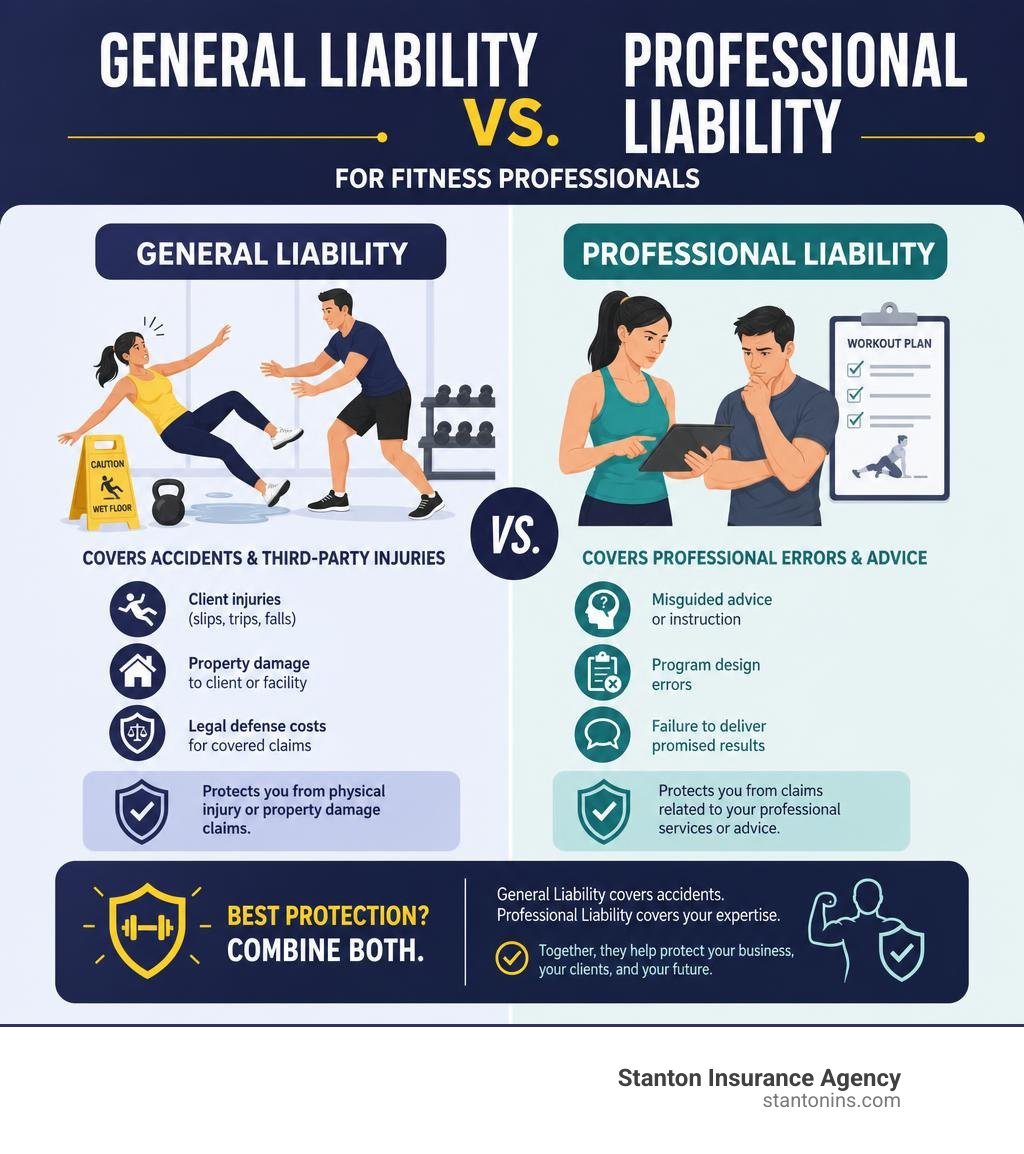
General Liability vs. Professional Liability
It is vital to understand the difference between General Liability and Professional Liability, as standard business policies often exclude one or the other.
- General Liability: This covers “slip-and-fall” accidents and general property damage. If a client slips on a wet spot near the water cooler in your studio, or trips over a yoga mat before class even begins, it falls under General Liability.
- Professional Liability (Errors & Omissions): This covers claims directly resulting from your professional instruction, advice, or training programs. If a client claims they suffered a torn ligament because you gave them poor form cues during a heavy squat, or because you designed an inappropriate progression, this is a professional error.
For personal trainers, having both of these coverages packaged together is non-negotiable. You can read more about how these dual coverages work in tandem in our guide on personal trainer liability insurance.
Additional Coverages to Consider
Depending on how you run your business, you may want to look for policies that offer these valuable add-on coverages:
- Product Liability: If you sell or recommend supplements, resistance bands, protein powders, or branded fitness equipment, this protects you if a client experiences an allergic reaction or gets injured by a defective product you supplied.
- HIPAA Violation Defense: If you store sensitive client health histories or intake forms digitally, a data breach could lead to severe penalties. Many policies offer up to $25,000 to cover legal defense costs for alleged HIPAA violations.
- Licensure Defense: If a client files a formal complaint against your personal training or health coaching credentials with a state licensing board, this coverage provides up to $25,000 for legal representation to protect your credentials.
- Subpoena Assistance: If you are subpoenaed to testify as a witness in a lawsuit involving a client (even if you aren’t the one being sued), this provides up to $10,000 to cover attorney fees to prepare you for depositions.
- Abuse and Molestation Defense: Regrettably, physical contact is common during hands-on form corrections. Many specialized policies include up to $100,000 in defense reimbursement to protect you against false allegations of misconduct.
- Identity Theft Protection: Some robust professional plans include up to $25,000 in identity restoration services to safeguard your personal finances.
Eligibility, Exclusions, and Virtual Training Limits
While insurance offers excellent protection, every policy has boundaries. Understanding who qualifies for coverage and what activities are excluded is critical to ensuring you don’t face a claim completely unprotected.

Eligible Activities and Acceptable Certifications
To qualify for standard, discounted fitness insurance programs, most carriers require you to hold an active certification from an accredited organization. Acceptable certifications include those that establish strict professional standards, require rigorous testing, and mandate annual continuing education. Examples of highly regarded certifying bodies include:
- National Academy of Sports Medicine (NASM)
- Athletics and Fitness Association of America (AFAA)
- American Council on Exercise (ACE)
- Yoga Alliance (for yoga teachers)
Holding these certifications demonstrates to underwriters that you utilize safe, industry-standard training methods. Eligible modalities under standard programs typically include traditional personal training, yoga, Pilates, Zumba, aerobics, and general group fitness. For instructors focusing primarily on movement and rhythm, you can explore specialized program limits through resources like the DANCE INSTRUCTOR guidelines.
Common Exclusions and Ineligible Activities
Standard fitness instructor policies are not designed for extreme sports or high-risk training styles. Common exclusions and ineligible activities typically include:
- Gymnastic Apparatuses, Tumbling, and Stunting: Standard policies do not cover trampoline training, high-level aerial silks, or gymnastics.
- Open Water Activities: Any training conducted in lakes, oceans, or open water is excluded.
- Coaching Competitive Teams: Standard policies cover individual fitness instruction, not coaching organized, competitive school or club sports teams.
- Age Limits: Many programs require the insured instructor to be at least 18 years of age.
- Facility Ownership: If you own or lease a commercial gym space larger than 3,000 square feet, a simple instructor policy is insufficient. You will need a full commercial property and general liability package.
Coverage for Virtual and Online Training
The rise of virtual coaching has transformed the fitness industry. Fortunately, modern fitness instructor policies often extend coverage to online training, but with important limitations:
- Private vs. Public Platforms: Coverage is generally active when you are instructing clients under direct supervision via private, password-protected platforms (such as Zoom, Skype, or private client portals).
- Public-Access Exclusions: If you post pre-recorded workout videos to public, unrestricted platforms like YouTube or Instagram without a formal client screening process, claims arising from those videos are typically excluded.
- Best Practices: To protect your online business, always require virtual clients to sign comprehensive waiver and release agreements before their first session, and conduct thorough digital health history assessments.
Cost Factors and How to Obtain Coverage
Protecting your business is surprisingly affordable. The cost of your premium is directly tied to your specific risk profile, but standard rates are within reach for any active professional.
How Much Does Fitness Instructor Liability Insurance Cost?
For independent instructors, basic professional and general liability coverage can start as low as $11 per month (or roughly $169 to $189 per year). If you are currently a student working toward your certification, you may qualify for highly discounted student rates as low as $65 per year.
Several key factors will influence your final premium:
- Location: Operating in high-density metropolitan areas like Boston, Massachusetts, or Nashua, New Hampshire, can slightly impact your rates compared to rural areas.
- Hours Worked & Revenue: Full-time trainers with high client volumes naturally carry more risk exposure than part-time weekend instructors.
- Experience & Claims History: A clean record with zero prior claims helps keep your rates at the absolute minimum.
If you are operating in the Bay State, you can explore local rate variations and requirements by reviewing Personal Trainer Insurance in Massachusetts or checking out the Massachusetts Personal Trainer Insurance Portal for local compliance insights.
How to Apply for and Choose the Right Policy
Obtaining coverage is a straightforward, digital process. When applying, you will typically fill out a brief online application detailing your certifications, training modalities, and business structure.
Once approved, you will receive an instant Certificate of Insurance (COI) via email. If you train clients at multiple local gyms, you can easily submit “additional insured” requests to add those specific facilities to your certificate, which extends your policy’s defense coverage to them if they are sued due to your negligence.
Many fitness policies are written through Risk Purchasing Groups (RPGs). Under this structure, individual professionals join a large group to purchase insurance from an A-rated carrier. This allows you to secure highly competitive rates while still receiving your own individual policy limits—meaning your coverage limits are completely separate and are not shared with or depleted by other members of the group. You can review typical program structures and enrollment forms by checking out the Fitness Instructors and Personal Trainers Insurance Program resource page.
Frequently Asked Questions about Fitness Instructor Insurance
Do I need my own insurance if I teach at a gym?
Yes, in almost all cases. Even if you are classified as a W-2 employee, your gym’s commercial policy is designed to protect the gym’s corporate entity first. If a client names you personally in a lawsuit, or if the gym’s policy limits are exhausted by a major claim, you could face significant personal exposure. If you operate as an independent contractor (1099), you are legally a separate business entity, and the gym’s policy will not cover you at all. To learn more about how to evaluate your gym’s policy, read this guide on whether your gym provides adequate fitness instructor insurance.
What is a general aggregate limit?
A general aggregate limit is the maximum amount your insurance carrier will pay out for all covered claims combined during a single policy period (usually one year). For example, if your policy has a $1,000,000 per-occurrence limit and a $3,000,000 general aggregate limit, the insurer will pay up to $1,000,000 for any single claim, and up to $3,000,000 total across all claims filed during that policy year.
Does fitness insurance cover outdoor classes?
Yes, standard policies generally cover you when instructing clients in outdoor settings like public parks, beaches, or athletic fields, provided you have the proper local permits to operate there. However, outdoor training introduces unique environmental risks. If a client suffers from a heat-related illness or dehydration during an outdoor boot camp, you could be held liable if you failed to provide adequate rest breaks or monitor weather conditions.
Conclusion
Your fitness business represents your passion, your hard work, and your livelihood. Do not let a single accidental injury or a groundless lawsuit derail everything you have built. Carrying a dedicated fitness instructor liability insurance policy ensures that you can focus on what you do best—helping your clients reach their goals safely and confidently.
At Stanton Insurance Agency, we specialize in providing trusted, local advice to business owners across Massachusetts and New Hampshire. We can help you navigate the nuances of professional liability, general liability, and specialized add-ons to build a policy that fits your business perfectly.
Ready to secure your business? Contact Stanton Insurance Agency today to speak with a local expert and get a customized quote tailored to your unique fitness business.
