
When ACA and Medicare Overlap: What You Need to Know Before You Turn 65
Understanding the relationship between aca and medicare is one of the most important steps you can take as you approach retirement age. Here is a quick summary:
ACA Marketplace vs. Medicare — At a Glance:
- Who each covers: ACA Marketplace plans cover people without employer or government insurance. Medicare covers Americans 65+ and certain people with disabilities.
- Can you have both? Generally no. It is illegal for anyone who knows you have Medicare to sell you a Marketplace plan.
- Do subsidies continue? No. Premium tax credits stop once you are eligible for premium-free Medicare Part A.
- What should you do at 65? Enroll in Medicare during your 7-month Initial Enrollment Period and cancel your Marketplace plan to avoid penalties and repayment of subsidies.
Millions of Americans rely on ACA Marketplace coverage before turning 65 — but the rules change dramatically once Medicare eligibility kicks in. Miss the transition window and you could face permanent premium penalties, unexpected tax bills, and coverage gaps that are hard to undo.
The two programs do not work in parallel the way you might expect. They operate under completely separate rules, different enrollment calendars, and distinct cost structures. Getting the timing wrong is surprisingly easy — and surprisingly costly.
I’m Geoff Stanton, President of Stanton Insurance Agency in Waltham, Massachusetts, and I’ve helped many clients navigate the intersection of aca and medicare coverage as part of building a complete protection plan for their families. In the sections below, I’ll walk you through everything you need to know to make this transition smoothly and avoid the most common — and most expensive — mistakes.
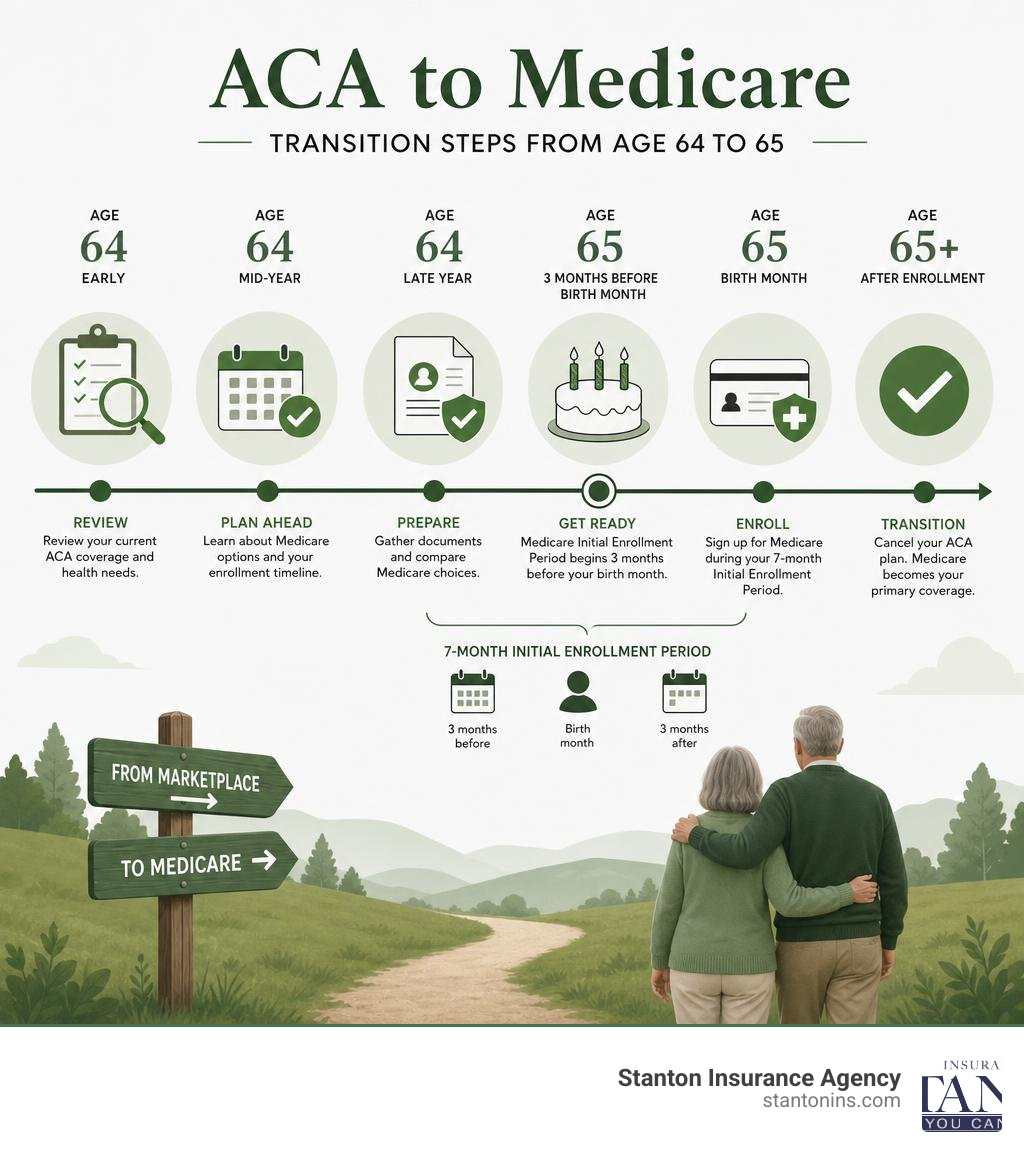
Navigating the Intersection of ACA and Medicare

When the Affordable Care Act (ACA) was signed into law, it revolutionized how millions of Americans secured health insurance. By early 2024, more than 20.8 million people had effectuated coverage through the ACA Marketplaces—more than tripling enrollment since 2014. By 2023, the national uninsured rate had dropped to a historic low of 7.7%, thanks in large part to ACA expansions, including Medicaid and subsidized Marketplace plans.
However, as you approach age 65, the ground beneath your feet shifts. The ACA Marketplace and Medicare are designed to be mutually exclusive for the vast majority of beneficiaries. The Marketplace is designed for individuals who lack access to other form of “minimum essential coverage,” while Medicare is a comprehensive federal program for seniors and those with specific disabilities.
If you are transitioning from an individual plan, you must understand that Medicare is not simply another plan on the exchange. It is a completely separate system. To understand how these two massive frameworks interact—and how to avoid paying double for coverage—it is helpful to look directly at the official guidelines on Medicare & the Marketplace.
Legal Restrictions on Combining ACA and Medicare
Can you simply keep your ACA plan because you like your doctor and want to avoid the hassle of switching? The short answer is no, and the law is very clear on this.
Under Section 1882(d) of the Social Security Act, it is strictly illegal for anyone to knowingly sell or issue an individual Marketplace Qualified Health Plan (QHP) to someone who is already enrolled in or eligible for Medicare. This anti-duplication provision is designed to protect consumers from paying for overlapping coverage that provides no additional benefit.
According to the Frequently Asked Questions Regarding Medicare and the Marketplace August 1, 2014 published by the Centers for Medicare & Medicaid Services (CMS), there are very few exceptions to this rule:
- The SHOP Exception: If you are covered under an employer-sponsored plan purchased through the Small Business Health Options Program (SHOP), you are exempt from the individual duplicate coverage prohibition. This is because SHOP coverage is treated as group employer coverage, where Medicare Secondary Payer rules apply.
- Premium Part A Buyers: If you do not qualify for premium-free Medicare Part A (typically because you or your spouse did not work the required 40 quarters in the U.S.), you have the option to decline premium-paying Part A and Part B to purchase or keep an ACA plan instead. However, doing so means you may face permanent late enrollment penalties if you decide to sign up for Medicare later.
- End-Stage Renal Disease (ESRD): Medicare enrollment for individuals with ESRD is voluntary. If you have ESRD and have not yet enrolled in Medicare, you can legally purchase and maintain an ACA Marketplace plan with subsidies.
For the general public, trying to maintain both plans is a financial disaster. If you keep your Marketplace plan after your Medicare coverage starts, you will lose all premium tax credits and cost-sharing reductions. You will have to pay the full, unsubsidized retail price for your ACA plan, and your insurance carrier may automatically terminate your coverage once they discover you are on Medicare.
Key Differences in Benefits Under ACA and Medicare
The benefit structures of these two programs differ significantly. Under the ACA, all plans must cover ten “Essential Health Benefits,” including maternity care, pediatric services, and mental health treatments.
Medicare, on the other hand, is divided into different parts:
- Part A (Hospital Insurance): Covers inpatient hospital stays, care in a skilled nursing facility, hospice care, and some home health care.
- Part B (Medical Insurance): Covers certain doctors’ services, outpatient care, medical supplies, and preventive services.
- Part C (Medicare Advantage): Private plans that bundle Parts A, B, and usually D, often offering extra benefits like dental, vision, and hearing.
- Part D (Prescription Drug Coverage): Private plans that help cover the cost of prescription drugs.
While the ACA standardizes out-of-pocket maximums for all compliant plans, Original Medicare (Parts A and B) has no annual out-of-pocket limit. This is why many seniors choose to purchase Medicare Supplement (Medigap) policies or transition to Medicare Advantage plans to cap their financial exposure.
The ACA has also greatly improved Medicare’s benefits. For example, the ACA phased out the infamous Part D “doughnut hole” coverage gap and eliminated coinsurance and deductibles for key preventive services, such as annual wellness visits, cancer screenings, and cardiovascular evaluations. You can read more about how these consumer protections carry over in the guide on Medicare Coverage and the Affordable Care Act.
The 7-Month Transition Window and Avoiding Penalties
The transition from an ACA plan to Medicare is governed by a strict timeline. This is known as your Initial Enrollment Period (IEP). Your IEP is a 7-month window centered around your 65th birthday:
- Three months before the month you turn 65.
- The month you turn 65.
- Three months after the month you turn 65.
To prevent any gaps in coverage, we strongly recommend signing up during the first three months of your IEP. This ensures your Medicare coverage starts on the first day of your birthday month.
| Enrollment Period | Timing | Impact on Coverage & Penalties |
|---|---|---|
| Initial Enrollment Period (IEP) | 7-month window around your 65th birthday | No penalties. Coverage starts smoothly on your birthday month if you enroll early. |
| General Enrollment Period (GEP) | January 1 – March 31 annually | Coverage starts the month after you sign up. Subject to permanent late enrollment penalties if you missed your IEP. |
| Special Enrollment Period (SEP) | Triggered by qualifying life events (e.g., losing employer group coverage) | Allows enrollment outside standard windows without penalty. Note: Losing ACA coverage does not trigger a Medicare SEP. |
Part B and Part D Late Enrollment Penalties
Many early retirees who have managed their Modified Adjusted Gross Income (MAGI) to secure high ACA subsidies make the mistake of delaying Medicare enrollment because they prefer their Marketplace plan’s costs. This is a highly risky move.
Unlike the ACA, which no longer enforces a federal individual mandate tax penalty, Medicare penalizes late enrollment severely—and these penalties are permanent.
- Part B Late Penalty: For every 12-month period you were eligible for Part B but did not enroll, your monthly premium increases by 10% permanently. In 2026, the standard Part B premium is $185 per month. If you delay enrollment for two years, you will pay an extra $37 every single month for the rest of your life.
- Part D Late Penalty: If you go 63 days or more without “creditable” drug coverage after your IEP ends, you will face a permanent penalty of 1% of the national base beneficiary premium ($36.78 in 2026) per month of delay.
It is vital to note that individual ACA Marketplace drug coverage is not automatically considered creditable for Medicare Part D. Private insurers must determine annually whether their plans meet Medicare’s standards and notify you in writing. If your ACA drug coverage is not creditable, those months will count toward a permanent Part D penalty. To understand how these rules collide for early retirees, check out ACA to Medicare at 65: The 7-Month Window That Costs Early.
How to Cancel Your Marketplace Plan Safely
Your ACA coverage will not automatically end when your Medicare begins. You must take proactive steps to cancel your Marketplace plan to avoid a costly overlap where you are paying for both, or worse, receiving illegal tax subsidies that you must repay when you file your taxes.
To transition smoothly:
- Wait for confirmation: Do not cancel your ACA plan until you have received your red, white, and blue Medicare card and confirmed your start date.
- Log in to your account: Go to HealthCare.gov or your state-run exchange and report a life change. Set your ACA termination date for the day before your Medicare coverage becomes active.
- Handle multi-person households: If your spouse or children are on your Marketplace plan and need to stay on it, do not cancel the entire policy. Instead, update your application to remove yourself while keeping your family members enrolled.
For step-by-step instructions on ending your exchange plan, visit Changing from Marketplace to Medicare | HealthCare.gov.
Impact of Recent Legislation on Healthcare Costs
The landscape of public and private health insurance is shifting rapidly as we navigate the middle of 2026. The passage of the 2025 Budget Reconciliation Act has introduced sweeping changes to federal spending, eligibility rules, and subsidy structures across Medicare, Medicaid, and the ACA.
The Congressional Budget Office (CBO) expects the cost of federal Marketplace subsidies and related programs to total $1.32 trillion from 2025 through 2034. However, with the spending cuts outlined in the 2025 legislation, the Center on Budget and Policy Priorities estimates that up to 15 million more people could find themselves without health insurance by 2034.
These macro-level policy shifts have real-world consequences for older adults transitioning between systems. Longitudinal research has shown that adults with continuous health insurance coverage in midlife experience better health outcomes and lower out-of-pocket costs when they finally age into Medicare at 65. To understand how prior coverage impacts your long-term health and costs, you can explore the detailed study on Health Care Utilization and Costs for Older Adults Aging Into Medicare After the Affordable Care Act – PMC.
Changes to Medicaid and Medicare Subsidies
The 2025 Budget Reconciliation Act has introduced stricter eligibility standards that directly affect low-income seniors and dual-eligible individuals:
- Medicaid Work Requirements: Starting January 1, 2027, able-bodied Medicaid recipients ages 19–64 must complete and verify 80 hours per month of work, community service, or education. While this does not apply to those over 65, it creates a massive administrative hurdle for early retirees on Medicaid who are approaching Medicare age.
- Low-Income Subsidy (LIS) Reductions: About 40% of Medicare beneficiaries rely on Part D Low-Income Subsidies (also known as “Extra Help”) to pay for their prescriptions. The 2025 law reduces federal funding for these subsidies, leading to higher out-of-pocket prescription costs for low-income seniors.
- Medicaid Asset Caps: Stricter asset limits are making it harder for low-income seniors to qualify for Medicare Savings Programs (MSPs), which help pay for Part B premiums and deductibles.
Marketplace Premium Trends in 2026
For those who are not yet 65 and are still relying on the ACA Marketplace, budgeting has become more challenging. In 2025, benchmark premiums on the Marketplace rose by an average of 4%, driven by inflation and the rising cost of specialty drugs.
Furthermore, the enhanced premium tax credits originally introduced during the pandemic are facing expiration. Without these enhanced subsidies, average premiums for individual Marketplace plans are projected to rise significantly, making the transition to Medicare at age 65 even more of a financial relief for qualifying seniors.
State-Specific Marketplace Rules for Massachusetts and New Hampshire

At Stanton Insurance Agency, we proudly serve clients across Massachusetts and New Hampshire. Because the ACA allows states to run their own exchanges or rely on the federal platform, the transition process looks slightly different depending on which side of the state line you call home.
Massachusetts Health Connector Guidelines
Massachusetts operates its own state-based exchange, the Massachusetts Health Connector. The Commonwealth also enforces its own individual mandate, meaning residents must maintain minimum essential coverage or face a state tax penalty.
Key details for Massachusetts residents:
- ConnectorCare: This state-subsidized program offers low- or no-cost plans to residents with incomes up to 500% of the Federal Poverty Level (FPL). If you are enrolled in ConnectorCare, your subsidies will end the moment you become eligible for premium-free Medicare Part A.
- Local Transition Support: The Health Connector provides local navigators to help you transition. Because Massachusetts has unique state laws regarding Medigap plans (which are continuously open for enrollment and do not use medical underwriting), transitioning to Medicare can offer excellent, flexible supplemental coverage.
To explore local plans and state-specific transition rules, visit the Massachusetts Health Insurance Marketplace: 2026 ACA Coverage.
New Hampshire Marketplace Options
Unlike Massachusetts, New Hampshire uses the federal HealthCare.gov platform to facilitate its marketplace, though it maintains state-level oversight of its insurance products.
Key details for New Hampshire residents:
- Plan Offerings: Granite Staters can choose from several private carriers on the federal exchange.
- Medicaid Expansion: New Hampshire has expanded Medicaid, covering adults up to 138% of the FPL. If you are on expanded Medicaid, you must transition to Medicare when you turn 65, as Medicaid becomes the secondary payer.
- Medigap Rules: Unlike Massachusetts, New Hampshire Medigap plans generally use medical underwriting if you apply outside of your initial 6-month Medigap Open Enrollment Period. This makes it absolutely critical to time your transition perfectly to secure supplemental coverage without being denied for pre-existing conditions.
For more details on navigating the Granite State’s platform, see New Hampshire’s Federally Facilitated Health Insurance Marketplace.
Frequently Asked Questions About Medicare and the Marketplace
Can I keep my Marketplace plan if I am eligible for Medicare?
Technically, yes, but it is almost never a good idea. Once you become eligible for premium-free Medicare Part A, you lose eligibility for any ACA premium tax credits or cost-sharing reductions. This means you will have to pay the full, unsubsidized price for your Marketplace plan.
Additionally, because of anti-duplication laws, your insurance company is permitted to terminate your individual Marketplace policy once they learn you have Medicare. Keeping both plans will result in paying double for coverage without receiving double benefits, as the plans do not coordinate coverage.
What is the 2026 Part D out-of-pocket cap?
Starting in 2025 and continuing into 2026, a major consumer protection cap has been placed on Medicare Part D. Your annual out-of-pocket costs for covered prescription drugs are capped at $2,100.
Once you reach this limit, you will pay $0 for your covered Part D drugs for the rest of the calendar year. This is a massive benefit that outpaces most private individual marketplace plans. For full details on this cap and other 2026 updates, you can refer to the official Medicare and You Handbook 2026.
Does Medicare Part B count as Minimum Essential Coverage?
No. Medicare Part B alone does not constitute Minimum Essential Coverage (MEC) under the ACA. To meet the MEC requirements (which are still relevant for state taxes in Massachusetts), you must have Medicare Part A, a Medicare Advantage Plan (Part C), or be enrolled in both Parts A and B.
If you only enroll in Part B and do not have Part A, you could technically be subject to state-level tax penalties in Massachusetts, and you will lack critical hospital coverage.
Conclusion
Navigating the transition from the ACA Marketplace to Medicare does not have to be a headache. By understanding the strict timeline of your 7-month Initial Enrollment Period, recognizing the legal boundaries of dual enrollment, and knowing your state’s specific guidelines, you can protect both your health and your retirement savings.
At Stanton Insurance Agency, we specialize in helping residents of Massachusetts and New Hampshire build comprehensive protection plans for their valuable assets—and that includes your health and financial well-being. Whether you are transitioning to Medicare, looking for a supplemental Medigap policy, or trying to coordinate coverage for a younger spouse who still needs an ACA plan, we are here to provide trusted, personalized guidance.
Don’t let the transition catch you off guard. Get a Personal Health Insurance Quote or contact us today to speak with a local expert who can guide you through the process step-by-step.
