How Much Does Renters Insurance Really Cost?
Renters insurance policy cost is lower than most people expect. Here is a quick summary of what you can expect to pay:
| Coverage Level | Monthly Cost | Annual Cost |
|---|---|---|
| Basic ($10k property / $100k liability) | ~$11-$13/mo | ~$112-$133/yr |
| Standard ($30k property / $100k liability) | ~$13-$23/mo | ~$151-$170/yr |
| Robust ($40k property / $300k liability) | ~$22-$25/mo | ~$263/yr |
| Massachusetts average | ~$11-$14/mo | ~$133-$168/yr |
| New Hampshire average | ~$11-$12/mo | ~$129-$145/yr |
Most renters are surprised to find out just how affordable this protection is. For less than the cost of a streaming subscription, you can cover your personal belongings, protect yourself from liability, and even pay for a hotel if your apartment becomes uninhabitable.
Yet a significant number of renters skip coverage entirely — often because they assume it costs far more than it does.
The reality? A standard policy in Massachusetts or New Hampshire typically runs $11 to $14 per month. Even a more robust policy with higher property and liability limits rarely breaks $25 per month.
That said, the exact price you pay depends on several factors — where you live, how much coverage you choose, your deductible, your credit history, and more. Understanding those factors helps you find the right policy without overpaying.
I’m Geoff Stanton, President of Stanton Insurance Agency and a Certified Insurance Counselor (CIC) with over two decades of experience helping Massachusetts and New Hampshire residents understand renters insurance policy cost and find coverage that fits their budget. In this guide, I’ll walk you through everything that drives your premium — and how to get the most protection for your dollar.
Quick Renters insurance policy cost terms:
Breaking Down the Average Renters Insurance Policy Cost
When we look at the national landscape in May 2026, the average renters insurance policy cost across the United States sits at approximately $170 to $180 per year. However, “average” can be a bit misleading because insurance is highly localized. In some states, such as Louisiana, renters might pay over $300 annually due to high risks of natural disasters.
Fortunately for those of us in the Northeast, our rates tend to be much more favorable. In Massachusetts, the average annual cost is roughly $133 to $168. In New Hampshire, it is even lower, often averaging around $129 to $145 per year. This makes renters insurance one of the most cost-effective financial safety nets available.
To put this in perspective, let’s compare it to homeowners insurance. While a homeowner in 2026 might pay an average of $2,424 per year to protect their dwelling and property, a renter only pays a fraction of that. This is because, as a renter, you aren’t responsible for the physical structure of the building—your landlord is. You are only paying to protect what’s inside and your personal liability.
For a deeper dive into these numbers, you can check out the Average Cost of Renters Insurance in 2026 | Bankrate or read our own breakdown on how much is renters insurance.
Regional Variations: Why Location Matters
Even within Massachusetts and New Hampshire, your specific ZIP code plays a starring role in determining your premium. Insurance companies aren’t just looking at your state; they are looking at the statistical likelihood of a claim in your neighborhood.
- Crime Rates: If you live in an area with a higher frequency of reported thefts or burglaries, your premium will likely reflect that increased risk.
- Weather Risks: While we don’t deal with many hurricanes compared to the Gulf Coast, coastal areas in Massachusetts may face higher rates due to storm surge or winter “nor’easter” risks.
- Proximity to Fire Services: Believe it or not, living near a fire station or having a fire hydrant right outside your building can actually lower your renters insurance policy cost.
Whether you are looking for Massachusetts renters insurance or New Hampshire renters insurance, we always recommend getting a localized quote to see how your specific neighborhood impacts your rate.
How Coverage Limits Influence Your Renters Insurance Policy Cost
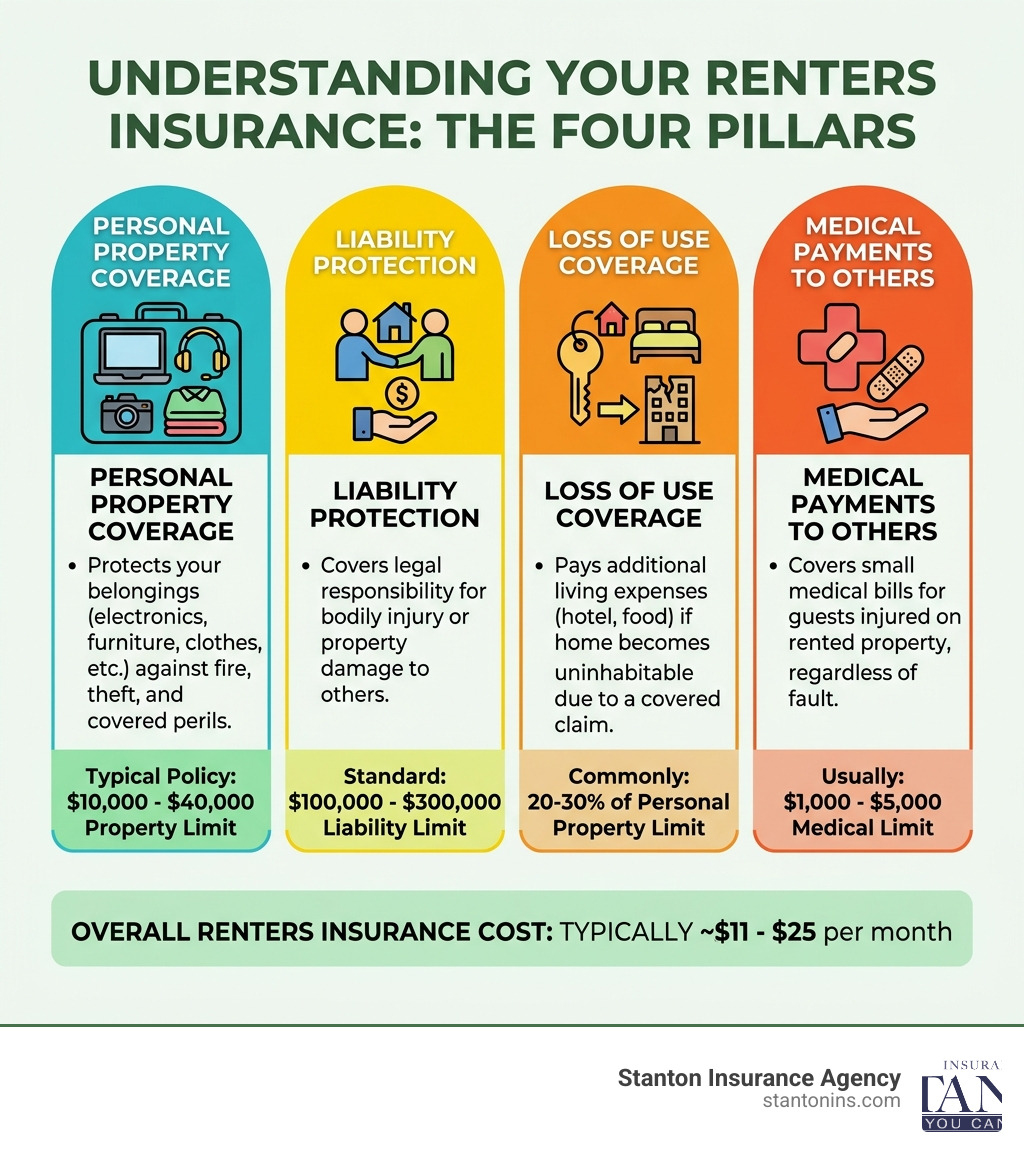
The “how much” of your policy is the biggest lever you can pull to change the price. Most policies are built on four main types of coverage:
- Personal Property: This is the dollar amount needed to replace your stuff. Most people start at $10,000 or $15,000, but if you have a lot of electronics or high-end furniture, you might need $30,000 or more.
- Liability: This protects you if someone sues you for injury or property damage. A standard limit is $100,000, but increasing this to $300,000 is surprisingly cheap—often costing only about $1 more per month.
- Loss of Use: Also known as Additional Living Expenses (ALE), this pays for hotel stays and extra food costs if a fire or burst pipe makes your apartment unlivable.
- Medical Payments: This covers small medical bills if a guest is injured in your home, regardless of who is at fault.
Choosing the right balance is key. If you want to understand what the bare essentials look like, see our guide on minimum coverage renters insurance.
Key Factors That Determine Your Monthly Premium
Beyond just the limits you choose, several structural and policy-level decisions will dictate your final bill.
Deductibles: The Out-of-Pocket Factor
Your deductible is the amount you pay out of pocket before the insurance company kicks in. Common deductibles are $500 or $1,000. If you choose a higher deductible, you are taking on more risk yourself, which means the insurance company will reward you with a lower monthly premium. However, we always caution our clients: don’t pick a $1,000 deductible if you don’t have $1,000 in savings ready to go for an emergency.
ACV vs. RCV: How You Get Paid
This is a critical distinction that affects your renters insurance policy cost and your satisfaction during a claim.
| Feature | Actual Cash Value (ACV) | Replacement Cost Value (RCV) |
|---|---|---|
| Cost | Lower monthly premium | ~10-15% higher premium |
| Payout | Depreciated value (old price) | Cost of a brand-new item today |
| Example | $200 for a 5-year-old laptop | $1,200 for a new equivalent laptop |
While ACV is cheaper, most experts (ourselves included) recommend RCV. It ensures that if your five-year-old TV is stolen, you actually get enough money to buy a new one, rather than just getting a check for its “garage sale” value. For more on how these choices impact your wallet, check out our article unpacking renters insurance costs.
Building Type and Safety Features
Where you live matters just as much as what you own.
- High-Rise vs. Single-Family: High-rise apartment buildings often have lower rates because they have 24/7 security, sprinklers, and fire-resistant construction. A single-family rental home might be more susceptible to theft or fire, leading to a slightly higher premium.
- Building Age: Newer buildings with updated wiring and plumbing are generally cheaper to insure than historic New England brownstones.
According to data from Insure.com, these structural factors can shift your premium by 5% to 10%.
Personal Factors and the Renters Insurance Policy Cost
Your personal history is also part of the math. Insurance companies look at claims history—if you’ve filed three theft claims in the last five years, your rate will likely be higher because you are statistically more likely to file another.
Credit-Based Insurance Scores are another major factor in many states. Statistically, there is a correlation between credit health and insurance risk. However, there is a very important exception for our local clients: Massachusetts prohibits the use of credit scores in setting renters insurance prices. If you are in New Hampshire, your credit score may still play a role, but in the Bay State, your premium is based on other factors.
Finally, let’s talk about our four-legged friends. Some insurance companies have dog breed restrictions. If you own a breed that is statistically categorized as “high risk” for bites, you might see a higher liability premium, or you might need a specific rider to ensure you are covered. You can learn more about how this works in our guide to personal liability insurance for renters.
Maximizing Savings with Discounts and Bundles

Just because renters insurance policy cost is already low doesn’t mean you shouldn’t try to make it lower! There are several ways to shave dollars off your premium:
- Bundling: This is the king of discounts. If you buy your renters insurance from the same company that insures your car, you can often save 5% to 25% on both policies. In some cases, the discount on your auto insurance is so large that the renters policy effectively pays for itself.
- Safety Devices: Does your apartment have smoke detectors? A fire extinguisher? A deadbolt on the front door? Most companies offer small discounts for these basic safety features. If you have a professionally monitored security system, the savings can be even more significant.
- Pay in Full: Paying your annual premium in one lump sum usually removes the $1 to $5 “installment fee” that companies charge for monthly billing.
- Paperless Billing: Going green can save you a few dollars a year in administrative fees.
For more tips on keeping your rates down, see our resource on affordable renters insurance. You can also see how rates are trending nationally via NerdWallet.
Protecting High-Value Items and Estimating Your Needs

A standard renters policy has “sub-limits” for certain categories of items. For example, even if you have $30,000 in total property coverage, the policy might only pay out a maximum of $1,500 for jewelry or $2,500 for electronics in the event of a theft.
If you have an engagement ring, a professional camera setup, or a high-end musical instrument, you should look into Scheduled Personal Property (also called a “rider” or “floater”).
- Cost: Usually about $1 to $2 for every $100 of value.
- Benefit: No deductible applies to these items, and they are covered for a broader range of risks (like accidentally leaving your ring in a hotel room).
To figure out how much coverage you actually need, we recommend doing a “digital home inventory.” Walk through your apartment with your phone and record a video of every drawer, closet, and shelf. It makes estimating the total value much easier and provides vital evidence if you ever need to file a claim. For a full list of what is usually included, check our page on renters insurance coverage.
Frequently Asked Questions about Renters Insurance Costs
Why is renters insurance so much cheaper than homeowners insurance?
The primary reason is the scope of coverage. A homeowners policy has to cover the actual “bricks and mortar”—the roof, the foundation, the walls, and the garage. Replacing a house costs hundreds of thousands of dollars. As a renter, your landlord’s insurance covers the building. Your policy only covers your “stuff” and your liability, which represents a much lower risk for the insurance company. You can find more details on this in our section on apartment insurance.
Does my roommate’s property affect my premium?
Generally, no. We almost always recommend that roommates have their own separate policies. While it is technically possible to share a policy in some states, it can get messy. If your roommate files a claim, it goes on your insurance record too. Keeping separate policies ensures your renters insurance policy cost stays tied to your own history and belongings. For those new to the rental market, our first-timers handbook explains this in detail.
How can I accurately estimate the value of my belongings?
Don’t just guess! Most people underestimate the value of their “boring” stuff—clothes, towels, kitchen appliances, and linens. These add up quickly. Use an inventory app or a simple spreadsheet. Group items by category (e.g., “Bedroom Furniture,” “Kitchenware”) and estimate what it would cost to buy them brand new today. This ensures you aren’t underinsured. For more on this, see what renters insurance covers.
Conclusion
At the end of the day, the renters insurance policy cost is a small price to pay for the massive peace of mind it provides. Whether you are renting a studio in Boston or a house in Concord, NH, protecting your hard-earned assets is a fundamental part of financial health.
At Stanton Insurance Agency, we pride ourselves on being more than just a quote engine. We are local experts who live and work in the same communities you do. We understand the specific regulations in Massachusetts and New Hampshire, and we’re here to help you navigate the options to find a policy that fits your life perfectly.
Don’t leave your future to chance. Protect your belongings with a renters insurance policy today and sleep better tonight knowing we’ve got your back.