
What is D&O Insurance 101: Crucial Shield
Why D&O Insurance Is Critical for Protecting Your Personal Assets
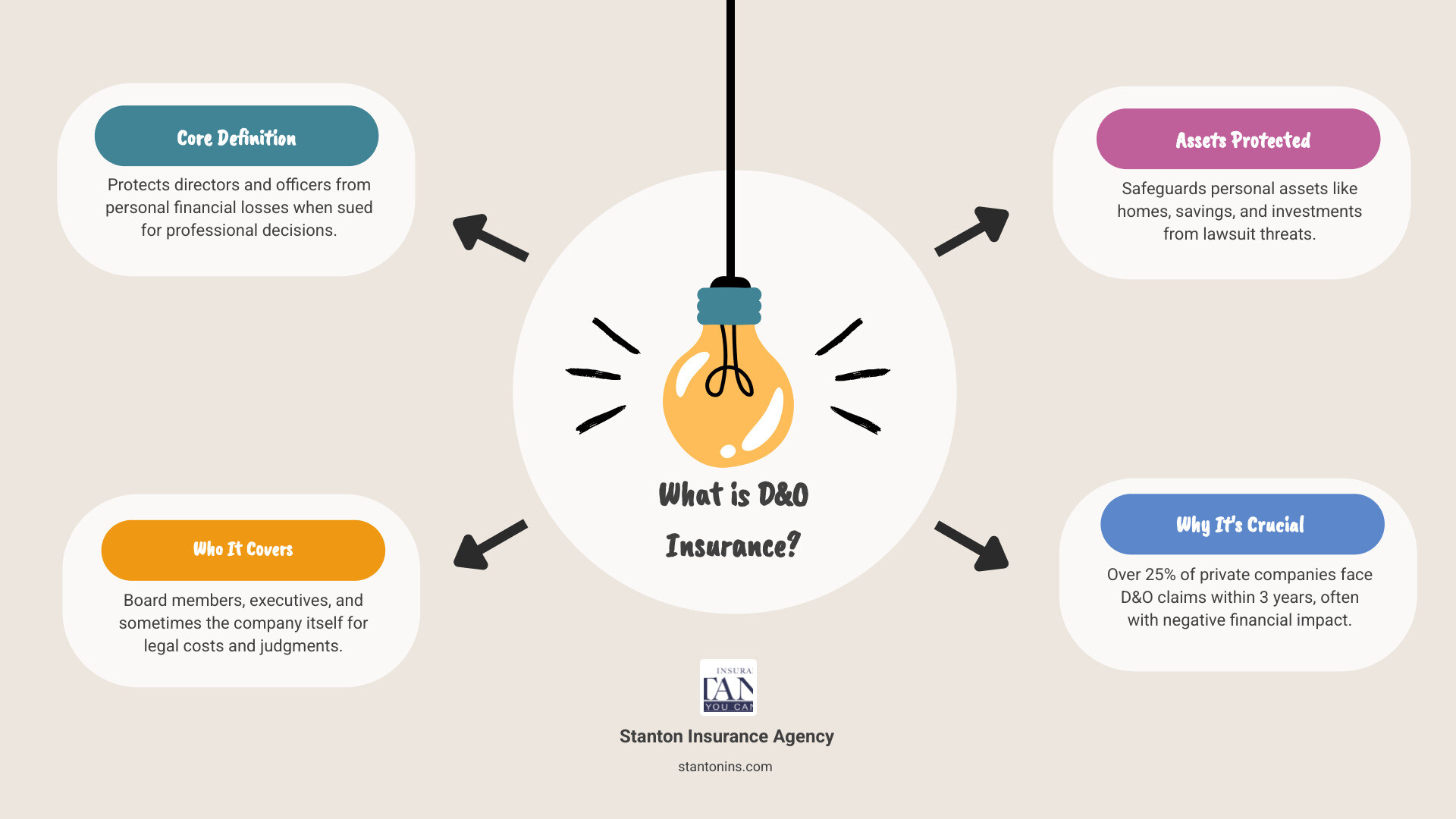
What is D&O insurance is a question every business leader should ask before accepting a director or officer position. Directors and Officers (D&O) liability insurance protects company leaders from personal financial losses when they’re sued for decisions made in their professional capacity.
Quick Answer for D&O Insurance:
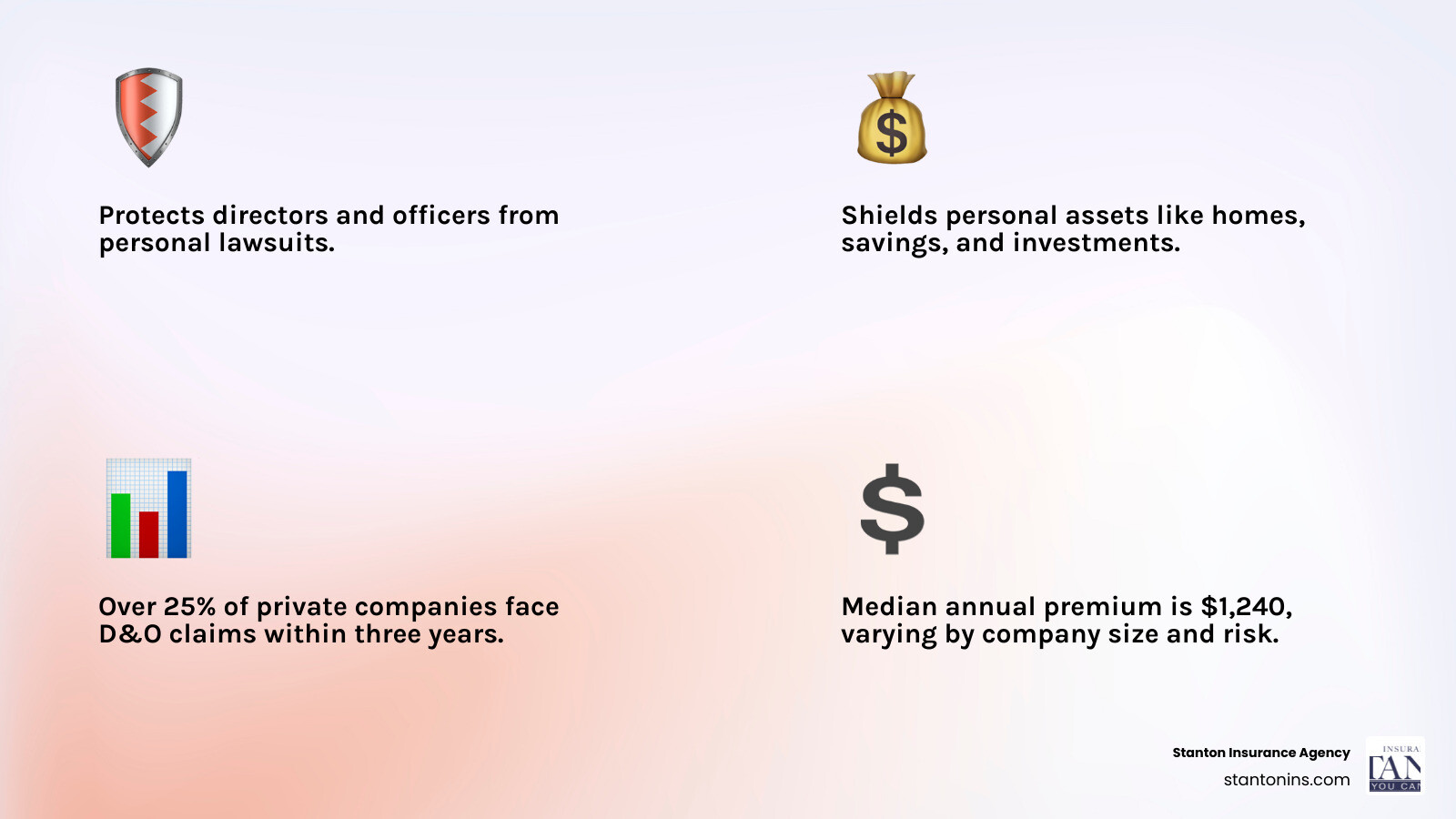
- What it is: Insurance that protects directors and officers from personal lawsuits
- Who it covers: Board members, executives, and sometimes the company itself
- What it protects: Personal assets like homes, savings, and investments
- Why it matters: More than 25% of private companies face D&O claims within three years
- Cost: Median annual premium is $1,240, but varies widely by company size and risk
The statistics are sobering. Research shows that more than 25% of private companies reported a D&O loss over three years, with 96% suffering negative financial impact. For nonprofits, the average claim costs $35,000 to settle, with one in ten claims reaching $100,000 before settlement.
This isn’t just about big corporations either. Private companies face lawsuits from customers, vendors, and competitors for issues like unfair trade practices or employment violations. Nonprofits get sued by donors, beneficiaries, and regulators over fund mismanagement or mission failures.
I’m Geoff Stanton, President of Stanton Insurance Agency, and I’ve helped countless Massachusetts and New Hampshire businesses understand what is D&O insurance and secure proper coverage for their leadership teams. Having worked in insurance for over two decades, I’ve seen how D&O claims can devastate unprepared organizations and their leaders.
What is d&o insurance definitions:
What is Directors & Officers (D&O) Liability Insurance?
Picture yourself serving on a board of directors. You’ve spent years making careful decisions, always believing you’re acting in the company’s best interest. Then one day, a lawsuit arrives with your name on it—not just as a representative of the company, but as a personal defendant. Your house, your retirement savings, even your children’s college fund could be at risk.
This scenario plays out more often than most leaders realize. It’s exactly why Directors & Officers (D&O) liability insurance exists, and understanding what is D&O insurance could be the difference between financial security and personal ruin.
What is D&O insurance? Simply put, it’s specialized protection designed to shield company leaders from personal financial catastrophe. This coverage steps in when directors or officers face lawsuits related to their leadership decisions. Unlike your typical business insurance that covers slip-and-fall accidents or property damage, D&O insurance protects against claims of mismanagement, breach of fiduciary duty, and other “wrongful acts” that executives might face.
Think of D&O insurance as a financial bodyguard for your leadership team. When someone alleges that a director made a poor decision that cost money, or that an officer failed in their duties, this insurance covers the legal bills, settlements, and court judgments that follow.
The protection works in two key ways. First, it can pay defense costs, settlements, and judgments directly to protect the individual leader’s personal assets. Second, it can reimburse the company when the organization pays these costs on behalf of its executives.
Who might sue your directors and officers? The list is longer than most people expect. Shareholders and investors might claim poor financial decisions hurt their returns. Employees could allege wrongful termination or harassment. Customers and vendors might pursue claims over business practices they consider unfair. Even competitors and government regulators can initiate lawsuits that put your leadership team in legal jeopardy.
Here’s what makes D&O insurance different from other business coverage: it’s specifically designed for the unique risks that come with making executive decisions. While your General Liability policy handles someone getting injured on your property, your D&O policy handles someone claiming your CEO’s strategic decision was negligent or your board’s vote violated fiduciary duties.
The core mission is straightforward but crucial—ensuring that a leader’s personal wealth isn’t destroyed by their professional responsibilities. Without this protection, serving in leadership becomes a gamble with your family’s financial future. With it, qualified executives can focus on growing the business instead of worrying about personal liability.
Who Needs D&O Insurance and Why Is It Crucial?

You might think that what is D&O insurance for is only for the big, publicly traded companies you read about in the news. It’s a common thought! But here’s the surprising truth: organizations of all shapes and sizes are vulnerable to D&O lawsuits. In fact, statistics show that over 25% of private companies faced a D&O claim within just three years, and almost all of them (96%) felt a negative financial hit. This isn’t just a “big company” problem; it’s a “any company with a board or leadership team” problem.
What types of organizations need D&O Insurance?
Let’s break down who really benefits from this crucial protection:
-
Public Companies: These are often front and center for shareholder lawsuits. Think claims related to stock performance, how financial information is shared, or big mergers. With so many eyes on them and strict federal rules, D&O coverage isn’t just nice to have; it’s absolutely essential. Back in 2011, a survey found that nearly 70% of public companies had faced a shareholder lawsuit in the previous decade. That’s a huge risk!
-
Private Companies: Don’t let the “private” part fool you. While they might not have public shareholders, private businesses are far from immune. Lawsuits can pop up from all sorts of places: competitors claiming unfair practices, customers unhappy with a product, creditors, or even employees suing for things like wrongful termination. A 2011 survey showed that about 1 in 5 private companies also experienced a shareholder lawsuit. For a smaller company, a single lawsuit, which can cost an average of over $300,000, could be truly devastating.
-
Nonprofit Organizations: These mission-driven groups do so much good, but their leaders face unique risks too. Nonprofits can be sued by donors, people they serve, volunteers, or even government agencies. These claims often involve questions of how funds were managed or if the organization stayed true to its mission. With about 1.5 million nonprofits across the U.S., the potential for claims is very real. The average D&O claim against a nonprofit costs around $35,000 to settle, and alarmingly, one in ten claims can reach $100,000 before it’s settled. That’s why Stanton Insurance Agency offers specialized Insurance For Nonprofit Organizations to help these vital groups.
Beyond simply protecting assets, D&O insurance plays another huge role: it helps you attract and keep the best talent. Think about it: highly qualified executives and board members are naturally hesitant to put their personal assets on the line just to serve an organization. Offering robust Board Member Insurance sends a clear message. It shows that your company truly values its leadership and is committed to protecting them. It’s a signal that you stand behind your leaders, giving them the confidence to make those tough, necessary decisions without the constant fear of personal financial ruin.
Decoding Your D&O Policy: Coverage, Exclusions, and How It Works
Now that we understand what is D&O insurance and why it’s so vital, let’s pull back the curtain and look at the inner workings of a D&O policy. Understanding its key components – what it covers, what it doesn’t cover, and its unique operational structure – is absolutely essential. This knowledge empowers you to ensure your organization and its leaders have the precise protection they need, without any unwelcome surprises down the road.
What does D&O insurance cover?
At its heart, D&O insurance is designed to cover the financial fallout from what are called “wrongful acts.” While the precise definition can vary slightly from one policy to another, it generally steps in when allegations arise regarding actions taken by directors and officers in their leadership roles.
This includes claims of Breach of Fiduciary Duty, which means failing to act in the best interest of the company or its stakeholders. It also covers Negligence, Errors, and Omissions – basically, honest mistakes or oversight in management decisions. If there are accusations of Misleading Statements and Misrepresentation, like providing inaccurate financial reports or making untrue statements, D&O can help.
Beyond that, it can cover claims related to a Failure to Adhere to Company Bylaws or Regulations, ensuring compliance with internal rules or external laws. Even allegations of Wrongful Interference with a Contract, where actions improperly disrupt business agreements, fall under its umbrella. And, importantly, D&O policies often address claims of Lack of Corporate Governance, meaning a failure to implement proper oversight or internal controls.
Perhaps one of the most significant areas of coverage you’ll find is for Employment Practices Liabilities. This includes serious allegations such as wrongful termination, discrimination, harassment, or retaliation. In fact, for many organizations, a staggering 94% of the claims dollars paid out under a D&O policy emanate from employment practices allegations, making this a truly significant area of exposure. The policy ultimately covers the types of financial losses that directors and officers might be liable for, including the crucial defense costs, settlements, and any court-ordered judgments. For a more detailed look at what’s covered, we have a whole guide dedicated to Director And Officer Liability Insurance Coverage.
What does D&O insurance not cover?
While D&O insurance is a powerful shield, it’s crucial to understand that it’s not a “get out of jail free” card. Like all insurance policies, D&O policies come with specific exclusions.
For starters, deliberately illegal acts or obtaining illegal profits are never covered. This means if a director intentionally commits Fraud and Criminal Acts, the policy will not respond. Similarly, claims involving Bodily Injury and Property Damage are typically excluded from D&O policies. These types of claims are usually covered by a Commercial General Liability policy, which is a different type of Business Liability Insurance. D&O is all about financial losses, not physical harm or property damage.
Another important exclusion is for Prior & Pending Litigation. If claims or circumstances were already known to the insured before the policy period began, they’re generally not covered. This prevents folks from buying insurance after they already know a claim is brewing. You’ll also often see an Insured vs. Insured exclusion. This means policies typically exclude claims brought by one insured individual (or the company) against another, which helps prevent collusion. However, there are often important exceptions for situations like derivative actions (where shareholders sue on behalf of the company) or whistleblower claims.
Finally, policies typically exclude any Illegal Remuneration or Personal Profit obtained through illicit means, as well as certain Uninsurable Fines and Penalties that are deemed uninsurable by law, even if D&O can cover defense costs for related regulatory investigations.
How D&O Insurance Works: Claims-Made and Shrinking Limits
Understanding what is D&O insurance in terms of its operational mechanics is key because it works a bit differently from many other types of liability insurance you might be familiar with. Two crucial concepts to grasp are its “claims-made” nature and the idea of “shrinking limits.”
First, D&O policies are typically written on a Claims-Made Basis. What does this mean? It’s simple: the policy provides coverage only if two conditions are met. The wrongful act must have occurred and the claim must be filed while the policy is active. So, if you decide to cancel your D&O policy, you might need to purchase what’s called “tail coverage” (or an Extended Reporting Period). This “tail” protects you against future claims that arise from past actions, as long as those actions happened while your original policy was in force. It’s a crucial detail many organizations overlook!
Second, prepare for the reality of Shrinking Limits. In a D&O policy, every dollar spent on legal defense costs actually reduces the total amount of money available to pay for a settlement or judgment. Unlike some other liability policies where defense costs might be “outside the limits” (meaning they don’t eat into your coverage amount), D&O policies often see their total coverage erode as legal battles drag on. This means you could potentially use up your entire policy limit just on attorney fees before a settlement or judgment is even reached.
The ABCs of D&O Coverage
Most D&O policies are structured with three distinct coverage parts, often called “sides” or “insuring agreements.” Understanding these is key to grasping how the policy functions and ensures truly comprehensive protection for everyone involved. Let’s break them down:
| Coverage Side | Who Is Paid? | What Is Covered? | When Does It Apply? |
|---|---|---|---|
| Side A | The individual director or officer directly. | Personal liability and legal defense costs. | When the company cannot or will not legally indemnify the individual (e.g., in bankruptcy, where corporate assets are frozen, or for derivative shareholder suits where the company is technically the plaintiff). This is crucial for protecting personal assets. |
| Side B | The company (reimbursement). | The company’s costs for indemnifying its directors and officers. | When the company has paid the legal fees or settlement on behalf of an executive, as permitted by its bylaws or state law. The policy reimburses the company for these expenses. |
| Side C | The company (entity coverage). | The company’s own liability. | Typically for securities claims against the company itself (for publicly traded companies) or a broader range of claims (e.g., regulatory investigations, employment practices) for private companies where the entity itself is also named in a lawsuit. |
Understanding these three “sides” helps paint a clear picture of how D&O insurance provides a multi-layered defense, protecting both the individual leaders and the organization itself from the financial fallout of leadership decisions.
Practical Considerations: Cost, Nonprofits, and Special Situations

Beyond the policy language itself, several practical factors truly shape the need for and structure of D&O insurance. Understanding these helps us at Stanton Insurance Agency tailor the very best coverage for your unique situation, ensuring your leaders are protected.
What factors influence the cost of D&O insurance?
The cost of D&O insurance can swing quite a bit! While some surveys show a median annual cost around $1,240 for many customers, it can range from just a few hundred dollars for a small, local nonprofit to many thousands—or even millions—for a sprawling corporation. It’s a significant investment, with the U.S. market seeing about $2.9 billion in D&O premiums written between 2013 and 2014 alone.
So, what drives these costs? Several key factors come into play. Your company’s size and revenue are big ones; larger businesses with more assets tend to be bigger targets for lawsuits, which naturally means higher premiums. The industry you’re in also matters. High-risk fields like technology, healthcare, or financial services often face more regulatory scrutiny or rapid changes, leading to pricier policies.
Your organization’s financial health is another consideration. A history of instability or major financial restatements can increase the perceived risk in an insurer’s eyes. And, as you might guess, a claims history of past D&O lawsuits will certainly impact future costs. Being a publicly traded company versus a private one also plays a huge role; public companies face far greater regulatory oversight, especially from the SEC, and more shareholder activism, making their D&O policies generally more expensive and complex.
Finally, the coverage limits you choose and your deductible (the amount you pay before the insurance kicks in) directly affect the premium. Higher limits and lower deductibles will increase the cost. On the flip side, strong corporate governance – things like clear bylaws and effective risk management – can sometimes lead to more favorable rates.
Special Considerations for Nonprofit Organizations
Nonprofits are an enormous part of the U.S. economy, with about 1.5 million operating today! Their leaders, often dedicated volunteers, face unique risks that many don’t anticipate. It’s a sobering fact that a staggering 94% of D&O claims dollars for nonprofits stem from employment practices allegations, such as wrongful termination or discrimination.
While the federal Volunteer Protection Act offers some immunity for volunteers, it’s limited. It doesn’t necessarily cover defense costs, nor does it shield against all types of actions, especially if gross negligence or willful misconduct is alleged. The numbers really highlight the vulnerability: the average claim against a nonprofit D&O costs around $35,000 to settle. For many mission-driven organizations, this sum alone could be crippling. Even more concerning, one of every 10 claims against nonprofit directors and officers reaches $100,000 before settlement. These figures powerfully underscore why D&O insurance isn’t just a “nice-to-have” for nonprofits; it’s a critical safety net for these vital organizations and the passionate individuals who serve them.
D&O Insurance During Mergers & Acquisitions (M&A)
Mergers and acquisitions (M&A) are exciting times for growth, but they’re also periods of significantly heightened risk for directors and officers. Lawsuits frequently pop up from shareholders of the acquired company. They might feel the sale price was too low, that the process was mismanaged, or that there were misrepresentations during the transaction. These complex corporate actions inherently increase the likelihood of litigation.
It’s absolutely critical to ensure that your D&O coverage, often in the form of a “tail policy” (which is essentially an extended reporting period), stretches beyond the closing date of the transaction. This protects directors from those “trailing liabilities” that can surface months, or even years, after the deal is done. Without proper D&O coverage, the personal assets of directors involved in an M&A deal could be alarmingly exposed.
Frequently Asked Questions About D&O Insurance
We often hear similar questions from our clients across Massachusetts and New Hampshire. It’s completely natural to have these queries, especially when diving into something as important as what is D&O insurance. Let’s clear up some of the most common points.
Is D&O insurance included in a General Liability policy?
No, these are actually separate policies that cover very different kinds of risk. Think of it this way: a General Liability policy steps in if there’s a claim for bodily injury or property damage. For example, if a customer slips and falls in your office, or if your business operations accidentally damage someone else’s property, that’s where General Liability helps.
On the other hand, D&O insurance is all about financial losses that come from management decisions or alleged “wrongful acts” by directors and officers. If a shareholder sues your board for alleged financial mismanagement, or an employee claims wrongful termination, that’s a D&O matter.
While they’re distinct, a smart and comprehensive Business Insurance plan often includes both. It’s all about building a full shield for your organization.
Are my personal assets really at risk if I serve on a board?
Yes, absolutely. This is one of the most critical reasons what is D&O insurance is designed to protect. When you serve on a board, you take on significant responsibilities. You have “fiduciary duties,” meaning you’re legally obligated to act in the best interest of the organization.
If you’re sued for a breach of these duties—whether the claim is true or not—and the company can’t or won’t cover your legal costs and any damages, then you are personally on the hook. This means your personal assets, like your home, your savings, and your investments, could be at risk. It’s a very real exposure, and it’s why D&O coverage is so vital for attracting and keeping great people on your board. They need to know they’re protected.
What happens if the company goes bankrupt? Can I still be covered?
This is a fantastic question, and it highlights why Side A coverage within a D&O policy is so incredibly important. If a company goes bankrupt, its assets are usually frozen or used to pay off debts. This means the company might be legally unable to pay for your defense costs or any judgments against you.
In such a tough situation, Side A coverage steps in directly to pay those defense costs and protect the personal assets of the individual directors and officers. It truly acts as your last line of defense when the company can’t help. Without Side A coverage, directors and officers of a bankrupt company could face financially devastating personal losses.
Secure Your Leadership and Your Legacy
Making big decisions at the top of an organization always comes with some inherent risk. As a director or officer, you pour your time and expertise into guiding a business or nonprofit. But what happens if a decision, even one made with the best intentions, leads to a lawsuit?
This is precisely where Directors & Officers (D&O) liability insurance steps in. It’s not just another item on the budget; it’s a vital part of protecting your organization and its leadership. Think of it as a strong safety net for the individuals who steer the ship.
This essential coverage does three powerful things:
- It protects the personal wealth of the dedicated leaders you rely on. Your home, your savings – they shouldn’t be on the line just for serving an organization.
- It helps you attract and keep top talent. Qualified executives and board members are more willing to serve when they know their personal assets are protected. It shows your commitment to them.
- It provides a crucial financial backstop against the high costs of legal battles. Lawsuits can be crippling, but D&O insurance helps manage that financial risk.
Understanding what is D&O insurance and how it applies to your specific situation can be complex. That’s where we come in. At Stanton Insurance Agency, we pride ourselves on helping businesses and nonprofits across Massachusetts and New Hampshire steer these waters. We’re dedicated to exceeding your expectations by helping you understand your unique risks and securing the perfect coverage to protect your leaders and your organization’s future.
Ready to build a comprehensive protection plan that secures your leadership and your legacy? Explore our Business Insurance solutions today. We’re here to help you move forward with confidence.