
What Is Renters Insurance for Condos — and Do You Need It?
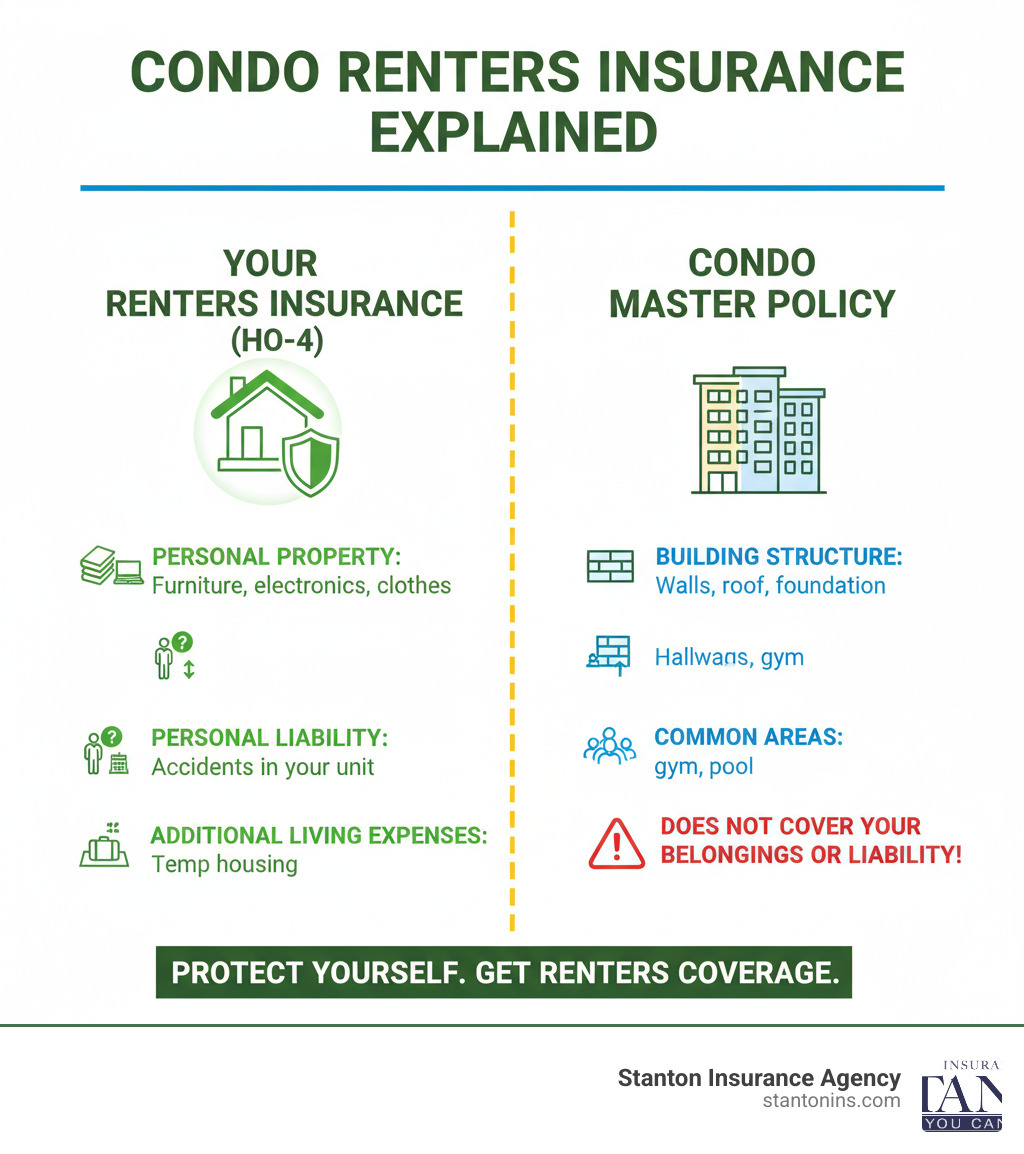
Renters insurance for condos is a type of insurance policy (called HO-4) that protects condo tenants’ personal belongings, covers personal liability, and pays for temporary housing if your unit becomes uninhabitable — all for as little as $5–$12 per month.
Here’s what it covers at a glance:
| Coverage Type | What It Does |
|---|---|
| Personal Property | Replaces your belongings if damaged by fire, theft, or water |
| Personal Liability | Covers legal and medical costs if someone is injured in your unit |
| Additional Living Expenses | Pays for hotel and meals if you can’t stay in your unit |
| Medical Payments | Covers a guest’s minor injuries regardless of fault |
Your condo building’s master insurance policy covers the structure and common areas — but not your furniture, laptop, or liability. That gap is exactly what renters insurance fills.
If you rent a condo unit, the condo association’s master policy does not protect you personally. Without your own renters insurance, you’d pay out of pocket to replace belongings or cover a lawsuit.
I’m Geoff Stanton, President of Stanton Insurance Agency in Waltham, Massachusetts, and a Certified Insurance Counselor with over 25 years of experience helping individuals and families find the right personal lines coverage — including renters insurance for condos. In this guide, I’ll walk you through everything you need to know to get properly protected without overpaying.
Simple renters insurance for condos glossary:
Understanding Renters Insurance for Condos vs. Condo Owners Insurance

Navigating insurance can feel like trying to assemble Swedish furniture without the manual. When it comes to condos, the terminology gets even more specific. There are two primary types of individual policies you’ll encounter: the HO-4 and the HO-6.
If you are the tenant—meaning you pay rent to a landlord who owns the unit—you need an HO-4 policy, commonly known as Renters Insurance. If you actually own the deed to the unit, you need an HO-6 policy, or Condo Insurance.
The main difference lies in what is being insured. An owner needs to protect the “bones” of the unit (the floors, cabinets, and fixtures), while a renter only needs to protect their “stuff” and their legal liability.
What is Renters Insurance for Condos?
At its core, renters insurance for condos is a safety net for your lifestyle. It doesn’t care about the roof of the building or the elevator in the lobby; it cares about your 65-inch TV, your wardrobe, and your bank account if a guest slips on a spilled drink.
Standard Renters Insurance Coverage provides three main pillars of protection:
- Personal Property: Coverage for your belongings.
- Liability: Protection if you are sued for accidental damage or injury.
- Additional Living Expenses: A budget for when you can’t stay in your home due to a covered disaster.
For a deeper dive into these specifics, you can check out our guide on What Does Renters Insurance Cover.
The Role of the Condo Association Master Policy
Living in a condo means you are part of a larger community, and that community has its own insurance. This is called the “Master Policy.” It is paid for through the condo fees (which your landlord likely pays).
The Master Policy typically covers:
- The building’s exterior (roof, siding, brickwork).
- Common areas (hallways, gyms, pools, elevators).
- Shared infrastructure (pipes inside the walls, electrical mains).
As a renter, you benefit from this because you aren’t responsible if a storm blows the roof off the building. However, the Master Policy stops at your front door. It will not buy you a new couch if a pipe bursts and floods your living room. Understanding where the Master Policy ends and your responsibility begins is the key to a solid Condominium Insurance Coverage Guide.
| Feature | Renters Insurance (HO-4) | Condo Owners Insurance (HO-6) |
|---|---|---|
| Who needs it? | Tenants renting a unit | People who own the unit |
| Personal Property | Included | Included |
| Unit Finishes (Floors/Walls) | Not Covered (Landlord’s job) | Included |
| Liability | Included | Included |
| Loss of Use | Included | Included |
What Does Your Policy Actually Cover?

When you buy renters insurance for condos, you aren’t just buying a piece of paper to satisfy a lease requirement. You are buying protection against “perils”—the insurance word for “bad things that happen.” Most policies in Massachusetts and New Hampshire cover perils like fire, smoke, lightning, theft, vandalism, and certain types of water damage.
According to Mass.gov, these policies are designed to ensure that a single bad day doesn’t result in total financial ruin.
Personal Property and Replacement Cost
Your “stuff” adds up faster than you think. Between your laptop, smartphone, furniture, and that high-end bicycle parked in the corner, the average condo renter has tens of thousands of dollars in assets.
When setting up your policy, we always recommend “Replacement Cost” coverage rather than “Actual Cash Value.”
- Actual Cash Value (ACV): Pays what your 5-year-old laptop is worth today (which might be $100).
- Replacement Cost: Pays what it actually costs to buy a brand-new laptop of similar quality today (which might be $1,200).
While it costs a few dollars more in premium, it is the only way to truly “break even” after a loss. For more on how to value your items, see How Much is Renters Insurance.
Personal Liability and Medical Payments
This is the “sleep better at night” portion of your policy. If you accidentally leave the bathtub running and it leaks into the unit below, damaging your neighbor’s expensive artwork, you are liable. Without insurance, that neighbor (or their insurance company) will come after you for the bill.
Personal Liability Insurance for Renters covers:
- Legal defense fees (which can be thousands of dollars even if you win).
- Settlements or judgments if you are found at fault.
- Personal Injury claims, such as libel or slander.
Additionally, “Medical Payments to Others” provides a smaller limit (usually $1,000 to $5,000) to pay for a guest’s quick trip to the ER if they trip over your rug. This is “no-fault” coverage, meaning it pays out quickly to prevent a small accident from turning into a big lawsuit.
Additional Living Expenses (ALE)
Imagine a small kitchen fire makes your condo smell like a campfire for three weeks while professional cleaners work. You can’t live there. Where do you go?
ALE (also known as “Loss of Use”) covers the increase in your living expenses. This includes:
- Hotel bills.
- Restaurant meals (since you can’t cook at home).
- Temporary laundry services.
This is a standard part of Apartment Insurance and condo renter policies alike, ensuring you aren’t homeless while your home is being repaired.
The Cost of Peace of Mind: Factors and Discounts
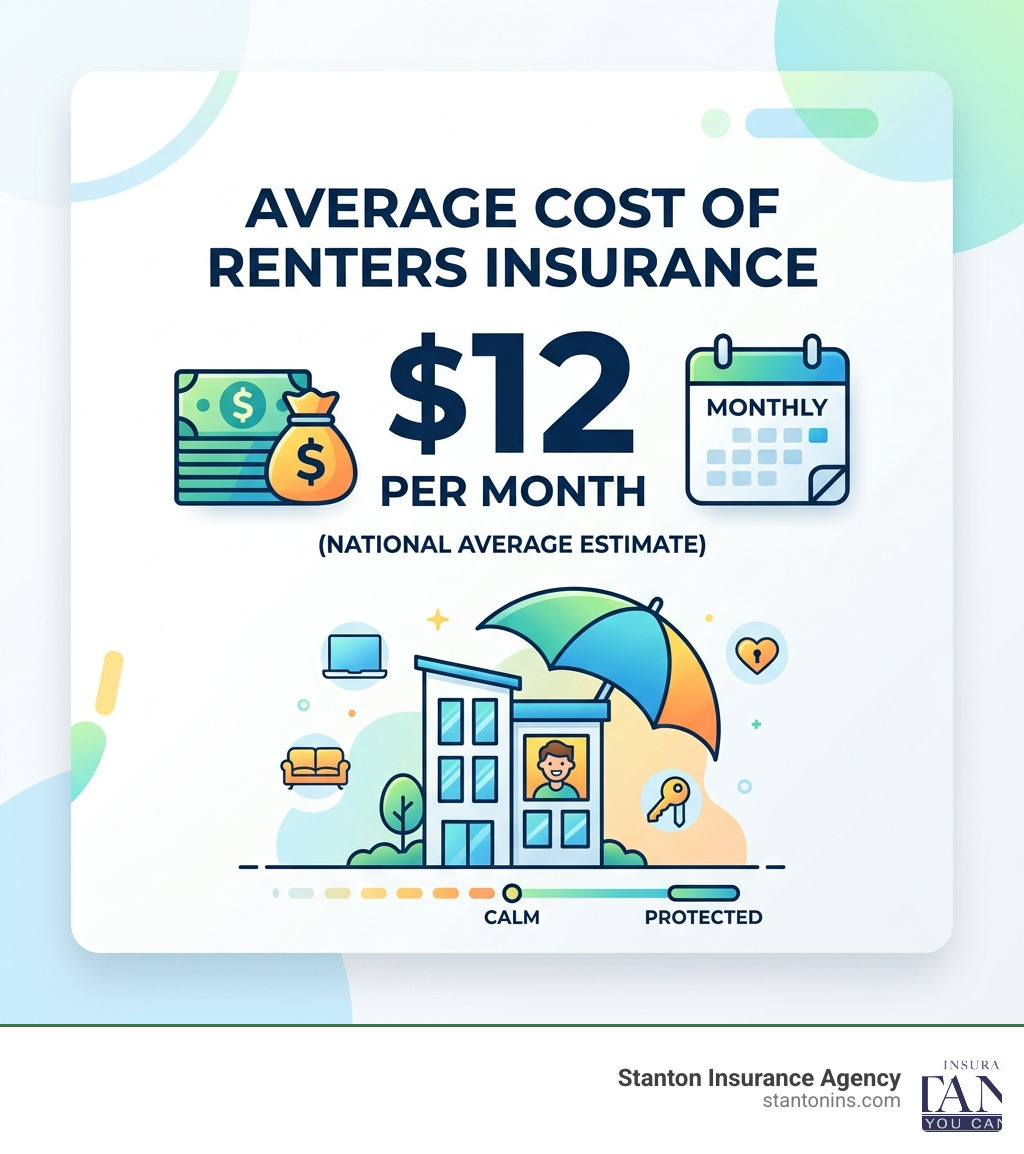
One of the biggest myths we hear at Stanton Insurance Agency is that insurance is too expensive. In reality, renters insurance for condos is one of the best bargains in the financial world. We often see quotes starting as low as $5 to $12 per month. That is less than a single fancy burrito or a couple of lattes.
Even at the higher end, most renters can find comprehensive coverage for less than $1 a day. In the context of your monthly rent in a place like Malden or Portsmouth, this is a tiny fraction of your budget for a massive amount of protection.
Factors Affecting Your Premium
Why does your friend pay $10 while you pay $15? Several factors influence How Much is Renters Insurance in Massachusetts:
- Location: Some ZIP codes have higher rates of theft or fire risk.
- Coverage Limits: Insuring $50,000 worth of stuff costs more than insuring $20,000.
- Deductible: Choosing a higher deductible (the amount you pay out of pocket during a claim) will lower your monthly premium.
- Security Features: Does your condo building have a 24/7 doorman, gated parking, or a central station fire alarm? These features make you a lower risk and lead to Cheap Renters Insurance.
Available Discounts for Condo Renters
We love helping our clients save money. There are several ways to shave dollars off your premium:
- Bundling: This is the big one. If you bundle your renters insurance with your auto insurance, you can often save up to 10% on your premium. Some carriers even offer an average of $30 in savings on the car insurance side just for adding a renters policy!
- Safety Devices: Smoke detectors, fire extinguishers, and deadbolt locks often trigger small discounts.
- Claims-Free History: If you haven’t filed an insurance claim in the last 5 years, many companies will reward your “low-risk” status.
- Pay in Full: Paying your annual premium upfront instead of monthly usually removes installment fees.
For a personalized look at your potential savings, you can start with Renters Insurance Quotes Massachusetts.
How to Get the Right Coverage for Your Unit
Getting insured is a simple process, but it requires a little bit of homework to ensure you aren’t underinsured. You don’t want to find out during a claim that you only had $10,000 in coverage when you actually owned $30,000 in belongings.
The first step is creating a Home Inventory. Walk through your condo and take a video of every room. Open the closets. Open the drawers. This video will be your best friend if you ever need to prove what you owned. There are many free apps available that allow you to log items, serial numbers, and receipts digitally.
Is Renters Insurance for Condos Required in MA and NH?
Technically, neither Massachusetts nor New Hampshire state law requires you to have renters insurance. However, your landlord almost certainly does.
In most modern lease agreements, landlords require tenants to carry a minimum amount of liability coverage (usually $100,000). They do this because they don’t want to be held responsible for your accidents. Beyond the lease, having this coverage is a vital part of your own Financial Protection.
As noted by the New Hampshire Insurance Department, even if it isn’t “required,” it is highly recommended because of how vulnerable you are without it.
Special Considerations for Short-Term Rentals
Are you planning to list your condo on Airbnb or another short-term rental platform while you’re away for the weekend? Stop and call your agent first.
Standard renters insurance for condos typically excludes “business activities.” If a short-term guest gets injured or steals your jewelry, your standard policy might deny the claim. Many condo associations also have strict rules or outright bans on short-term rentals. Always check your Condo Insurance Quote and your association bylaws before hosting.
Frequently Asked Questions about Condo Renters Insurance
Does renters insurance cover my roommate’s belongings?
Generally, no. A standard renters policy covers the “named insured” and resident relatives. Unless your roommate is your spouse or your sibling, their stuff is likely not covered under your policy.
We always recommend that each roommate carries their own policy for several reasons:
- Individual Limits: You don’t want to split a $20,000 limit with someone who owns $15,000 worth of shoes.
- Liability Disputes: If your roommate’s dog bites someone, you don’t want that claim appearing on your insurance record.
- Clarity: Separate policies prevent arguments over who gets the payout after a fire.
Does it cover water damage from a neighbor’s unit?
Yes! This is one of the most common claims in condos. If the person above you has a dishwasher failure and water seeps through your ceiling, ruining your bed and electronics, your renters insurance will step in.
Your insurance company will likely pay your claim first to get your life back to normal, and then they will “subrogate”—which is a fancy way of saying they will go after the neighbor’s insurance to get reimbursed. This saves you the headache of fighting with your neighbor’s carrier. For more on the owner’s side of this, see Does Condo Insurance Cover Water Damage.
Are high-value items like jewelry covered?
Yes, but with a catch. Most policies have “sub-limits” for certain categories. For example, a policy might cover $20,000 in total furniture but only $1,500 for jewelry or $2,500 for computers.
If you have an engagement ring or a high-end gaming rig that exceeds these limits, you need to “schedule” those items. This involves adding a “rider” or endorsement to your policy. You’ll provide an appraisal or a receipt, and that specific item will be covered for its full value, often with a $0 deductible. This is a key part of Personal Insurance/Renters Insurance planning.
Conclusion
Condo living offers a fantastic lifestyle—lower maintenance, great amenities, and often a prime location in our beautiful Massachusetts and New Hampshire communities. But that lifestyle needs protection.
At Stanton Insurance Agency, we believe that renters insurance for condos is the single most cost-effective way to protect your future. Whether you are a student in Boston, a professional in Malden, or enjoying the seacoast in Portsmouth, we are here to provide the trusted protection your assets deserve.
Don’t wait for a burst pipe or a stolen bike to realize you’re unprotected. As of April 2026, rates remain incredibly affordable. Contact us today to secure your Renters Insurance and enjoy your condo life with total peace of mind.