
What Is Personal Lines Insurance? (And Why It Matters)
What is personal lines insurance is one of the most common questions people ask when they start thinking seriously about protecting their finances. Here’s the short answer:
Personal lines insurance is coverage that protects individuals and families from financial losses caused by accidents, property damage, injury, or death. It is different from business insurance, which covers companies and organizations.
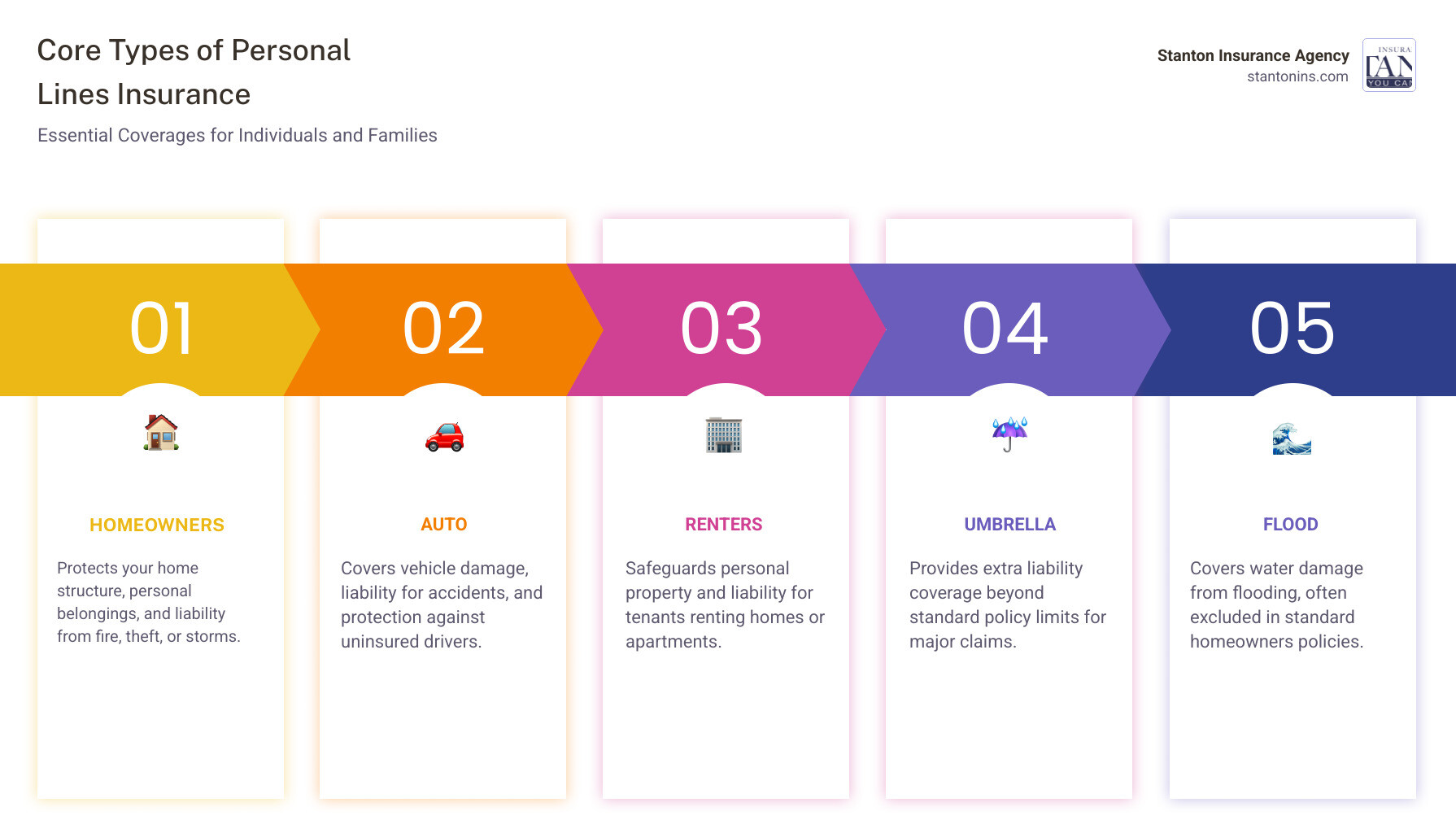
The most common types of personal lines insurance include:
- Homeowners insurance – covers your home and belongings
- Auto insurance – covers vehicles and driving liability
- Renters insurance – covers belongings for those who rent
- Umbrella insurance – adds extra liability protection above standard policy limits
- Flood insurance – covers flood damage excluded from standard home policies
- Life insurance – provides financial support to loved ones after death
- Disability insurance – replaces income if you cannot work
Personal lines insurance makes up about 53% of all net premiums written in the property and casualty insurance market. That’s a reflection of just how many people rely on it every day to protect their homes, cars, and savings from unexpected events.
Without the right coverage, a single car accident, house fire, or lawsuit could wipe out savings you’ve spent years building.
I’m Geoff Stanton, President of Stanton Insurance Agency and a 4th generation owner with over two decades of experience helping individuals and families understand what is personal lines insurance and find the right protection for their needs. As a Certified Insurance Counselor (CIC), I’ve seen how the right personal lines coverage can be the difference between financial recovery and financial ruin.
Essential what is personal lines insurance terms:
- what is personal liability in home insurance
- what is personal liability insurance for renters
- what is personal umbrella insurance
What is Personal Lines Insurance?
At its core, what is personal lines insurance refers to a category of property and casualty insurance products designed for and purchased by individuals rather than businesses. These policies serve as a financial indemnity, meaning they are intended to restore you to the financial position you were in before a loss occurred.
The industry operates on the principle of risk pooling. Thousands of people pay premiums into a “pool,” and when one person suffers a covered loss—like a kitchen fire or a fender bender—the funds from that pool are used to pay for the repairs. This makes massive, life-altering expenses affordable for the average person.
Personal lines insurance focuses on two primary areas:
- Property Protection: This covers physical things you own, such as your house, your car, or your furniture.
- Liability Protection: This covers your legal responsibility if you accidentally hurt someone else or damage their property.
For more detailed insights, you can explore Understanding Personal Lines Insurance or check out our more info about personal insurance page to see how these coverages fit into your daily life.
Personal Lines vs. Commercial Lines Insurance
While both types of insurance provide protection, the scale and complexity differ significantly. Personal lines are tailored for the “average Joe” or a family unit, while commercial lines are built for enterprises, from small local shops to massive corporations.
In the property and casualty market, personal lines actually hold the slightly larger piece of the pie, accounting for approximately 53% of net premiums written, while commercial lines account for the remaining 47%. This is largely because almost every adult in America needs some form of personal coverage—whether it’s auto insurance to drive to work or homeowners insurance to satisfy a mortgage lender.
| Feature | Personal Lines Insurance | Commercial Lines Insurance |
|---|---|---|
| Policyholder | Individuals or Families | Businesses or Non-profits |
| Primary Risks | Home, Auto, Personal Liability | Professional Liability, Workers’ Comp, Cyber Risk |
| Complexity | Standardized forms, easier to understand | Highly customized, complex legal language |
| Market Share | ~53% of P&C Market | ~47% of P&C Market |
| Typical Costs | $1,000 – $3,000 per policy | Highly variable (can be millions) |
Commercial insurance involves much higher risk assessments. A business might need to cover dozens of employees, a fleet of trucks, and professional errors that could cost millions. Personal lines, by contrast, focus on protecting your individual wealth and the lifestyle you’ve worked hard to build.
Core Types of Personal Lines Insurance Coverage
Understanding what is personal lines insurance requires a look at the specific “lines” or classes of coverage available. Most people don’t just have one policy; they have a suite of coverages that act as a safety net.

- Homeowners Insurance: This is the bedrock of personal protection for most families. It covers the structure of your home and your personal belongings. Learn more about home insurance.
- Renters Insurance: Even if you don’t own the building, your stuff is valuable. Renters insurance covers your belongings and provides liability protection if a guest is injured in your apartment. Check out our guide to renters insurance.
- Umbrella Insurance: This is “extra” liability insurance. If you are sued for $1 million after a car accident but your auto policy only covers $300,000, an umbrella policy kicks in to cover the rest.
- Flood Insurance: Most people are surprised to learn that standard homeowners policies do not cover floods. In many parts of Massachusetts and New Hampshire, this is a critical add-on.
Protecting Your Property: What is Personal Lines Insurance for Homeowners?
For homeowners, insurance is often a requirement from your mortgage lender. But it’s more than just a box to tick. A standard homeowners policy usually includes:
- Dwelling Coverage: The cost to rebuild your house from the ground up.
- Personal Property: Coverage for your clothes, electronics, and furniture. If you want to dive deeper into this specific area, read what is personal property insurance.
- Scheduled Items: Standard policies have limits on high-value items like jewelry or fine art. “Scheduling” these items ensures they are covered for their full appraised value.
- Replacement Cost vs. Actual Cash Value: We always recommend replacement cost. If your five-year-old laptop is stolen, replacement cost pays for a brand-new equivalent. Actual cash value only pays what that old laptop was worth on the used market.
If you live in a multi-unit building, you’ll want to look into condo insurance specifics or multi-family insurance, which handle the unique “walls-in” vs. “walls-out” coverage requirements.
On the Road: What is Personal Lines Insurance for Vehicles?
Auto insurance is the most common personal line because it is legally required in almost every state. In Massachusetts and New Hampshire, there are specific state auto insurance requirements you must follow.
Beyond the legal minimums, a robust personal auto policy includes:
- Collision: Repairs your car if you hit something.
- Comprehensive: Repairs your car if a tree falls on it, it’s stolen, or you hit a deer.
- Uninsured Motorist: Protects you if you’re hit by someone who doesn’t have insurance.
We also help clients with specialized vehicles. Whether you enjoy the open road on two wheels or the open water, these personal lines ensure your hobbies don’t become financial liabilities.
How Personal Insurance Works: Premiums and Deductibles
The mechanics of what is personal lines insurance come down to two numbers: your premium and your deductible.
- Premium: This is the amount you pay (monthly or annually) to keep the policy active.
- Deductible: This is the amount you pay out-of-pocket before the insurance company pays a dime on a claim.
There is almost always an inverse relationship between these two. If you choose a higher deductible (say, $2,500 instead of $500), your annual premium will usually be lower because you are taking on more of the risk yourself.
During the underwriting process, the insurance company looks at your risk factors. Are you a safe driver? Is your home near a fire station? Do you have a history of filing many claims? These factors determine how much you’ll pay. For a deep dive into the liability side of this equation, see our personal liability complete guide.
Factors Influencing Your Insurance Costs and Savings
Living in New England brings unique challenges to personal lines insurance.
- Location: In Massachusetts, coastal risks or high-density urban areas can drive up premiums. In New Hampshire, winter weather and rural fire protection levels are major factors.
- Claims History: Just like a credit score, your “insurance score” matters. Frequent small claims can lead to higher rates or even non-renewal.
- Credit Score: In many states, a higher credit score correlates with lower insurance premiums, as data shows people with good credit tend to file fewer claims.
- Bundling: This is the easiest way to save. Combining your home and auto policies with us can often save you 15% to 25% on your total bill.
For those with significant assets, Personal Umbrella and Excess Liability in Massachusetts is a must-read. As your wealth grows, so does your “target” size in a lawsuit. An umbrella insurance policy provides that extra layer of peace of mind for a relatively low annual cost (often $150–$400 for $1M in coverage).
Lastly, don’t ignore the flood insurance necessity. Even if you aren’t in a high-risk zone, about 20% of flood claims come from low-to-moderate risk areas.
Frequently Asked Questions about Personal Insurance
Can I use my personal auto insurance for business deliveries?
Generally, no. Most personal auto policies have “commercial exclusions.” If you are using your car for pizza delivery, courier services, or ridesharing (like Uber or Lyft) without a specific endorsement, your insurer can void your coverage entirely. If you get into an accident while “on the clock,” you could be left paying for all damages out of your own pocket. If you use your vehicle for work, let us know so we can add the right business-use or rideshare endorsement.
Does standard homeowners insurance cover flood damage?
This is a major misconception. Standard homeowners policies exclude flood damage caused by external rising water. To be protected against events like heavy rain, storm surges, or overflowing rivers, you need a separate policy through the National Flood Insurance Program (NFIP) or a private flood insurer. However, “water backup” (like a sump pump failure) can often be added to a standard policy as an endorsement. Check our flood insurance details for more information.
What happens if I am labeled a high-risk driver?
If you have multiple accidents, a DUI, or several speeding tickets, you may be labeled “high-risk.” This often results in significant premium increases or your current carrier refusing to renew your policy. You might be required to have an SR-22 filing to prove you have insurance. The good news is that as a local agency, we work with specialty carriers that cater to high-risk individuals, helping you stay legal while you work on improving your driving record.
Conclusion
At Stanton Insurance Agency, we believe that understanding what is personal lines insurance is the first step toward true financial security. We aren’t just selling policies; we are providing trusted protection for the things you value most. Whether you are buying your first home in Massachusetts or looking for better auto rates in New Hampshire, our local expertise and personalized service ensure you get the right coverage at the right price.
Don’t leave your future to chance. Let us help you build a financial fortress around your family and your assets.
Secure your personal insurance quote today and experience the peace of mind that comes with being properly protected.
