
What You Need to Know Before You Add a Car to Your Insurance
Knowing how to add a car to your insurance policy is something most drivers will need to do at least once — whether you’re buying a new vehicle, picking up a used car, or adding a second vehicle to your household.
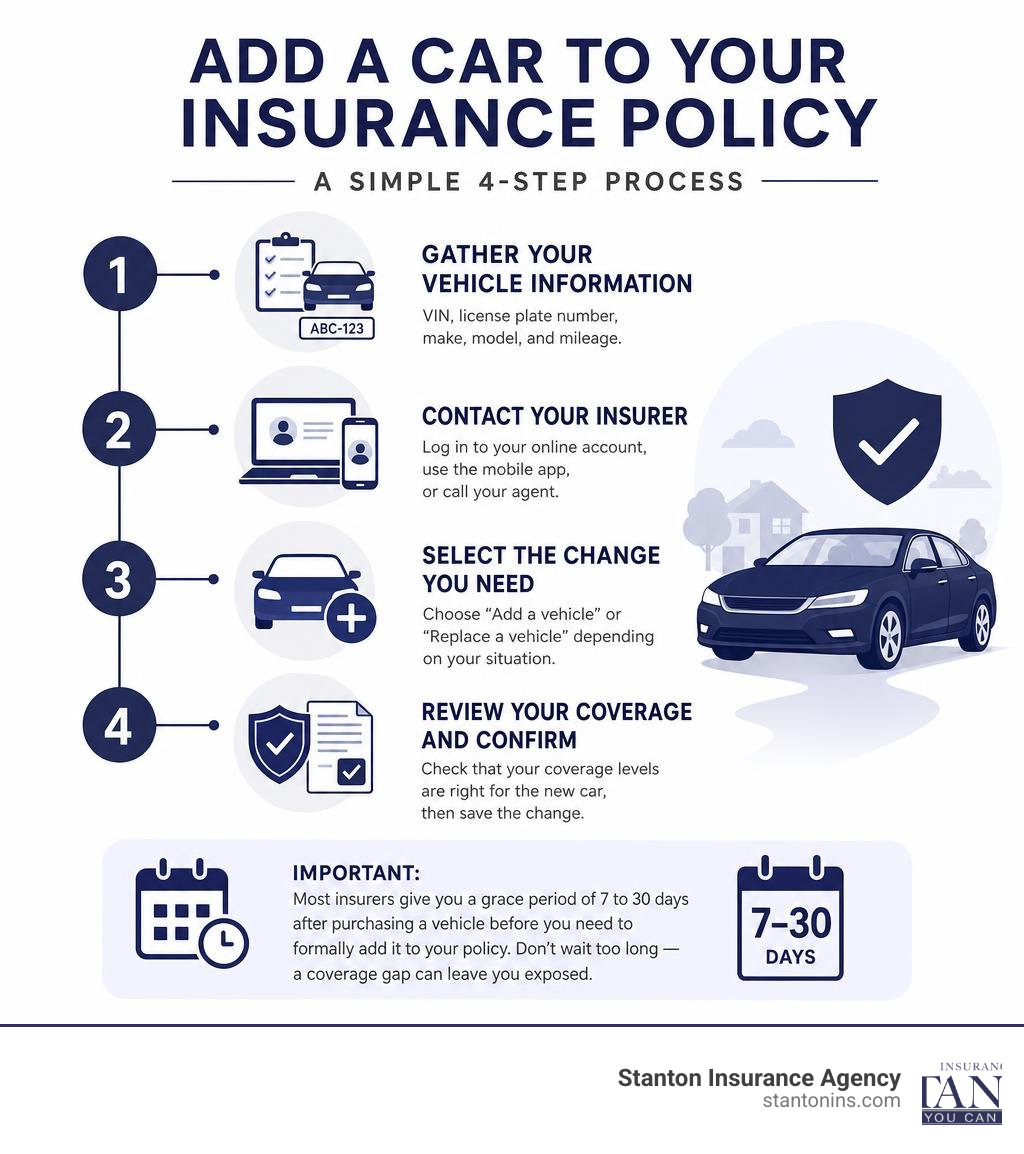
Here’s how to add a car to your insurance policy in 4 steps:
- Gather your vehicle information — VIN, license plate number, make, model, and mileage
- Contact your insurer — log in to your online account, use the mobile app, or call your agent
- Select the change you need — choose “Add a vehicle” or “Replace a vehicle” depending on your situation
- Review your coverage and confirm — check that your coverage levels are right for the new car, then save the change
Important: Most insurers give you a grace period of 7 to 30 days after purchasing a vehicle before you need to formally add it to your policy. Don’t wait too long — a coverage gap can leave you exposed.
The process is straightforward in most cases. But the details matter: the type of car, how it’s financed, who will drive it, and your current policy all affect what you need to do and what it will cost.
I’m Geoff Stanton, President of Stanton Insurance Agency and a Certified Insurance Counselor (CIC) with over 25 years of experience helping Massachusetts and New Hampshire drivers add a car to their insurance and keep their coverage airtight. In the sections below, I’ll walk you through every step so you get it right the first time.
Add car to insurance basics:
How to Add Car to Insurance: A Step-by-Step Guide
Adding a vehicle to your policy is a routine administrative update, but skipping a step can lead to administrative headaches or, worse, a denial of coverage if you are involved in an accident. Whether you are navigating the registration rules of the Registry of Motor Vehicles (RMV) in Massachusetts or handling the transition in New Hampshire, following a structured process is essential.

To ensure a seamless transition and continuous coverage, follow this step-by-step guide:
- Verify Your Existing Policy Status: Before purchasing your new ride, check your current policy limits and status. Understanding your current baseline helps you make informed coverage decisions for your new asset.
- Collect the Vehicle Identification Number (VIN): The VIN is your vehicle’s unique 17-character fingerprint. It tells your insurer the exact make, model, safety features, and engine type of the vehicle. You can find this on the driver’s side dashboard (visible through the windshield) or on the driver’s side door jamb.
- Determine the Policy Action (Add vs. Replace):
- Adding a Vehicle: Select this option if you are keeping your current car and putting an additional vehicle on your policy.
- Replacing a Vehicle: Select this option if you sold or traded in your old car and want to transfer your existing coverage to your new vehicle.
- Provide Odometer Readings and Garaging Address: Insurers need to know the starting mileage of the vehicle and where it will be parked overnight. For residents in Massachusetts or New Hampshire, the garaging location must match the primary address listed on your policy.
- Submit Lienholder or Lease Information: If your vehicle is financed or leased, you must provide the name and address of your lender. Lenders require specific coverage limits to protect their financial stake in the vehicle.
- Review and Adjust Your Coverage Limits: A brand-new vehicle usually requires more protection than an older, paid-off car. Take this opportunity to assess your liability, collision, and comprehensive limits.
- Secure Your New Proof of Insurance: Once the changes are finalized, your insurer will issue an updated insurance card or a temporary binder document.
For a detailed look at setting up coverage for the first time or modifying a policy, read our comprehensive guide on How to Get Car Insurance in Massachusetts and review the official state guidelines on the Basics of Auto Insurance | Mass.gov.
Can I Add Car to Insurance Online or Do I Need to Call?
The modern insurance landscape gives you multiple ways to update your policy. Many national carriers offer self-service online portals and mobile apps where you can add a car to your insurance policy in under a minute when you have all the required information ready.
However, online self-service has strict limitations:
- No Backdating Allowed: If you purchased a car last week and forgot to add it, online portals and mobile apps will not allow you to backdate the coverage start date. You will be forced to call your insurer directly—often within a strict 30-day window—to request a backdated change.
- Complex Scenarios: If you are adding a vehicle with an out-of-state title, a classic car, or a vehicle registered to a business, automated online systems will often block the transaction and prompt you to call.
This is where a local independent agent shines. At Stanton Insurance Agency, we handle the heavy lifting for you. Instead of navigating confusing online dropdown menus or waiting on hold with a direct writer’s call center, you can send us your new vehicle’s bill of sale or VIN, and we will update your policy accurately. We ensure that your state-specific forms are filed correctly with the MA RMV or NH DMV, saving you time and protecting you from costly coverage gaps.
Rules to Add Car to Insurance for Someone Else
A common question we hear is: “Can I add my partner’s, child’s, or roommate’s car to my own insurance policy?”
The short answer is: It depends on ownership and residency.
To add any vehicle to an insurance policy, there must be an insurable interest. This means the policyholder must suffer a direct financial loss if the vehicle is damaged or destroyed. Generally, you cannot insure a vehicle that you do not own or lease.
However, there are exceptions to this rule:
- Shared Residence and Joint Policies: If you live in the same household and are both listed as named insureds on the policy, you can typically combine your vehicles onto a single multi-car policy, even if the titles are in separate names.
- Spouses and Domestic Partners: Married couples living together can easily insure vehicles owned by either spouse under one shared policy.
- Dependent Children: If your child is away at college but still uses your household address as their permanent residence, their vehicle can usually remain on your policy. However, some states have unique restrictions. For example, if a vehicle is titled solely in your child’s name, certain regulations may require them to have their own separate policy.
For a deeper dive into how vehicle ownership interacts with insurance coverage, check out our article on Does Insurance Follow the Car or Driver in Massachusetts?. You can also read more about adding household members and drivers through How to Add Someone to Your Car Insurance.
Grace Periods and Timelines for New Vehicles
When you buy a new or used car, you don’t always have to call your insurance agent from the dealership lot before driving away. Most auto insurance policies feature a built-in grace period (also known as automatic coverage) for newly acquired vehicles.

The grace period typically ranges from 7 to 30 days, depending on your insurance carrier and your state’s laws. During this window, your existing policy’s coverages will temporarily extend to your new vehicle.
- If you are replacing a vehicle: Your new car will usually receive the same coverage as the vehicle it replaced.
- If you are adding an additional vehicle: The new car will typically receive the broadest coverage currently listed on any vehicle on your policy.
However, relying blindly on a grace period is risky. If your existing policy only has basic liability coverage and you buy a brand-new financed vehicle, your grace period will not automatically provide the physical damage coverages (comprehensive and collision) that your lender requires.
Grace Periods for New vs. Used Cars
The rules surrounding grace periods can vary based on whether you are buying a brand-new car from a dealership or a used car from a private seller.
- Dealership Purchases (New or Used): Dealerships are legally required to verify that you have active auto insurance before they let you drive the car off the lot. A current, active insurance card is often sufficient proof of insurance for the dealership, provided you fall within your policy’s automatic coverage grace period.
- Private Party Sales: When buying a used car from an individual, there is no dealership to check your insurance. However, the state laws of Massachusetts and New Hampshire still require active coverage the moment the wheels touch a public road.
To avoid any coverage gaps, we always recommend reviewing your specific policy booklet or contacting us to confirm your exact grace period. If you are registering a vehicle in New Hampshire, consult the New Hampshire Insurance Department Automobile Insurance Guide. For Massachusetts drivers, you can review state-specific requirements through official state resources or contact our team directly to ensure you are fully compliant with local laws.
How to Get Immediate Proof of Insurance
If your dealership or lender requires immediate, official proof of insurance before releasing your new vehicle, relying on a verbal grace period won’t cut it. You will need a formal document showing that the new vehicle is explicitly listed on your policy.
Here is how to get immediate proof:
- Use Your Carrier’s Mobile App: If your insurance company supports instant updates, log in to your account, add the vehicle, and download your new digital insurance ID card immediately.
- Request an Insurance Binder: An insurance binder is a temporary, legally binding document issued by your agent or insurer that proves you have active coverage while your formal policy paperwork is being processed.
- Have Your Agent Send Proof Directly: At Stanton Insurance Agency, we can generate a binder or updated policy declaration page and email or fax it directly to your dealership or lender while you are signing the paperwork.
Coverage Options and Premium Impacts
Adding a vehicle to your policy will naturally change your insurance premium. The exact impact depends on the vehicle’s make, model, age, safety features, and how you intend to use it.
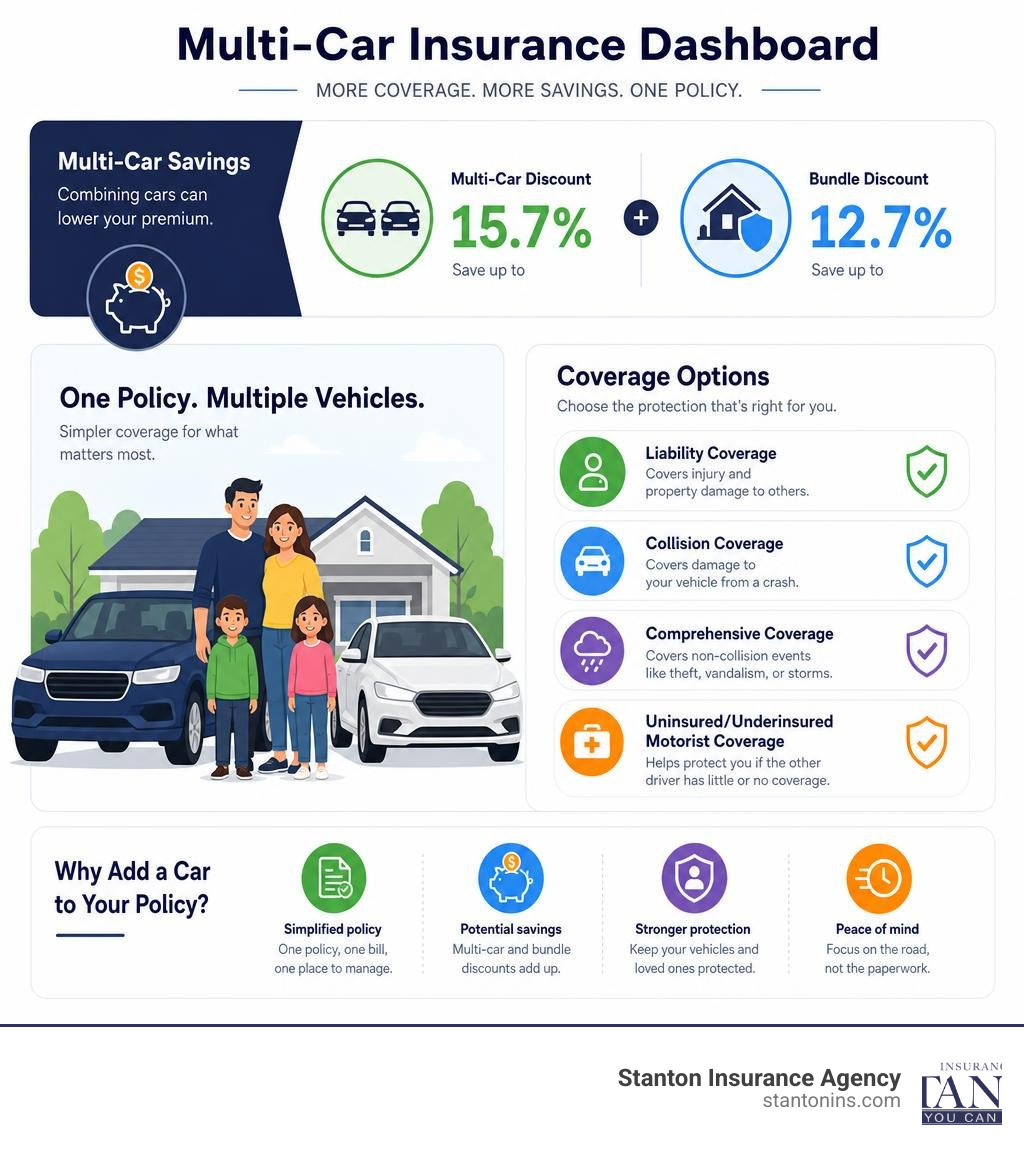
Fortunately, adding a second vehicle to your policy can qualify you for a multi-car discount, which can save you up to 15.7% on your premiums with some insurers. Furthermore, if you bundle your auto policy with your home, renters, or condo insurance, you can save up to 12.7% on your premiums based on leading industry data.
To understand how rates are calculated in our region, take a look at Massachusetts Car Insurance: What You Can Expect to Pay.
Coverage Options to Review for Your New Vehicle
When you add a car to your insurance, you shouldn’t just copy and paste your old coverage levels. A new or higher-value vehicle requires a careful review of your coverage options:
- Collision Coverage: This pays to repair or replace your vehicle if it is damaged in an accident with another vehicle or object, regardless of who is at fault.
- Comprehensive Coverage: This covers damage caused by events outside your control, such as theft, vandalism, animal strikes, fire, or weather events (like New England winter storms).
- Gap Insurance: If your new car is financed or leased, it will depreciate the moment you drive it off the lot. If your car is totaled, standard insurance only pays the actual cash value (ACV) of the vehicle. Gap insurance covers the “gap” between what the car is worth and what you still owe on your loan or lease.
If you are financing your new purchase, read our guides on Car Insurance Requirements for Financed Cars and Your Car Insurance Explained From A to Z: What’s Covered to ensure you meet all your lender’s mandates. For a comparison of your options, check out our breakdown of Full Coverage vs Liability Car Insurance.
Multi-Vehicle Policy Requirements and Discounts
To put multiple vehicles on a single policy and secure a multi-car discount, insurers have a few basic ground rules. The table below compares the key differences and requirements between single-car policies and multi-car policies:
| Feature | Single-Car Policy | Multi-Vehicle Policy |
|---|---|---|
| Multi-Car Discount | Not applicable | Yes (typically up to 15.7% savings) |
| Garaging Address Rule | Must match primary policy address | All vehicles must share the same primary address |
| Registration State | Must match the policy’s state | All vehicles must be registered in the same state |
| Vehicle Ownership | Titled to the named insured | Titled to named insured, spouse, or resident relatives |
| Policy Administration | One deductible and limit set | Can customize deductibles and coverages per vehicle |
Frequently Asked Questions About Adding a Car to Insurance
What information do I need to provide when adding a vehicle?
To add a vehicle to your policy, you will need to provide:
- The 17-character Vehicle Identification Number (VIN)
- The exact make, model, and year of the vehicle
- The current odometer reading (mileage)
- The primary garaging address
- The names of all regular drivers in the household
- The name and billing address of your lienholder or leasing company (if financed or leased)
For more information on protecting a financed vehicle, read Don’t Get Stranded: Your Guide to Auto Insurance for Financed Vehicles.
Can I get liability insurance on a financed car?
While you can technically purchase liability-only insurance on a vehicle you own outright, lenders and leasing companies will never allow you to carry only liability coverage on a financed car. Lenders require you to carry physical damage protection—specifically comprehensive and collision coverage—with maximum deductible limits (usually $500 or $1,000) to protect their investment.
To learn more about these requirements, read our detailed article: Can I Get Liability Insurance on a Financed Car.
How does adding a teen driver with a new car affect rates?
Adding a newly licensed teen driver to your policy alongside a new vehicle will significantly increase your insurance premium. Because young drivers lack road experience, insurance carriers classify them as higher risk.
However, you can offset these premium increases by:
- Encouraging your teen to maintain a B average or higher to qualify for a Good Student Discount
- Enrolling them in an approved defensive driving course
- Keeping them on your household policy rather than purchasing a separate policy, which is almost always more expensive
To learn more about financing and insuring a vehicle for a young driver, read New Driver, New Ride: How to Finance Your First Car and Get Insured.
Conclusion
Adding a new vehicle to your household is an exciting milestone, but keeping your assets protected requires active policy management. Whether you are buying a brand-new car, replacing an old family vehicle, or combining policies with a partner, taking the time to update your coverage correctly ensures you stay safe on the roads of Massachusetts and New Hampshire.
At Stanton Insurance Agency, we specialize in providing trusted, local protection for your most valuable assets. We cut through the insurance jargon to help you find the right coverage, secure every eligible discount, and handle the paperwork seamlessly.
Ready to add a new car to your policy or compare quotes? Contact Stanton Insurance Agency today to speak with one of our local experts and keep your coverage airtight.
