
Why Auto Insurance for Financed Vehicles Matters
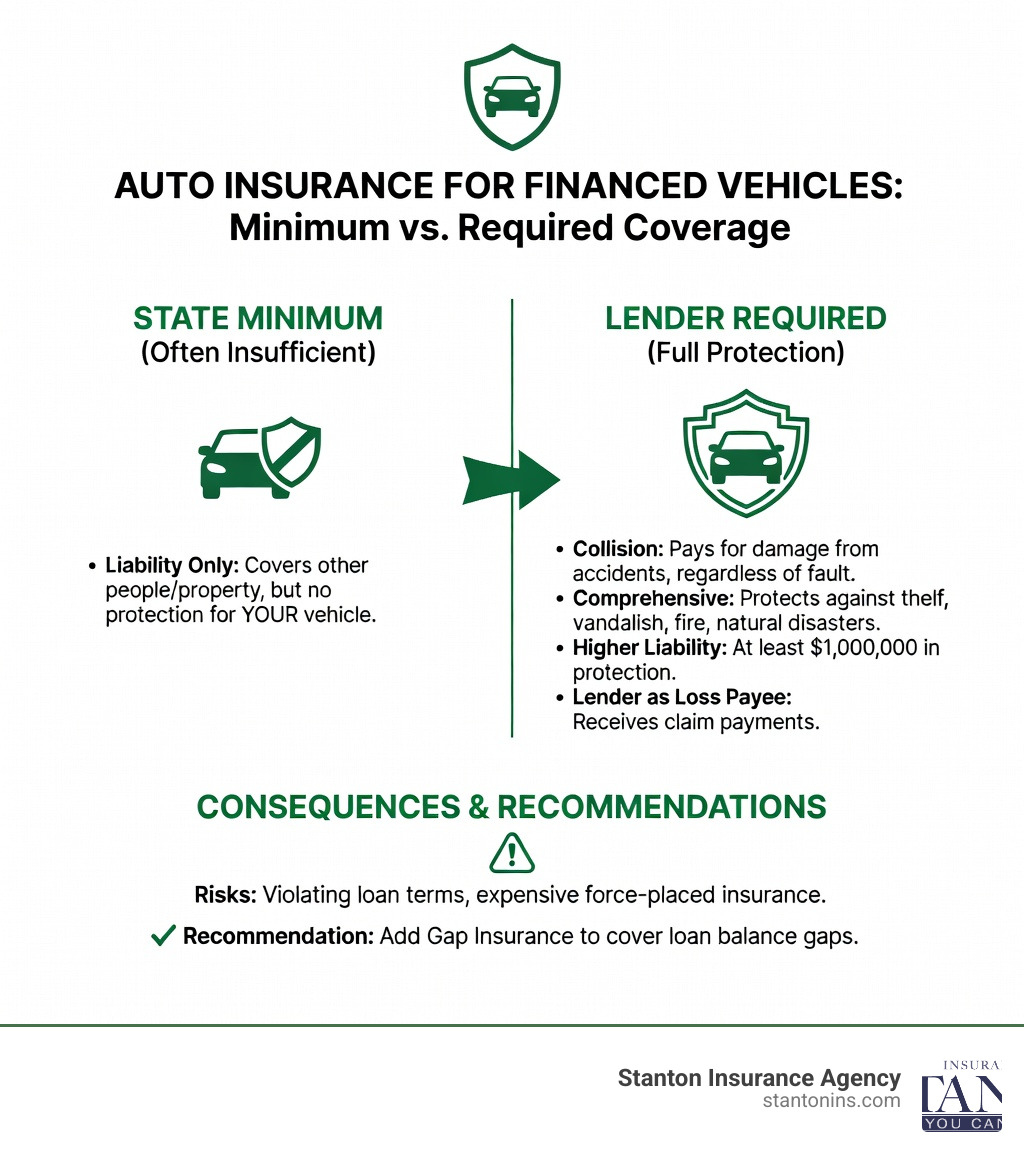
Auto insurance for financed vehicles requires more than the state minimum coverage. Here’s what you need to know:
Key Requirements for Financed Vehicles:
- Collision coverage – Pays for damage to your car from accidents, regardless of fault
- Comprehensive coverage – Protects against theft, vandalism, fire, and natural disasters
- Higher liability limits – Most lenders require at least $100,000/$300,000 in liability protection
- Lender as loss payee – Your lender must be listed on your policy and receives claim payments
- Gap insurance (recommended) – Covers the difference between your car’s value and loan balance if totaled
You cannot:
- Carry only state minimum liability insurance
- Drop or downgrade coverage during your loan term
- Remove the lender from your policy until the loan is paid off
After saving for a down payment and finding the perfect car, the last step before driving home is securing proper insurance. But when you finance a vehicle, your insurance needs are different—and more expensive—than if you owned the car outright.
Your lender has a financial stake in your vehicle until you pay off the loan. That’s why they require comprehensive protection that goes far beyond what Massachusetts or New Hampshire law mandates. Without the right coverage, you risk violating your loan agreement, facing force-placed insurance that can cost thousands more, or being stuck with a loan balance on a car you can no longer drive.
I’m Geoff Stanton, President of Stanton Insurance Agency in Waltham, Massachusetts. With over 25 years of experience helping clients steer auto insurance for financed vehicles, I specialize in finding the right coverage to meet lender requirements while keeping costs manageable.
Glossary for auto insurance for financed vehicles:
- car insurance requirements for financed cars
- does car insurance cost more for financed cars
- finance cars with insurance for first time drivers
Understanding Auto Insurance for Financed Vehicles
When you finance a car in Massachusetts or New Hampshire, the relationship between you, your car, and your insurance company changes. You aren’t just insuring your own interests anymore; you’re insuring the bank’s interests, too.
In the eyes of the law in Massachusetts, you are required to carry certain minimums to legally drive. However, your lender—the entity actually footing the bill for the car—has much stricter rules. They become what is known as a lienholder. Because they technically own the title to the vehicle until that final payment clears, they want to ensure that their “collateral” (your car) is protected against almost any scenario.
This means auto insurance for financed vehicles is rarely a “set it and forget it” situation. You are required to list the lender as a loss payee on your policy. This ensures that if the car is damaged, the insurance company pays the repair shop or the lender directly, making sure the asset is either fixed or the loan is paid back.
Learn more about car insurance requirements for financed cars:
Why Lenders Mandate Full Coverage
You might wonder, “Why can’t I just get the basic liability required by the state?” The answer is simple: risk. If you only have liability insurance and you accidentally drive your brand-new SUV into a New Hampshire stone wall, your insurance will pay for the wall, but it won’t pay a dime for your car. If your car is totaled and you don’t have collision coverage, you still owe the bank $30,000 for a pile of scrap metal.
Lenders mandate full coverage to:
- Protect the Collateral: The car is the guarantee for the loan. If the car disappears or is destroyed, the guarantee is gone.
- Mitigate Financial Risk: Lenders want to ensure that even if you can’t afford to fix the car out of pocket, the insurance company will.
- Ensure Compliance: Your loan agreement is a legal contract. Failing to maintain the required insurance is often considered a “default” on the loan, just like missing a payment.
Learn more: Why Financed Cars Cost More to Insure
The Role of the Loss Payee
Being a loss payee gives the lender a “seat at the table.” When we set up your policy at Stanton Insurance Agency, we add your bank’s name and address to the declarations page. This creates a formal link.
If you decide to cancel your policy or if you miss a payment and the policy lapses, the insurance company is legally required to notify the loss payee. Trust us, the bank will find out faster than you can say “uninsured.” Additionally, for large claims, the settlement check will be made out to both you and the lender. This ensures you don’t just take the $10,000 repair check and go on a vacation while leaving the car damaged.
Essential Coverage Types: Beyond the State Minimum
The term “full coverage” is actually a bit of a misnomer in the industry—it’s not a single “thing” you buy, but rather a combination of coverages. When dealing with auto insurance for financed vehicles, you need to look at how these compare to state minimums.
| Coverage Type | MA/NH State Minimum Liability | Full Coverage for Financed Cars |
|---|---|---|
| Bodily Injury Liability | $20,000/$40,000 (MA) | $100,000/$300,000 |
| Property Damage Liability | $5,000 (MA) | $50,000 |
| Collision Coverage | Not required by law | Required by Lender |
| Comprehensive Coverage | Not required by law | Required by Lender |
| Uninsured Motorist Protection | Required in MA/NH | $100,000/$300,000 |
Note: New Hampshire is unique because it does not technically mandate auto insurance for most drivers, but it does require “financial responsibility.” However, if you finance a car, the lender’s requirements override the state’s lack of a mandate.
- Collision coverage: This is the workhorse. It covers damage to your car if you hit another vehicle, a tree, or even a deep New England pothole.
- Comprehensive coverage: Think of this as “everything but a collision.” It covers theft, vandalism, fire, and damage from animals (like that deer that jumped out on I-93) or falling branches during a Nor’easter.
- Higher liability limits: While the lender cares about the car, we care about you. Most lenders require $100,000/$300,000 limits because a single accident can easily exceed the $20,000 state minimum in Massachusetts, leaving you personally liable for the rest.
Learn more: What Kind of Auto Insurance Options Are Available When Financing a Car?
Standard Auto Insurance for Financed Vehicles
When you walk into a dealership in Waltham or Manchester, they will ask for proof of insurance. Most lenders won’t let you drive off the lot without at least 100/300/50 liability limits.
At Stanton Insurance Agency, we often recommend even higher limits. National statistics show that the average cost of car insurance is $2,685 per year for full coverage, compared to about $800 for minimum coverage. While the jump from $20,000 to $100,000 in liability seems massive, the premium difference is often surprisingly small—averaging only about $200 per year for five times the protection.
Collision and Comprehensive Specifics
- Collision Details: This coverage is vital for financed cars. Whether you slide on black ice in January or have a fender bender at a rotary, collision ensures the lender’s asset is restored to its previous value.
- Comprehensive Details: This protects you against the “acts of God.” If a flood in the Charles River basin ruins your engine, comprehensive coverage has your back.
- Deductibles: This is the amount you pay out of pocket before insurance kicks in. Lenders usually cap your deductible at $500 or $1,000. They don’t want you having a $2,500 deductible because if you can’t afford to pay that $2,500, the car won’t get fixed, and their collateral is compromised.
Gap Insurance and Protecting Your Equity
One of the biggest traps in auto insurance for financed vehicles is the “equity gap.” A new car loses 15% of its value the moment you drive it off the lot. If you bought a car for $35,000 with a small down payment, you might owe $34,000, but the car’s “Actual Cash Value” (ACV) is now only $29,750.
If that car is stolen or totaled tomorrow, your standard insurance policy only pays the ACV of $29,750. You are still on the hook for the remaining $4,250 to the bank. This is what we call “negative equity.”
Learn more: Can I Get Liability Insurance on a Financed Car?
When Gap Insurance is Necessary
Gap insurance isn’t always mandatory, but it’s almost always a smart move if:
- You made a low down payment: (Less than 20%).
- You have a long loan term: (60 months or longer), meaning you’re paying off the principal slower than the car is losing value.
- You drive a lot of miles: Higher mileage speeds up depreciation.
- You rolled over negative equity: If you traded in an old car and added what you owed on it to your new loan.
How Gap Insurance Works for Financed Vehicles
Gap insurance bridges the financial chasm between what the insurance company says the car is worth and what the bank says you owe.
According to industry data, adding GAP insurance typically increases premiums by approximately $350 to $800 for 3 to 5 years of coverage. This breaks down to about $30 to $66 per month added to your auto insurance premiums. While it sounds like an extra expense, it’s much cheaper than writing a $5,000 check to a bank for a car that’s sitting in a salvage yard.
Learn more: Financing Your First Car and Getting Insured
Managing Costs and Avoiding Force-Placed Insurance
We know that auto insurance for financed vehicles can feel like a heavy burden on top of a monthly car payment. However, trying to cut corners by dropping coverage is a dangerous game that usually ends with the lender “helping” you in the most expensive way possible.
The Dangers of Force-Placed Insurance
If your insurance lapses or you try to downgrade to liability-only, your lender will receive a notice. After a short grace period, they will purchase a policy for you and add the cost to your monthly loan payment. This is called force-placed insurance.
Force-placed insurance is a nightmare for three reasons:
- It’s incredibly expensive: Often double or triple the cost of a standard policy.
- It only protects the lender: It usually only includes collision and comprehensive for the balance of the loan. It often provides zero liability protection for you.
- It can lead to default: If you can’t afford the new, higher loan payment, the lender can repossess the car.
Strategies for Saving on Auto Insurance for Financed Vehicles
You don’t have to break the bank to meet your lender’s requirements. Here are some proven ways we help our clients at Stanton Insurance Agency save:
- Bundle and Save: Combining your auto insurance with your home or renters insurance can save you up to 25%.
- Telematics Programs: Many carriers offer discounts for using a plug-in device or app that tracks safe driving habits.
- Deductible Adjustment: If your lender allows it, moving from a $500 deductible to a $1,000 deductible can significantly lower your annual premium. Just make sure you have that $1,000 in an emergency fund!
- Shop Multiple Carriers: Rates for full coverage vary wildly. For example, annual premiums for full coverage can vary by more than $1,200 depending on the insurance carrier. As an independent agency, we shop these for you.
- Vehicle Choice: Before you buy, check the insurance costs of different makes and models. A sports car will always cost more to insure than a sensible sedan, even if they cost the same to buy.
Learn more: Basics of Auto Insurance in Massachusetts
Frequently Asked Questions about Financed Car Insurance
Do I need full coverage if my car is financed?
Yes. It is a standard requirement in almost every auto loan agreement in the United States. Lenders require comprehensive and collision coverage to ensure their collateral is protected. If you attempt to carry only liability insurance, you will likely face force-placed insurance from your lender.
Can I drop full coverage once my car loan is paid off?
Legally, yes. Once you receive the title from the bank, you are the sole owner and can choose to carry only the state-mandated minimums. However, we recommend evaluating the car’s value first. If the annual cost of comprehensive and collision coverage is more than 10% of the car’s total value, it might be time to scale back. If the car is still worth $15,000, dropping coverage could be a massive financial risk.
What happens if my financed car is totaled?
If the car is a total loss, the insurance company calculates the Actual Cash Value. They send a check to the lender (the loss payee) first. If the check covers the full loan, the lender sends you any remaining balance. If the check is less than what you owe, you must pay the difference to the bank immediately, unless you have Gap insurance to cover that “gap.”
Does insurance cost more for financed vehicles compared to owned ones?
The insurance rate isn’t necessarily higher just because the car is financed, but your total bill will be higher because you are required to carry more types of coverage (collision and comprehensive) and often higher limits than you might choose for an older car you own outright.
What is force-placed insurance and how does it work?
Force-placed insurance is a policy the lender buys on your behalf if your own coverage lapses. It is designed to protect the lender’s interest in the car, not your liability as a driver. It is typically much more expensive than a policy you would find on your own and is added to your monthly car payment.
Conclusion
Navigating auto insurance for financed vehicles doesn’t have to be a solo journey. At Stanton Insurance Agency, we pride ourselves on being more than just an insurance provider—we are your local partners in Massachusetts and New Hampshire. We understand the specific requirements of local lenders and the unique driving conditions of New England.
Whether you’re buying your first car in Waltham or upgrading your family vehicle in Manchester, we’re here to ensure you meet your lender’s requirements without overpaying. We aim to exceed customer expectations by providing trusted protection for your most valuable assets. Don’t leave your financial security to chance or a “force-placed” policy that doesn’t protect you.
Get a personalized car insurance quote today or reach out to our team to review your current financing agreement. We’ll help you find the perfect balance of protection and value, so you can focus on the road ahead.