
Why Understanding Insurance Terms Can Save You Money and Stress
Understanding insurance terms is the first step to making smart decisions about your coverage. Here are the most important terms you need to know:
| Term | What It Means |
|---|---|
| Premium | The amount you pay (monthly or annually) to keep your policy active |
| Deductible | What you pay out-of-pocket before insurance kicks in on a claim |
| Policy Limit | The maximum your insurer will pay for a covered loss |
| Exclusion | What your policy does not cover |
| Endorsement | An add-on that modifies your base policy |
| Adjuster | The person who reviews your claim and determines the payout |
| Underwriting | The process insurers use to assess your risk and set your premium |
| Liability Coverage | Protection if you’re legally responsible for someone else’s injury or property damage |
Insurance policies are dense. They’re full of industry jargon that can make even a simple car accident claim feel overwhelming. Most people sign their policy, file it away, and only dig it out when something goes wrong — which is exactly the wrong time to be learning what words like subrogation or actual cash value actually mean.
The good news? You don’t need a law degree to understand your coverage. You just need a plain-language guide that breaks it all down.
I’m Geoff Stanton, President of Stanton Insurance Agency and a Certified Insurance Counselor (CIC) with over two decades of experience helping Massachusetts and New Hampshire families navigate the complexities of their policies — and understanding insurance terms is where that confidence always starts. In this guide, I’ll walk you through every key term you need to know, from the basics to the fine print.
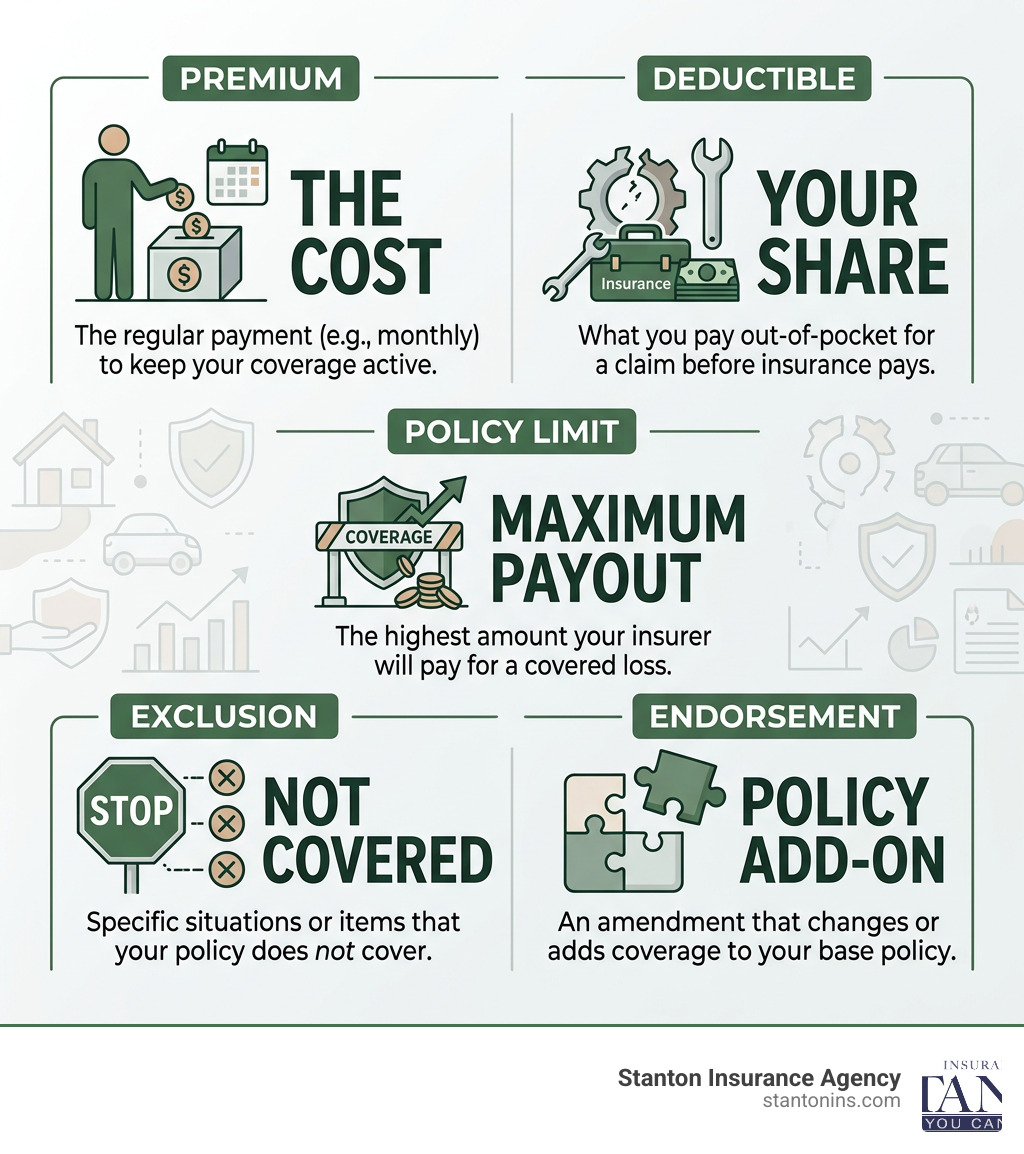
Important understanding insurance terms terms:
The Foundation: Understanding Insurance Terms for Every Policy
Before we dive into the specifics of your car or home, we need to talk about the “Big Three” terms that appear in almost every contract. Whether you are looking at what is term life insurance? or a basic renters policy, these pillars determine what you pay and what you get.
- Premium: This is the “subscription fee” for your insurance. It is the amount of money you pay—typically monthly, quarterly, or annually—to keep your coverage active. If you stop paying the premium, your policy will “lapse,” meaning you have no protection if something goes wrong.
- Deductible: Think of this as your “skin in the game.” It is the amount you agree to pay out-of-pocket before your insurance company starts picking up the tab. For example, if you have a $500 deductible and a tree falls on your car causing $2,000 in damage, you pay the first $500, and the insurance company pays the remaining $1,500.
- Policy Limit: This is the ceiling. It is the maximum amount an insurance company will pay for a covered loss. If you have a $100,000 limit on your home’s contents and a fire destroys $120,000 worth of furniture and clothes, the insurance company stops paying once they hit that $100,000 mark.
For a deeper dive into technical definitions, the Glossary of Insurance Terms from the NAIC is an excellent resource for standardized industry language.
Why Understanding Insurance Terms Reduces Your Risk Profile
When you apply for a policy in Massachusetts or New Hampshire, you go through a process called underwriting. This is where the insurance company acts like a detective. They look at your risk profile—essentially a score of how likely you are to file a claim.
Several factors influence this profile:
- Credit Score: In many states (including New Hampshire, though Massachusetts has specific restrictions on its use for auto insurance), your credit history can influence your “insurance score.”
- Telematics: Many modern carriers offer “usage-based insurance.” By using a plug-in device or a smartphone app, you can share your actual driving habits (speed, braking, time of day) with the insurer. If you’re a safe driver, this can lead to significant discounts.
- Actuarial Data: This is the high-level math. Actuaries use massive amounts of statistical data to predict risks based on your age, location, and the type of property you are insuring.
The Role of an Adjuster in Understanding Insurance Terms
If you ever have to file a claim—known as the First Notice of Loss (FNOL)—you will meet an adjuster.
The adjuster is the licensed professional who investigates the claim. Their job is to:
- Investigate: Verify that the loss actually happened and is covered by your policy.
- Evaluate: Determine the extent of the damage. For a car, they might look at repair shop estimates; for a home, they might inspect the roof.
- Settle: Calculate the final payout based on your policy’s terms and deductibles.

Auto Insurance Essentials: From Liability to Full Coverage
Auto insurance is often the first place people get tripped up by jargon. You might hear the term “full coverage,” but in the industry, that isn’t actually a technical term. Usually, it refers to a combination of several different coverages.
- Liability Insurance: This is mandatory in almost every state. According to our liability insurance definition, it pays for the other person’s medical bills and property damage if you are at fault in an accident. It also covers your legal defense if you get sued.
- Collision Insurance: This covers your own vehicle. As explained in what is collision insurance?, it pays to repair or replace your car if you hit another car or an object (like a fence or a light pole).
- Comprehensive Insurance: This is for everything except a collision. If your car is stolen, keyed by vandals, or damaged by a hailstorm, what is comprehensive insurance cover? explains how this protection kicks in.
- Uninsured/Underinsured Motorist (UM/UIM): This is vital in New England. If someone hits you and they don’t have insurance (or don’t have enough), what is uninsured motorist? coverage steps in to pay for your injuries and damages.
Protecting Your Investment with Specialized Add-ons
Standard policies are great, but sometimes you need a little extra. This is where endorsements (also called riders) come in. These are amendments to your policy that add specific protections.
One of the most common is Gap Insurance. If you total a brand-new car, the insurance company only pays you what the car was worth at the time of the crash. If you owe $30,000 on your loan but the car is only worth $25,000, you’re “underwater” by $5,000. What is gap insurance? clarifies how this add-on covers that “gap.”
Other common add-ons include:
- Rental Reimbursement: Pays for a rental car while yours is in the shop after a covered accident.
- Roadside Assistance: Covers towing, flat tire changes, and jump-starts.
- Accident Benefits: While we focus on MA and NH, those traveling north should be aware of the public automobile insurance plan benefits in places like Quebec, which operate on a different “no-fault” medical system.
Total Loss and Valuation Terms
When a car is badly damaged, the insurer may declare it a Total Loss. This happens when the cost of repairs exceeds the Total Loss Threshold (usually 70-80% of the car’s value). If this happens, the car receives a Salvage Title, meaning it cannot be driven until it is fully repaired and inspected by the state.
But how much do they pay you? That depends on two key terms:
| Valuation Method | Definition |
|---|---|
| Actual Cash Value (ACV) | The “garage sale” price. It’s the replacement cost minus depreciation (wear and tear). |
| Replacement Cost | The “store price.” It’s the amount it would actually cost to buy a new, similar item today without deducting for age. |
Property and Liability: Protecting Your Home and Assets
Your home is likely your biggest asset, so understanding insurance terms here is critical for long-term security.
- Personal Property Insurance: This covers your “stuff”—furniture, electronics, clothes, and even the food in your freezer. What is personal property insurance? explains how this follows you even when you’re traveling.
- Personal Liability: If a guest slips on an icy walkway at your Massachusetts home and sues you, what is personal liability in home insurance? is what pays for your lawyer and any settlement. This also applies to renters; what is personal liability insurance for renters? provides the same protection for those who don’t own the building.
- Loss Assessment: If you live in a condo, the association might charge all owners for damage to common areas (like the lobby or roof). What is loss assessment coverage? helps pay your share of those unexpected bills.
Expanding Protection with Umbrella Policies
Sometimes, the liability limits on your auto or home policy aren’t enough. If you’re involved in a major accident or someone is seriously injured on your property, a lawsuit could easily exceed $500,000.
This is where Umbrella Insurance comes in. As a form of Excess Liability, what is umbrella insurance? (and specifically what is personal umbrella insurance?) acts as a secondary layer of protection. It kicks in after your primary policy is exhausted, protecting your savings and future earnings from claims involving what is bodily injury?.
Named Perils vs. All-Risk Coverage
When you look at your property policy, you’ll see it’s written in one of two ways:
- Named Perils: This policy only covers you for things specifically listed in the document (e.g., fire, lightning, windstorm). If it’s not on the list, it’s not covered.
- All-Risk (Open Perils): This is the gold standard. It covers everything unless it is specifically excluded. Common exclusions include floods, earthquakes, and intentional acts.
For a loss to be covered, it generally must be a Fortuitous Event—an accident that happened by chance, not something you did on purpose or caused through gross neglect. For a full list of what counts as a “peril,” check out the Triple-I guide to property perils.
Advanced Concepts: Understanding Insurance Terms for Claims and Risks
As you get deeper into insurance, you’ll encounter terms that describe how and when claims are handled.
- Occurrence Policy: This covers any incident that happens during the policy period, regardless of when the claim is actually filed.
- Claims-made Policy: This only covers claims if both the incident and the filing of the claim happen while the policy is active. These are more common in professional liability.
- Subrogation: This is the process where your insurance company pays for your loss and then goes after the “at-fault” party’s insurance to get their money back. It’s essentially them “stepping into your shoes” to settle the score.
- Depreciation: The decrease in value of an item over time due to age and wear.
- Diminished Value: The loss in resale value a car suffers even after it has been perfectly repaired following an accident.
Business and Professional Liability Terminology
If you run a business in New Hampshire or Massachusetts, the terminology gets even more specialized.
- Cyber Liability: In an age of data breaches, what is cyber liability insurance? is essential for protecting against the costs of hacked systems or stolen customer data.
- D&O (Directors and Officers): What is director and officer liability insurance? protects the personal assets of corporate leaders if they are sued for their management decisions.
- Builders Risk: If you’re constructing a new building, what is builders risk guide? explains how this covers the structure while it’s under construction.
- Professional Indemnity: Also known as Errors and Omissions (E&O), this protects professionals (like architects or consultants) against claims of negligence or bad advice.
Policy Lifecycle and Maintenance
Your relationship with your policy isn’t “set it and forget it.” It has a lifecycle:
- Binder: A temporary document that provides proof of insurance before the formal policy is issued.
- Renewal Process: Every 6 or 12 months, your policy will come up for renewal. This is the best time to review your coverage and see if your risk profile has changed.
- Cancellation: If you cancel a policy mid-term, you might be subject to a Short Rate Penalty—a fee for breaking the contract early.
- Lapse: If you fail to pay your premium and the policy is cancelled, you have a “lapse in coverage.” This not only leaves you unprotected but can also make your future premiums much higher.
Frequently Asked Questions about Understanding Insurance Terms
What is the difference between a deductible and a premium?
A premium is the recurring price you pay (monthly or annually) to keep your insurance active, similar to a subscription. A deductible is a one-time amount you pay out-of-pocket only when you file a claim for a covered loss. Generally, choosing a higher deductible will lower your premium.
What does liability coverage actually protect against?
Liability coverage protects your financial assets if you are found legally responsible for injuring someone else or damaging their property. It covers the costs of settlements or judgments against you, and perhaps most importantly, it pays for your legal defense fees, which can be astronomical even if you win the case.
How do endorsements modify my existing policy?
Endorsements, also known as riders, are written amendments that change the original terms of your policy. They can be used to add coverage (like a rider for an expensive engagement ring), delete coverage, or change limits. They allow you to customize a “cookie-cutter” policy to fit your specific life.
Conclusion
At the end of the day, understanding insurance terms isn’t just about winning a trivia night—it’s about protecting the life you’ve worked hard to build. When you know the difference between ACV and Replacement Cost, or why an Umbrella policy is a smart move for your family, you move from a place of confusion to a place of power.
At Stanton Insurance Agency, we believe in trusted protection. We aren’t just here to sell you a policy; we’re here to be your Massachusetts and New Hampshire insurance experts. We take the time to explain the jargon so you can sleep soundly knowing your home, car, and business are properly covered.
Ready to see how these terms apply to your own life? Get a personalized quote for Auto Insurance today and let us help you build a policy you actually understand.