
What Is Insurance for Sole Traders — and Do You Need It?
Insurance for sole trader businesses is not legally required in most cases — but it is one of the smartest financial decisions you can make as a self-employed person. Here’s a quick summary of what you need to know:
| Question | Quick Answer |
|---|---|
| Is sole trader insurance mandatory? | Generally no, but some industries and client contracts require it |
| What coverage do most sole traders need? | General liability and professional indemnity are the most common starting points |
| Does home insurance cover my business? | No — most home policies exclude or severely limit business-related claims |
| Can my personal assets be at risk? | Yes — as a sole trader, your personal and business finances are legally the same |
| How much does it cost? | Policies can start as low as a few dollars a month, depending on your trade and coverage level |
Running your own one-person business means you get the freedom to call the shots. But it also means you personally absorb every financial risk your business faces. There’s no employer behind you, no corporate shield, and no safety net — just you, your work, and whatever happens along the way.
A client injury, a professional mistake, a stolen laptop, a lawsuit — any one of these could cost thousands of dollars out of your own pocket. And if you think your homeowner’s policy has you covered, it almost certainly doesn’t. Most personal policies either exclude business-related claims entirely or cap payouts at amounts far too low to matter.
I’m Geoff Stanton, President of Stanton Insurance Agency and a Certified Insurance Counselor (CIC) with over two decades of experience helping small business owners — including sole traders — find the right insurance for sole trader situations in Massachusetts and New Hampshire. In this guide, I’ll walk you through exactly what coverage you need, what’s legally required in our region, and how to protect your livelihood without overpaying.
Quick insurance for sole trader terms:
- Personal Liability Insurance
- definition for liability insurance
- personal liability insurance definition
Why You Need Dedicated Insurance for Sole Trader Operations
The biggest misconception we encounter at Stanton Insurance Agency is the idea that a “small” business only has “small” risks. In reality, as a sole proprietor, you face the same legal liabilities as a major corporation, but without the massive legal department to back you up.
The Personal Liability Trap
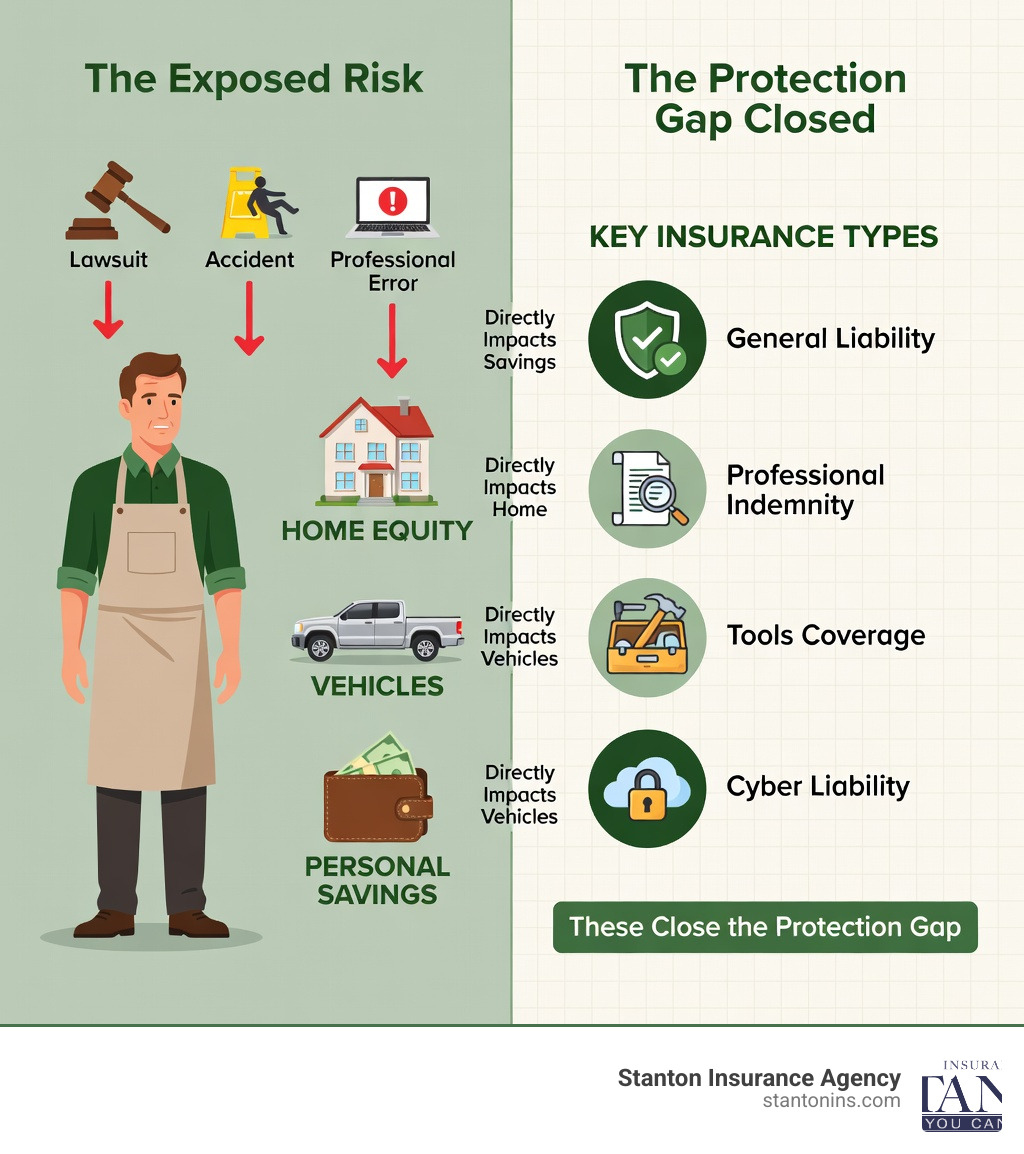
In a sole proprietorship, there is no legal separation between you and your business. As the U.S. Small Business Administration (SBA) points out, this means you are personally responsible for all business debts and obligations. If a client sues you for $100,000 and you don’t have business-liability-insurance, that money doesn’t just come from your business checking account—it can come from your personal savings, your car’s equity, or even your home.
Why Your Home Policy Isn’t Enough
Many sole traders operating out of a home office in Manchester, NH, or Worcester, MA, assume their homeowners insurance will step in. Unfortunately, what-is-personal-liability-insurance is designed for “non-business” activities. Most homeowner policies specifically exclude business-related claims. If a delivery person trips on your porch while dropping off a business package, or if a fire starting in your business printer destroys your house, your personal policy might deny the claim entirely.
The Cost of Defense
Even if you did nothing wrong, the cost of defending yourself in court can be staggering. A dedicated insurance for sole trader policy doesn’t just pay out settlements; it provides for your legal defense, hiring experts and lawyers to protect your reputation and your wallet. Without this, a single “frivolous” lawsuit could result in bankruptcy simply from the legal fees alone.
Essential Coverage: The Best Insurance for Sole Trader Professionals

When we sit down with a new freelancer or contractor, we look at two primary pillars of protection. While every business is unique, most “one-person bands” need a combination of General Liability and Professional Liability.
Commercial General Liability (CGL)
Think of commercial-general-liability as your “slip and fall” insurance. It protects you if your business activities cause physical injury to someone else or damage their property.
- Example: You are a self-employed painter in Nashua. You accidentally knock over a ladder, smashing a client’s expensive stained-glass window. CGL covers the repair costs.
Professional Indemnity (Errors & Omissions)
If you provide advice, designs, or professional services, you need Errors & Omissions (E&O) / Professional Liability. This covers financial losses caused by your mistakes or negligence.
- Example: You are a freelance accountant. A math error on a client’s filing results in a $10,000 IRS penalty. They sue you for that amount. E&O is what steps in to help.
The “BOP” Advantage
For many, the most cost-effective route is a Business Owners Policy (BOP). This bundles general liability with property insurance, often at a lower rate than buying them separately.
| Coverage Type | What it Protects | Real-World Example |
|---|---|---|
| General Liability | Third-party bodily injury & property damage | A client trips over your laptop cord in your office. |
| Professional Liability | Financial loss from errors or bad advice | You miss a deadline that causes a client to lose a contract. |
| Business Property | Your equipment, tools, and inventory | Your work laptop is stolen from your locked vehicle. |
Navigating Mandatory Requirements in Massachusetts and New Hampshire
While the federal government doesn’t mandate insurance for sole trader entities, the states of Massachusetts and New Hampshire certainly have their own rules.
Workers’ Compensation
In Massachusetts, the laws are quite strict. Our small-business-insurance-ma-guide notes that almost all employers are required to carry Workers’ Comp. While a “pure” sole trader with zero employees is often exempt, you might still need it to win contracts. Many general contractors in the North Shore or Boston area won’t let you on a job site without a certificate of insurance (COI) showing you have Workers’ Comp, even if you’re working alone.
In New Hampshire, the rules are slightly different, but the New Hampshire Insurance Department still emphasizes that coverage is a vital safety net. If you ever hire a “casual” helper or a seasonal intern, you’ve crossed the line into needing mandatory coverage.
Commercial Auto Insurance
If you use your vehicle to transport tools, deliver products, or visit multiple job sites a day, your personal car-insurance might not cover an accident. If you’re a florist in Concord delivering arrangements or a consultant in Burlington driving to client meetings, you should talk to us about a commercial endorsement. Personal policies are for commuting; business-insurance is for everything else.
Contractual Mandates
Even if the law doesn’t require it, your clients might. It is increasingly common for professional service contracts to require a minimum of $1 million in General Liability coverage before you can even sign the dotted line.
Protecting Your Digital and Physical Assets
In 2025, a sole trader’s most valuable asset is often their data or their specialized tools. If either is compromised, the business grinds to a halt.
Cyber Liability Insurance
Don’t think you’re too small for hackers. Small businesses are often targeted because they have weaker defenses. Cyber-insurance-for-small-business is essential if you store client emails, credit card info, or sensitive project data. It covers the costs of notifying clients after a breach, data recovery, and even legal fees if you’re sued for a leak.
Tools and Equipment (Inland Marine)
If you are a tradesperson, your tools are your livelihood. Standard small-business-insurance property coverage often only covers items while they are at your business premises. If your tools are stolen from a job site or your van, you need “Inland Marine” coverage (a fancy insurance term for property in transit).
Business Interruption
What happens if a fire forces you out of your home office for two months? You still have bills, but you can’t work. Business Interruption insurance, often detailed in our business-liability-ultimate-guide, replaces your lost income and helps pay for a temporary workspace so you can keep your business alive while you recover.
Frequently Asked Questions about Insurance for Sole Trader Businesses
Is public liability insurance mandatory for a sole trader?
Legally, no, but practically, yes. While Massachusetts and New Hampshire state guidelines agree it isn’t a federal law, you’ll find it nearly impossible to work with reputable clients without it. Most commercial landlords and project managers will require a COI (Certificate of Insurance) to prove you have coverage for third-party injuries. Working with a business-insurance-broker is the fastest way to get these certificates issued so you don’t miss out on work.
Can I use my home insurance for my business?
As we’ve touched on, this is a dangerous game. Standard home policies have very low limits (often $2,500) for “business property” and usually zero coverage for business liability. An independent-insurance-agency like ours can help you bridge this gap. Sometimes we can add a simple “home-based business” endorsement to your existing policy, but often a separate, affordable commercial policy is the only way to ensure you’re truly protected. Understanding what-is-an-independent-insurance-agency helps you see why we can shop multiple carriers to find the one that plays nice with home-based setups.
How much does insurance for sole trader coverage cost?
The cost is likely lower than you think. For a low-risk consultant, a basic policy can cost less than a monthly cell phone bill. Factors that affect your price include:
- Your Industry: A roof repairer pays more than a graphic designer.
- Revenue: Higher earnings can mean higher risk exposure.
- Location: Rates in Boston may differ from rural New Hampshire.
- Claims History: Staying claim-free keeps your rates low.
As the best-independent-insurance-agency in our area, we specialize in finding “sweet spot” policies that provide maximum protection for a minimal monthly investment.
Conclusion: Securing Your Future with Stanton Insurance Agency
Being a sole trader is an act of bravery. You’ve bet on yourself, and that’s something we deeply respect at Stanton Insurance Agency. But being brave shouldn’t mean being reckless. Without the right insurance for sole trader protections, you are one bad day away from losing everything you’ve worked so hard to build.
We don’t believe in “one size fits all” insurance. We take the time to understand whether you’re a freelance writer in Portsmouth or a landscaper in Danvers. Our goal is to provide trusted protection for your most valuable assets—your business and your personal peace of mind.
Don’t leave your future to chance. Let us help you navigate the complexities of Massachusetts and New Hampshire insurance requirements so you can get back to what you do best: running your business.
Get a personalized quote for your business today and see how affordable professional protection can be. Whether you need a simple COI for a new client or a comprehensive bundle, our business-insurance-broker team is ready to help you thrive.