
Ultimate D&O Shield 2025: Protect Leaders
Why Directors and Officers Face Growing Personal Liability Risks
Directors and officers liability prevention insurance and indemnification protects business leaders from personal financial losses when they’re sued for their management decisions. Here’s what you need to know:
- Indemnification: The company’s promise to pay legal costs and damages on behalf of directors and officers
- D&O Insurance: Specialized coverage that kicks in when the company can’t or won’t indemnify
- Prevention: Strong corporate governance and clear policies to reduce liability risks
- Coverage Types: Side A (personal protection), Side B (company reimbursement), Side C (entity coverage)
Serving as a director or officer of any organization carries significant responsibility and personal risk. Whether you’re leading a publicly traded corporation, private business, or local nonprofit, even unfounded allegations can result in costly litigation that threatens your personal assets.
The numbers tell the story: 80% to 90% of public M&A deals face stockholder litigation, and more than 25% of private companies report D&O losses over three years. These aren’t just large corporation problems – small businesses and nonprofits face claims from employees, vendors, customers, and regulators.
The good news? A proper defense strategy combining corporate indemnification, D&O insurance, and strong governance can shield leaders from devastating financial exposure.
I’m Geoff Stanton, President of Stanton Insurance Agency, and I’ve spent over two decades helping Massachusetts and New Hampshire businesses protect their leadership teams through comprehensive directors and officers liability prevention insurance and indemnification programs. My experience in claims management and commercial insurance has shown me how critical these protections are for attracting and retaining quality leadership.
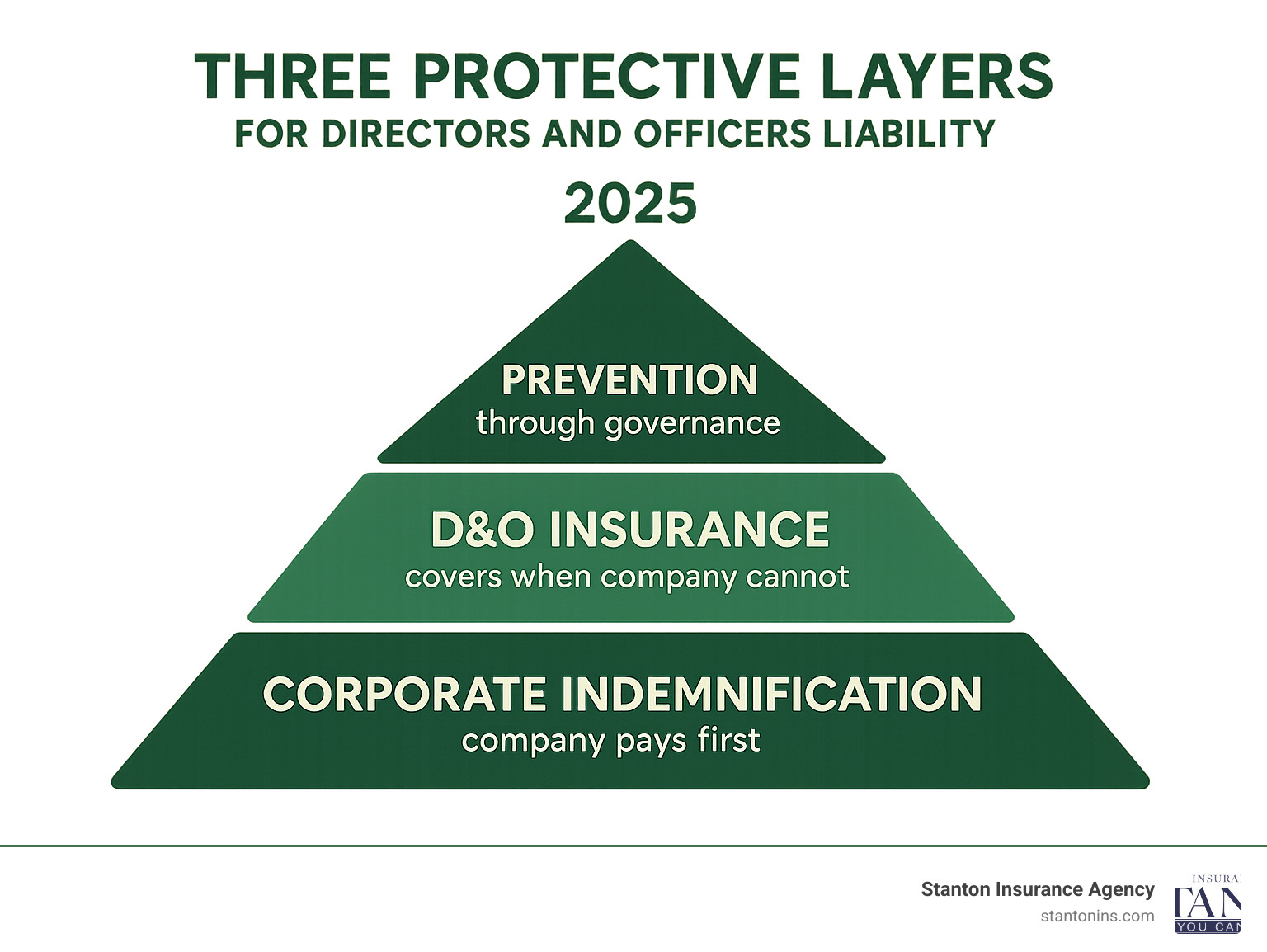
Simple guide to directors and officers liability prevention insurance and indemnification terms:
- management liability insurance
- is director and officer’s insurance included in general liability
- directors and officers insurance cost
The Foundation of Protection: Corporate Indemnification
Think of corporate indemnification as the bedrock of your protection as a director or officer. It’s essentially a formal promise from the company you serve. This promise says, “If you’re sued because of your work here, we’ll cover your legal costs, settlements, and any judgments.”
Why is this so important? Well, these leadership roles come with big responsibilities and big risks. Without this promise, talented individuals might simply say “no thanks!” to joining a board. Indemnification helps attract and keep the best people. It’s not just a nice gesture; it’s a vital part of building a strong leadership team.
You’ll usually find this protection outlined in the company’s bylaws or articles of incorporation. But for the strongest possible shield, you’d ideally want a separate, dedicated indemnification agreement, or even a Deed of Access, Indemnity, and Insurance. While a company’s promise to indemnify can sound unlimited, it’s always tied to its financial health. This makes it a crucial first line of defense, but not the only one, in your comprehensive strategy for directors and officers liability prevention insurance and indemnification.
Legal Boundaries and the Importance of Agreements
Now, while indemnification is powerful, it’s not a blank check. State laws, like Maine’s Title 13-B, §714 and similar rules here in Massachusetts and New Hampshire, set the boundaries. For example, a company generally can’t protect a director if they acted in bad faith, engaged in willful misconduct, or breached their duty of loyalty. This makes sense, right? It’s about protecting honest leadership.
This is precisely why a standalone indemnification agreement is so incredibly valuable. Unlike general company bylaws, it’s a binding contract. That means it’s much harder for a company to change or revoke it later. It gives you, as a director, clearer and more enforceable rights. This includes something super important: the company’s promise to advance your legal defense fees upfront. Imagine facing a lawsuit without that!
There’s a lot more focus on individual accountability. Directives, like one from the U.S. Department of Justice, emphasize that agencies are looking closely at individual executives in cases of misconduct. This means you, as a leader, are under the microscope more than ever.
With this heightened scrutiny, having a strong, custom indemnification contract is key. While the company’s promise sounds unlimited, remember it’s always tied to their financial ability. So, having your own agreement, carefully negotiated, can provide a much more robust and personally enforceable layer of protection. A good agreement will spell out everything: the key terms, how your defense costs will be advanced, and the clear process for getting indemnified. These personalized contracts are much stronger than general provisions in company documents because they’re a two-way street—a contract that can’t be changed without your agreement.
Learn more: What is director and officer liability insurance?
What is Directors and Officers (D&O) Liability Insurance?

Think of directors and officers liability prevention insurance and indemnification as your financial safety net when corporate indemnification isn’t enough. This specialized coverage serves as the critical second layer of protection, stepping in when your company either can’t or won’t cover the costs of defending you against claims.
The reality is that even well-intentioned companies sometimes can’t fulfill their indemnification promises. Maybe the company is facing bankruptcy and simply doesn’t have the funds. Perhaps you’re dealing with a shareholder derivative suit where the law actually prohibits the company from indemnifying you. Or there might be a specific type of claim that falls outside what the company can legally cover.
When these situations arise, D&O insurance becomes your personal shield. It protects your home, your savings, and your other personal assets from being used to pay for defense costs, settlements, or judgments. The financial stakes are real—legal defense costs alone can easily reach six or seven figures, even for claims that ultimately prove to be groundless.
This insurance works hand-in-hand with corporate indemnification. When your company does step up to cover your legal costs, D&O insurance often reimburses the company, helping preserve its financial strength. When the company can’t help, the insurance provides direct protection to you personally.
Who Needs D&O Insurance and How Does It Differ from CGL?
The simple answer is that virtually every organization with leadership needs this protection. Whether you’re running a publicly traded corporation, a family business, or volunteering on a nonprofit board, you face potential liability for your management decisions.
The numbers tell a sobering story. More than 25% of private companies reported a D&O loss over just three years, with 96% of those experiencing negative financial impacts. Small businesses often face even greater vulnerability because they typically have fewer financial resources to weather a legal storm.
Here’s where many people get confused: D&O insurance is completely different from your Commercial General Liability (CGL) policy. Your CGL covers physical problems—like when someone slips and falls at your office or your product causes property damage. D&O insurance covers the financial fallout from your management decisions, oversight responsibilities, and fiduciary duties.
For example, if an employee claims you discriminated against them in a promotion decision, that’s a D&O claim. If a vendor sues claiming your company’s financial statements were misleading, that’s D&O territory. If regulators investigate your compliance practices, you’ll need D&O coverage for those defense costs. These management-related risks are explicitly excluded from standard business liability policies.
The distinction matters because without proper D&O coverage, you’re essentially going without insurance for some of the most common and expensive claims that business leaders face today.
Learn more: Is Director and Officers Insurance Included in General Liability?
Deconstructing the D&O Policy: Sides, Exclusions, and Key Terms
A D&O policy isn’t something you can pick off the shelf and expect to work perfectly for your situation. Think of it more like a custom-custom suit—it needs to fit your organization’s specific risks and circumstances. The complexity of these policies can be overwhelming at first, but understanding the core structure will help you make informed decisions about protecting your leadership team.
The heart of any directors and officers liability prevention insurance and indemnification policy lies in its three-part structure, commonly called “Sides.” Each side serves a different purpose and protects different parties, working together to create comprehensive coverage for your organization.
The Three Sides of D&O Coverage
Side A coverage is the most critical protection for individual directors and officers. This is your personal safety net when the company can’t or won’t step in to help. It covers your personal assets—your home, savings, and other investments—when you’re facing legal costs, settlements, or judgments from a lawsuit related to your role as a leader.
Side A kicks in during some pretty scary scenarios. If your company goes bankrupt, it obviously can’t pay your legal bills. When shareholders file derivative suits (essentially suing you on behalf of the company), the law often prohibits the company from indemnifying you. This coverage is also known as non-indemnifiable loss coverage, and it provides limits exclusively for claims against individual directors and officers that aren’t covered by company indemnification.
Side B coverage protects the company’s balance sheet. When your organization does the right thing and covers your legal expenses through indemnification, Side B reimburses the company for those costs. This keeps the company financially healthy while still protecting its leaders. It’s essentially insurance for the company’s promise to protect you.
Side C coverage protects the company itself when it gets sued directly. While this is most common for publicly traded companies facing securities claims or shareholder class actions alleging misrepresentation, private companies and nonprofits can benefit too. These organizations might face entity claims related to employment practices or other management decisions that affect the organization as a whole.
Understanding Key Policy Terms and Exclusions for Directors and Officers Liability Prevention, Insurance, and Indemnification
D&O policies come with some unique features that can catch you off guard if you’re not prepared. Most importantly, these are “claims-made” policies. This means the policy must be active when someone files a claim against you, regardless of when the alleged wrongful act actually happened. Some policies are even more restrictive, requiring that claims be both made and reported during the policy period.
This timing requirement makes continuous coverage absolutely essential. A gap in your D&O coverage—even for just a few days—can leave you completely exposed to claims from past actions.
Another critical feature is “shrinking limits” or “eroding limits.” Every dollar spent on legal fees comes directly out of your policy limit, reducing what’s available for settlements or judgments. If you have a $1,000,000 policy and spend $250,000 on defense costs, you only have $750,000 left for everything else. This reality makes it crucial to buy adequate coverage limits from the start.
Policy exclusions can be deal-breakers if you don’t understand them. Most policies won’t cover claims arising from fraud or criminal acts, though they may provide defense coverage until there’s a final legal determination of guilt. The “insured vs. insured” exclusion prevents coverage when one director sues another, and other exclusions eliminate coverage when other policies already provide protection.
One of the most important features to look for is a “severability clause.” This provision prevents one director’s wrongful acts from destroying coverage for everyone else on the board. Without this protection, one person’s misconduct could leave all the “innocent” directors without coverage when they need it most.
Capacity exclusions can also limit coverage if a claim involves actions outside your official director or officer role, even if other covered acts are involved. These subtle policy details can make the difference between full coverage and no coverage at all.
The devil is truly in the details with D&O policies. Slight wording changes can significantly impact coverage, especially for alleged fraudulent acts. That’s why working with experienced insurance professionals who understand these nuances is so important for building effective directors and officers liability prevention insurance and indemnification protection.
Learn more: Directors and Officers Liability Insurance Explained
A Comprehensive Strategy for Directors and Officers Liability Prevention, Insurance, and Indemnification

You know, just hoping for the best when it comes to leadership liability isn’t really a plan; it’s a recipe for trouble! What we need is a robust defense, a shield built with multiple layers. This means being proactive and combining smart governance, solid contractual protections, and an insurance program that truly fits your needs. When these elements work together, they create a comprehensive approach that really protects both your organization and its individual leaders from the financial fallout of a lawsuit.
It all starts with good governance. Think of it as setting clear boundaries and having a strong roadmap. This includes things like having excellent internal controls and a well-defined code of conduct. These practices help you spot potential problems early and ensure your risk management strategies are well in place. Plus, doing things right can even lead to better terms and premiums on your D&O insurance!
Advanced D&O Liability Scenarios and Protections
Beyond the typical management claims we often hear about, directors face some pretty unique risks. For example, there are “veil piercing” claims. These are attempts to hold directors personally responsible for company debts, often because someone alleges the corporate structure was misused—perhaps by mixing personal and company money, or not properly funding the business. In these tough situations, the company might not be able or willing to step in and indemnify you. That’s when your D&O insurance truly becomes your sole protector. You see, you shouldn’t just rely on the company always being able to cover you, especially if there are allegations of fraud or abuse.
Then there’s “Outside Position Liability.” This comes into play when you serve on another board, like a charity or a subsidiary, at your company’s request. It’s an often-overlooked area that can create significant, unexpected liability for you personally and for the company that asked you to serve. These roles can bring up complicated issues like dual loyalties or even joint liability. Your company’s D&O coverage for these situations usually acts as “excess” coverage, meaning it kicks in after any protection from the outside entity. Smart companies have clear programs to manage these appointments and make sure their D&O coverage lines up perfectly.
And let’s not forget Mergers and Acquisitions (M&A). These are absolute hotbeds for litigation! Statistics show that a whopping 80% to 90% of public M&A deals are challenged by shareholder lawsuits. These suits often claim breaches of fiduciary duty or issues with disclosures. D&O insurance is incredibly important during these times because M&A activity significantly increases the risk of lawsuits against directors and officers. It’s also crucial to think about tail coverage (or “runoff” programs) after a deal closes. This extends protection for claims that pop up later but relate to wrongful acts that happened before the M&A. A truly effective D&O program needs to anticipate and cover these advanced scenarios.
Learn more: Directors and Officers Insurance for Nonprofits
The Evolving Risk Landscape: Regulatory Scrutiny and Modern Threats
The world of risk for directors is always changing, isn’t it? We’re seeing much more regulatory scrutiny and a sharper focus on individual accountability. This means every decision is being examined more closely than ever before. For instance, the chance of a public company being sued in a securities class action has jumped significantly, from 3.5% in 2014 to 8.5% in 2018. This trend, combined with the U.S. Department of Justice’s strong focus on individual accountability, makes robust directors and officers liability prevention insurance and indemnification more essential than ever.
And it’s not just traditional risks. New threats are constantly emerging. Major cyber incidents, for example, can trigger D&O claims if the board is seen as having failed in its oversight duties regarding data security or privacy. While cyber insurance covers the direct costs of a breach, your D&O policy can protect you from claims related to management decisions around those cyber incidents. As artificial intelligence becomes more and more a part of our businesses, we also expect to see claims related to “AI washing” (where companies misrepresent their AI capabilities) or the mishandling of AI-related risks. These create brand new avenues of liability for corporate leaders. This constantly evolving landscape truly highlights why you need flexible and comprehensive D&O coverage.
Personal and Specialized Coverage Options for Directors and Officers Liability Prevention, Insurance, and Indemnification
If you have significant personal assets, or if you serve on several boards, a corporate D&O policy might not be quite enough on its own. That’s where Personal Directors Liability (PDL) insurance comes in. This is a policy you purchase yourself to provide dedicated, extra coverage on top of any corporate D&O policies. PDL can even act as first-dollar coverage if no indemnification is available. This makes it perfect for high-net-worth individuals, those who sit on many boards, or anyone concerned about a nonprofit’s financial ability to indemnify its leaders. Some newer PDL policies even offer blanket coverage for your whole family, protecting multiple members across various directorships!
When your company is looking at corporate D&O, it’s also really important to think about getting a standalone policy versus just an endorsement to another insurance package. Now, an endorsement (like adding D&O coverage to your Commercial General Liability policy) can seem cheaper and simpler. But a standalone D&O policy almost always offers broader, more specialized coverage. With an endorsed policy, D&O claims might even cause your premiums or renewals for your other business policies to go up. A standalone policy keeps D&O claims separate, protecting the premiums and renewal of your other essential business insurance. Often, a standalone policy gives you better, more comprehensive protection in the long run.
Learn more: Management Liability Insurance
Frequently Asked Questions about D&O Protection
Is D&O insurance necessary for small businesses or nonprofits?
Absolutely, yes! It’s a common misconception that directors and officers liability prevention insurance and indemnification is only for big corporations with fancy boardrooms. But the truth is, small businesses and nonprofits are just as, if not more, vulnerable to lawsuits. They often don’t have the deep pockets needed to cover the huge costs of a legal defense.
Think about it: claims can come from so many places – unhappy vendors, disgruntled customers, employees, donors, or even government regulators. For organizations right here in Massachusetts, New Hampshire, and Maine, these risks are very real. In fact, a study by Chubb showed that over 25% of private companies faced a D&O loss in just three years, and a staggering 96% of them felt a financial hit. This really highlights why D&O insurance isn’t just for the Fortune 500; it’s a vital safeguard for organizations of any size.
What is the difference between a ‘claims-made’ and an ‘occurrence’ policy?
This is a really important distinction when it comes to insurance policies! Let’s break it down simply.
An “occurrence” policy is what you often see with general liability insurance. It covers wrongful acts that happen during the policy period, no matter when the actual claim is filed. So, if something goes wrong today, but the lawsuit doesn’t pop up until years from now, an occurrence policy from today would still cover it.
On the other hand, a “claims-made” policy is the standard for D&O insurance. This means the policy only covers claims that are made and reported during the active policy period. Both the alleged wrongful act and the claim itself need to fall within the policy’s effective dates. Because of this, keeping your D&O coverage continuous and uninterrupted is super important. You don’t want any gaps that could leave you exposed!
Do defense costs reduce my D&O policy limit?
Yes, in most D&O policies, they do. This is a critical feature to understand, and it’s often called a “shrinking” or “eroding” policy limit.
Here’s what that means: every dollar spent on legal fees, attorney costs, and other defense expenses directly reduces the total amount of money available under your policy. So, if you have a $1 million policy limit and your legal defense costs reach $300,000, you’d only have $700,000 left for any potential settlement or judgment. Since legal costs can add up incredibly fast, knowing this helps you figure out exactly how much coverage your organization truly needs to feel secure.
Conclusion: Building Your Leadership Shield
Protecting the dedicated directors and officers who steer our organizations calls for more than just a single insurance policy. It’s about crafting a strong, multi-layered shield. Think of it as a robust defense strategy that works on several fronts.
This powerful shield starts with solid corporate governance. Good practices and clear rules help prevent missteps from happening in the first place. Next, it’s reinforced by a clear and binding indemnification agreement. This is your company’s promise to stand by its leaders. Finally, it’s all backed up by a comprehensive directors and officers liability prevention insurance and indemnification program. This program is specially designed to fit your organization’s unique needs and risks.
Navigating all these different layers might seem a bit daunting. But protecting the individuals who guide your organization is an incredibly important duty. It ensures you can attract and keep the very best talent, allowing them to focus on their mission without constant worry about personal financial risk.
At Stanton Insurance Agency, we truly get these complexities. Our team brings decades of experience to the table, helping businesses right here in Massachusetts, New Hampshire, and Maine. We’re here to help you understand your specific risks and build a D&O program that offers genuine peace of mind.
Ready to ensure your leadership team is fully protected? Don’t leave their personal assets vulnerable. Explore our business insurance solutions today, and let’s build that leadership shield together!