
Why Health Insurance Technology Companies Are Reshaping Coverage in 2026
Health insurance technology companies are transforming one of the most complex industries in the world — making it faster, smarter, and more transparent for everyone involved.
Here are some of the top health insurtech companies you should know about right now:
| Company | Core Focus | Notable Stat |
|---|---|---|
| Devoted Health | Medicare Advantage | $12.9B valuation |
| Cityblock Health | Value-based care | $5.7B valuation |
| Collective Health | Employer health benefits | $1.5B valuation |
| HealthJoy | Employee benefits navigation | AI virtual assistant |
| Shift Technology | AI fraud detection | 100M+ suspicious claims detected |
| Oscar Health | Consumer health insurance | Founded 2012, unicorn status |
The numbers tell a clear story. As of 2023, there were 140 healthtech unicorns globally, collectively valued at over $320 billion. In the US alone, there are now 1,500 insurtech companies — and 25 have crossed the $1 billion valuation mark.
This isn’t just a Silicon Valley story. Cities like Chicago, Boston, and beyond are producing startups that are rethinking everything from claims processing to fraud detection to how employees pick a health plan.
I’m Geoff Stanton, President of Stanton Insurance Agency in Waltham, Massachusetts, and with over 25 years in the insurance industry — including time in claims — I’ve watched health insurance technology companies evolve from simple digital forms to full AI-powered platforms. Understanding these companies helps you make smarter decisions about your own coverage.
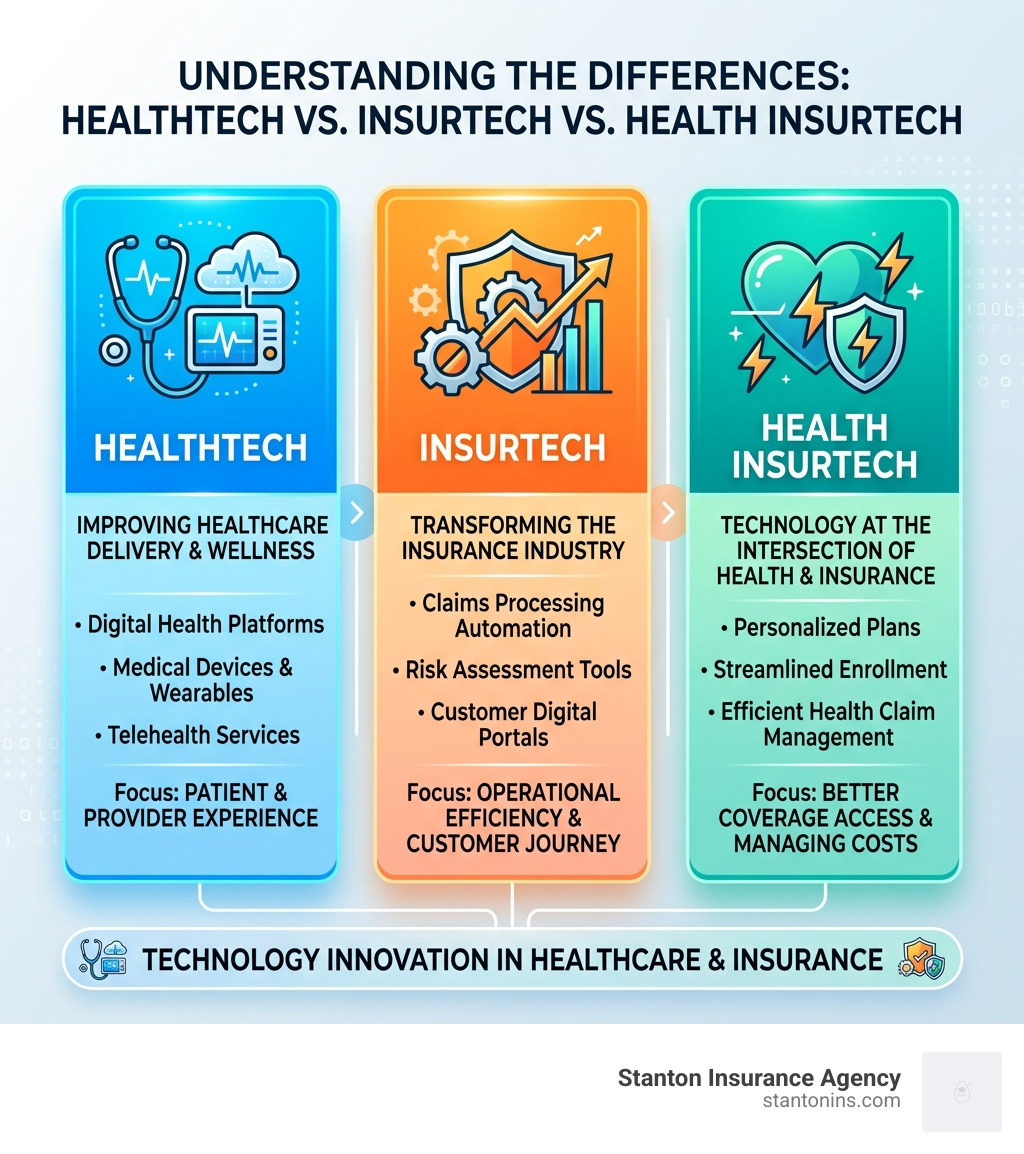
Simple guide to health insurance technology companies:
The Evolution of Health Insurance Technology Companies
The insurance world used to be a place of endless paper trails and “we’ll get back to you in ten business days.” But things have changed. Today, health insurance technology companies (often called health insurtechs) are disrupting the status quo by applying modern software to age-old problems.
While “HealthTech” focuses on clinical outcomes—like a new app for monitoring heart rates—and “Insurtech” might focus on auto or home policies, health insurtech sits right in the middle. These companies specialize in the “plumbing” of the healthcare system: how we enroll in plans, how claims get paid, and how premiums are calculated.
For those of us working at Independent Health Insurance Agencies, we see the impact of this disruption every day. It’s no longer just about digitizing a PDF; it’s about using data to predict health risks before they become expensive medical emergencies. This shift is also vital for employers managing complex transitions, such as navigating What is COBRA Insurance? for departing staff, as tech platforms now automate much of that administrative burden.
Key Innovations from Health Insurance Technology Companies
The “secret sauce” for these companies usually involves two things: big data and predictive analytics. By analyzing millions of data points, these platforms can spot trends that a human adjuster might miss.
For example, companies like Softheon have built Healthcare Software Solutions for Payers & Government that manage over 30 million enrollments. They use automation to handle the heavy lifting of billing and reconciliation, which used to take months but now happens in real-time. Similarly, Simplify Healthcare provides Cloud Based Health Plan Management Solutions that replace messy spreadsheets with smart workflows. This ensures that when you look at your benefit summary, the information is actually accurate and compliant with the latest regulations.
Why Health Insurance Technology Companies are Essential for Payers
In the past, insurance companies (payers) were often seen as the “bad guys” who just collected checks and denied claims. Modern health insurance technology companies are helping payers evolve into “partners in care.”
Platforms like HealthEdge are providing Healthcare SaaS To Accelerate Digital Transformation, moving insurers toward “touchless” transaction processing. This means claims are paid faster and with fewer errors. Another leader, Abacus Insights, focuses on making data “usable.” Their platform updates data every 15 minutes—a massive leap from the industry average of 24 hours—allowing insurers to react instantly to a member’s needs.
Leading Health Insurtech Unicorns to Watch in 2026
In startups, a “unicorn” is a private company valued at over $1 billion. In the health insurance space, these aren’t just rare beasts; they are the new heavyweights.
| Company | Valuation | Primary Focus |
|---|---|---|
| Devoted Health | $12.9 Billion | Medicare Advantage & Integrated Care |
| Cityblock Health | $5.7 Billion | Medicaid & Lower-Income Communities |
| Tempus | $8.1 Billion | Data-Driven Precision Medicine |
| Collective Health | $1.5 Billion | Self-Funded Employer Platforms |
| Next Insurance | $4.0 Billion | Small Business Coverage |
In our neck of the woods, the Top Massachusetts Insurance Startups 2026 list is growing rapidly. We are seeing a massive influx of capital into companies that can prove they save money for both the insurer and the policyholder.
High-Growth Startups and Market Valuations
The growth is staggering. By April 2026, the global healthtech market has seen its valuation soar past $320 billion. Much of this is driven by Series E and Series F funding rounds where investors pour hundreds of millions into proven platforms.
For those tracking the Top Boston, MA Health Tech Companies 2026, names like Centauri Health Solutions stand out. They specialize in Healthcare Technology and Services that help health plans manage risk adjustment and eligibility for Medicaid and Medicare Advantage. By turning fragmented data into “intelligent actions,” they help ensure that the most vulnerable populations get the coverage they deserve.
Specialized Platforms for Employee Benefits
If you’ve ever tried to understand your company’s dental or vision benefits, you know it can feel like reading ancient Greek. Health insurance technology companies are fixing this with “concierge-style” platforms.
HealthJoy, for instance, uses an AI virtual assistant to guide employees through their plans. It features a digital wallet for insurance cards and a benefits summary that actually makes sense. Meanwhile, Bamboo Health is a Leader in Real-Time Care Intelligence™, connecting physical and behavioral health data. Their network is used by over 2,500 hospitals to ensure that when a patient is discharged, their insurer and primary care doctor know about it instantly, preventing costly readmissions.
Core Technologies Driving the Insurtech Revolution

What’s actually happening under the hood of these health insurance technology companies? It’s more than just a pretty website. We are now in the era of “Agentic AI”—AI that doesn’t just answer questions but can actually perform tasks, like reconciling a disputed claim or flagging a potential data breach.
This technology is especially important for Cyber Insurance for Technology Companies. As insurtechs handle more sensitive health data, they need robust protection. Many startups now bundle Technology BOP Insurance to cover both their physical assets and their digital liabilities.
AI in Fraud Detection and Risk Assessment
Fraud is a multi-billion dollar drain on the healthcare system. Shift Technology is a prime example of a company using AI to fight back. Their platform has analyzed over 1 billion policies and claims, helping top global insurers detect over 100 million suspicious activities.
This level of scrutiny is also vital for Cyber Liability and Data Breach Insurance. When a company like NantHealth provides Technology that Simplifies Healthcare, they must ensure that every piece of genomic or clinical data is shielded from hackers. AI helps by identifying “anomalous” behavior in the data—spotting a breach before it becomes a headline.
Payment Integrity and Data Interoperability
One of the biggest headaches in health insurance is “payment integrity”—basically, making sure the right person got paid the right amount for the right service. In the past, this was done months after the fact. Now, tech companies are doing it “prospectively” (before the check is even mailed).
This helps keep costs down for everyone. When you ask, “How Much Is Personal Health Insurance?“, part of that price is influenced by how efficient the insurer is at preventing overpayments. This technology also extends to ancillary products like Dental Insurance, where automated claims processing can approve a routine cleaning in seconds.
Regional Spotlight: Innovation in Chicago and New England
While Silicon Valley gets a lot of the glory, the real “disruption” is happening in hubs like Chicago and right here in New England. Chicago is currently home to at least 16 major insurtech leaders, while the Massachusetts tech corridor is a global leader in health-specific technology.
In New Hampshire, the market is also evolving. The state maintains a strict list of Companies Licensed to Market Health Insurance in New Hampshire to ensure consumer protection, but many of these traditional carriers are now “white-labeling” technology from startups to stay competitive.
Chicago’s Disruptive Insurtech Ecosystem
Chicago has a knack for shaking up old industries. Health insurance technology companies in the region are providing intuitive platforms for Medicare, dental, and vision options. Meanwhile, Kin Insurance is using big data to automate applications—sometimes giving a quote based just on an address by pulling public data.
If you look at the 5 Top Insurance Companies in New Hampshire for March 2026, you’ll see a mix of local stalwarts and tech-forward agencies that are using these Chicago-born tools to serve New England residents more efficiently.
Massachusetts and New Hampshire Market Leaders
In Massachusetts, the focus is often on the intersection of deep-tech and healthcare. We see a lot of innovation in “real-time care intelligence” and payer data solutions. For a local business, this means that Small Business Insurance is becoming easier to manage.
For instance, new platforms are integrating Workers Compensation Insurance Importance directly into payroll software. This allows for “pay-as-you-go” models that help small businesses in Waltham or Manchester keep their cash flow steady while staying fully covered.
Frequently Asked Questions about Health Insurtech
What is the difference between healthtech and health insurtech?
Healthtech is a broad term that covers any technology used in healthcare, such as robotic surgery tools or fitness trackers. Health insurance technology companies (health insurtech) are a specific sub-sector focused on the financial and administrative side of healthcare—things like premiums, claims, policy underwriting, and enrollment.
How many healthtech unicorns are there in 2026?
As of April 2026, the number has grown significantly from the 140 recorded in 2023. The United States remains the dominant player, holding roughly 61% of the global valuation for new insurtech unicorns, which is currently estimated at a total value of $25 billion for the newest class of leaders alone.
Which health insurance technology companies are currently hiring?
Most major players are actively recruiting as they scale. According to platforms like Wellfound and Built In, there is high demand for AI engineers, data scientists specializing in risk modeling, and insurance operations specialists. Companies like Oscar Health and Devoted Health are frequently listed as top places to work due to their high growth and tech-first culture.
Conclusion
The rise of health insurance technology companies isn’t just about fancy apps; it’s about making healthcare more accessible and affordable for our neighbors in Massachusetts and New Hampshire. By automating the boring stuff—like claims processing and data entry—these companies allow providers to focus on what really matters: your health.
At Stanton Insurance Agency, we pride ourselves on being your local experts in this rapidly changing landscape. Whether you need Business Insurance for your growing tech startup or personal coverage for your family, we combine the latest industry insights with the trusted, personal service of a neighborhood agency. Technology is the tool, but protection and peace of mind are the goals.
