
What Is Broad Form Insurance? A Quick Answer Before We Dive In
Broad form insurance is a mid-level insurance policy that covers more risks than a basic plan, but fewer than a fully comprehensive (“special form”) policy.
Here’s a fast breakdown:
| Type | Also Known As | Coverage Level |
|---|---|---|
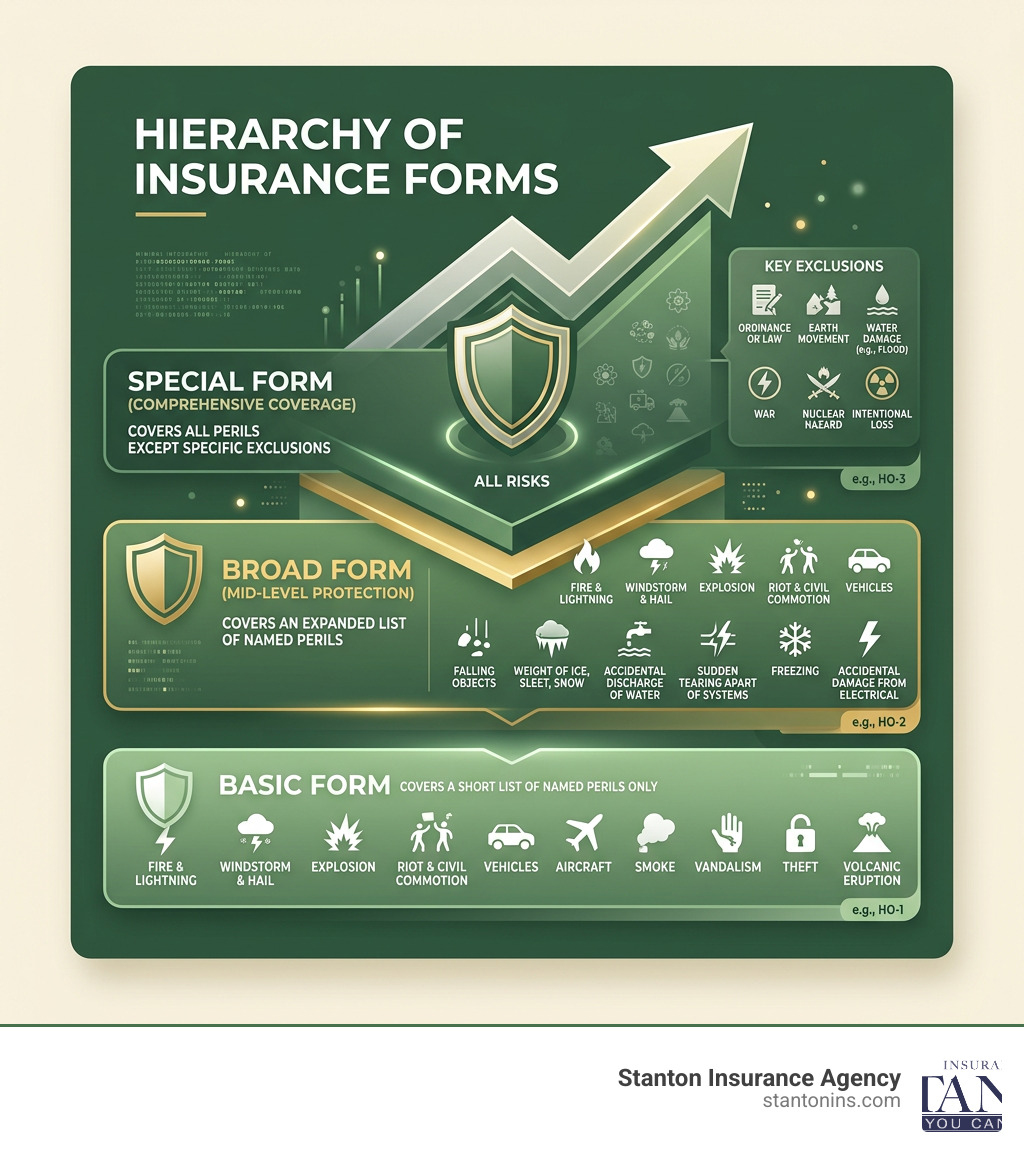
| Basic Form | HO-1 | Covers a short list of named perils only |
| Broad Form | HO-2 | Covers an expanded list of named perils |
| Special Form | HO-3 / Full Coverage | Covers all perils except those specifically excluded |
In auto insurance, broad form works differently — it covers a single named driver (not a specific vehicle) for minimum liability only, and is only available in 11 states.
In home insurance, it covers your home’s structure against all risks, but your personal belongings only against a named list of perils.
The bottom line: broad form sits in the middle — more protection than bare-bones coverage, but still with real gaps that could leave you paying out of pocket.
I’m Geoff Stanton, President of Stanton Insurance Agency and a Certified Insurance Counselor (CIC) with over two decades of experience helping homeowners and drivers navigate coverage decisions, including broad form insurance options. In this guide, I’ll walk you through exactly what broad form covers, where it falls short, and whether it makes sense for your situation.
Broad form insurance vocab to learn:
Understanding the Basics: What is Broad Form Insurance?

When you start looking into insurance, the terminology can feel like a secret language. You’ll hear terms like “named perils,” “open perils,” and “form types.” To understand Broad Form Insurance, you first have to understand how insurance companies categorize risk.
Most policies are built on a “form” system. A “peril” is simply an event that causes damage—like a fire, a windstorm, or a burst pipe. In a broad form insurance policy, the insurer provides a specific list of these perils. If it’s on the list, you’re covered. If it’s not, you’re on your own.
What is Broad Form Insurance?
At its core, broad form insurance is designed to be a driver-centric or owner-centric policy rather than a vehicle-centric or “all-risk” one. In auto insurance, it is often referred to as “named operator” coverage. This means the policy follows the person, not the car.
For homeowners, it serves as a middle-ground asset protection tool. It’s more robust than a “Basic Form” (which might only cover fire and lightning) but isn’t as exhaustive as a “Special Form.” We often see this used for secondary properties or by homeowners who want solid structure protection without the higher premiums associated with top-tier contents coverage.
Comparing Basic, Broad, and Special Form Policies
To make the right choice for your family in Massachusetts or New Hampshire, you need to see how these tiers stack up against each other.
| Feature | Basic Form (HO-1) | Broad Form (HO-2) | Special Form (HO-3) |
|---|---|---|---|
| Dwelling Coverage | Named Perils (approx. 10) | Expanded Named Perils (approx. 16) | Open Perils (All except exclusions) |
| Contents Coverage | Named Perils | Named Perils | Named Perils |
| Typical Use | Rare/Vacant land | Mid-range homes/Rentals | Most standard homes |
| Cost | Lowest | Moderate | Higher |
The jump from Basic to Broad is significant. While Basic Form covers the “big ones” like fire, smoke, and explosions, broad form insurance adds protection for things like falling objects (think of a tree limb hitting your roof) and the weight of ice and snow—a very real concern for us here in New England!
Broad Form Auto Insurance: Coverage and Limitations
Broad form auto insurance is a bit of a “unicorn” in the insurance world. It’s a liability-only policy that covers one specific person. If you have this policy, you are covered to drive any car you own or have permission to use, but the coverage is strictly for the damage you cause to others.
Where is Broad Form Auto Insurance Available?
It is important to note that broad form insurance for auto is not available everywhere. In fact, according to the states where it is licensed, it is currently only offered in 11 states: Colorado, Delaware, Idaho, Iowa, Maryland, Mississippi, Nebraska, Nevada, Ohio, Tennessee, and Washington.
If you are a resident of Massachusetts or New Hampshire, you won’t find a “Broad Form Named Operator” policy as a standard filing. However, understanding how it works is helpful if you are moving or if you are looking into broad collision coverage options that are available in our region. In states like Michigan, “broad form” actually refers to a specific type of collision coverage where your deductible is waived if you aren’t at fault.
Advantages and Disadvantages of Broad Form Auto
The primary “pro” is the price. Since it only covers one driver and offers minimal liability, it is often one of the cheapest ways to stay legal on the road. It’s also a common choice for high-risk drivers who need an SR-22 filing to reinstate their license.
However, the “cons” are heavy. Because it is driver-specific, if you let a friend borrow your car and they get into an accident, your broad form insurance likely won’t pay a dime. Furthermore, it offers zero protection for your own vehicle. If your car is totaled in a storm or stolen, you have no recourse.
Common Exclusions in Broad Form Insurance
You should assume that anything not explicitly listed as “covered” is excluded. Common gaps include:
- Collision Damage: No repairs for your own car if you hit something.
- Comprehensive Coverage: No coverage for theft, vandalism, or “acts of God.”
- Passenger Injuries: It often excludes Medical Payments or PIP for your passengers.
- Unauthorized Drivers: No coverage for anyone else behind the wheel.
Protecting Your Property with Broad Form Homeowners Insurance
In the realm of property, broad form insurance (the HO-2 policy) is a step up from the bare minimum. While we generally recommend an HO-3 (Special Form) for primary residences in Massachusetts, an HO-2 can be a viable choice for certain situations. Understanding Home Insurance in Massachusetts requires knowing which perils are most likely to strike your zip code.
What Does Broad Form Property Insurance Cover?
The “Broad” list of perils usually includes everything in a basic policy plus:
- Falling objects: Like a neighbor’s tree falling onto your garage.
- Weight of ice, snow, or sleet: A major factor for New Hampshire winters.
- Accidental discharge of water: Such as a pipe suddenly bursting (but not slow leaks!).
- Freezing of plumbing: Coverage for the damage caused by frozen pipes.
- Sudden damage from electrical current: Protecting your appliances from surges.
Cost Analysis: Broad Form vs. Standard Policies
Generally, a broad form policy sits in the “mid-range” for premiums. In some regions, homeowners might see premiums around $1,250 annually for a broad form policy, whereas a full comprehensive policy might be 15-20% higher.
The trade-off is the deductible and the “named peril” nature of the contents. If your expensive sofa is ruined by something not on the list (like a spilled bottle of wine or a pet accident), broad form insurance will not cover it. For more details on finding the right balance, check out our home insurance services.
Real-World Scenarios and Claims Examples
To truly understand broad form insurance, we need to look at how it behaves when the “rubber meets the road”—sometimes literally.
The Borrowed Vehicle Scenario
Imagine you have a broad form auto policy. You borrow your brother’s truck to move some furniture. You accidentally rear-end another car.
- The Result: Your broad form policy acts as “excess” coverage. It will help pay for the damage to the other person’s car and their medical bills after your brother’s primary insurance is exhausted. However, it will do nothing to fix your brother’s truck. If your brother didn’t have collision coverage on his own policy, you might be writing him a very large personal check.
The Property Damage Scenario
Consider a homeowner in New Hampshire with an HO-2 broad form policy. During a deep freeze, a pipe in the upstairs bathroom bursts, flooding the living room.
- The Result: Because “freezing of plumbing” and “accidental discharge of water” are specifically named perils in broad form insurance, the repairs to the walls and floors (the structure) are covered.
- The Catch: If the water ruins your unlisted personal electronics or a custom rug, and the insurer determines the “peril” didn’t meet the strict definition for contents coverage, that part of the claim could be denied. This is why we always urge clients to review their “named perils” list carefully.
Frequently Asked Questions about Broad Form Insurance
Who is broad form auto insurance best suited for?
It is ideal for single drivers who own multiple older, low-value vehicles and do not have other household members who need to drive those cars. It’s also a frequent choice for those who need to maintain continuous insurance history for a low price while they are between vehicles.
Can you add optional coverages like collision or comprehensive to a broad form auto policy?
Generally, no. Broad form insurance for auto is designed as a bare-bones liability policy. Its structure is intentionally simple to keep costs down. If you find that you need protection for your own vehicle, you typically must upgrade to a standard auto policy that includes those specific coverages.
How does broad form insurance compare to non-owner insurance?
While they sound similar, there is a key difference. Broad form insurance covers the driver for cars they own as well as cars they borrow. Non-owner insurance is specifically for people who do not own a car but want liability protection when they rent vehicles or drive a friend’s car.
Conclusion
At Stanton Insurance Agency, we believe that the best insurance policy is the one that lets you sleep soundly at night. While broad form insurance offers a tempting price point and covers the “broad” basics, it isn’t always the right fit for a busy household with multiple drivers or high-value assets.
As independent agents, we take the time to look at your specific risks in Massachusetts and New Hampshire. We don’t just sell policies; we provide trusted protection for what matters most to you. Whether you are looking for the most affordable way to stay legal on the road or the most robust protection for your family home, we are here to help you weigh the pros and cons of every form.
Ready to see how your current coverage compares? Get a Massachusetts car insurance quote today and let us help you find the perfect fit for your budget and your peace of mind.