
Cyber Insurance Coverage 101: Essential Safeguard
Understanding Cyber Insurance Coverage
When you run a business, you protect your building and vehicles. But what about your digital assets? Cyber insurance coverage is like a shield for your business in the digital world. It helps protect you from the financial shock of cyberattacks and data breaches.
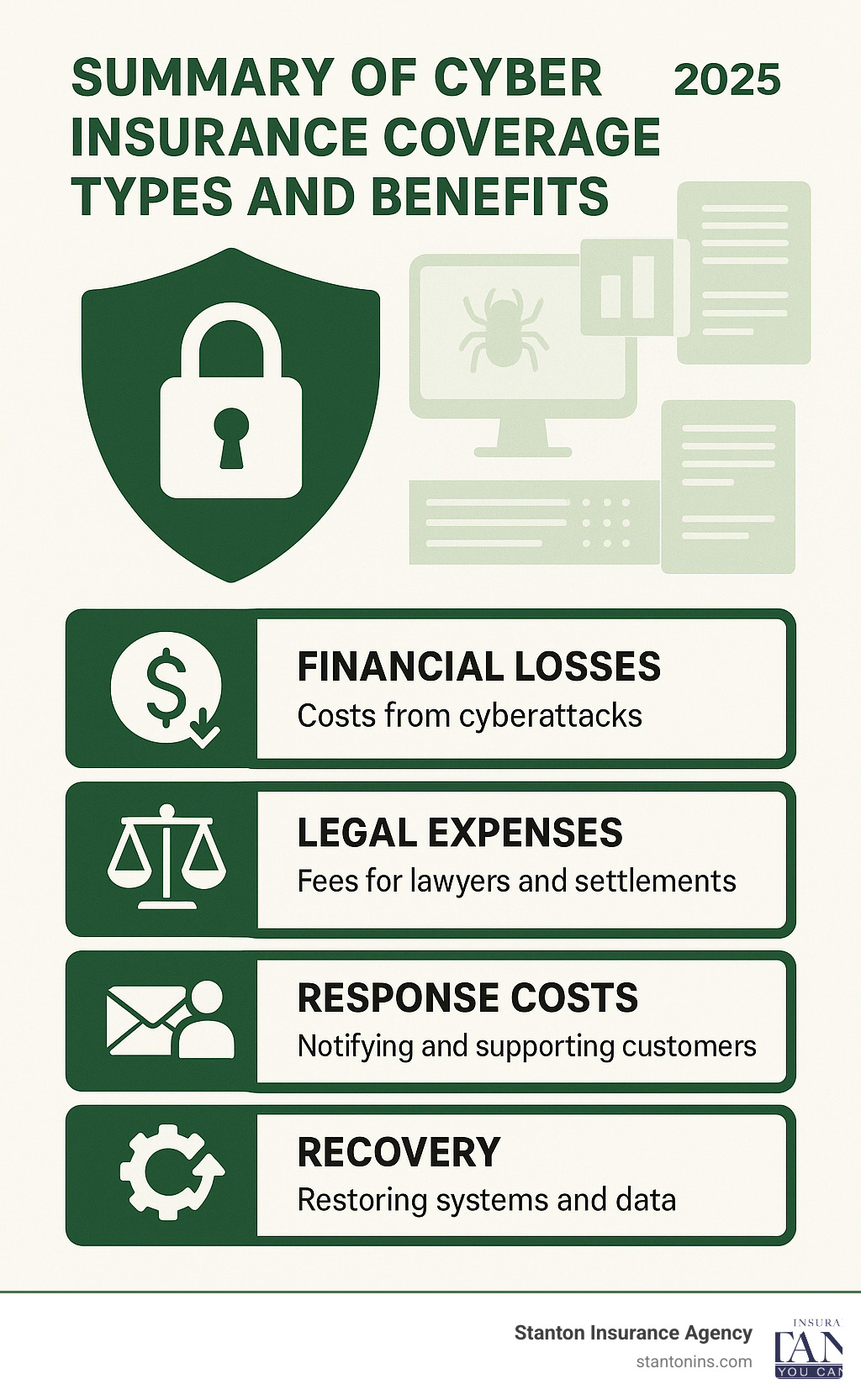
Here’s what cyber insurance typically covers:
- Financial losses: Costs from cyberattacks like data breaches and hacking.
- Legal expenses: Fees for lawyers, courts, and settlements.
- Response costs: Notifying customers, providing credit monitoring, and managing public relations.
- Recovery: Restoring damaged computer systems and recovering lost data.
A single cyberattack can be financially devastating. After hackers breached Sony’s PlayStation Network in 2011, the company faced over $171 million in costs. For most businesses, especially smaller ones, such an expense would be impossible to handle alone. More than 40% of small businesses were victims of a cyberattack in 2023, and 88% of small business owners feel vulnerable. This shows the threat is not just for big companies; it’s a daily reality for everyone.
This guide will explain everything you need to know about what cyber insurance coverage offers, why it’s essential, and how it can help your business survive a digital incident.
As President of Stanton Insurance, Geoff Stanton has years of experience helping businesses and individuals understand complex risks. His expertise, built since joining the claims department in 1999, directly informs how he views the critical role of cyber insurance coverage in protecting modern businesses.
Cyber insurance coverage word roundup:
What is Cyber Insurance and Why Is It Crucial for Your Business?
Cyber insurance, also called cyber risk or cyber liability insurance, is a specialized shield designed to protect your business from the costs of internet-based attacks and data breaches.
You might wonder if your existing insurance already covers this. It’s a critical point: your standard general liability policy, which covers physical risks like property damage, almost always excludes cyber incidents. This leaves a significant gap in your protection, exposing your business to the potentially devastating financial fallout of an attack.
Cyberattacks are not just a problem for large corporations; they are a daily threat to businesses of all sizes. The financial impact of a single incident can be enough to threaten a company’s survival.
So, why is cyber liability insurance important? It’s about managing risk and building resilience. This coverage helps your business absorb the financial damage, respond effectively, and recover with minimal disruption. While strong cybersecurity measures are your first line of defense, cyber insurance acts as the critical safety net when those defenses are inevitably tested. It’s a crucial part of your overall cybersecurity strategy, working with your preventative efforts, not replacing them.
Understanding Your Cyber Insurance Coverage: First-Party vs. Third-Party
When evaluating cyber insurance coverage, it’s helpful to understand that policies typically include two main categories of protection: first-party coverage and third-party coverage.
First-party coverage protects your own business from direct losses. This includes costs like data recovery, business interruption, cyber extortion payments, and incident response expenses. Think of it as coverage for what happens to your business.
Third-party coverage protects you from claims made against your business by others. This includes legal defense costs, settlements, and regulatory fines when customers, partners, or regulatory bodies hold your business responsible for a cyber incident that affected them.
Understanding this distinction helps you evaluate whether your policy provides comprehensive protection for both the direct impact on your operations and potential liability claims from others affected by a cyber incident involving your business.
What Isn’t Covered? Common Exclusions and Gaps
While cyber insurance coverage is an incredibly powerful tool for safeguarding your business in the digital age, it’s important to understand that it’s not a magic wand that covers every single scenario. Just like any other insurance policy, cyber policies come with specific exclusions and limitations. Knowing these ins and outs is crucial for managing your overall risk effectively and avoiding any unpleasant surprises if you ever need to file a claim.
Think of it this way: insurers expect businesses to be proactive partners in their own security. They want to see that you’re taking reasonable precautions and maintaining a good level of cybersecurity hygiene. If basic security measures are overlooked, or if certain types of events occur, coverage might be denied. Let’s walk through some common exclusions you might find in a cyber insurance coverage policy:
- Pre-Existing Incidents: If a data breach or cyberattack already happened, or you knew about it, before your policy’s start date, it typically won’t be covered. It’s like trying to buy car insurance after you’ve already had an accident – the damage that happened before the policy began isn’t included.
- Preventable Issues & Human Error (with a note): While policies aim to cover the financial aftermath of attacks, they generally don’t cover losses that result directly from a clear failure to put basic security controls in place. For instance, if your IT team doesn’t update software, leaving a known vulnerability wide open for attackers, the resulting damage might not be covered. However, it’s worth noting that many policies do cover human error in the context of social engineering (like an employee accidentally falling for a phishing scam) if specific additions, called endorsements, are made to your policy. This shows how nuanced these policies can be!
- Acts of War/Terrorism: Damage from cyberattacks that are officially linked to nation-states or declared acts of war are commonly excluded. The insurance industry generally views these as “acts of war” and beyond the scope of typical commercial insurance policies.
- Infrastructure Failures: Losses caused by widespread power grid failures, internet outages, or other big infrastructure problems that aren’t directly related to a cyberattack specifically targeting your systems are generally not covered. These are often seen as broader business continuity risks.
- Future Revenue Loss & Brand Devaluation: While your business interruption coverage will help with lost income during a specific “period of restoration” (which is often around 180 days), policies typically don’t cover the potential loss of future profits beyond that period. They also don’t usually cover the long-term damage to your brand or the devaluation of your intellectual property due to a breach. So, if a breach leads to a permanent drop in customer trust and sales years down the line, that long-term impact might not be covered.
- Loss of Intellectual Property (IP): While some policies might cover the cost of getting your data back, they often don’t cover the actual value of the intellectual property itself if it’s stolen or compromised. This would typically require a specific endorsement or a separate IP policy.
- Criminal Prosecution: Cyber insurance coverage generally helps with civil liabilities and related costs, but it doesn’t cover criminal prosecution against individuals within your organization.
It’s also really important to remember that professional liability insurance, which covers errors and omissions in the services you provide, explicitly does not cover cyber liabilities like data breaches. This clearly shows why a dedicated cyber insurance coverage policy is absolutely essential.
Understanding these exclusions is a key part of effectively managing your cybersecurity risks. That’s why we always recommend a thorough review of your policy language with an experienced broker. For more detailed insights into what isn’t covered, you can explore our articles on what cyber insurance does not cover and whether professional liability insurance covers cyber.
Who Needs Cyber Insurance and How Much Does It Cost?

In today’s interconnected economy, the question isn’t if your business needs cyber insurance coverage, but what kind and how much is appropriate for your specific operations. Cybercriminals don’t discriminate by size; in fact, small businesses are often seen as easier targets due to having fewer dedicated security resources.
Who Needs Cyber Insurance Coverage?
The short answer is almost every business. If your business uses email, stores customer data, or processes payments online, you have a significant cyber risk. You might think, “Oh, we’re too small to be a target.” But that’s a common misconception! Small businesses with fewer than 100 employees are 350% more likely to be targeted by social engineering attacks. Cybercriminals find it more profitable to target small and mid-sized organizations because they often have weaker defenses.
Consider these scenarios:
- Does your business store customer information like names, addresses, credit card numbers, or Social Security numbers? (Think retail, healthcare, financial services).
- Do you provide services to other businesses that rely on technology, such as IT consulting, web development, or marketing agencies?
- Do you process online payments or use platforms like Shopify?
- Does your daily operation rely heavily on computer systems and networks?
- Do you handle sensitive client data, as therapists, lawyers, or accountants do?
If you answered yes to any of these, your business has a vulnerability that cyber insurance coverage is designed to protect. Even contractors, who might not immediately think of themselves as tech-heavy, often store client data, process payments, and use digital tools, making them vulnerable.
For more detailed insights, check out our guide on who needs cyber liability insurance.
Factors Influencing Your Cyber Insurance Coverage Cost
The cost of cyber insurance coverage isn’t one-size-fits-all; it varies widely based on your specific risk profile. In 2024, the average annual premium for businesses ranged from $1,200 to $7,000, with a median cost of around $2,000 per year. It’s worth noting that premiums saw significant fluctuations, with an almost 80% rise in Q2 2022, but then stabilized and even decreased by 50-60% for some policyholders in 2023 and 2024.
Here are the key factors insurers evaluate when determining your premium:
- Industry: Businesses in high-risk sectors like healthcare, finance, and retail, which handle vast amounts of sensitive data, typically face higher premiums. Manufacturing, often overlooked, is also a prime target due to the high cost of operational downtime.
- Company Size & Revenue: Larger companies with more employees, higher revenue, and more extensive networks generally have a greater exposure to risk, leading to higher costs.
- Data Sensitivity and Volume: The type and volume of data you handle is a major factor. Storing Personally Identifiable Information (PII) or Protected Health Information (PHI) carries a higher risk than less sensitive data. The more records you have, the higher the potential cost of a breach.
- Strength of Security Measures: This is huge! Insurers want to see that you’re proactive. Implementing robust cybersecurity controls (like multi-factor authentication, employee training, and strong firewalls) can significantly lower your premium and make you a more attractive risk to insurers.
- Coverage Limits & Deductible: As with any insurance, choosing higher coverage limits (e.g., $5 million instead of $500,000) will increase your premium. Similarly, a lower deductible (the amount you pay out-of-pocket before coverage kicks in) will result in a higher premium.
- Claims History: A history of prior cyber incidents or claims will inevitably lead to higher premiums, as it indicates a higher risk profile for the insurer.
Understanding these factors can help you make informed decisions about your policy and potentially lower your costs. For a deeper dive into pricing, explore our article on the cost of cyber liability insurance.
Proactive Steps to Reduce Cyber Risk and Lower Premiums
You know how they say an ounce of prevention is worth a pound of cure? Well, that’s especially true in cybersecurity! While cyber insurance coverage acts as a crucial safety net for your business, taking smart, proactive steps to beef up your security isn’t just a good idea – it can actually save you money on your premiums. Insurers love to see businesses that are serious about protecting themselves. Think of it as showing them you’re a responsible partner in managing risk. In fact, many of these controls are now considered standard cyber insurance requirements if you want to get a policy in the first place.
So, what can you do to make your business a tougher target for cybercriminals and potentially lower your cyber insurance coverage costs?
First off, one of the simplest yet most powerful tools is Multi-Factor Authentication (MFA). This means requiring more than just a password to log in – maybe a code from your phone or a fingerprint. It’s like adding an extra lock to your digital doors. Make sure you use MFA for all remote access, email, cloud applications, and critical systems.
Next, your team is your first line of defense. Conduct Regular Employee Training! Teach everyone how to spot sneaky phishing scams, why strong, unique passwords are a must, and how to avoid common social engineering tricks. A well-informed team can significantly reduce the risk of human error, which, surprisingly, is a major cause of data breaches.
And speaking of data, imagine losing everything. Scary thought, right? That’s why Maintaining Offline Backups is so critical. Regularly back up all your important data and systems, and here’s the key: keep those copies offline and physically separate from your network. This way, even if a nasty ransomware attack encrypts your live systems, you’ll have a clean version to restore from that the bad guys can’t touch.
For a deeper layer of protection, consider using Endpoint Detection and Response (EDR) Solutions. These aren’t just your old-school antivirus programs. EDR tools actively monitor all your computers and servers, looking for suspicious activity. If they find something, they can quickly shut it down, helping to contain threats before they cause widespread damage.
Now, what happens if an attack does get through? You need a plan! Create a Comprehensive Incident Response Plan. This isn’t just a dusty document; it’s your roadmap for what to do during and after a cyber incident. It outlines who does what, how you’ll communicate, and the steps to get back on track. Practicing this plan can cut down recovery time significantly.
Finally, keeping your software up-to-date is non-negotiable. Perform Regular Patching and Software Updates across all your operating systems, applications, firewalls, and network devices. Cybercriminals love to exploit old vulnerabilities. By patching regularly, you’re closing those doors before they can get in. Also, make sure you Implement Strong Access Controls, meaning employees only have access to the data and systems they absolutely need for their job. This “least privilege” approach limits potential damage if an account gets compromised. And don’t forget to Conduct Regular Risk Assessments and Penetration Testing to find weak spots before the hackers do.
By actively putting these measures in place, you’re not just building a stronger, more resilient business. You’re also sending a clear message to insurers that you’re a responsible, low-risk client. This proactive stance can often lead to better policy terms and, yes, potentially lower premiums for your cyber insurance coverage. For even more great tips on keeping your digital world safe, be sure to check out our general guide on cyber security. And if you’re looking for practical steps, this resource offers 6 Steps to a Better Cyber Insurance Policy.
Frequently Asked Questions about Cyber Insurance
We often hear similar questions from business owners navigating cyber insurance coverage. Let’s address some of the most common ones:
What’s the difference between cyber liability and data breach insurance?
It’s a great question, as these terms are sometimes used interchangeably, but there can be important distinctions. Data breach insurance is often a more basic or entry-level form of coverage. It primarily focuses on the direct costs associated with responding to a breach of Personally Identifiable Information (PII) or Protected Health Information (PHI). This typically includes expenses like notifying affected customers, providing credit monitoring services, and managing public relations after a breach.
Cyber liability insurance, on the other hand, is generally a broader and more comprehensive policy. While it includes the data breach response elements, it extends to cover a wider range of cyberattacks and related financial losses. This can include costs from various types of cyber incidents (like ransomware, denial-of-service attacks, or business email compromise), privacy investigations by regulatory bodies, and legal defense costs and settlements if your business is sued by third parties (customers, partners) due to a cyber incident. For larger businesses or those with more complex digital operations, cyber liability insurance offers a more robust shield.
Does my general liability policy cover cyberattacks?
No, and this is one of the most critical points we emphasize. In almost all cases, a standard general liability policy does not cover cyber-related incidents. General liability insurance is designed to protect your business from claims of bodily injury (e.g., a customer slipping and falling in your store) and property damage (e.g., accidentally damaging a client’s property). Over the years, as cyber threats emerged, insurance providers added specific exclusions to general liability policies for losses stemming from data breaches, network security failures, or other cyber events. This means that if your business experiences a data breach and you only have a general liability policy, you’ll likely be on the hook for all the associated costs yourself. A dedicated cyber insurance coverage policy is essential to bridge this significant gap.
Are ransomware payments covered by cyber insurance?
Yes, most modern cyber insurance coverage policies typically include a specific type of coverage called “cyber extortion.” This component is designed to cover the costs associated with a ransomware attack. This usually includes:
- The ransom payment itself: If your business decides, in consultation with experts, that paying the ransom is the best course of action to recover your data or open up your systems.
- Expert consultant fees: Costs for specialized negotiators, forensic experts, and legal counsel who can help you manage the ransomware crisis, negotiate with the attackers, and ensure any payment is handled securely.
However, it’s important to note that paying a ransom should never be your first or only course of action. Law enforcement agencies often advise against it, as it can encourage further criminal activity. Your cyber insurer will typically provide guidance and resources to help you assess the situation and make the most informed decision, focusing on recovery while minimizing risk.
Secure Your Business’s Future
Navigating the digital world can feel a bit like walking a tightrope – exciting, full of opportunity, but also with the constant possibility of a stumble. The risks are real, from sneaky phishing scams to full-blown ransomware attacks. But here’s the good news: you don’t have to face these challenges alone. Cyber insurance coverage isn’t just a fancy extra anymore; it’s a fundamental part of keeping your business safe and sound in today’s interconnected world.
Whether your business calls Massachusetts, New Hampshire, or Maine home, understanding what a good policy covers is your first step. Then, it’s about pinpointing your specific vulnerabilities and taking smart, proactive security measures. When you combine these efforts, you’re not just protecting your data; you’re building a resilient defense that can truly shield your business from the financial devastation a cyberattack can bring.
At Stanton Insurance Agency, we genuinely believe in providing trusted protection for your most valuable assets – and that increasingly includes your digital ones. We understand that the unique challenges businesses face in today’s digital landscape can be overwhelming. That’s why our expert team is here to help. We’ll steer you through the complexities of cyber insurance coverage with a friendly, clear approach, helping you find a policy that’s perfectly custom-fit to your unique needs. Our goal? To make sure your business is prepared for whatever the digital world might throw your way.
Ready to fortify your digital defenses? Let’s chat.
Contact us today for a comprehensive review of your business insurance needs.