
What Does Collision Mean? The Word That Shapes Your Insurance Coverage
What does collision mean depends on the context — but here’s a quick answer:
| Context | Definition |
|---|---|
| General | The forceful coming together of two or more objects |
| Physics | An event where two or more bodies exert forces on each other, exchanging energy or momentum |
| Insurance | An accident in which your vehicle strikes another vehicle or object |
| Legal | A preventable impact, often involving negligence or human error |
| Figurative | A clash of interests, ideas, or people — as in “on a collision course” |
The word shows up everywhere — in physics textbooks, police reports, insurance policies, and everyday conversation. But the meaning shifts depending on where you see it. A physicist and an insurance adjuster both use the word “collision,” but they mean very different things by it.
That difference matters — especially when you’re filing a claim after a crash.
I’m Geoff Stanton, President of Stanton Insurance Agency in Waltham, Massachusetts, and as a Certified Insurance Counselor with over two decades of experience, I’ve helped countless clients understand what does collision mean when it counts most — at claim time. In the sections below, we’ll break down the word from every angle so you can feel confident about your coverage.
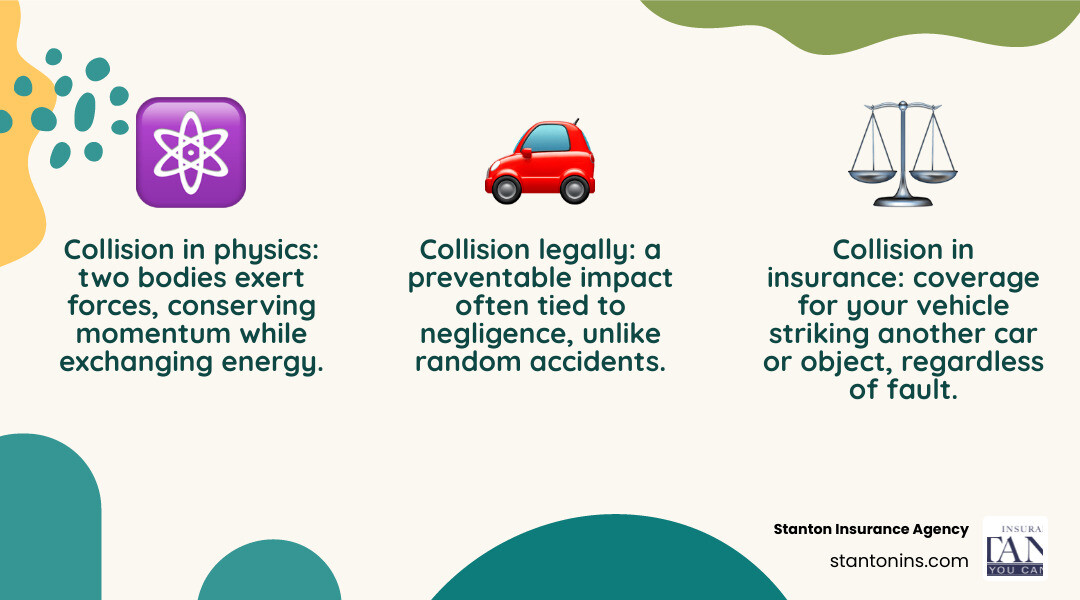
What does collision mean basics:
What Does Collision Mean? Dictionary and Contextual Definitions

When we look at the literal Meaning of collision in English, it is defined as an instance of two or more moving objects striking violently against each other. Major authorities like Merriam-Webster describe it as a “clash” or an “act or instance of colliding.”
However, the word isn’t just for car crashes and billiard balls. It carries a heavy weight in ideas. A “collision of interests” occurs when two parties have goals that cannot both be met, leading to a metaphorical smash-up. Whether it is a physical impact or a figurative conflict, the core essence remains the same: two separate trajectories meeting in a way that forces a change.
Understanding What Does Collision Mean in Physics
In the realm of science, a collision is any event where two or more bodies exert forces on each other in a relatively short time. According to Britannica, it is characterized by “impulsive forces,” which are incredibly large forces acting over a tiny fraction of a second.
In physics, a collision doesn’t even necessarily require “touching” in the way we think of it. For example, in sub-atomic physics, particles might “collide” through electromagnetic repulsion without their physical surfaces ever meeting. The key is the exchange of energy and the conservation of momentum. When these bodies interact, their velocity vectors change, and energy is transformed from one state to another.
What Does Collision Mean in the Insurance Industry?
For those of us in Massachusetts and New Hampshire, the insurance definition is the one that impacts our wallets. In the insurance world, Auto Collision Insurance refers specifically to a type of first-party coverage.
What Is Collision Insurance exactly? It is the portion of your policy that pays to repair or replace your vehicle if it is damaged in an impact. Unlike liability insurance, which pays for the other person’s car, collision coverage protects your asset. Whether you hit a telephone pole in Manchester or another car on Route 128, this coverage is what ensures you aren’t left footing a massive repair bill out of pocket.
The Science of Impact: Elastic vs. Inelastic Collisions
To truly understand the “crunch” of a car crash, we have to look at how energy behaves. Not all hits are created equal.
| Feature | Elastic Collision | Inelastic Collision |
|---|---|---|
| Kinetic Energy | Conserved (No net loss) | Not Conserved (Lost to heat/sound/deformation) |
| Momentum | Conserved | Conserved |
| Example | Sub-atomic particles, Billiard balls | Car crashes, dropping a ball of clay |
| Result | Objects bounce off perfectly | Objects may stick together or deform |
In a perfectly elastic collision, the objects bounce away with the same total kinetic energy they started with. You see this most often in high-level science, such as the 300 TB of LHC proton collision data released by CERN for researchers. In the macro world, billiard balls come close, but even they lose a tiny bit of energy to the “click” sound you hear.
Perfectly Inelastic Collisions and Vehicle Safety
Most real-world collisions are inelastic. This is actually a lifesaver in automotive engineering. When two cars hit each other, they often “coalesce” or stick together, and the kinetic energy is used to deform the metal.
This is the principle behind “crumple zones.” By designed-in “perfectly inelastic” behavior, the car absorbs the energy of the impact so that your body doesn’t have to. At extreme speeds, known as hypervelocity (often over 2,500 m/s or Mach 7.3 for structural metals), materials actually start to behave like fluids because the impact forces are so much higher than the material’s internal strength.
The Idiom: Being on a Collision Course
We often hear that two politicians or two companies are “on a collision course.” According to the Britannica Dictionary, this means they are behaving in a way that will inevitably lead to a serious disagreement or problem. It describes a trajectory where, unless someone changes direction, a “clash” is certain. It’s the linguistic version of watching two cars head toward each other on a one-way street—you know what’s coming, and it isn’t good.
Collision vs. Accident: Legal and Insurance Distinctions
Is there a difference between an “accident” and a “collision”? To the average person, no. To a lawyer or an insurance adjuster, yes.
The word “accident” implies something that happened by pure chance—an “act of God” like a tree limb falling on a parked car during a freak storm. A “collision,” however, often implies preventability. Most traffic incidents are the result of human error, distracted driving, or a failure to follow the rules of the road.
As noted in the Basics of Auto Insurance from Mass.gov, terminology helps determine fault. If you “accidentally” ran a red light, it’s still a “collision” caused by negligence.
Why Terminology Matters for Massachusetts and New Hampshire Drivers
In Massachusetts and New Hampshire, the distinction is vital for liability. New Hampshire follows specific car accident laws regarding junctions and fault, while Massachusetts operates under a “no-fault” system for medical payments but still assigns fault for vehicle damage.
Understanding the legal terminology helps you navigate the claims process. If a police report labels the event a “collision” due to a “failure to yield,” that phrasing carries more weight in a legal setting than the more generic “accident.”
Determining Fault in Modern Collisions
How do we figure out who is responsible? Investigators look at several factors:
- Impairment: Was a driver under the influence?
- Distraction: Was someone texting?
- Vehicle Defects: Did the brakes fail?
- Environmental Factors: Was the sun in the driver’s eyes or was the road icy?
What Does Collision Insurance Cover includes coverage regardless of who is at fault, but knowing the “why” of the impact helps your insurance company decide if they need to pursue the other driver’s insurance for reimbursement (a process called subrogation).
Practical Applications of Collision Coverage
So, you’ve had a bump. Now what? This is where the rubber meets the road for your policy. Your collision coverage is there to protect your asset, but you need to know the mechanics of the claim.
Common Scenarios: From Rear-End Hits to Hitting Objects
Collisions aren’t always car-vs-car. They include:
- Fender benders in a grocery store parking lot.
- Rear-end hits at a stoplight. Interestingly, statistics show that injuries from rear-end collisions have trended downward recently, potentially saving over $45 million in accident damage costs per year due to better safety tech.
- Fixed objects: Backing into your own garage door or hitting a guardrail.
- Animals: You might wonder, Does Hitting A Deer Fall Under Collision Coverage? Actually, hitting a live animal is usually a comprehensive claim, but swerving to miss the deer and hitting a tree is a collision claim.
Understanding the Difference Between Collision And Comprehensive Insurance Coverage is the first step in making sure you are fully protected.
Choosing the Right Policy for Your Vehicle
Not every collision policy is the same. At Stanton Insurance Agency, we often help clients choose between:
- Full Collision: Covers you regardless of fault.
- Limited Collision: In states like Massachusetts, this only pays if you are not more than 50% at fault. It’s cheaper, but riskier. We’ve broken this down further in our guide on Is Limited Collision Worth It.
- Deductibles: This is the amount you pay before the insurance kicks in. Choosing a higher deductible can lower your premium, but you need to be sure you have that cash on hand if a collision occurs.
Check out our Comprehensive and Collision Coverage guide for a deeper dive into these options.
Frequently Asked Questions about Collisions
What is the primary difference between an accident and a collision?
While often used interchangeably, an “accident” is generally viewed as an unavoidable event or act of chance. A “collision” typically implies a preventable event where two objects strike each other, often involving human error or negligence.
Does collision insurance cover hitting a stationary object?
Yes. Collision insurance is designed to cover your vehicle whenever it hits another object. This includes stationary items like fences, trees, light poles, or even a deep pothole that damages your suspension.
How does physics define a perfectly elastic collision?
A perfectly elastic collision is an encounter between two bodies where the total kinetic energy remains constant. There is no energy lost to heat, sound, or permanent deformation of the objects. While rare in the “real world,” this is common at the sub-atomic level.
Conclusion
At the end of the day, understanding what does collision mean is about more than just definitions—it’s about protection. Whether it’s the physics of energy absorption or the fine print of a Massachusetts auto policy, knowing the “how” and “why” of a crash helps you make better decisions for your family and your fleet.
At Stanton Insurance Agency, we pride ourselves on being the local experts who help you navigate these complex terms. We don’t just sell policies; we provide trusted protection for your most valuable assets.
Ready to ensure you’re covered for whatever the road throws at you? Protect your vehicle with Stanton Insurance Agency today. We’re here to help you stay on the right course—and off a collision one.
